
How to Settle Paints Dealer Claims
The end-to-end process to settle paints dealer claims — scheme, rate-difference and damage evidence, validation, approval and settlement by credit note.

Settling a paints dealer claim runs through six stages: the scheme or price-revision circular is communicated, the dealer files the claim with evidence — stock statement at the revision date, scheme reference, damage proof — a field or sales officer verifies it, finance validates it against the scheme rules and stock data, an approver signs off per the delegation-of-authority matrix, and the claim is settled, usually by credit note, and reconciled. Two stages cause most of the delay: gathering complete evidence, and validating each claim against the circular and the price-revision date.
All ₹ figures below are illustrative, not benchmarks. Your scheme circular, price-revision circular and dealer agreement always govern. This guide owns the end-to-end process; for the wider picture across dealer schemes, rate-difference and painter incentives, see the pillar on paints channel claims and rebates in India, and for the loyalty side, painter and contractor loyalty programs. Dealer claims sit inside a multi-tier structure, mapped in the India multi-tier channel claim map and the distributor vs dealer vs super-stockist distinction.
The six-stage paints claim settlement process
Every dealer claim — a scheme claim, a rate-difference claim, or a damage claim — moves through the same six stages. Getting the sequence right, and knowing which two stages absorb most of the time, is what turns a backlog into a predictable pipeline. The generic version of this lifecycle is set out in the claim process explained; below is the paints-specific shape, covering scheme, rate-difference and damage claims together.
Stage 1 — Scheme or price-revision circular communicated
Everything downstream traces back to the governing document: for a scheme claim, the circular that fixes what is rewarded, the qualifying products, the period, the slab or per-unit rate, any caps and the claim window; for a rate-difference claim, the price-revision circular that fixes the old and new price per SKU and the effective revision date. If the circular is ambiguous — an unstated revision date, a cap that could read two ways — every claim under it inherits that ambiguity and disputes multiply at validation. A clean circular names the base, states the exact revision date stock is measured at, and fixes the evidence a claim must carry. The menu of scheme designs a circular can describe is mapped in types of trade schemes in India, and the shape of dealer purchase incentives in purchase incentives. This stage costs little time but sets the ceiling on how cleanly the other five run.
Stage 2 — Dealer files the claim with evidence
The dealer computes the claim against the circular and files it with supporting evidence. For a rate-difference claim that means the stock statement as at the price-revision date, the old and new price per SKU, and the units held. For a scheme claim it means the purchase invoices and the sales or secondary base where the scheme rewards retail. For a damage claim it means photographs or a returned-goods note for the leaked or damaged tins. This is the first of the two slow stages: evidence gathering is where claims sit for days, because the dealer is assembling stock statements and invoices after the fact. Filing inside the claim window matters as much as the amount — a correct claim filed late is still rejected. A claim filed complete on the first pass is the single biggest lever on total settlement time. In ClaimDS, dealers and internal teams file claims against the specific scheme or price-revision circular and attach the stock statement, invoice and damage proof in one place. <!-- TODO: confirm capability wording with founder --> The step-by-step is documented in submit a sales claim.
Stage 3 — Field / sales-officer verification
Before finance sees the claim, someone closer to the dealer verifies the claims that need eyes on the ground. For a rate-difference claim, a sales officer confirms the declared stock is plausible for that dealer and matches what the depot last supplied. For a damage claim, the officer confirms the tins were genuinely damaged or leaked and not resale-able. For a scheme claim, they confirm the secondary sales look real. This is the human check that base data alone cannot give, and it is where scheme and damage leakage is caught early rather than clawed back later. The trade-off is speed: routing every claim through verification slows the pipeline, so most companies verify by exception — value threshold, claim type, or a risk flag — rather than universally. Damage and rate-difference claims almost always need it, because they hinge on physical stock; the treatment of returned and damaged goods is in credit notes for expired, damaged goods and returns. Clear ownership at this stage keeps it from becoming a bottleneck.
Stage 4 — Finance validation against scheme rules, stock data and caps
This is the second slow stage, and the one that most determines whether settlement is defensible. Finance recomputes the claim from the base rather than trusting the filed figure: does the declared stock match the depot's supply history, is the rate difference computed on stock actually held at the revision date, does the scheme amount match the circular's rate on the correct base, is it within any cap, was it filed in the window, does the claim duplicate one already settled? Validation is arithmetic plus rule-checking, and it is exacting precisely because a wrong approval here becomes a real over-payment. ClaimDS validates each claim against its own scheme rules, stock data and caps, and flags mismatches, breached caps and likely duplicates for a reviewer rather than passing them silently. <!-- TODO: confirm capability wording with founder -->
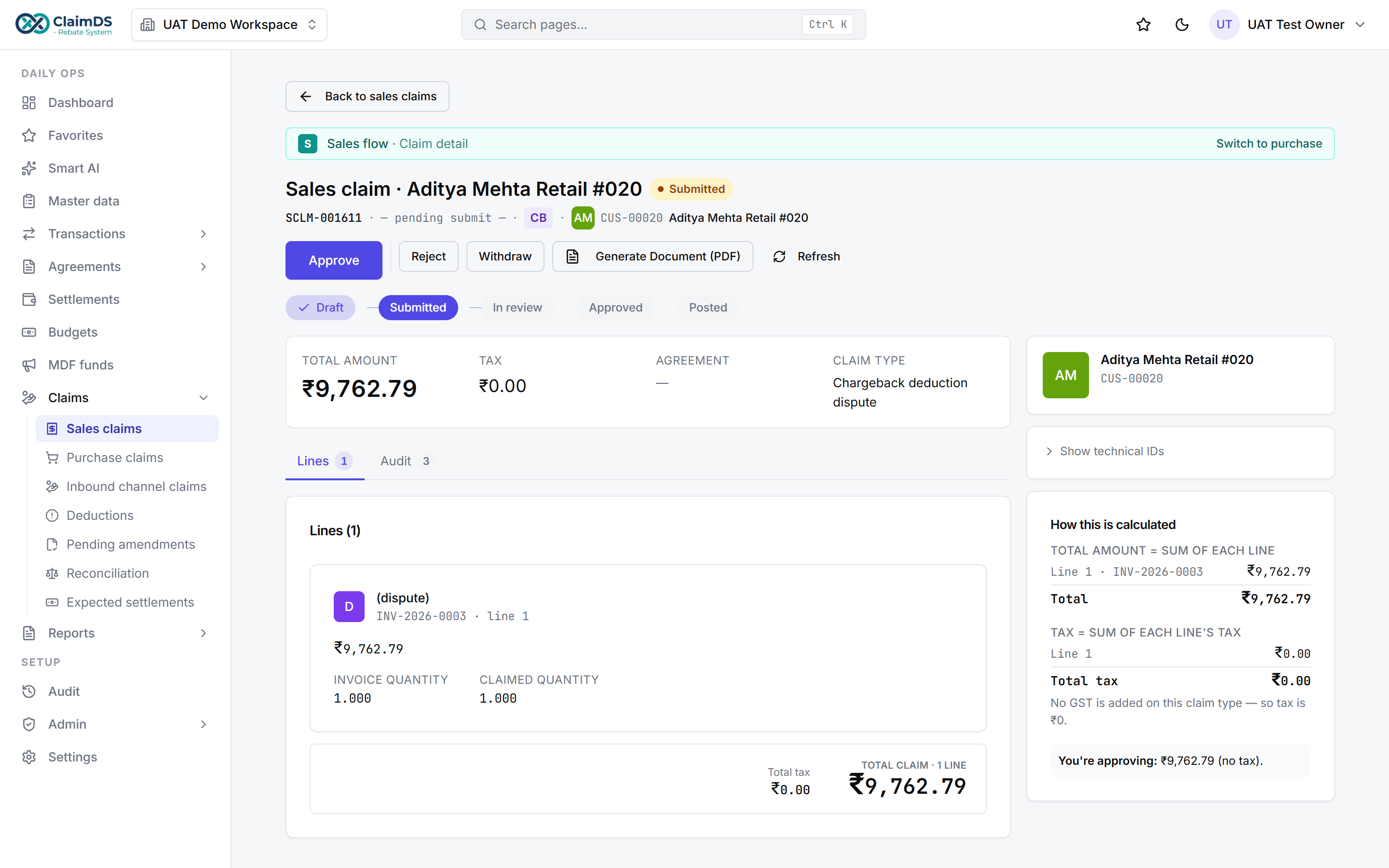 Validation: a claim checked against its scheme rules and stock data.
The over-claims caught here are the ones that otherwise become deductions and disputes downstream — the mechanism behind revenue leakage in rebate programs and the discipline in deduction management best practices. The rate-difference mechanics themselves are set out in price protection and rate-difference credit notes under GST.
Ready to see validation run on your own dealer claims? Book a demo and we will walk a live claim through the six stages on your data.
Stage 5 — Approval per the delegation-of-authority matrix
A validated claim still needs sign-off, and the delegation-of-authority matrix decides who signs. Approval routes by value: an area or sales manager clears smaller claims, while larger ones escalate to a controller or finance head. The matrix exists to keep small claims fast without letting a large one settle on one person's say-so — and to leave an audit trail of who approved what. Well-designed approval routing is the difference between a queue that clears daily and one that waits on a single overloaded approver; the patterns are in claim and rebate approval workflows and the finance-owner view in claims and deductions management for the CFO. ClaimDS routes each claim to the right approver by value and records every approval and rejection with a reason. <!-- TODO: confirm capability wording with founder --> The workflow is documented in the claim approval workflow.
Stage 6 — Settlement by credit note, and reconciliation
Once approved, the claim is settled — in the Indian paints channel, usually by credit note against the dealer's account rather than cash, because it offsets what the dealer owes and keeps the GST trail clean. The credit note must carry the right GST treatment; whether it is a financial or tax credit note changes the reporting, as set out in financial vs tax credit notes under GST and GST credit notes for rebates under Rule 53(1A). Scheme and incentive payouts can also attract TDS — the ground covered in Section 194R TDS on dealer and distributor incentives and GST and TDS on paints dealer and painter incentives. Settlement is not the end: the credit note has to be reconciled back against the accrual and, on the GST side, against the returns — the discipline in reconciling scheme credit notes to GSTR-2B/3B. ClaimDS settles approved claims by credit note and reconciles each one against its accrual and the dealer account. <!-- TODO: confirm capability wording with founder --> The how-to is in reconcile a claim to a credit note, and cancellations in rebate clawbacks and scheme cancellations.
The evidence standard
A dealer claim is only as strong as the evidence it carries, and paints evidence turns on one thing above all: what stock the dealer held, and when. A rate-difference claim without a stock statement dated to the revision date cannot be validated at all — there is nothing to compute the difference against. A valid claim ties an amount to a specific SKU, a specific quantity at a specific date, and the circular it is claimed under, so validation can recompute it and audit can trace it later. The table below sets out what each claim type must carry. Where any row is missing, the claim stalls at verification rather than settling; the same evidence gap is what turns a legitimate claim into a downstream deduction, as covered in returns, reversals and cancellations in channel claims. The right base data also depends on whether the scheme rewards what the dealer buys or what the dealer retails — the primary-versus-secondary distinction in primary, secondary and tertiary sales.
| Evidence element | What it proves | Scheme claim | Rate-difference claim | Damage claim |
|---|---|---|---|---|
| Stock statement at revision date | The units eligible for the price difference | Not usually required | Required | Not required |
| Scheme / price-revision circular reference | The rule the claim is made under | Required | Required | Where scheme-linked |
| Old and new price per SKU | The per-unit difference being claimed | Not required | Required | Not required |
| Purchase / sales invoice | The commercial base the claim is computed from | Required | Supporting | Supporting |
| Damage / leakage proof | The tins were genuinely unsaleable | Not required | Not required | Required |
| Claim-window compliance | The claim was filed inside the allowed period | Required | Required | Required |
Why claims get rejected
Most rejections are not judgement calls — they are concrete failures against the circular, and each has a specific fix. Knowing the recurring eight lets a dealer file clean the first time and lets finance reject consistently rather than case by case. The eight below account for the bulk of a typical paints claim reject pile.
- Stock not declared at the revision date. A rate-difference claim arrives with no dated stock statement, so the eligible quantity is unknown. Fix: attach the stock statement as at the exact price-revision date before filing.
- Outside the claim window. The scheme or price-revision claim was filed after the window closed. Fix: file inside the window; a late claim is rejected however valid the amount.
- Duplicate claim. The same stock, scheme period or damage was already claimed and settled. Fix: check the claim history for that dealer and period and withdraw the duplicate.
- Damage without proof. A damage claim has no photographs or returned-goods note for the tins. Fix: attach the damage evidence and the returned-goods reference before filing.
- Scheme not eligible. The dealer did not hit the target, or the product or period does not qualify. Fix: validate against the scheme circular's qualifying criteria before filing.
- Cap breached. The claimed amount exceeds the per-claim, per-dealer or scheme cap. Fix: claim up to the cap and, if the circular allows, escalate the balance separately.
- Stock data mismatch. The declared stock does not reconcile to the depot's supply history for that dealer. Fix: reconcile the stock statement against dispatches and file the corrected figure.
- Wrong price basis. The rate difference is computed on the wrong old or new price, or the wrong SKU. Fix: recompute against the price-revision circular's SKU-level prices and re-file.
The over-claims and disputes these prevent are the same leakage discussed in revenue leakage in rebate programs; the arithmetic behind eligibility sits in the accrual view of purchase incentives.
Spreadsheets vs a claims system
Most dealer-claim operations start in a spreadsheet, and for a handful of claims a month that is fine. What breaks is scale — not because the spreadsheet is wrong, but because paints claims turn on stock held at a specific date, and a spreadsheet has no way to reconcile a dealer's declared stock against the thousands of dispatches and claims already recorded. The comparison below is about operational reality, not a promised return; it is the argument for a purpose-built dealer claims management system over a shared file, and it applies equally to a distributor claim settlement desk running the same volume.
| What has to happen | In a spreadsheet | In a claims system |
|---|---|---|
| Stock-at-date reconciliation | Manual lookup across tabs and files | Declared stock checked against dispatch history |
| Duplicate detection | Eyeballed, easily missed | Flagged automatically per dealer and period |
| Audit trail | Overwritten cells, no history | Every action recorded with who and when |
| Ageing visibility | Rebuilt by hand each week | Ageing and status across the network live |
| Validation against the circular | Re-typed rules, drift over time | Claim checked against its own circular |
ClaimDS holds each claim against its scheme or price-revision circular, flags duplicates and breached caps, and shows claim ageing and status across the dealer network in one view. <!-- TODO: confirm capability wording with founder -->
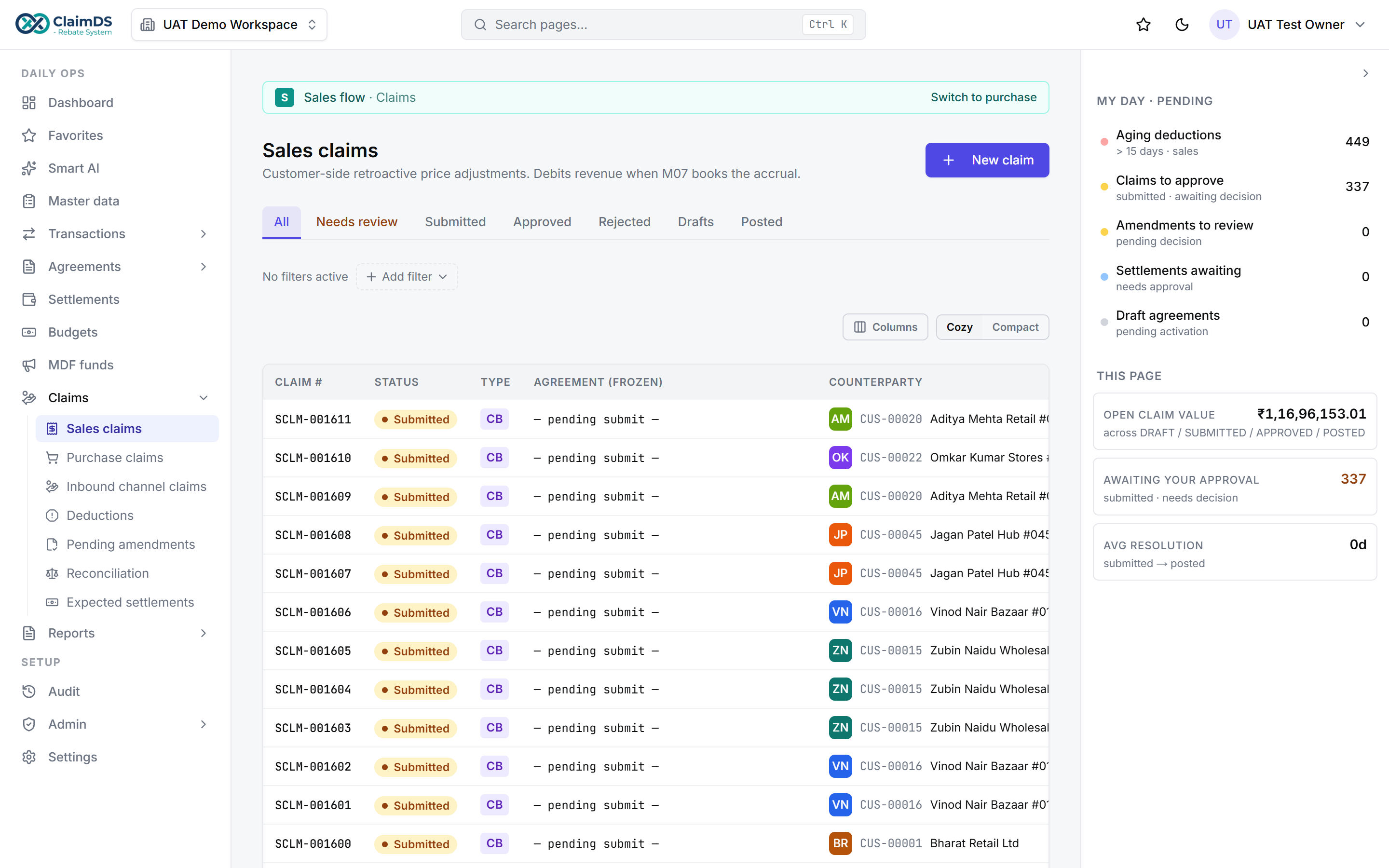 Claim ageing and status across the network, in one view.
The move off spreadsheets is the same one distributors and rebate teams make; the broader case is in dealer rebate software and incentive management software, and the ERP fit in ERP integration for claims, rebate and TPM software.
See it on your own dealer claims. Book a demo and we will walk a live rate-difference and a live damage claim through validation, approval and settlement on your data.
Frequently asked questions
How long does a paints dealer claim take to settle?
There is no fixed number: it depends on how complete the evidence is and how cleanly validation runs. A claim filed with its stock statement at the revision date, scheme reference and damage proof can move through verification, approval and credit note quickly. Missing evidence or a mismatch against the scheme circular is what stretches settlement from days into weeks.
What documents are needed for a rate-difference claim?
A valid rate-difference claim carries the dealer's stock statement as at the price-revision date, the price-revision circular it is claimed under, the old and new price for each SKU, and proof the claim was filed inside the window. The stock statement is the load-bearing document: without stock declared at the revision date, the difference cannot be validated.
Why was my claim rejected?
The usual reasons are concrete: stock was not declared at the revision date, the claim fell outside the window, it duplicated one already settled, damage was claimed without proof, or a cap was breached. Each has a fix — attach the dated stock statement, re-file inside the window, or resubmit only the eligible portion with the evidence it needs.
Is a claim settled by credit note or payment?
In the Indian paints channel most dealer claims are settled by credit note against the dealer's account rather than cash payment, because the claim offsets what the dealer owes and keeps the GST trail clean. Some cases — an exited dealer, or a scheme that specifies a payout — settle by payment. The dealer agreement and scheme circular decide which applies.
What is a rate-difference claim in paints?
A rate-difference or price-protection claim compensates a dealer holding stock bought at an old price when the company revises the price downward. The dealer claims the difference between old and new price on the units still in stock at the revision date. It protects the dealer from a loss on inventory they have already paid for.
Why must stock be declared at the price-revision date?
Because the rate difference is only owed on units actually held when the price changed. A stock statement dated to the revision date fixes exactly how many units of each SKU qualify. Without it, finance cannot separate protected stock from units sold or bought after the revision, and the whole claim becomes impossible to validate defensibly.
See ClaimDS on your own claims data
A 30-minute walkthrough tailored to how your channel actually settles claims.
Related posts

Channel Claims and Rebates in Indian Agri-Inputs
How schemes, claims and rebates work across the Indian agri-input channel — fertilizers, crop-protection and seeds, seasonal schemes and expiry returns.
How to Settle Agri-Input Dealer Claims
The step-by-step process to settle agri-input dealer and distributor claims in India — seasonal schemes, liquidation claims and near-expiry returns.
Expiry and Season-End Returns in Agri-Inputs
How near-expiry, damage and season-end returns work in Indian agri-inputs — declaring returnable stock, the claim window and how each return settles.