Purchase Incentives: How Channel Purchase-Linked Programs Work
Purchase incentives explained — buy-side incentives you earn from suppliers vs sell-side incentives you offer partners to drive purchases. Structures, accrual and settlement.
Purchase incentives are programs tied to purchase volume — and the term carries two meanings: incentives you earn from suppliers for your own purchases (buy-side), and incentives you offer channel partners to drive theirs (sell-side). Both accrue against purchase volume and settle later, usually by credit note. This guide centres on the channel meaning.
Two meanings — disambiguated
| Buy-side purchase incentive | Sell-side purchase incentive | |
|---|---|---|
| Who earns it | You, from your suppliers | Your distributor/dealer, from you |
| Trigger | Your purchase volume | Their purchase volume |
| Direction of money | In (supplier → you) | Out (you → partner) |
| Related | Supplier rebates | Distributor rebate software |
Keeping the two apart matters because they account differently and sit on opposite sides of the ledger. The buy-side view connects to vendor rebate management; the sell-side is a form of channel incentive under the rebate management software pillar.
How channel purchase incentives work
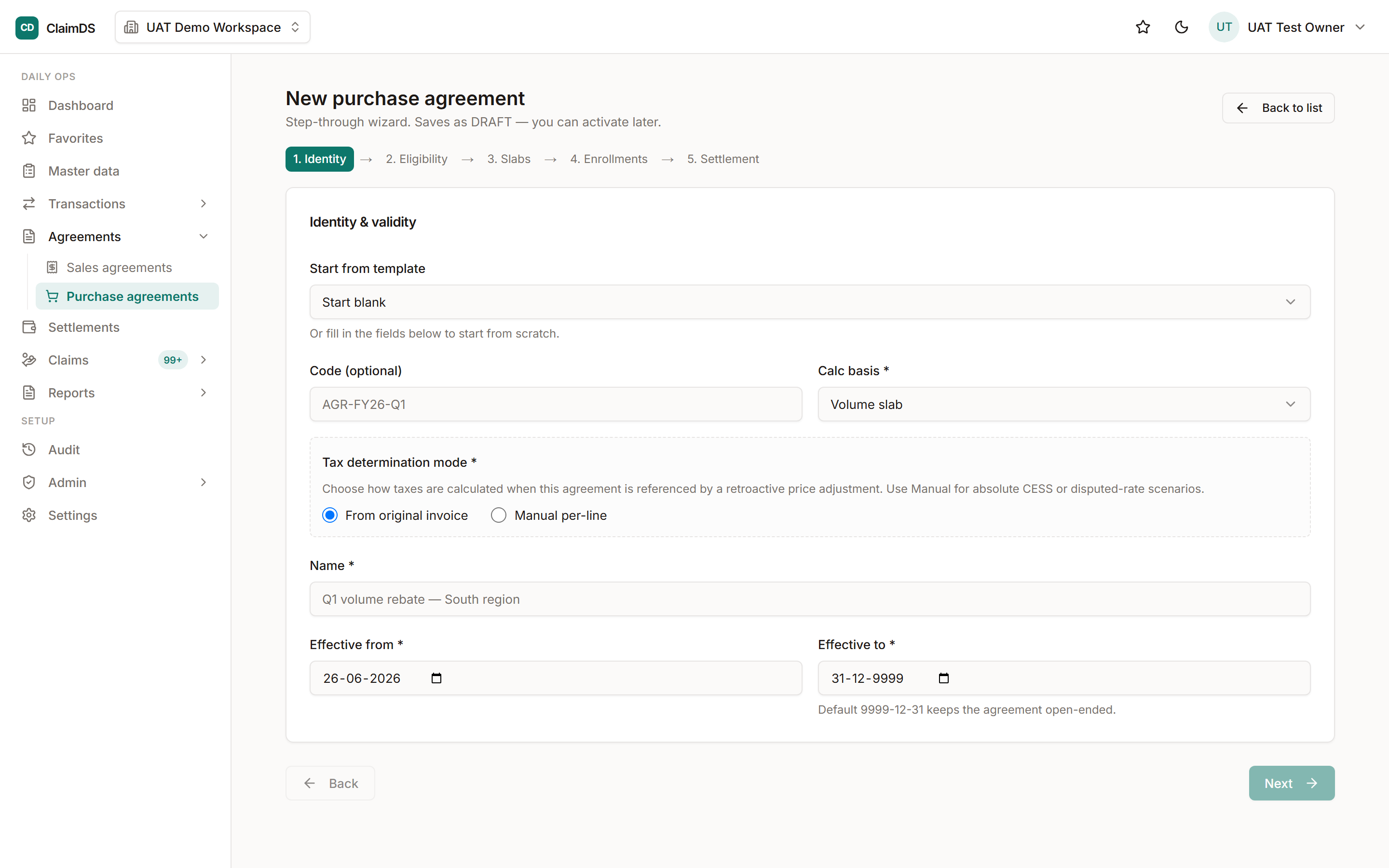
A sell-side purchase incentive rewards a partner for buying more from you — a slab or growth structure on primary purchases. It is agreed as a rule, accrued as purchases post, claimed, validated against the agreement, and settled by credit note. The slab mechanics are in volume rebates; the sell-through counterpart is customer rebates.
Structures, accrual and settlement
The discipline is the same as any rebate: accrue live, validate against the agreement, settle correctly. Because purchase incentives are earned over a period and settled afterwards, an accurate live accrual is what keeps finance honest and partners paid on time — the rebate tracking view.
Where ClaimDS fits
ClaimDS handles both buy-side and sell-side purchase-linked programs in one India-first product, accruing against purchase volume and settling by GST-correct credit note, at a mid-market price (a ClaimDS-supplied ~₹3–5 lakh/yr figure, positioning not a benchmark).
GST note: Purchase incentives may settle via credit notes with ITC consequences. This article is general information, not tax or legal advice; GST positions — including CBIC Circular No. 251/08/2025-GST and the Finance Act 2026 amendments to Section 34 of the CGST Act (assented 30 March 2026, not yet notified into force as of publication) — must be re-verified at publish time with a qualified professional.
Frequently asked questions
What are purchase incentives?
Purchase incentives are programs tied to purchase volume. They have two meanings — buy-side incentives a business earns from its suppliers for its own purchases, and sell-side incentives a business offers channel partners to drive their purchases. Both accrue against purchase volume and usually settle by credit note.
What is the difference between buy-side and sell-side purchase incentives?
Buy-side purchase incentives are money you earn from suppliers for buying more (linked to supplier rebates). Sell-side purchase incentives are money you offer distributors or dealers to buy more from you. Same volume trigger, opposite direction of money — and different accounting.
How are purchase incentives settled?
Purchase incentives are accrued against qualifying purchase volume and settled later, usually by GST credit note. The choice between a tax and financial credit note follows the GST rules for the adjustment.
See ClaimDS on your own claims data
A 30-minute walkthrough tailored to how your channel actually settles claims.
Related posts

Benefits of Automating Rebate Calculations for Channel Partners
The benefits of automating rebate calculations — for the brand (accuracy, speed, leakage control, audit) and the channel partner (transparent statements, faster settlement, trust).
The Key Challenges in Manual Rebate Processing (and What They Cost You)
The failure modes of spreadsheet rebate processing in Indian channels — version conflicts, slab-boundary errors, single-person risk, no audit trail — and the path out.
Core Features of a Robust Rebate Management System (Checklist)
A definitive feature checklist for a rebate management system — scheme design, real-time accrual, claim validation, settlement, analytics, multi-tier RTM and GST fidelity.