Volume Rebates: Slab-Based & Volume-Incentive Programs
Volume rebates explained — retrospective vs prospective slabs, growth incentives, true-ups and accrual mechanics, with worked slab examples for Indian channels.
A volume rebate is an incentive paid to a channel partner for reaching defined sales or purchase volumes, usually as a percentage that rises across slabs. It is earned after the sale and settled later — commonly through a credit note rather than on the original invoice — which is why accurate accrual and slab math matter so much.
What a volume rebate is
Volume rebates — also called slab-based or tiered incentives — are the most common scheme in Indian channels. A manufacturer rewards a partner for hitting volume, with the rate typically rising as turnover grows. Because the reward is earned over a period and settled afterwards, it must be accrued accurately and claimed correctly; this is the engine behind distributor rebate programs and sits under the rebate management software pillar.
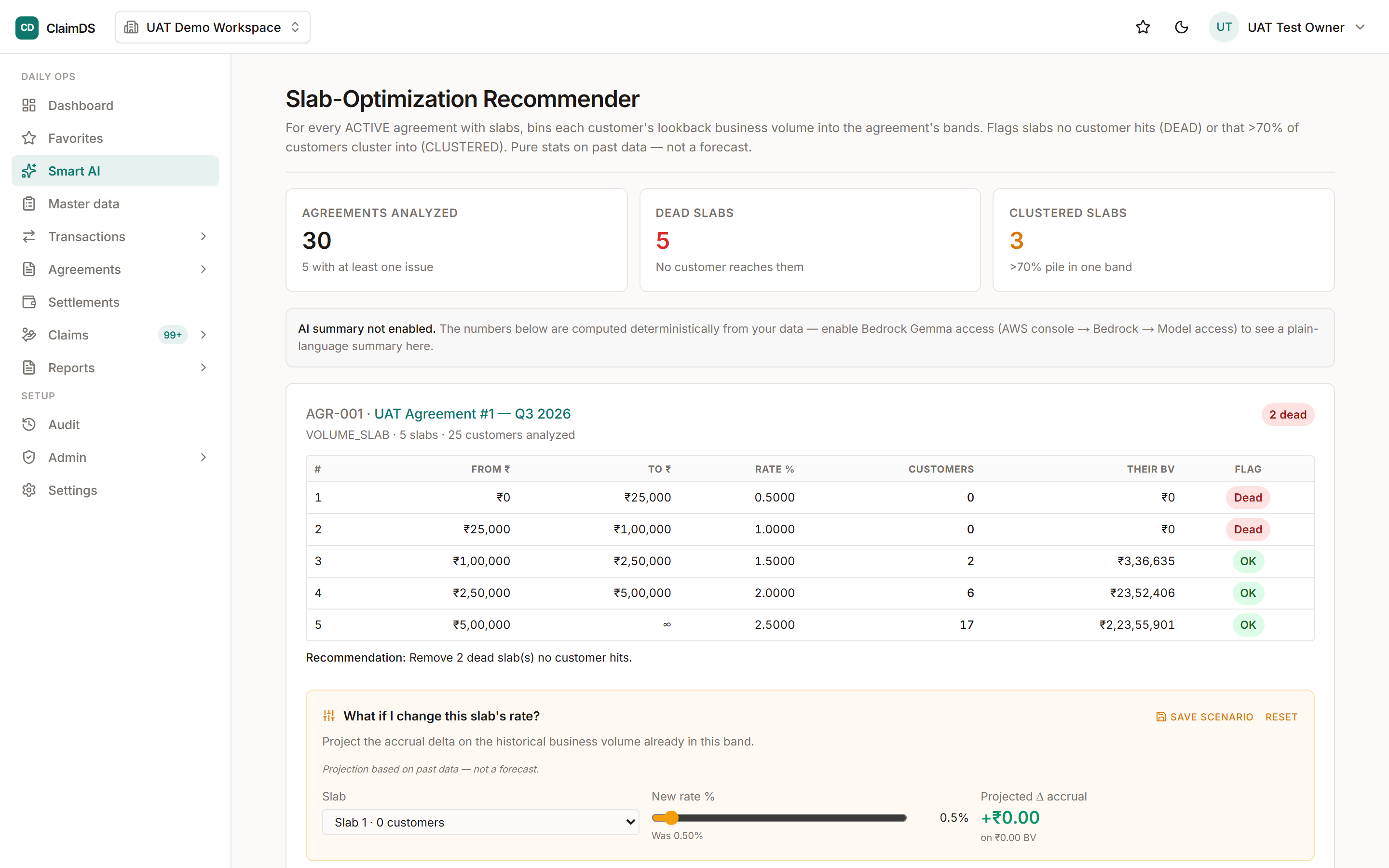
Retrospective vs prospective slabs
The single most consequential design choice is whether slabs are retrospective or prospective. Consider a partner doing ₹1,20,00,000 against slabs of 1% to ₹50L, 1.5% to ₹1cr, 2% above:
| Method | How it applies | Rebate on ₹1.2cr |
|---|---|---|
| Prospective (marginal) | Each rate applies only to volume in its band | ₹50,000 + ₹75,000 + ₹40,000 = ₹1,65,000 |
| Retrospective (whole-turnover) | Top rate reached applies to all volume | 2% × ₹1.2cr = ₹2,40,000 |
Same sales, very different payout. Confusing the two is a frequent, expensive error — exactly the kind software eliminates by encoding the method once.
Growth incentives and true-ups
Many schemes layer a growth condition — an extra payout for beating a prior-period baseline — on top of the volume slab. These require the system to hold the baseline and the achievement, and to run a period-end true-up that reconciles the running accrual to the final, confirmed entitlement.
Dealer vs distributor volume rebates
The mechanics rhyme but the design differs. Distributor volume rebates usually operate on primary purchase volume; dealer volume rebates often tie to sell-through or display conditions and sit lower in the tier structure — see secondary scheme settlement for the cross-tier case.
Accrual mechanics
Volume rebates are accrued as sales post, applying the correct slab rate to the running volume so finance always sees a live liability. Exact-decimal money math matters: on large volumes, a rounding habit compounds into real money. This live accrual is detailed in rebate tracking software and reconciled per rebate accounting.
GST settlement
Volume rebates settle by credit note, with the tax-vs-financial choice affecting ITC. See financial vs. tax credit notes.
GST note: This article is general information, not tax or legal advice. GST positions — including CBIC Circular No. 251/08/2025-GST and the Finance Act 2026 amendments to Section 34 of the CGST Act, assented 30 March 2026 but not yet notified into force as of publication — must be re-verified at publish time with a qualified professional.
Frequently asked questions
What is a volume rebate?
A volume rebate is an incentive paid to a channel partner for reaching defined sales or purchase volumes, usually as a percentage that rises across slabs. It is earned after the sale and settled later, commonly through a credit note rather than on the original invoice.
What is the difference between retrospective and prospective slabs?
In a retrospective slab, once a partner crosses a threshold the higher rate applies to all volume from the start. In a prospective slab, the higher rate applies only to volume above the threshold. The two produce different rebate amounts for the same sales.
How are volume rebates accrued?
Volume rebates are accrued as sales post, applying the correct slab rate to the running volume so finance sees a live liability. Period-end true-ups adjust the accrual once final volumes and any growth conditions are confirmed.
See ClaimDS on your own claims data
A 30-minute walkthrough tailored to how your channel actually settles claims.
Related posts

Why ClaimDS Is the Best Rebate Management Software in India
Why Indian distributors and dealers need finance-grade rebate and claims settlement: multi-tier fidelity, GST credit-note compliance, faster payouts.
Customer Rebates: Programs & Software
Customer rebate programs explained — structures, claim validation, accrual and the GST treatment of customer rebates. Distinct from supplier and distributor rebates.
SMB Rebate Software for India
Indian SMB rebate software — affordable, fast-deploy rebate management for mid-market manufacturers and distributors. Why enterprise suites are overkill for SMBs.