Rebate Management Software: The Complete 2026 Guide (India)
What rebate management software does, the rebate types it handles, GST credit-note treatment, and how to choose a system for Indian multi-tier RTM.
Rebate management software is a system that automates how a business designs, accrues, claims, validates and settles rebate and incentive programs across its sales channel. It replaces spreadsheets with one auditable record of every scheme, the live accrued amount owed to each partner, and the GST-compliant credit note that finally settles the claim.
What rebate management software does
Rebates are one of the largest and least-controlled lines of trade spend in Indian distribution. A manufacturer announces a 2% quarterly scheme; a distributor does the sales; months later a credit note arrives that nobody can fully reconcile against what was actually earned. Rebate management software exists to close that gap. It is the system of record for every incentive program — turning informal scheme circulars and manual spreadsheets into structured agreements that calculate themselves.
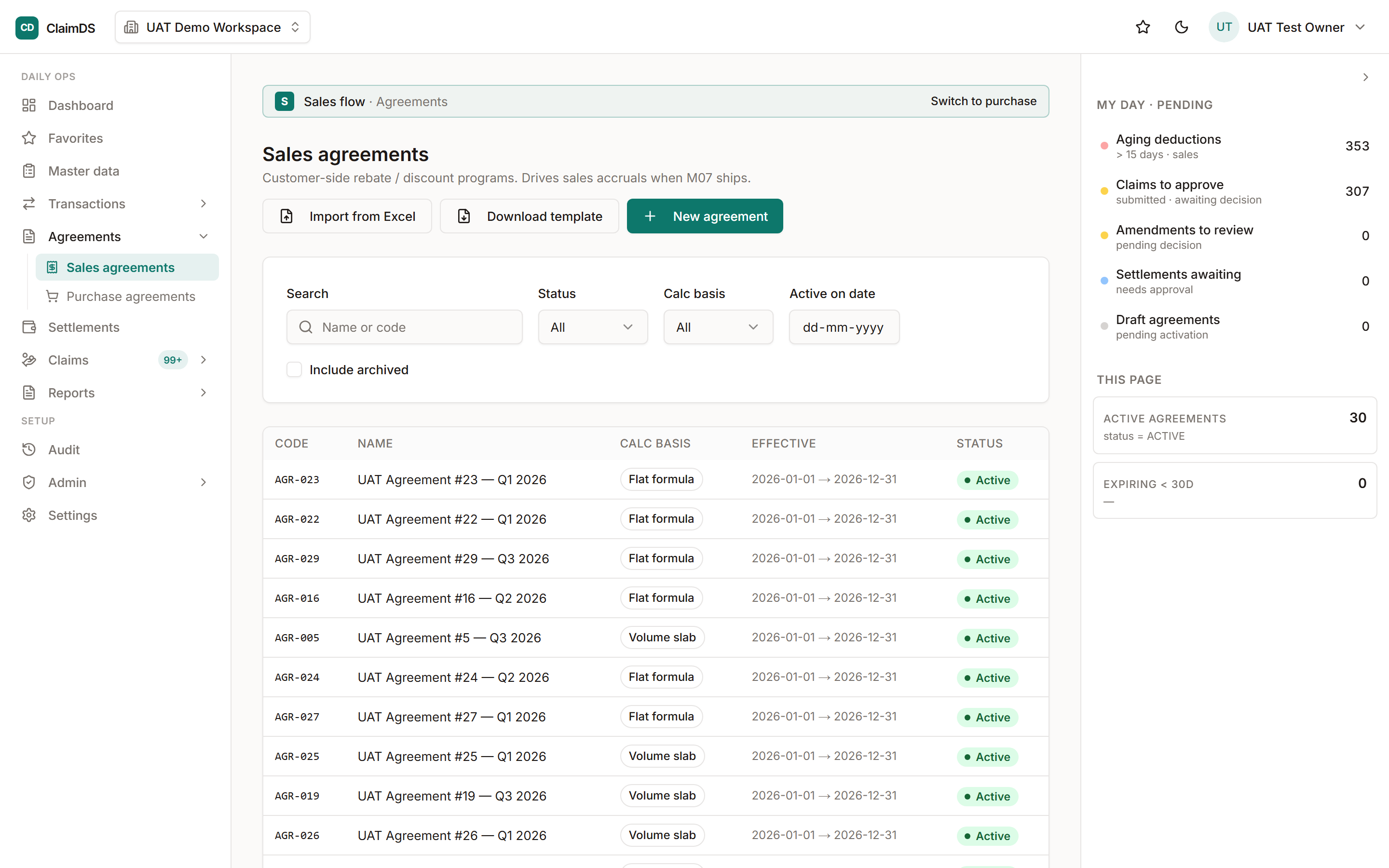
At its core, a rebate management system does four things: it captures the scheme (slabs, targets, eligibility, validity) as structured data; it accrues in real time against actual sales or purchase volume so finance always knows the live liability; it validates and processes claims against the agreement so disputes shrink; and it settles the approved amount through a compliant credit note with a full audit trail. For a broader view of how rebates sit alongside other channel claims, see our pillar on claims management software.
The rebate types it handles
"Rebate" is an umbrella term. A capable system covers the full range used in Indian channels, because a real distributor or manufacturer rarely runs just one kind:
- Volume and slab rebates — the most common: a percentage that rises as a partner crosses defined turnover slabs, settled retrospectively or prospectively.
- Growth and target rebates — paid for beating a prior-period or agreed target.
- Supplier rebates — buy-side rebates a business earns from its suppliers, accrued against purchases.
- Vendor rebates — vendor-funded programs that need accrual accuracy and clean reconciliation.
- Distributor and dealer rebates — sell-side incentives down the channel, often multi-tier.
- Customer rebates — end-customer programs with their own validation and GST treatment.
A tool that only handles flat-percentage rebates forces the messiest schemes — exactly the ones that leak the most money — back into spreadsheets.
The rebate lifecycle: accrual to settlement
Every rebate moves through a defined lifecycle: scheme captured → accrued → claim raised → validated → approved → settled. Making that lifecycle visible — instead of locked in one person's spreadsheet — is most of the value. Accrual is the live, growing liability calculated from real volume. Claiming is the partner's formal request; see how to submit a rebate or claim request. Validation checks the claim against the agreement and sales data. Settlement issues the credit note. The generic version of this flow is in the claim process explained.
How rebates are settled under GST
This is where Indian rebate management diverges from any global tool. Rebates are usually settled by credit note — but not all credit notes are equal under GST.
| Aspect | Tax (GST) credit note — Section 34 | Financial / commercial credit note |
|---|---|---|
| Changes output tax? | Yes — reduces supplier's output GST | No |
| Recipient ITC reversal? | Yes — proportionate reversal required | No reversal required |
| When used | Discount known/agreed before or at supply, linked to invoices | Post-sale commercial discount not meeting Section 15(3)(b) conditions |
Choosing the wrong instrument creates real exposure — either lost tax or an unexpected ITC reversal demand. Read the detail in financial vs. tax credit notes under GST and our guide to CBIC Circular 251 and post-sale discounts. For the accounting mechanics, see rebate accounting.
GST note: This article is general information, not tax or legal advice. GST positions — including CBIC Circular No. 251/08/2025-GST and the Finance Act 2026 amendments to Section 34 of the CGST Act, assented 30 March 2026 but not yet notified into force as of publication — must be re-verified at publish time with a qualified professional.
Why spreadsheets break in multi-tier RTM
Indian route-to-market is rarely two tiers. A typical chain runs manufacturer → super-stockist → distributor → sub-stockist → dealer → retailer, with secondary schemes running below the primary. Spreadsheets fail here for predictable reasons: no single source of truth, manual slab math that compounds errors, no live accrual, no audit trail, and credit-note type chosen by habit rather than rule. Mid-market businesses commonly estimate 1–3% of channel turnover lost to under-settled or unclaimed rebates (treat that range as an industry rule-of-thumb, not a surveyed figure).
How to choose a system
Run a short, structured evaluation rather than a feature beauty-contest. Map your actual scheme types first; score each tool on claim-type breadth, multi-tier fidelity and GST correctness; pilot on one real quarter of data; and check reconciliation against a credit note you already received. Finance leaders should also read the CFO revenue-leakage playbook. Our best rebate management software buyer's guide turns these into a scored evaluation.
Frequently asked questions
What is rebate management software?
It is a system that automates the design, accrual, claiming, validation and credit-note settlement of rebate and incentive programs across a sales channel, replacing spreadsheets with a single auditable record of what is owed and what has been paid.
How is a rebate different from a discount?
A discount reduces the price at the time of sale and appears on the invoice. A rebate is earned after the sale once a condition such as a volume or growth target is met, then settled later, usually through a credit note rather than on the original invoice.
How are rebates settled under GST in India?
Rebates are typically settled by credit note. A tax (GST) credit note under Section 34 reduces the supplier's output tax and requires the recipient to reverse proportionate ITC; a financial or commercial credit note does not change tax and needs no ITC reversal. The correct choice depends on whether the discount was known before supply.
Do small and mid-market Indian businesses need rebate management software?
Yes, when scheme volume, channel tiers or claim disputes outgrow spreadsheets. Mid-market manufacturers and distributors running multiple slab, growth and secondary schemes commonly lose an estimated 1–3% of turnover to calculation errors and unclaimed accruals, which purpose-built software is designed to recover.
See ClaimDS on your own claims data
A 30-minute walkthrough tailored to how your channel actually settles claims.
Related posts

Why ClaimDS Is the Best Rebate Management Software in India
Why Indian distributors and dealers need finance-grade rebate and claims settlement: multi-tier fidelity, GST credit-note compliance, faster payouts.
Customer Rebates: Programs & Software
Customer rebate programs explained — structures, claim validation, accrual and the GST treatment of customer rebates. Distinct from supplier and distributor rebates.
SMB Rebate Software for India
Indian SMB rebate software — affordable, fast-deploy rebate management for mid-market manufacturers and distributors. Why enterprise suites are overkill for SMBs.