The Claim Process Explained: From Submission to Settlement
The channel claim process step by step — creation, documentation, validation, approval, settlement and reconciliation, with owners, SLAs and where claims stall.
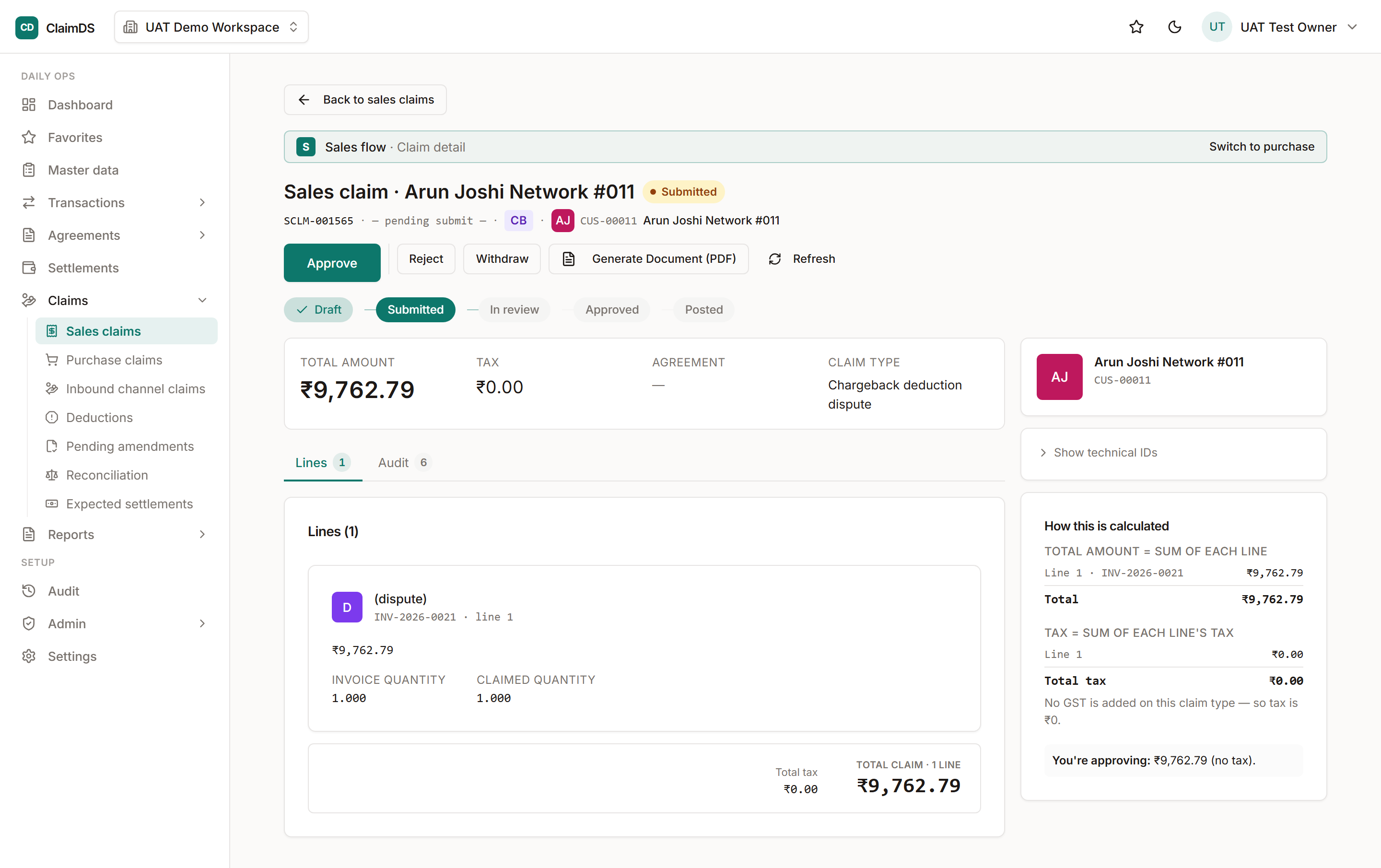
The claim process is the lifecycle a channel claim follows from start to finish: it is created and submitted, documented with evidence, validated against the agreement and data, approved, settled (usually by credit note), and reconciled against the accrual or expected amount. Making each stage explicit is what turns claims from a backlog into a controlled flow.
The six stages
- Create and submit. The claim is raised with a clear reason and reference (invoice, scheme, agreement).
- Document. Evidence is attached — invoices, scheme terms, stock or damage records.
- Validate. The claim is checked against the agreement and the underlying data.
- Approve. The validated claim is approved with the right authority and segregation of duties.
- Settle. The amount is settled, usually by GST credit note.
- Reconcile. The settlement is matched against the accrual or expected amount; any gap is resolved.
This is the generic backbone behind every claim type in the claims management hub; the submission detail is in how to submit a claim request.
Owners and turnaround
| Stage | Typical owner | What good looks like |
|---|---|---|
| Create / document | Commercial / ops | Complete evidence at submission |
| Validate | Finance | Rules applied consistently |
| Approve | Approver | Authority + segregation of duties |
| Settle | Finance | Correct credit-note type |
| Reconcile | Finance | Settlement matches accrual |
Track turnaround time (TAT) per stage so bottlenecks are visible — the basis of the benchmark in the ROI & settlement-time guide.
Where claims get stuck
Two stages dominate delays: validation (missing or mismatched evidence) and reconciliation (settlement not matching the accrual). Both are solved by capturing evidence up front and reconciling automatically — see distributor claims management for the operational view.
One process, many claim types
The same six-stage process underlies rebates, chargebacks, price protection and buyback — only the evidence and validation rules change. That is why a single platform across claim types is more efficient than separate tools: see the related processes for chargebacks and buyback.
GST note: This article is general information, not tax or legal advice. Where settlement involves GST credit notes, positions — including CBIC Circular No. 251/08/2025-GST and the Finance Act 2026 amendments to Section 34 of the CGST Act, assented 30 March 2026 but not yet notified into force as of publication — must be re-verified at publish time with a qualified professional.
Frequently asked questions
What is the claim process?
The claim process is the lifecycle a channel claim follows — creation and submission, documentation, validation against the agreement and data, approval, settlement (usually by credit note), and reconciliation against the accrual or expected amount.
Who owns each stage of the claim process?
Typically commercial or operations create and document claims, finance validates and settles, and a designated approver applies authority. Clear ownership at each stage keeps the process repeatable and auditable.
Where do claims get stuck?
Claims stall most at validation, when evidence is missing or does not match the agreement, and at reconciliation, when settlement does not align with the accrual. Defined SLAs and an audit trail keep claims moving.
See ClaimDS on your own claims data
A 30-minute walkthrough tailored to how your channel actually settles claims.
Related posts

What Is Claims Management Software? A Practical Guide
Claims management software, explained: what it is, the claim lifecycle, the Indian claim types it settles, GST credit notes, and how to choose one.
How to Submit Rebate Claims Fast and Accurately with ClaimDS
A step-by-step guide to submitting rebate and scheme claims fast and accurately: the documents, the 5 steps, GST credit notes, and how to cut rejections.
Distributor Claim Settlement Software: A Buyer's Guide for Indian Mid-Market
What distributor claim settlement is, why spreadsheets fail at scale, what to look for in software, and how ClaimDS helps Indian mid-market finance teams.