Distributor Claim Settlement Software: A Buyer's Guide for Indian Mid-Market
What distributor claim settlement is, why spreadsheets fail at scale, what to look for in software, and how ClaimDS helps Indian mid-market finance teams.
In short
Distributor claim settlement is checking what a distributor claims against what your scheme actually owes them, then approving, adjusting or rejecting it and settling the agreed amount, usually by credit note. Software matters once volume and dispute rates outgrow spreadsheets — this guide covers what to look for.
If your company sells through distributors, dealers or stockists, claims are a fact of life. Partners raise them for schemes, rebates, price drops, damaged stock and more — and every unresolved claim is either money you owe sitting on your books, or money you are owed slipping away. This guide explains, in plain English, what distributor claim settlement is, why it gets hard at scale, and what to look for if you are evaluating software to manage it.
It is written for the people who actually own this work at Indian mid-market companies — finance managers, controllers, and the operations leads who live in the claims inbox.
What distributor claim settlement actually means
A claim is a request from a channel partner to be paid (or to deduct) an amount they believe your agreement entitles them to. Settlement is the work of checking that claim against what the agreement actually says, deciding the right number, and closing it out — typically by issuing a GST credit note or scheduling a payout. For the full taxonomy of claim types a distributor files, see distributor claims management; for the settlement flow itself, see the FMCG claim settlement process end to end.
Done well, settlement answers four questions for every claim:
- Which agreement does this fall under? A claim only makes sense against a specific scheme or contract.
- What does that agreement actually owe? The slab, tier, rate or special price that applies for the period.
- Does it match our own records? The quantities and values the partner claims, against the transactions you recorded.
- What did we decide, and why? A defensible accept, adjust or reject — with the reason kept on record.
When those four questions are easy to answer, claims close quickly and partners trust the numbers. When they are not, claims pile up.
The common types of distributor claims
"Claims" is an umbrella term. In Indian channel businesses you will usually see a mix of:
- Scheme and rebate claims — volume rebates, slab schemes, and secondary schemes that cascade down through the channel.
- Price protection — when prices drop, partners claim the difference on stock they are still holding.
- Chargebacks and billbacks — deductions for agreed special prices to specific customers.
- Damage, expiry and returns — claims for unsellable stock.
- Promotional and display claims — trade-spend reimbursements for activity at the partner's end.
Each type has its own rules, and each is only valid against a specific agreement. That is exactly what makes settlement fiddly: the same partner can raise five kinds of claim in one file, and each line needs to be checked against a different set of terms.
Why spreadsheets break down at scale
Almost everyone starts in Excel, and for a while it works. The trouble is that a spreadsheet does not know anything about your agreements — so every cycle, a person has to supply that knowledge by hand. At low volumes that is manageable. At scale, four problems compound:
- The agreement lives in someone's head. Terms sit in emails, PDFs and memory, so the first question on every disputed claim — which scheme is this? — takes hours.
- The math changes per tier. Volume, stepped, tiered and special-pricing schemes each compute differently. One wrong slab on one line is invisible in a sheet of thousands of rows, until it quietly distorts margin across a quarter.
- Tie-outs never quite happen. Re-keying a partner's file and checking every line by hand is slow, so in practice it is not done every cycle. The lines nobody checked are pure leakage.
- There is no trail. When a partner reopens a six-month-old claim, a spreadsheet cannot tell you who approved what, or why. You either pay again or spend days reconstructing it.
For a deeper look at exactly where this leakage happens, see Why distributor rebate claims slip through the cracks.
What to look for in claim settlement software
If you decide to move off spreadsheets, here is a practical checklist. Good software should:
- Model your agreements once. Volume, stepped, tiered and special-pricing schemes should be set up as real, reusable terms — not re-entered for every claim.
- Auto-match the partner's claim file. Upload what the partner sends, and the system should match it against the right agreement and your own transactions, then surface only the variances that need a decision.
- Accrue automatically. You should always know your current liability and receivable, without a month-end spreadsheet marathon.
- Be built for Indian GST. A settled claim usually becomes a credit note. The software should generate a compliant credit note — with GSTIN and HSN validated and ITC reversal tracked — from the same claim it reconciled. (More on this in GST credit notes for rebates.)
- Keep a tamper-evident audit trail. Every decision, and the reason for it, recorded so it holds up months later or at assessment.
- Isolate your data. In a multi-tenant product, your data must be strictly walled off from every other company's.
- Deploy without a year-long project. Mid-market teams need value in weeks, not a heavy enterprise rollout.
A quick test: ask any vendor to show you a partner claim file going in, and the variances coming out with the agreement math already applied. If they can only show you a place to store claims — not reconcile them — keep looking.
How ClaimDS helps
ClaimDS is built specifically for the Indian channel and for mid-market budgets and timelines. It closes the loop the four questions above describe:
- Agreements, modelled once. Set up each scheme — volume, slab, tiered or special pricing — and ClaimDS uses the right terms automatically for every claim.
- Reconciliation, not just storage. Upload a partner's claim file and ClaimDS matches it against your agreements and transactions, then shows you only the variances to work.
- Accruals that stay current. The position updates as transactions land, so you always know what you owe and are owed.
- GST designed in. Settled claims become Rule 53(1A)-compliant credit notes, with GSTIN/HSN validation and ITC-reversal tracking — not bolted on afterwards.
- A trail that survives scrutiny. Every change is recorded in a tamper-evident audit log, with strict per-tenant data isolation.
The result is the thing every finance team actually wants: claims that close in days, margins you can explain, and a settlement you can defend.
If you would like to see it on realistic data, the live demo takes about ten seconds to spin up — or book a demo below and we will walk through it on your own kind of schemes.
Frequently asked questions
What is distributor claim settlement, in one line?
It is the process of checking what a distributor or dealer claims against what your scheme or agreement actually owes them, then approving, adjusting or rejecting it and paying the agreed amount — usually as a credit note.
How long should claim settlement take?
With clean agreements and the right tooling, most routine claims should close in days, not weeks. The bottleneck is rarely the payment — it is the back-and-forth of matching claims to agreements and proving the right number.
Can't we just keep using Excel?
Excel works until volume and scheme complexity grow. It does not know your agreement terms, keeps no reliable audit trail, and forces manual tie-outs every cycle. Most teams outgrow it once claims run into the hundreds per month across many schemes.
Does claim settlement software handle GST credit notes?
Good India-built software does. A settled claim usually becomes a GST credit note, which has required particulars and an ITC-reversal step. Look for software that generates the credit note from the same agreement and claim it reconciled.
How long does ClaimDS take to deploy?
ClaimDS is built to deploy fast for mid-market teams — import your counterparties, materials and agreements, and you can start reconciling claims without a multi-month rollout.
What features should an FMCG company look for in claims management software?
Look for six things: scheme modelling that holds your terms including slabs and windows; claim validation against those terms rather than manual checking; GST-compliant credit-note settlement; data exchange with the systems you already run; a complete audit trail per settlement; and automatic clawback when returns arrive after a payout. Judge each against your own schemes, not a feature list.
What should Indian FMCG companies look for in a trade promotion claims solution?
The India-specific tests: does it settle through GST-compliant credit notes and support the tax-versus-financial credit-note choice; does it handle the multi-tier channel of C&F agents, super-stockists, distributors and retailers; does it compute secondary schemes on sell-through rather than only primary sales; and does it work in INR across an April–March financial year?
See ClaimDS on your own claims data
A 30-minute walkthrough tailored to how your channel actually settles claims.
Related posts
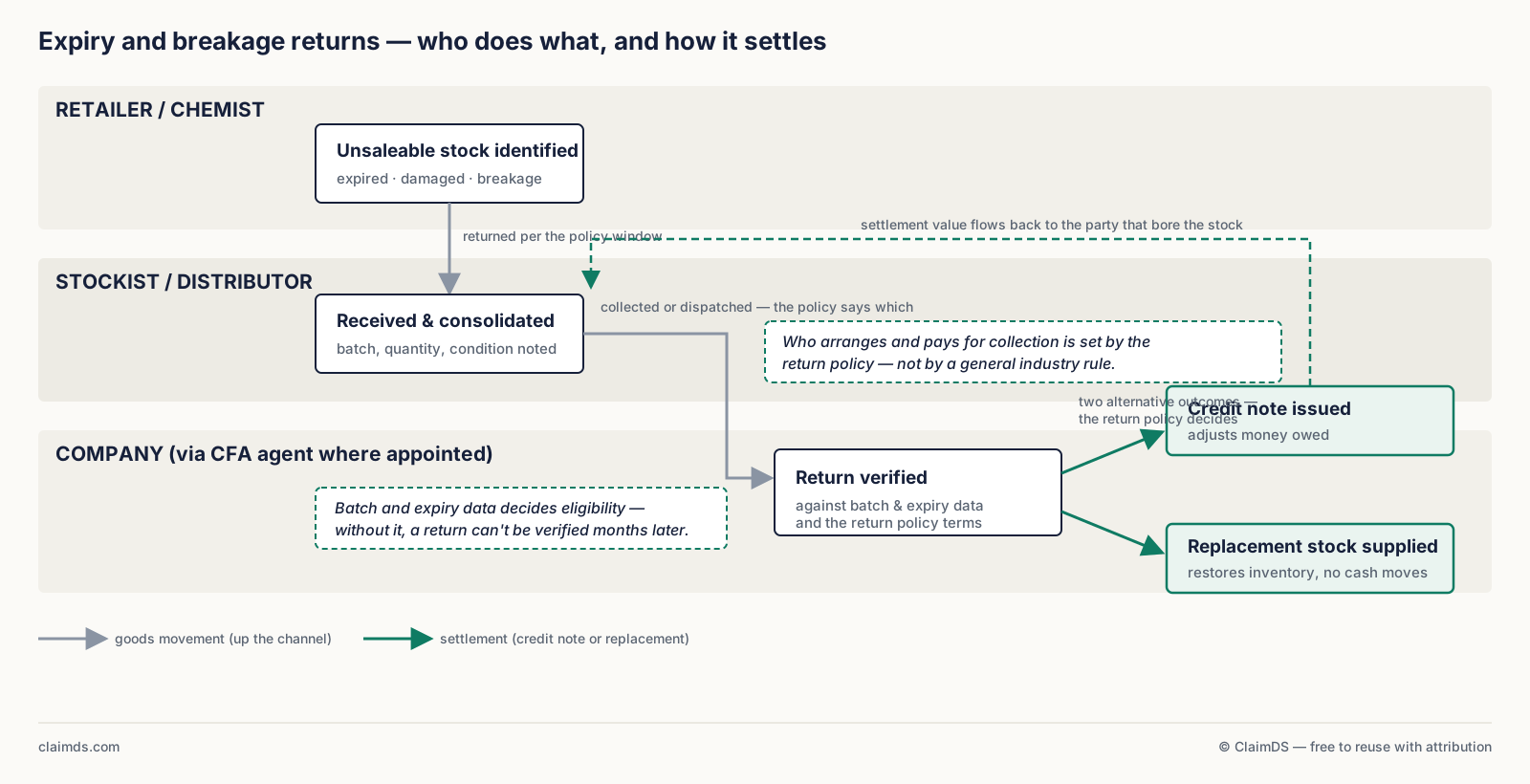
Expiry and Breakage Returns: Who Collects, Who Pays, and How It Settles
Who collects expired stock, who bears the cost, and whether it is settled by replacement or credit note — the operational side of expiry and breakage returns.

Subvention Claims: How Interest and Dealer Support Actually Get Settled
When a brand funds a zero-interest offer or supports a dealer's cost, the money moves as a claim. How subvention works and what it takes to settle it.
How to Build a Claim and Scheme Simulator in Excel
The workbook structure behind every channel claim model — four tabs, codes not names, terms off the formula, and the control totals that catch silent errors.