
Channel Claims and Rebates in Indian Paints
How claims, dealer schemes and painter loyalty work in the Indian paints channel — the dealer network, the influencer channel, rate difference and returns.

In Indian paints, the manufacturer sells through dealers and distributors to retail paint shops — but the person who decides which brand goes on the wall is the painter or contractor. So money flows back up the channel in two streams: dealer schemes that reward the trade for volume and targets, and painter loyalty rewards that court the influencer. Add rate-difference claims when prices revise on held stock, and it is the influencer channel and its tax treatment that make paints distinct from any other channel.
What is the Indian paints channel, tier by tier?
Paints runs on a conventional distribution spine with one feature no other channel shares as strongly: an influencer tier sitting between the retailer and the consumer. Goods flow straight down the spine, but the buying decision is captured off to the side, at the painter. Mapping every tier — including the influencer — is the prerequisite for understanding which claim comes from whom.
At the top, the manufacturer owns the products, mixes the bases, prints the shade cards, and declares every scheme and price. It rarely ships direct to the trade; instead it moves stock to a depot or C&F (carrying and forwarding agent), a regional stocking point that holds inventory and invoices the trade on the company's behalf. From there, stock reaches the dealer or distributor — the trade partner who buys in bulk, carries the working capital, runs the tinting machine, and executes the company's schemes. Below the dealer sits the retailer, the neighbourhood paint shop that sells to walk-in customers and to painters buying on a job.
Then comes the tier that defines paints: the painter or contractor. The painter does not buy for resale — the painter applies the product and, crucially, tells the household what to buy. Because the influence lives here, paint companies court painters directly with loyalty rewards, bypassing the trade margin entirely. At the base is the consumer, the household or builder who pays for the finished wall but seldom chooses the brand alone.
| Tier | What it does | What it claims or earns | From whom |
|---|---|---|---|
| Manufacturer | Owns products, declares schemes and prices | Nothing (settles claims) | — |
| Depot / C&F | Stocks regionally, invoices the trade | Handling margin, no claims | Manufacturer |
| Dealer / distributor | Buys bulk, tints, runs schemes | Volume and target schemes, rate difference, damage returns | Manufacturer |
| Retailer (paint shop) | Sells to walk-ins and painters | Display support, small-volume benefit | Dealer / company |
| Painter / contractor | Applies paint, influences the buy | Loyalty rewards, contractor incentives | Manufacturer (direct) |
| Consumer | Pays for the finished job | Nothing | — |
If the line between a distributor, a dealer and a super stockist blurs in your own network, the difference between a distributor, dealer and super stockist explainer untangles it, and India's multi-tier channel claim map shows how these tiers connect across industries.
What do paints companies settle with their channel?
Paint companies pay their channel through several distinct claim types, and folding them into one bucket is the first mistake a manual process makes. Each has its own evidence, its own validation rule, and its own settlement path — and each has a satellite article for the detail.
Dealer volume and target schemes are the trade rewards: buy or sell a defined quantity in a month, cross a value slab, or stock a full range, and a per-unit or percentage benefit applies. These sit inside the wider family of trade schemes in India and route to the paints dealer claim settlement process satellite for the end-to-end flow.
Painter and contractor loyalty programs are the influencer stream. Painters register coded purchases or scan packs, accrue points, and redeem them for rewards — a benefit paid to the person who drives the sale, not to the dealer who booked it. The mechanics and enrolment live in painter and contractor loyalty programs, and the wider pattern in channel loyalty programs.
Rate-difference (price-revision) claims protect the dealer's stock when the company revises prices. On a price cut, stock already with the dealer at the old rate is compensated for the gap — the same protection logic as price protection and rate-difference credit notes under GST, and detailed for this channel in paints rate-difference and damage claims.
Damage and leakage returns cover stock that arrives dented, leaking or expired on the shelf. The dealer returns it and claims credit, the same discipline as credit notes for expired and damaged goods returns.
Display and tinting support reimburses the retailer for shop branding, shade-card stands, and the running cost of the tinting machine that mixes shades on demand — an evidence-and-reimbursement claim rather than a performance reward. Because the tinting machine is what lets a small shop offer thousands of colours without stocking them, its upkeep is a recurring support claim in its own right. The buy-side mirror, where a company earns rebates from its own raw-material suppliers, is in supplier and purchase rebates in paints India.
What paints vocabulary will you see on claim forms?
Paint claim forms carry terms that mean different things to sales, to the shop, and to finance. This table is the quotable glossary — bookmark it, and see the full product glossary for terms beyond the channel.
| Term | What it means |
|---|---|
| Dealer scheme | A performance reward paid to a dealer for hitting volume, value or range targets. |
| Painter loyalty program | A points-based reward run directly with painters to court the influencer of the sale. |
| Contractor incentive | A benefit paid to a contractor who specifies or buys in bulk for a project. |
| Tinting machine | The in-shop machine that mixes a base and colorant to a shade on demand. |
| Shade card | The printed swatch fan a customer and painter choose a colour from. |
| Rate difference | The gap between old and new price on held stock, compensated after a price revision. |
| Price revision | A company-declared change to product prices that can trigger rate-difference claims. |
| DLP | Dealer landing price — the net cost to the dealer after discounts, the base for margin. |
| Damage / leakage return | Stock returned as dented, leaking or expired, claimed back as credit. |
| Display support | Reimbursement for shop branding, shade-card stands and point-of-sale material. |
| Depot / C&F | A regional carrying-and-forwarding stock point that invoices the trade for the company. |
| Base and colorant | The white or tint base plus the colorant a tinting machine combines into a shade. |
Why are paints claims harder than they look?
Paint claims read like simple arithmetic — a rate times a quantity — but five structural features make them genuinely hard to run at scale. Each carries a consequence that surfaces as delay, dispute or leakage.
The painter influencer channel needs its own rewards and tax handling. The person who drives the sale is not in the trade, so the company rewards an individual outside its invoicing chain. Consequence: painter loyalty runs as a separate programme with its own enrolment, redemption and a tax step under Section 194R TDS on dealer and distributor incentives, covered for this channel in GST and TDS on paints dealer and painter incentives.
Prices revise often, creating rate-difference claims on stock. Paint prices move with input costs, and every revision leaves dealers holding stock at the old rate. Consequence: each revision spawns a wave of rate-difference claims that must be reconciled against exact stock-on-hand, or the company over-compensates.
Loyalty rewards are benefits in kind. Points redeemed for goods, gold or a trip are not cash, but they are still a taxable benefit. Consequence: finance must classify and value each reward before it is paid, adding a step no cash payout would need.
Claims span the dealer and the influencer at once. A single scheme cycle produces both dealer credit notes and painter rewards, on different documents and different accounts. Consequence: the company runs two settlement systems in parallel, and reconciling volume across both is as hard as seeing secondary sales in any channel.
Settlement crosses a GST document decision. Every dealer settlement resolves into a credit note, and the note type has tax consequences. Consequence: finance cannot rubber-stamp settlement; it must classify each one — the discipline in financial vs. tax credit notes under GST.
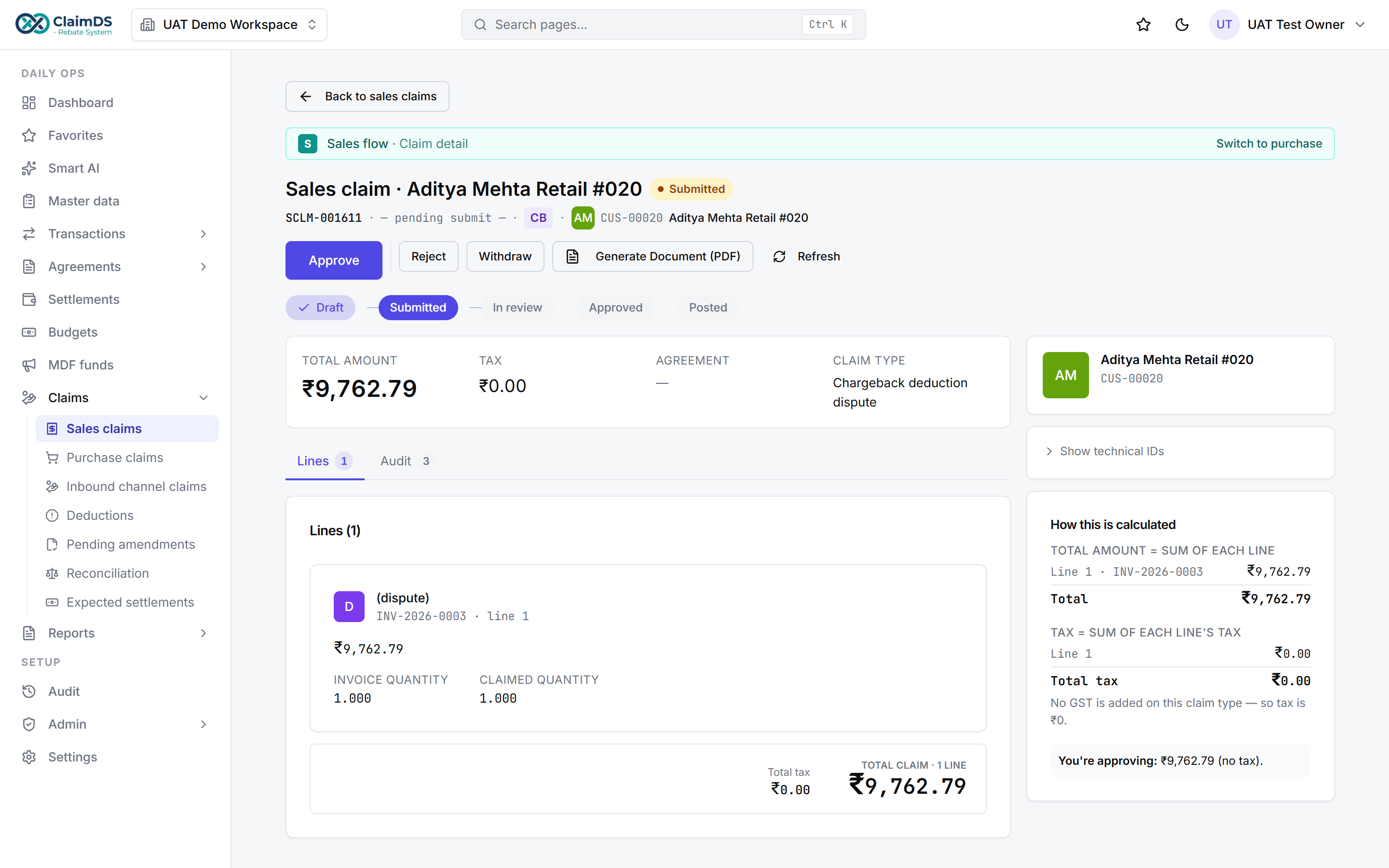
A claim moving through validation and approval before settlement.
How does settlement actually happen?
Settlement turns an approved claim into money — or, far more often, into a credit note or a reward. The path is consistent even when the claim types are not: a claim is filed with proof, validated against scheme terms, stock records or the loyalty ledger, approved by whoever the authority matrix names for its value band, and then settled. The claim process explained walks each stage in depth, and the claim approval workflow covers the routing.
For the trade, the settlement instrument is almost always a credit note against the dealer's purchase account, offsetting future orders rather than moving cash. For the painter, settlement is a reward, payout or redemption to the individual — a different document on a different track. Two tax decisions bite here. The credit-note type — a tax credit note reduces the original GST liability and the dealer's input tax credit, while a financial credit note does not — and, on the painter side, the Section 194R TDS step that attaches before a benefit in kind is booked. Both are routed to GST and TDS on paints dealer and painter incentives for the detail; keep every credit note referencing its claim, and every claim referencing the scheme, price revision or loyalty record behind it — an unbroken trail from entitlement to settlement document.
Two habits keep paints settlement clean. Batch dealer credit notes on a predictable cycle so trade partners can reconcile against their own purchase ledgers rather than chasing individual notes. And keep the trade track and the painter track apart — they carry different documents, different accounts and different tax treatment, so folding dealer credit notes and painter rewards into one run is exactly where mis-classification and part-settlement leakage creep in.
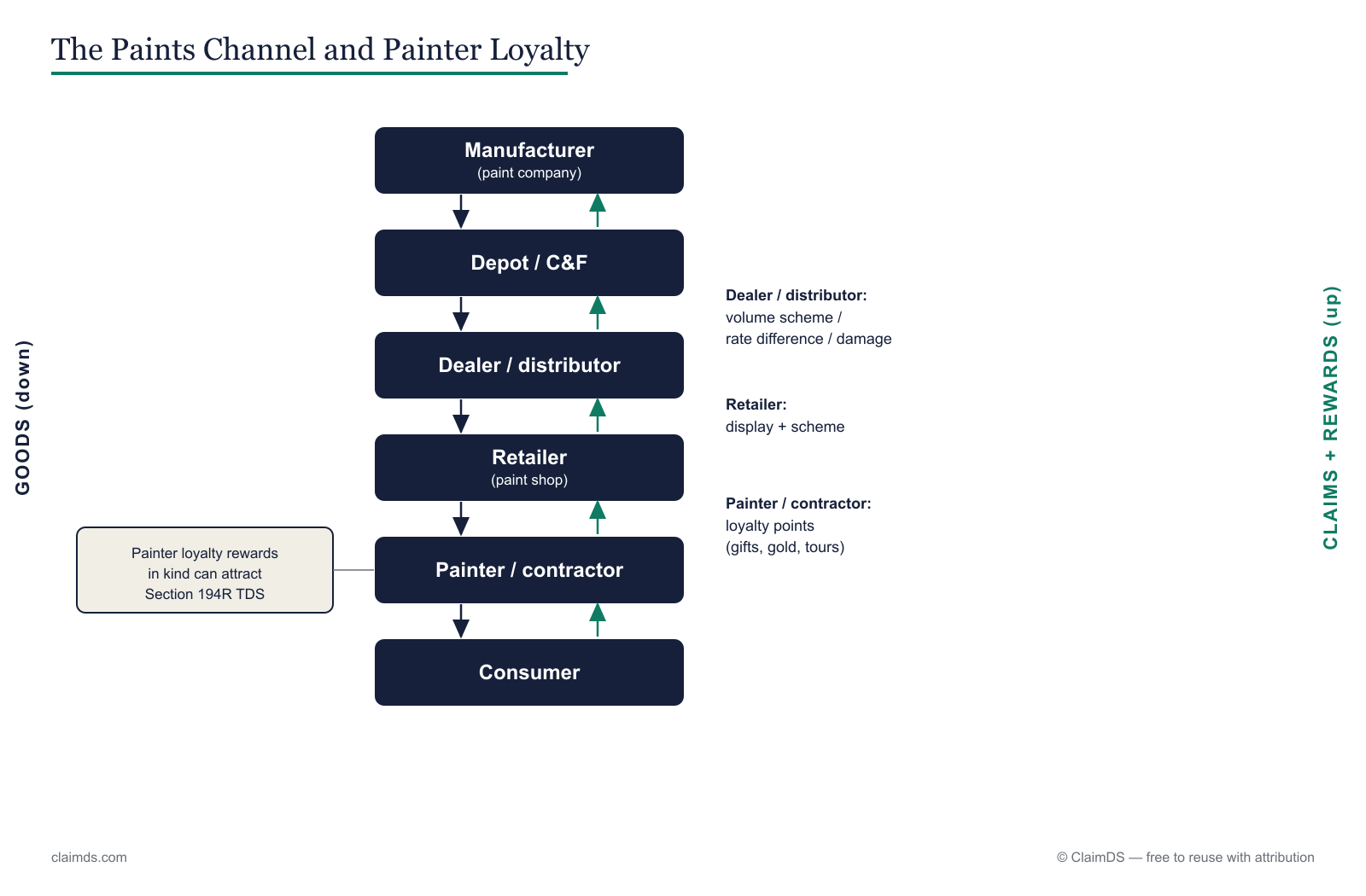
Source: ClaimDS — free to reuse with a link back to this article.
Where should you go next?
This pillar defines the territory; the satellites go deep on each part of it.
- The paints dealer claim settlement process — the end-to-end journey from filing to credit note, with owners and turnaround.
- Painter and contractor loyalty programs — how the influencer channel is enrolled, tracked and rewarded.
- GST and TDS on paints dealer and painter incentives — how each stream is taxed, and when 194R and a tax credit note apply.
- Paints rate-difference and damage claims — price-revision compensation and the return of damaged or leaking stock.
- Supplier and purchase rebates in paints India — the buy-side mirror: rebates a company earns from its own suppliers.
For the tooling behind this — dealer rebate software and dealer claims management software — and the wider picture in channel rebates in India.
Running dealer schemes, painter loyalty and rate-difference claims across every tier in one place — scheme terms, dealer claims, loyalty rewards, evidence and GST-ready settlement — is what turns this from a monthly reconciliation scramble into a controlled flow.
<!-- TODO: confirm capability wording with founder -->To see it working on your own dealer network, painter base and claim volumes, book a demo.
GST note: This article is general information, not tax or legal advice. Where settlement involves GST credit notes or Section 194R TDS, positions must be re-verified at publish time with a qualified professional.
Frequently asked questions
What is a dealer scheme in paints?
A dealer scheme in paints is a benefit a paint company offers its dealers and distributors to reward performance — hitting a monthly volume target, crossing a value slab, or stocking a product range. It is usually paid as a credit note against the dealer's account or as a payout once the stated terms are met over a defined period.
What is a painter loyalty program?
A painter loyalty program is a reward scheme run directly with painters and contractors — the people who apply the paint and influence which brand a household buys. Painters earn points by registering coded purchases or scanning packs, then redeem them for cash, goods or benefits. It rewards the influencer rather than the dealer who sold the product.
What is a rate-difference claim in paints?
A rate-difference claim arises when a paint company revises prices while a dealer still holds stock bought at the old rate. On a price cut, the company compensates the dealer for the gap between the old and new price on that stock, usually through a credit note. It protects the dealer from a loss caused purely by the company's price revision.
Why are painters important in the paints channel?
Painters and contractors are important because they drive the buying decision. A household rarely names a shade or brand itself — the painter recommends what to buy and often purchases it on the customer's behalf. That makes the painter the true influencer of the channel, which is why paint companies run loyalty rewards for painters alongside the schemes they run for dealers.
Who settles paints dealer claims?
The paint company that declared the scheme or revised the price settles the claim, usually through its finance or commercial team after the claim passes validation and approval. Dealers file claims upward against scheme terms and stock records; the company checks them, then issues settlement — most often as a credit note against the dealer's purchase account rather than cash.
Is a painter loyalty reward taxable?
A painter loyalty reward can attract tax because it is often a benefit given in the course of business, which brings Section 194R into view when it crosses the threshold, and rewards paid in kind add their own treatment. The exact position depends on the reward form and value, so it must be confirmed with a qualified professional at settlement time.
How are paints claims settled — credit note or reward?
Dealer claims usually settle by credit note against the dealer's purchase account, offsetting future orders rather than moving cash. Painter loyalty is settled differently — as a reward, payout or redemption to the individual painter. The split matters because the two streams carry different documents and different tax steps, so paint companies run them on separate settlement tracks.
See ClaimDS on your own claims data
A 30-minute walkthrough tailored to how your channel actually settles claims.
Related posts

Channel Claims and Rebates in Indian Agri-Inputs
How schemes, claims and rebates work across the Indian agri-input channel — fertilizers, crop-protection and seeds, seasonal schemes and expiry returns.
How to Settle Agri-Input Dealer Claims
The step-by-step process to settle agri-input dealer and distributor claims in India — seasonal schemes, liquidation claims and near-expiry returns.
Expiry and Season-End Returns in Agri-Inputs
How near-expiry, damage and season-end returns work in Indian agri-inputs — declaring returnable stock, the claim window and how each return settles.