Types of Trade Schemes in India: The Complete Guide for Manufacturers and Channel Teams
Slab, QPS, target, display, visibility, tour, gift and secondary schemes — how each type is calculated, settled and taxed, with worked ₹ examples.
A trade scheme is a manufacturer-funded incentive offered to the channel — distributors, dealers, stockists, retailers — for achieving something the manufacturer wants: purchase volume, sales targets, in-store visibility, or liquidation of slow stock. Indian channel businesses run dozens of them at any time, under names that vary by industry and even by company. Underneath the names, though, there are about ten structural types — and the type is not a labelling detail. It determines how the benefit is calculated, how the claim is evidenced, whether settlement rides a GST credit note, a financial credit note, a payout or free goods, and which tax provisions apply. This guide walks through each type with an illustrative ₹ example, its usual settlement mode, and the dispute it most often produces. If you are new to the vocabulary, what a rebate is and distributor vs dealer vs super stockist cover the basics.
All numbers below are illustrative, not benchmarks. Your scheme circular always governs.
Trade scheme vs consumer scheme
The first split to make. A consumer scheme (price-off, extra grammage, scratch-and-win on the pack) targets the end buyer; a trade scheme targets the channel. They are funded, claimed and settled differently:
| Trade scheme | Consumer scheme | |
|---|---|---|
| Who it targets | Distributors, dealers, stockists, retailers | End consumers |
| Who funds it | Manufacturer (trade spend / scheme budget) | Manufacturer (consumer promotion budget, often built into the pack) |
| Who claims | The channel partner, against evidence | Nobody in the channel — the benefit rides the product; the trade may claim reimbursement only where it funds the offer at the counter |
| How it settles | Credit note, payout or free goods against a validated claim | Priced into the transaction; no claim lifecycle |
Everything below is about the left column.
Slab schemes
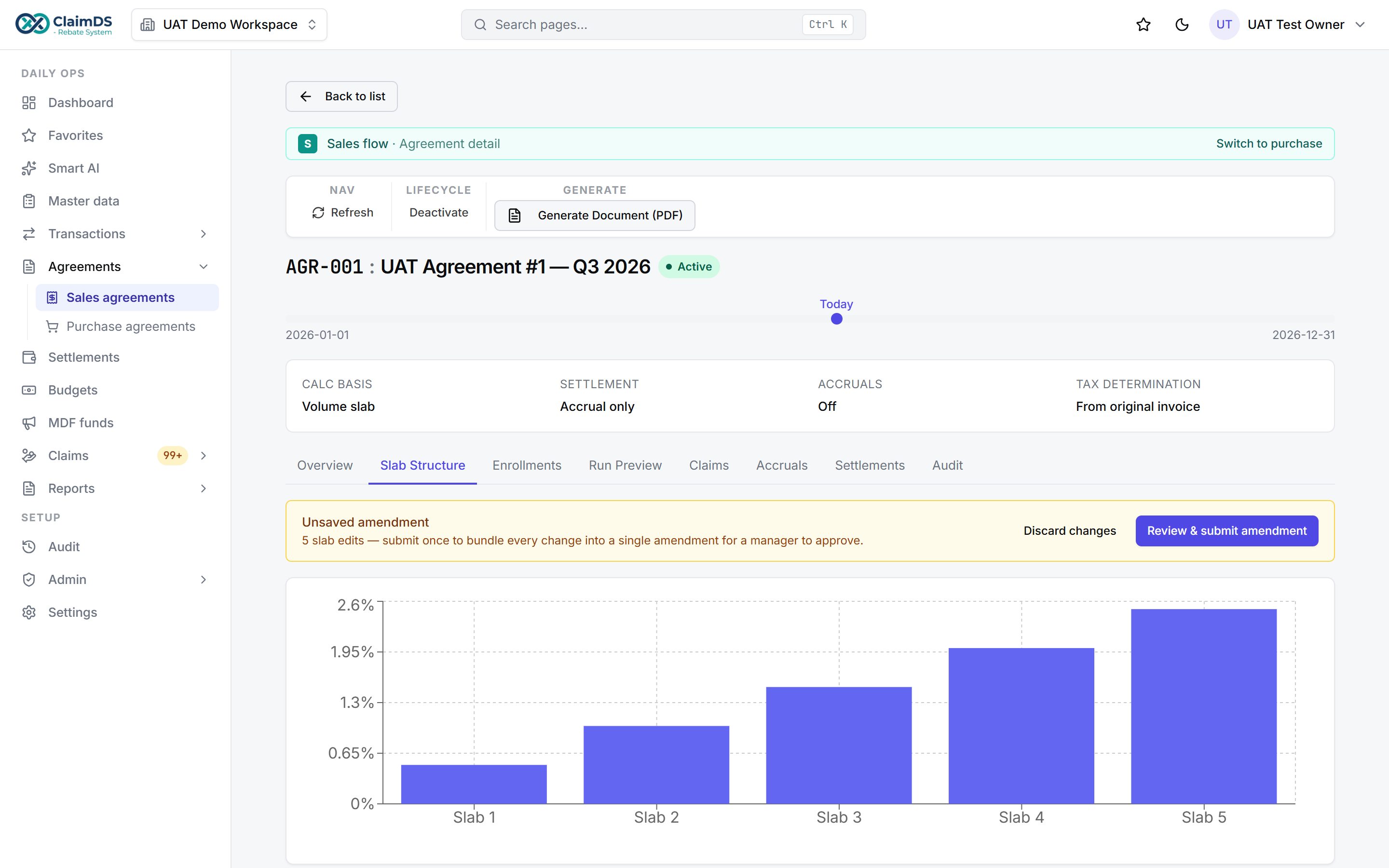
A slab scheme pays a percentage of purchase value that steps up as the distributor's purchases cross defined value slabs within the period. It is the workhorse of Indian trade spend — simple to communicate, and tunable by moving the slab boundaries or rates. The circular must say whether the achieved slab's rate applies to the whole base or per tier, because the two designs pay very different amounts.
Illustrative example. A monthly purchase scheme, achieved slab's rate on the whole net base:
| Monthly net purchases | Rate |
|---|---|
| ₹10,00,000 – ₹14,99,999 | 1.0% |
| ₹15,00,000 – ₹24,99,999 | 1.5% |
| ₹25,00,000 and above | 2.0% |
A distributor's net purchases for the month are ₹18,50,000 → slab 2 → 1.5% × ₹18,50,000 = ₹27,750.
Here is how a slab scheme is defined in practice — percentage slabs on purchase value, with the accrual computed continuously:
- Typical settlement: credit note — a GST credit note where the scheme was agreed before supply and can be linked to invoices, otherwise a financial credit note.
- Common dispute: calculating on gross purchases instead of net of returns, which routinely lands the distributor one slab too high — the arithmetic (including mid-period pro-rating) is worked through in how to calculate FMCG distributor claims.
- Tax pointer: whether the credit note can reduce taxable value is a Section 15(3) question — see GST on trade discounts and dealer incentives.
QPS — Quantity Purchase Schemes
QPS stands for Quantity Purchase Scheme: a per-unit payout that unlocks when purchase quantity crosses defined milestones. Where a slab scheme thinks in rupees of turnover, a QPS thinks in cases or pieces — which makes it immune to price changes mid-period and trivially verifiable against purchase quantities. The broader family of quantity-and-value structures is mapped in volume rebates.
Illustrative example. A quarterly QPS on a brand:
| Cases purchased in the quarter | Payout per case |
|---|---|
| 500 – 999 | ₹15 |
| 1,000 and above | ₹22 |
A distributor buys 1,240 cases → 1,240 × ₹22 = ₹27,280.
- Typical settlement: credit note (tax or financial, on the same logic as slabs); some companies settle small QPS amounts as free goods.
- Common dispute: returned cases not netted off the quantity — the distributor counts 1,240, the manufacturer counts 1,180, and the milestone (or the rate) changes.
- Tax pointer: quantity discounts known at or before supply are the classic candidates for taxable-value reduction under Section 15(3); post-hoc ones settle financially.
Target incentive schemes
A target incentive pays for achievement against an individually assigned target — usually a value target for the period — rather than against absolute slabs. The design choice that matters is pro-rata vs cliff: does 85% achievement earn a proportionate (or stepped) payout, or nothing at all until a threshold is crossed?
Illustrative example. Quarterly target ₹60,00,000; achievement ₹51,00,000 = 85%.
| Design | Rule | Payout |
|---|---|---|
| Stepped pro-rata | 80–89% pays 0.75% of achieved value | 0.75% × ₹51,00,000 = ₹38,250 |
| Cliff | Below 90% pays nothing | ₹0 |
- Typical settlement: financial credit note or payout — target incentives are usually finalised after the period, which fails the before-supply condition for a GST credit note.
- Common dispute: what counts as achievement — billing vs dispatch vs collections, and whether returns booked after the quarter reduce it. Cliff designs also invite quarter-end billing distortions.
- Tax pointer: a cash target incentive to a partner who simply buys and sells is generally a discount, not a taxable service — but the line matters; see GST on trade discounts and dealer incentives.
Display schemes
A display scheme pays for in-store execution during a defined window — an end-cap, a floor stack, a paid shelf facing — typically a fixed amount per outlet per month. It is an execution purchase, not a discount, and the claim is only as good as its photo evidence.
Illustrative example. ₹6,000 per outlet per month for an end-cap display across 20 agreed outlets; the dated photo audit passes 17 → 17 × ₹6,000 = ₹1,02,000, not ₹1,20,000.
- Typical settlement: payout against the dealer's invoice, or a credit note where the company's policy routes it that way.
- Common dispute: undated or reused photos, and outlets swapped without amending the agreed list — there is no formula rescue for a missing photo.
- Tax pointer: where the dealer is contractually obliged to execute the display, it is a service by the dealer, invoiced to the manufacturer with GST — the paperwork flow is in the scheme settlement and GST documentation playbook.
Visibility schemes
Visibility schemes fund durable branding assets — glow-sign boards, in-shop branding, painted facades, fixture branding. The distinction from display schemes is worth keeping sharp: display pays for recurring in-window execution; visibility pays, usually once or annually, for an asset that stays up, verified by installation proof rather than a monthly photo cycle.
Illustrative example. Glow-sign boards at ₹12,000 per board installed across 8 dealer outlets → 8 × ₹12,000 = ₹96,000, claimed once against installation photos and the vendor bill.
- Typical settlement: payout against invoices (the manufacturer is effectively buying signage), sometimes routed as reimbursement to the dealer.
- Common dispute: asset ownership and maintenance — who pays when the board fails in year two, and whether a claim can recur for the same asset.
- Tax pointer: as with displays, contracted branding execution by the dealer is a GST-taxable service in the dealer's hands; the manufacturer's ITC position depends on the facts.
Tour schemes
A tour scheme awards a trip — domestic or international — to partners who achieve an annual or seasonal target. It buys aspiration and relationship, not just volume, which is why it survives every attempt to replace it with cash.
Illustrative example. Dealers achieving ₹1,20,00,000 annual purchases qualify for a trip costed at ₹85,000 per person; 14 dealers qualify → a scheme cost of ₹11,90,000, none of it flowing through a credit note.
- Typical settlement: benefit in kind — the manufacturer books the trip directly; nothing is paid to the dealer.
- Common dispute: qualification cut-offs (the dealer at 98.7% of target), and transferability — whether the owner can send a manager or family member.
- Tax pointer: trips are benefits in kind and commonly attract TDS under Section 194R — the mechanics, thresholds and grossing-up questions are covered in Section 194R TDS on dealer and distributor incentives.
Gift schemes
Gift schemes hand out articles — gold coins, electronics, appliances — for slab or target achievement. Structurally they are tour schemes with a deliverable you can hold, and they raise the same benefit-in-kind questions plus a GST one on the manufacturer's side.
Illustrative example. Top-slab achievers (₹50,00,000+ season purchases) receive a gold coin valued at ₹40,000; 22 distributors qualify → ₹8,80,000 of scheme cost delivered as goods.
- Typical settlement: free goods / benefit in kind — procured centrally and dispatched to qualifiers.
- Common dispute: valuation of the benefit (invoice cost vs market value) and proof of delivery to the right person.
- Tax pointer: two-sided — Section 194R TDS on the benefit's value (the 194R guide), and input-tax-credit restrictions on goods given away on the manufacturer's side — see GST on free goods and BOGO schemes.
Coupon and scratch-card schemes for retailers
These push the incentive one tier deeper: a scratch card or coupon inside the case, redeemable by the retailer who opens it. The economics are redemption-based — the cost is not the cards seeded but the cards that come back, which makes liability estimation part of scheme design. They sit at the transactional end of the spectrum whose relationship-building end is channel loyalty programs.
Illustrative example. 5,000 scratch cards seeded, prizes ₹50–₹500 per card:
| Metric | Value |
|---|---|
| Cards seeded | 5,000 |
| Cards redeemed | 3,150 (63%) |
| Average redemption value | ₹120 |
| Scheme cost | 3,150 × ₹120 = ₹3,78,000 |
- Typical settlement: payout or recharge/UPI transfer to the retailer on redemption, usually routed via the distributor or a redemption platform.
- Common dispute: duplicate and fraudulent redemptions — the same card code claimed twice, or cards redeemed from outside the scheme territory.
- Tax pointer: retailer benefits aggregate toward Section 194R thresholds too, which is easy to miss when redemptions are small and many.
Festive and seasonal schemes
Festive schemes concentrate firepower into a window — Diwali, Onam, the wedding season, harvest cycles — usually as a top-up stacked on the running scheme. Stacking is exactly what makes them dangerous to budgets: every layer computes on the same base, and the layers are often designed by different people.
Illustrative example. October: base slab scheme pays 1.5%, plus a Diwali top-up of 1% on the same net purchases. A distributor buys ₹20,00,000 → base ₹30,000 + top-up ₹20,000 = ₹50,000 — a 67% jump in scheme cost for a 0-unit change in behaviour if the volume would have come anyway.
- Typical settlement: same instrument as the base scheme it stacks on — usually credit notes.
- Common dispute: whether the top-up compounds with, replaces, or caps against the base scheme; circulars that never say so get settled by argument.
- Tax pointer: each stacked layer needs its own Section 15(3) test — a pre-agreed base scheme does not sanctify a mid-season top-up. Budget-side controls for exactly this problem are what trade promotion management software exists for.
Secondary schemes
A secondary scheme settles on the distributor's sales to retailers — secondary sales — not on what the distributor bought. It is the structural fix for pipeline-loading: primary-linked schemes reward stock pushed into the godown, secondary schemes reward stock that actually moved. The tiering of primary, secondary and tertiary sales is unpacked in primary vs secondary vs tertiary sales.
Illustrative example. ₹18 per case on secondary sales of a brand in the month. The distributor's DMS shows 6,700 cases billed to retailers, 300 returned → net 6,400 × ₹18 = ₹1,15,200.
- Typical settlement: financial credit note or payout — secondary schemes are computed after the fact and almost never meet the invoice-linking conditions for a GST credit note.
- Common dispute: the data dependency. The manufacturer can only validate what the DMS or the distributor's sales data shows, for the exact window, net of retailer returns — no data, no validation, only trust. The full mechanics are in secondary scheme settlement, and getting the data flowing reliably is an integration problem — see ERP and DMS integration for claims and rebates.
- Tax pointer: post-computed, so the financial-credit-note route dominates; the instrument choice is explained in financial vs tax credit notes under GST.
How trade schemes are settled
Three settlement modes cover nearly everything:
| Mode | When it fits | Effect |
|---|---|---|
| GST (tax) credit note | Scheme agreed before supply, linkable to invoices, Section 15(3) conditions met | Supplier reduces output tax; recipient reverses proportionate ITC |
| Financial / commercial credit note | Scheme finalised or computed after supply (most target and secondary schemes) | Amount settles; no GST change on either side |
| Payout / free goods | Services bought from the channel (display, visibility), benefits in kind (tours, gifts), retailer redemptions | Cash transfer, dealer invoice, or goods dispatch — outside the credit-note pair |
Whatever the mode, the claim itself moves through the same lifecycle:
| Stage | What happens |
|---|---|
| Submitted | The partner raises the claim with evidence inside the claim window |
| Validated | The claims team checks the base, the calculation and the evidence against the circular |
| Approved | The approver (often maker-checker) sanctions the amount — full, partial or rejected |
| Settled | The credit note is issued or the payout released, and the accrual is knocked off |
Who approves what, and in what order, is its own design problem — covered in claim and rebate approval workflows.
Documentation is what makes the lifecycle auditable: the scheme circular (the offer), the claim form or claim record (the demand), and the proof of performance (purchase registers, DMS reports, dated photos, installation certificates — whatever the circular specified). Settlements that cannot produce all three years later are the ones that hurt in a GST audit; the paper trail is laid out in the scheme settlement and GST documentation playbook.
What a scheme circular should contain
Most scheme disputes are circular defects. Before any scheme goes live, the circular should fix:
- Scheme period — exact start and end dates, and the time zone of "month-end" (billing date vs dispatch date).
- Eligibility — which partners, territories and product lines are in, and any exclusions.
- Base — gross or net of returns, which invoice values count, whether GST is included in the base.
- Calculation — slabs, milestones or targets, whole-base vs per-tier, pro-rata vs cliff, with one worked example.
- Caps — maximum payout per partner and for the scheme overall.
- Claim window — the last date a claim will be accepted, and what happens to late claims.
- Evidence — exactly what proof settles the claim (reports, photos, certificates) and in what form.
- Settlement mode — tax credit note, financial credit note, payout or free goods, and the settlement timeline.
- Interaction rules — whether the scheme stacks with, replaces or caps against other running schemes.
- Dispute route — who decides contested claims, and by when.
Scheme budgeting and leakage
Every scheme should be born with a budget: an allocation by scheme, period and geography, and an accrual that builds as achievement builds — not a lump discovered at settlement. The gap between what was budgeted, what was accrued and what was settled is where trade spend quietly leaks. The recurring leakage points: duplicate claims (the same purchases or the same photos claimed under two schemes), retroactive edits (slabs or eligibility adjusted after the period to make a favoured claim fit), and unclaimed accruals (amounts provisioned but never claimed, sitting as a stale liability nobody reconciles). Each of these is invisible in spreadsheets and obvious in a system that ties every claim to a scheme, a base and a budget line — the full failure catalogue is in revenue leakage in rebate programs.
One meaning to keep separate: the GST margin scheme
If you search "margin scheme" in a GST context you will meet an unrelated concept: the margin scheme under Rule 32(5) of the CGST Rules, 2017. It is a valuation mechanism for dealers in second-hand goods — GST is paid only on the margin between selling and purchase price (a negative margin is ignored), provided the goods are sold as-is or after minor processing and no input tax credit was claimed on their purchase. It has nothing to do with trade schemes, dealer margins or channel incentives — it just shares a word. If a colleague or a consultant mentions the "margin scheme," confirm which of the two conversations you are in.
Managing all of this in one place
Ten scheme types, three settlement modes, four lifecycle stages, and a circular's worth of rules per scheme — multiplied by every distributor, every month. ClaimDS manages that as one flow: schemes are defined with their slabs, bases and settlement mode; claims are captured with their evidence; validation checks the claim against the scheme's own rules; and settlement issues the right instrument with the audit trail attached. It is claims management software and rebate management software built for the Indian channel — and if your immediate problem is tracking who has earned what across partners, start with channel partner incentive tracking.
GST note: Tax treatments summarised here — Section 15(3) credit-note conditions, Section 194R TDS on benefits, ITC on free goods, Rule 32(5) — are pointers, not positions, and the details move. This article is general information, not tax or legal advice; confirm the current treatment of any scheme with a qualified professional before you design or settle it.
Frequently asked questions
What is a trade scheme?
A trade scheme is a manufacturer-funded incentive offered to channel partners — distributors, dealers, stockists or retailers — for hitting a defined objective such as purchase volume, sales targets, in-store visibility or stock liquidation. It is distinct from a consumer scheme, which targets end buyers. Trade schemes settle through credit notes, payouts or free goods against a claim raised by the channel partner.
What is a QPS scheme in FMCG?
QPS stands for Quantity Purchase Scheme. It pays a per-unit amount — per case, per carton or per piece — once the distributor's purchase quantity crosses defined milestones in the scheme period. Unlike a percentage slab scheme, the payout is fixed per unit, so it is insensitive to price changes and easy to verify against purchase quantities, which is why FMCG companies use it heavily.
What is a slab scheme?
A slab scheme pays a percentage of purchase value that steps up as the distributor's purchases cross defined value slabs in the period — for example 1% up to ₹15 lakh, 1.5% up to ₹25 lakh, and 2% beyond. The scheme circular must state whether the achieved slab's rate applies to the whole base or only to the portion inside each tier, because the two designs pay very different amounts.
What is the difference between a display scheme and a visibility scheme?
A display scheme pays for in-store execution during a defined window — an end-cap, a floor stack, a shelf facing — verified by dated photos, and it recurs monthly or per activation. A visibility scheme funds durable branding assets such as glow-sign boards, in-shop branding or painted facades, usually as a one-time or annual spend verified by installation proof. The evidence, duration and accounting differ, so keep them separate.
Are tour schemes taxable?
A trip awarded for target achievement is a benefit in kind, and benefits provided to distributors or dealers in the course of business commonly attract TDS under Section 194R of the Income-tax Act, generally at 10% of the benefit's value once thresholds are crossed. The GST side needs checking too, since the manufacturer is buying a service it gives away. This is general information — confirm the treatment with your tax advisor.
What is a secondary scheme?
A secondary scheme settles on the distributor's sales to retailers — secondary sales — rather than on what the distributor bought from the manufacturer. It rewards actual market movement instead of stock loaded into the pipeline. The catch is data dependency: the manufacturer can only validate the claim if it receives retailer-wise secondary sales data from the distributor's DMS or sales records for the exact scheme window.
What is the difference between a trade scheme and a consumer scheme?
A trade scheme targets the channel — distributors, dealers, retailers — and is claimed by the channel partner against evidence, settling via credit note, payout or free goods. A consumer scheme targets the end buyer with price-offs, extra grammage or contest entries, is funded through the pack or the retail price, and never produces a distributor claim, though the trade may claim reimbursement for funding it at the counter.
How are trade schemes settled?
Three modes dominate. GST (tax) credit notes reduce taxable value where Section 15(3) conditions are met. Financial or commercial credit notes settle the amount with no GST change — the default for schemes finalised after supply. Direct payouts or free goods cover benefits that cannot ride a credit note. The scheme type usually determines the mode, which is why the circular should fix it up front.
What should a scheme circular include?
At minimum — the scheme period, who is eligible, the base on which the benefit is computed, the exact calculation logic with slabs or milestones, any caps, the claim submission window, the evidence required, the settlement mode and timeline, and the dispute route. A circular that fixes all of these before the period starts prevents most of the disputes that surface at claim time.
See ClaimDS on your own claims data
A 30-minute walkthrough tailored to how your channel actually settles claims.
Related posts

Channel Loyalty Programs for Dealers and Distributors: Design, Points and Settlement (India)
How channel loyalty programs work in the Indian route-to-market — earn rules, tiers, points economics, redemptions, and the settlement layer underneath.
Scheme Settlement and Claim Documentation Under GST: The Ops Playbook
The end-to-end paper trail a scheme claim needs to survive a GST audit — from scheme circular to credit note to GSTR linkage — and how to automate it.
Secondary Scheme Settlement & Trade Promotion Agreement Management (India RTM)
Secondary scheme settlement in Indian RTM — primary vs secondary schemes, how secondary claims are captured and validated, and settlement via GST credit note.