Trade Promotion Management Software in India
What trade promotion management (TPM) software does, why Indian channel businesses need it, and how to choose one that fits the mid-market.
In short
Trade promotion management software plans, accrues for, reconciles and settles the schemes and rebates a company runs through its distributors and dealers. In India it also has to handle multi-tier channels and GST credit-note settlement. It is used by finance and sales-operations teams at mid-market manufacturers and distributors.

If your business runs schemes, rebates and incentives through distributors and dealers, trade promotion is probably one of your largest controllable spends — and one of the hardest to see clearly. Trade promotion management (TPM) software exists to fix that. This guide explains, in plain English, what TPM software does, why Indian channel businesses need it, and how to choose a system that fits a mid-market budget.
One naming note before we start: TPM here means trade promotion management. In Indian GST and pharma contexts the same initialism often refers to a third-party manufacturer, which is an unrelated subject.
It's written for the people who actually own this spend — finance managers, controllers, and the sales-operations leads who sign off on schemes and chase the distributor claims afterwards.
What is trade promotion management (TPM) software?
Trade promotion management software is the system that runs the full loop of a promotion: plan it, accrue for it, reconcile the claims against it, and settle it — usually as a GST credit note or a payout. Done well, it answers the four questions every promotion eventually raises:
- What did we agree? The scheme terms — slabs, tiers, rates, validity and which partners and SKUs qualify.
- What have we accrued? The running liability, updated as sales land, not rebuilt in a month-end spreadsheet.
- Does the claim match? When a partner claims, the software checks it against the agreement and your own transactions and shows only the variances.
- How did we settle it? A defensible, GST-compliant credit note or payout, with a record of the decision.
If a tool only stores schemes and claims but can't reconcile them, it isn't really TPM software — it's a filing cabinet.
Why Indian channel businesses need it
The Indian route-to-market is multi-tier — manufacturer to C&F agent or super-stockist, then distributor, then dealer and retailer — and promotions cascade down it. A single scheme can touch primary sales, secondary and tertiary sales, and special pricing all at once, and each of those generates distributor claims that must be checked against different terms. Layer GST credit notes and ITC reversal on top, and the spreadsheet that worked at ten schemes quietly breaks at a hundred.
Three more things are specific to running this in India. Settlement usually happens through a credit note, which forces a decision between a tax credit note and a financial or commercial one — a choice with different consequences for both sides' returns. Some channel payments raise TDS questions depending on how they are characterised. And everything runs in INR across an April–March financial year, which is the period your accruals and scheme windows have to line up with. A platform built for another market typically handles none of this natively.
The cost of getting this wrong is real money: over-payments on claims nobody had time to verify, and under-recovery on entitlements that were never tracked. TPM software is how mid-market companies get that spend under control without adding headcount.
Why this bites harder for a mid-sized business
For a large FMCG company, trade spend is managed by a dedicated commercial-finance team with enterprise tooling. For a small or mid-sized Indian business the same schemes exist — but they are usually run by a small team on spreadsheets, reconciled by hand at month-end, and argued over on WhatsApp when a distributor disputes a claim.
That gap is the point. Informally managed trade spend produces three predictable problems: margin that leaks without anyone noticing, claims paid that shouldn't have been, and no single number for what a scheme actually cost. None of them is dramatic on any one transaction — they accumulate. A slightly over-paid claim here, a duplicate deduction there, a scheme that ran longer than budgeted, and over a year a smaller business absorbs a cost it never planned for, straight off the bottom line.
Where rebate management fits
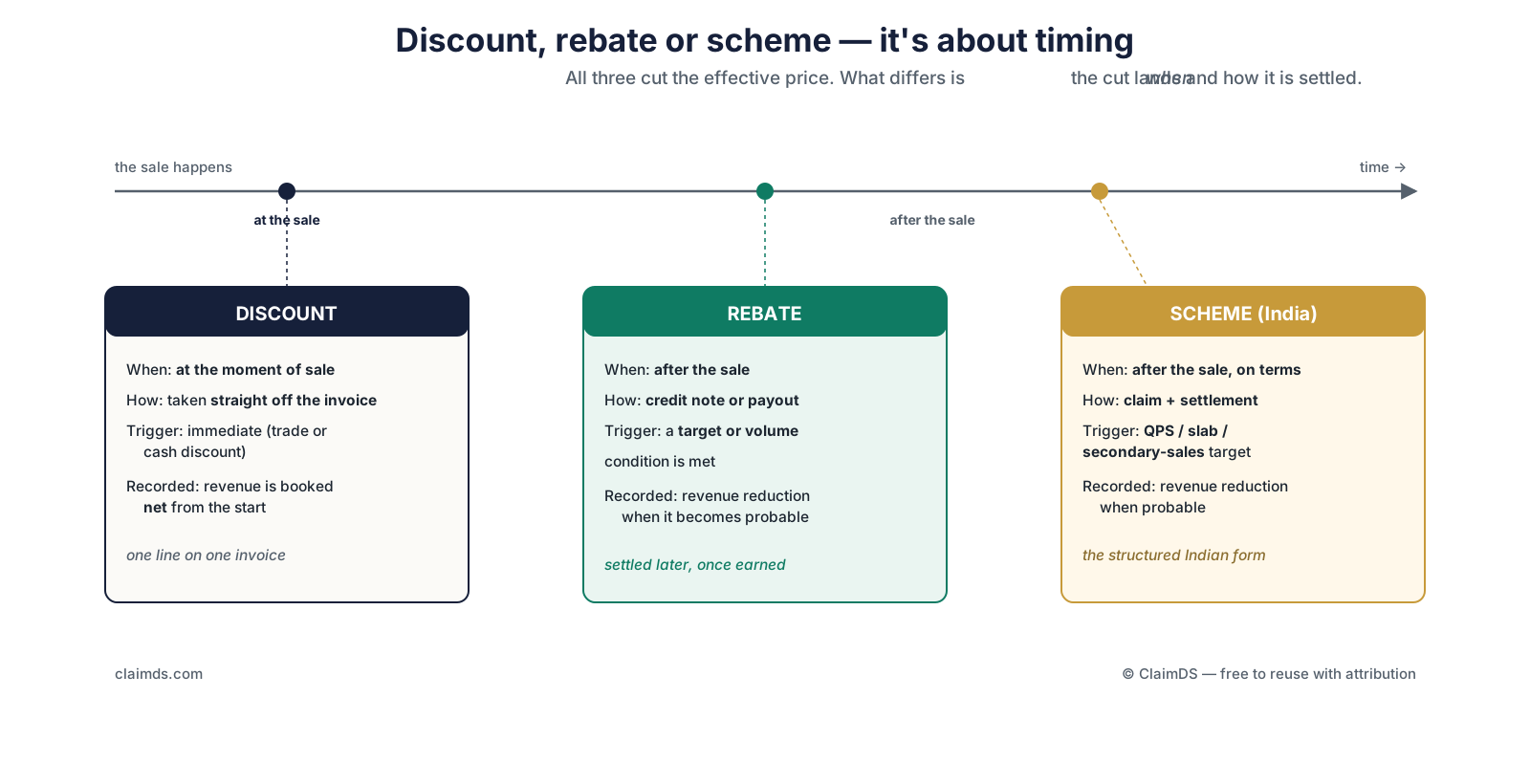
The two terms get used interchangeably, and they are not the same. Trade promotion management is the broader discipline of planning, running and settling all spend to the channel — schemes, allowances, displays and rebates. A trade rebate is one instrument within that spend, so rebate management is a part of trade promotion management, not a synonym for it. Many businesses run both in one system; the scope is what differs.
Why spreadsheets and generic ERPs fall short
Most teams manage trade promotions in Excel, propped up by an ERP. Both have a blind spot: they don't know your scheme terms.
- A spreadsheet doesn't know which slab applies to which period, keeps no reliable audit trail, and forces a manual tie-out of every claim line every cycle. The lines nobody had time to check are pure leakage — the same pattern we cover in why distributor rebate claims slip through the cracks.
- An ERP records the invoice and the payment, but it wasn't built to model a tiered secondary scheme or to reconcile a partner's claim file against it. You end up bolting spreadsheets onto the ERP anyway.
The result is the same everywhere: trade spend that's visible only after the quarter closes, and claims that take weeks to settle.
What to look for in trade promotion management software
If you're comparing options, here's a practical checklist. A TPM solution built for an Indian business should:
- Model schemes once — volume, stepped, tiered and special-pricing — and reuse the terms automatically, instead of re-keying them per claim. (The full menu of scheme structures the Indian channel actually runs is mapped in types of trade schemes in India.)
- Handle multi-tier (primary + secondary) schemes, because that's how the Indian channel actually works.
- Accrue automatically, so you always know your live trade-spend liability — tracked against the scheme budget, the discipline covered in how scheme budgets are allocated and utilized.
- Reconcile claims, not just store them — auto-match a partner's file and surface only the variances that need a decision.
- Build in Indian GST — generate Rule 53(1A) credit notes with GSTIN/HSN validation and ITC-reversal tracking. (More on this in GST credit notes for rebates.)
- Keep a tamper-evident audit trail and strict per-tenant data isolation.
- Suit the mid-market — fast to deploy and priced for ₹50 Cr–₹1,000 Cr+ businesses, not a year-long enterprise rollout.
Whether GST is even payable on a given discount depends on how the scheme is structured — our guide to GST on trade discounts and dealer incentives walks through the Section 15(3) rules.
A quick test for any vendor: ask them to show a partner's claim file going in and the variances coming out with the scheme math already applied. If they can only show you somewhere to store claims, keep looking.
How ClaimDS approaches trade promotion management
ClaimDS is built specifically for the Indian channel and for mid-market budgets and timelines. It runs the whole promotion-to-settlement loop:
- Schemes modelled once, with the right slab applied automatically for every claim and period.
- Accruals that stay current, so trade-spend liability is always visible — not reconstructed at quarter-end.
- Reconciliation, not storage — upload a partner's claim file and ClaimDS matches it against your agreements and transactions, surfacing only the variances. (For the deductions side, see our distributor claim settlement software buyer's guide.)
- GST designed in — settled promotions become compliant credit notes, with ITC reversal tracked on both sides.
- A trail that survives scrutiny, with per-tenant data isolation.
The outcome is the thing every finance team actually wants from trade promotion management: spend you can see in real time, distributor claims that close in days, and a number you can defend. What each promotion cost — projected before the period closes and measured after settlement — is covered in TPM software, liability forecasting and promotion ROI.
A related boundary question — whether this replaces the distributor management system you already run — is answered in how claims software works alongside a DMS.
What this does not do
Worth stating plainly, because trade promotion tools are often assumed to do more than they do. ClaimDS manages and settles trade promotions: it models the scheme, accrues the liability, reconciles claims against the agreement and produces the settlement. <!-- TODO: confirm capability wording with founder -->
It does not forecast promotion effectiveness, predict how much extra a promotion will sell, or optimise your promotional mix. Those depend on demand and consumption data that a settlement system does not hold, and they are a different category of product. What it will tell you is what a scheme calendar is going to cost at a given level of attainment, and what a promotion actually cost once the claims settled — which are arithmetic on data you already have.
Want to see it on your own kind of schemes? Book a demo below.
Related: trade spend management software takes the money view of the same activity — what has been committed, claimed, settled and accrued.
Frequently asked questions
What is trade promotion management software?
It is software that plans, tracks, settles and measures the discounts, schemes and incentives a company runs through its sales channel — so trade spend is controlled and every claim against it can be checked against the agreement that authorised it.
How is TPM software different from an ERP or CRM?
An ERP records the invoice and a CRM tracks the relationship, but neither knows your scheme terms or reconciles a partner's claim against them. TPM software is built specifically for the promotion-to-settlement loop — slabs, accruals, claims and credit notes.
Does trade promotion management software predict promotion effectiveness?
No. It manages and settles promotions — modelling the scheme, accruing the liability, reconciling claims against the agreement and producing the credit note. Predicting how much extra a promotion will sell is demand modelling, which needs market and consumption data a settlement system does not hold. That is a different category of product.
What is the difference between trade promotion management and trade spend management?
Trade promotion management is the process of designing and running promotions — the schemes, the claims and the settlement. Trade spend management is the money view of the same activity: what has been committed to the channel, what has been claimed against it, what has settled and what remains accrued. The same data, read for different questions.
Does trade promotion management software handle GST on trade promotions?
Software built for India should. Most channel settlements run through a credit note, so the system needs to produce a compliant one and track the input-tax-credit consequences, and to support the choice between a tax credit note and a financial or commercial one, since the two affect both parties' returns differently. The detailed treatment is covered in our GST credit-note guides.
Is GST payable on trade promotion discounts?
It depends on how the discount is structured. Discounts that meet the Section 15(3) conditions — agreed before supply and linked to specific invoices — can reduce taxable value via a tax credit note; discounts that don't meet them take the commercial credit-note route instead. Our guide on GST for trade discounts walks through the decision.
How should distributor claims under trade promotions be verified?
Test three things before settlement. Eligibility: was the partner enrolled, and do claimed sales fall within the scheme window, territory and SKU list? Arithmetic: does the claim match the entitlement computed from billing or DMS data at the correct slab? Evidence: do invoices, photographs and secondary-sales reports substantiate it, and was it claimed before? Automate the three-way match and retain the records.
What is the difference between a TPM system and a distributor management system (DMS)?
A DMS runs the front of the channel — partner ordering, field-force activity and secondary-sales capture. A trade promotion management system manages and settles the promotions that run across that channel: the scheme terms, the accrual, the claim reconciliation and the credit note. They answer different questions and are commonly run alongside each other rather than instead.
See ClaimDS on your own claims data
A 30-minute walkthrough tailored to how your channel actually settles claims.
Related posts
How to Model What a Trade Scheme Will Cost Before You Launch It
Before a scheme goes live, know its best, likely and worst-case cost. How to model scheme liability against budget, with worked examples in ₹.

Trade Spend Management Software for Indian Brands and Distributors
See what your channel spend actually costs — schemes committed, claims settled, deductions taken and accruals trued up, with GST-compliant settlement.
Trade Spend vs Advertising: Where Your Promotion Money Actually Goes
Trade spend and advertising (A&P) are two different budgets that behave differently. What separates them, why finance teams confuse them, and how each is tracked.