
Trade Spend vs Advertising: Where Your Promotion Money Actually Goes
Trade spend and advertising (A&P) are two different budgets that behave differently. What separates them, why finance teams confuse them, and how each is tracked.
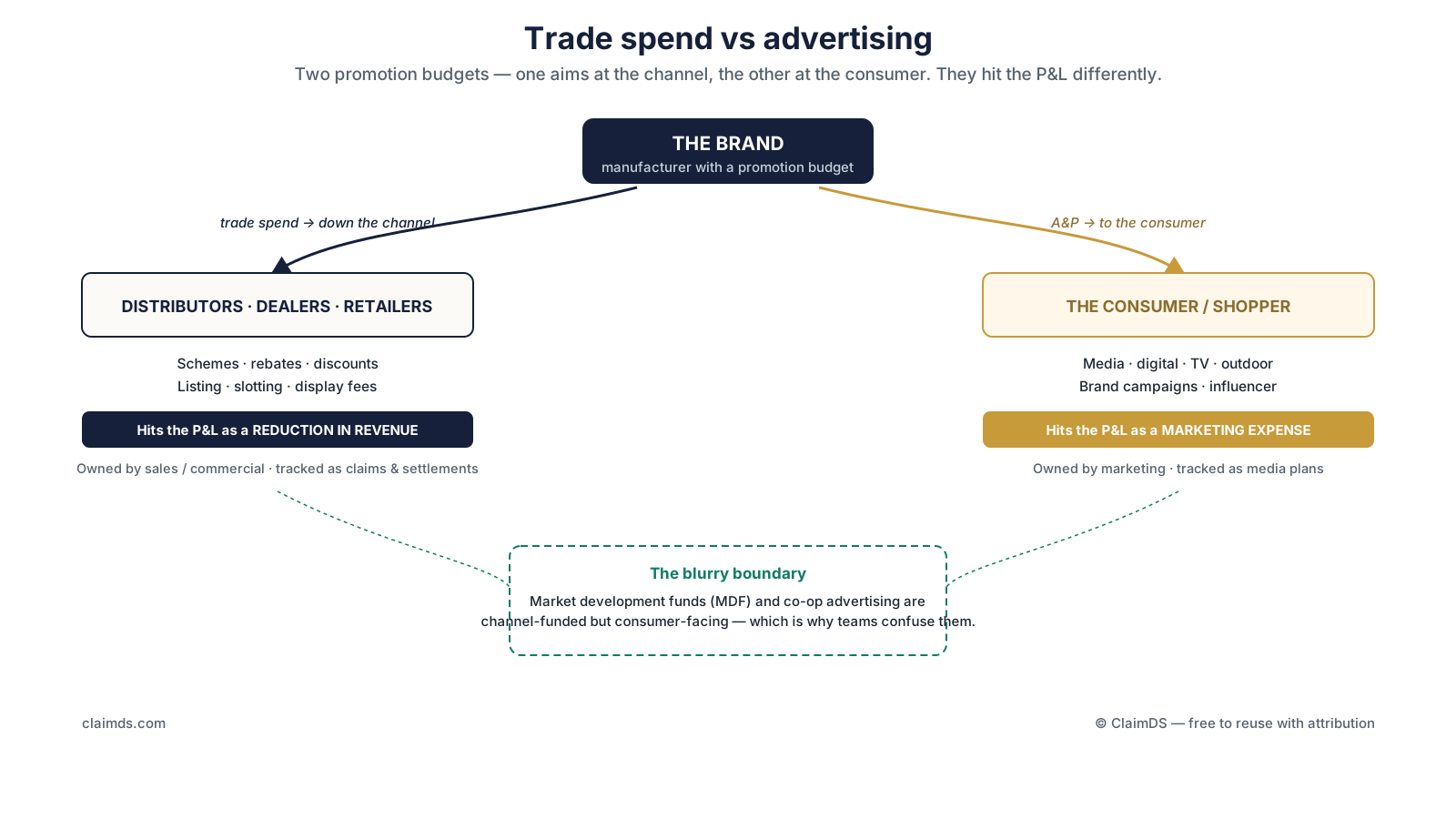
The short answer: trade spend and advertising are two different promotion budgets. Trade spend is money a brand pays its channel — distributors, dealers, retailers — to move product: schemes, rebates, discounts, listing fees. Advertising, or A&P, is money spent reaching the consumer — media, digital, brand campaigns. Trade spend reduces revenue; advertising is a marketing expense. They are accounted for differently.
The two get lumped together because both are "promotion" and both are large. But they aim at different people, sit in different places on the P&L, and are owned by different teams — and treating them as one number is how a brand loses sight of its second-biggest cost.
Trade spend vs advertising at a glance
| Trade spend | Advertising (A&P) | |
|---|---|---|
| Who it targets | The channel (distributors, dealers, retailers) | The consumer / shopper |
| Examples | Schemes, rebates, discounts, listing & slotting, display fees | Media, digital, TV, outdoor, brand campaigns |
| Where it hits the P&L | Usually a reduction in revenue | A marketing expense |
| Who owns it | Sales / commercial | Marketing |
| How it's tracked | Claims & settlements | Media plans |
What is trade spend?
Trade spend is the money a brand invests down its distribution channel to sell product — everything paid to distributors, dealers and retailers to stock, push and promote what the brand makes. It splits into a few broad categories: volume and slab schemes and rebates tied to how much a partner buys or sells; on-invoice and off-invoice discounts; secondary-sales schemes that reward what the channel sells on rather than just what it buys in; and the listing, slotting and display fees paid to retailers for shelf space and visibility.
For most consumer brands, trade spend is one of the largest lines in the business — frequently the biggest after the cost of goods. Yet it is also one of the hardest to see clearly, because it is spread across hundreds of schemes and thousands of claims, settled after the fact. The mechanics of these programmes sit in the CPG trade-promotion guide, and the channel-funded-but-consumer-facing slice — market development funds and co-op claims — is a category of its own.
What is advertising and promotion (A&P)?
Advertising and promotion (A&P) is the money a brand spends to reach and move the end consumer. It covers paid media — television, print, outdoor — plus digital and social, brand campaigns, and consumer promotions aimed at the shopper. Where trade spend works through the channel, A&P jumps over it to talk to the person who ultimately buys.
A&P is treated as a marketing expense and is owned by the marketing team, planned through media plans and campaign budgets. It is a genuine cost of building demand — money spent, not a price given away. That is the cleanest way to hold the line between the two: A&P is a cost of reaching the consumer; trade spend is a price reduction given to the channel.
Why the two get confused
Three things blur the line. First, both are "promotion" budgets — the word covers everything from a TV campaign to a dealer scheme, so they get spoken about together. Second, both are large — in a consumer business they can be the two biggest discretionary lines, so finance and leadership naturally compare them side by side. Third, and most importantly, some spend genuinely sits on the boundary.
Co-op advertising and market development funds (MDF) are the classic boundary cases: the brand funds them and they flow through the channel — which looks like trade spend — but the money buys consumer-facing advertising, which looks like A&P. A dealer running a local newspaper ad with brand co-funding is spending channel money on consumer reach. That dual nature is real, and pretending it belongs cleanly in one bucket is how the numbers drift. The honest answer is that MDF and co-op deserve their own tracking, which is why MDF and co-op claims are handled as a distinct category rather than folded into either budget. The broader distinction between channel-facing and consumer-facing promotion is drawn in consumer promotions vs trade promotions.
Why the accounting treatment differs
The reason the distinction matters beyond tidiness is that the two budgets hit the P&L in different places. Trade spend is, broadly, a reduction in revenue — it is a reduction in the price the brand realises as product moves down the channel, so it nets against the top line rather than sitting as a cost below it. Advertising is an operating expense — a cost incurred to build demand, recorded like other marketing costs.
Getting this right is what makes net revenue meaningful: book trade spend as an expense and you overstate both your revenue and your cost base; book it against revenue and the top line reflects what the business actually earned. The precise treatment depends on the spend type and your accounting framework, and the mechanics of recording a channel price reduction are set out in the rebate-accounting article once it is published. The broader gross-to-net story — how list price erodes to net through exactly these deductions — is in where revenue leaks out of a rebate program.
<!-- TODO: link the rebate-accounting (GAAP/Ind AS) article (rebates-indian-gaap-accounting) once it is out of draft. -->Why trade spend is harder to control
If A&P and trade spend hit the P&L differently, they also differ in how easily you can govern them. A media plan is a handful of large, planned, up-front commitments. Trade spend is the opposite: it is fragmented across hundreds of schemes and thousands of claims, settled after the fact, and — in most mid-market businesses — reconciled in spreadsheets. Each claim is validated and paid on its own, so the true, total cost is scattered across periods and partners and never sits in one view.
That fragmentation is exactly where trade spend leaks: overclaims that aren't caught, schemes that pay on the wrong base, claims settled without the evidence to survive an audit, and accruals that drift from what is actually owed. ClaimDS brings your channel schemes, claims and settlements into one auditable record, so the money paid down the channel is measured, validated and reconciled in one place rather than reconstructed at year-end.
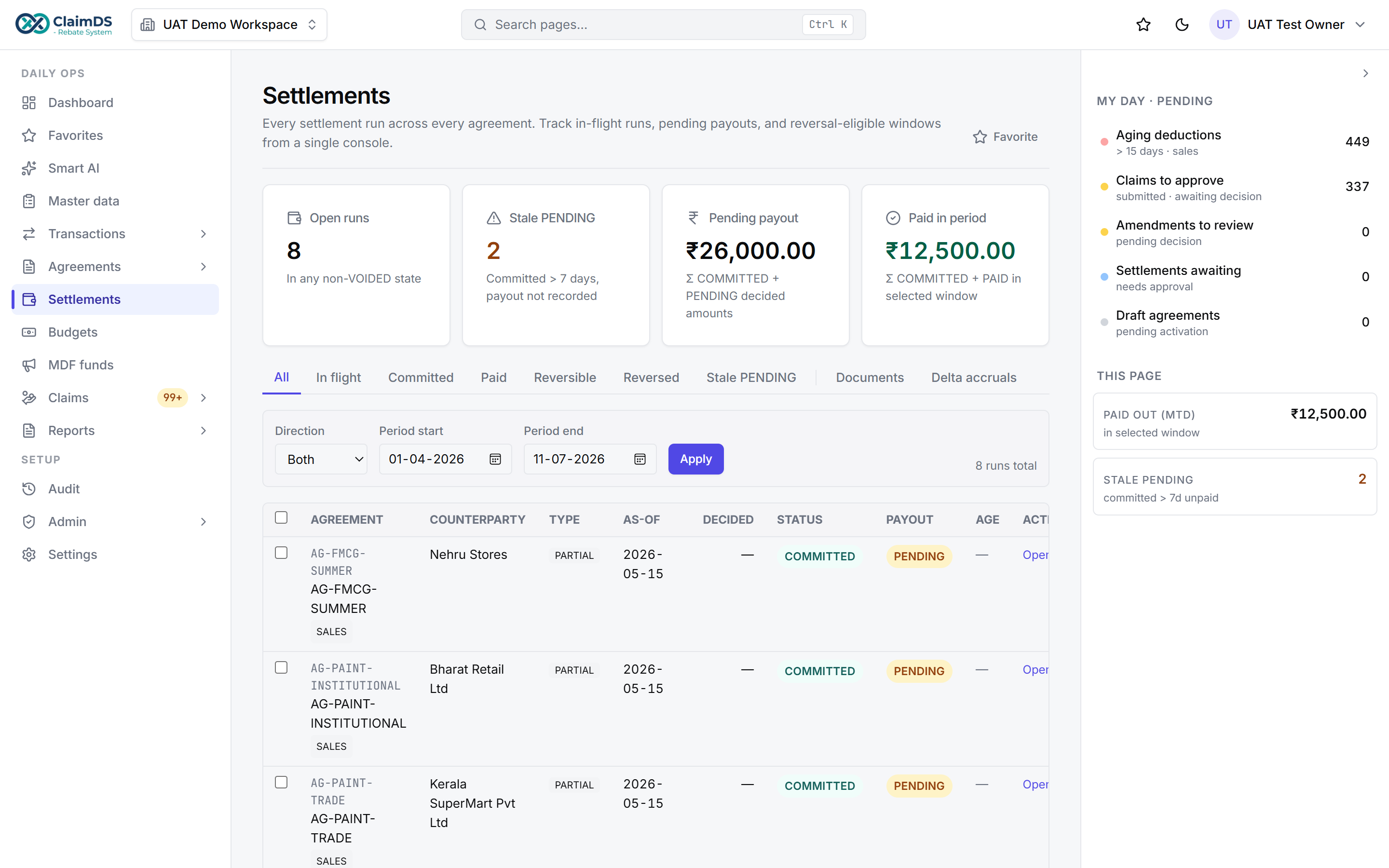
The ClaimDS settlement view — schemes, claims and payouts measured, approved and settled in one place.
General information, not advice. This article explains budgeting and accounting concepts in general terms and is not accounting, tax or legal advice. The treatment of any specific spend depends on your facts and accounting framework. Confirm the treatment of a specific trade-spend or advertising item with your accountant before relying on it.
Read next
- CPG trade-promotion guide — the full trade-spend toolkit and how each mechanic works.
- Consumer promotions vs trade promotions — the channel-facing vs consumer-facing split.
- MDF and co-op claims in India — the boundary category, funded by the brand but consumer-facing.
- Where revenue leaks out of a rebate program — the gross-to-net view of channel deductions.
- Rebate management software — the engine that tracks trade spend as claims and settlements.
Every rupee of trade spend starts as a claim you have to measure. ClaimDS tracks your channel schemes, claims and settlements in one auditable record — so the second-biggest line in your business is one you can actually see.
Book a demo to see how ClaimDS turns scattered trade-spend claims into one auditable settlement record.
Frequently asked questions
What is the difference between trade spend and advertising?
Trade spend is money a brand pays its channel — distributors, dealers and retailers — to move product, through schemes, rebates, discounts and listing or display fees. Advertising, or A&P, is money spent reaching the consumer through media, digital and brand campaigns. Trade spend typically reduces revenue; advertising is a marketing expense. Different owners, different budgets, different accounting.
What is included in trade spend?
Trade spend covers the money paid down the distribution channel to sell product: volume and slab schemes, rebates, on-invoice and off-invoice discounts, secondary-sales schemes, and the listing, slotting and display or visibility fees paid to retailers. It does not include consumer-facing media or brand advertising, which is a separate marketing budget owned by a different team.
Is trade spend an expense or a reduction in revenue?
Most trade spend is treated as a reduction in revenue rather than a marketing expense, because it is a reduction in the price realised down the channel rather than a cost of reaching the consumer. The exact treatment depends on the spend type and your accounting framework, so confirm any specific case with your accountant before relying on it.
What does A&P mean?
A&P stands for advertising and promotion — the budget a brand spends to reach and influence the end consumer. It covers media, digital, television, outdoor, brand campaigns and consumer promotions. A&P is a consumer-facing marketing expense, owned by the marketing team, and is distinct from trade spend, which is paid to the channel to move product.
Is co-op advertising trade spend or advertising?
Co-op advertising sits on the boundary. It is funded by the brand and paid through the channel — like trade spend — but the money buys consumer-facing advertising, like A&P. Market development funds (MDF) work the same way. This dual nature is exactly why the two budgets get confused, and why co-op and MDF need their own tracking rather than being lumped into either bucket.
Why is trade spend hard to track?
Trade spend is fragmented across many schemes, dealers and periods, and it is usually settled after the fact through claims and credit notes rather than up front. Because each claim is validated and reconciled separately — often in spreadsheets — the true cost is scattered and hard to see in one place, which is how trade spend quietly leaks and overspends go unnoticed.
See ClaimDS on your own claims data
A 30-minute walkthrough tailored to how your channel actually settles claims.
Related posts

Consumer Promotions vs Trade Promotions
Consumer promotions vs trade promotions — who each targets, who funds them, how they are measured, and why trade promotions create claims.
Painter and Contractor Loyalty Programs in India
How painter and contractor loyalty programs work in India — points, rewards and redemption, why brands run them, and the Section 194R tax pointer.
MDF and Co-op Claims in India: A Practical Guide
How the MDF claim process works in India — allocation, pre-approval, proof of performance, utilization, and how co-op funds settle by credit note.