Consumer Promotions vs Trade Promotions
Consumer promotions vs trade promotions — who each targets, who funds them, how they are measured, and why trade promotions create claims.
Consumer promotions and trade promotions are the two halves of trade spend, and they behave differently. A consumer promotion pulls the shopper at the shelf — a coupon, cashback, buy-one-get-one or contest — and is funded by the brand at the point of sale. A trade promotion pushes stock through the channel — distributor and dealer schemes, volume slabs, display support — and is earned by the partner, then claimed back. The sharpest practical difference: a trade promotion creates a claim the channel recovers from the brand, usually by credit note, while a consumer promotion mostly creates no channel claim at all.
That last point is where the two diverge for finance, and it is the work ClaimDS exists to handle.
What is a consumer promotion?
A consumer promotion is an offer aimed directly at the end shopper to trigger a purchase at the moment of decision. The brand funds it, but the benefit reaches the buyer at retail rather than travelling back up the channel as a claim.
The common Indian FMCG forms are familiar from any grocery aisle:
- Coupons — a discount redeemed at checkout, on-pack or digital.
- Price-off packs — a lower printed price, so the shopper simply pays less.
- Buy-one-get-one (BOGO) — extra units bundled free with a purchase.
- Cashback — a portion returned to the shopper after buying, often via an app or UPI.
- Scratch cards and contests — a chance-based reward that adds excitement to the pack.
Who it targets: the shopper. The whole point is to move the person standing at the shelf, whether by lowering the price, adding value, or creating a moment of delight. Who funds it: the brand, and the funding is usually absorbed at the point of sale — baked into the pack price, the redemption, or the promotional SKU — so it rarely becomes a separate downstream bill.
Because the benefit is delivered and consumed at retail, a consumer promotion typically leaves no channel claim behind. It is measured in shopper-facing terms: redemption rate, uplift in units sold, trial among new buyers, and share gain during the offer window. This is the marketing half of trade spend, and in wider industry vocabulary it sits under CPG consumer marketing — but for the finance team, it is the quieter half precisely because it does not generate claims to reconcile.
What is a trade promotion?
A trade promotion is an incentive aimed at the channel — distributors, dealers, super stockists and retailers — to push stock, hit volume targets, or execute visibility in the market. The partner earns it by performing, then recovers the value from the brand.
The recurring Indian forms include:
- Quantity purchase schemes (QPS) and volume slabs — a payout that unlocks once purchases cross a milestone. The full family is mapped in types of trade schemes in India, and how they behave in fast-moving goods in FMCG trade schemes explained.
- Secondary schemes — settled on the distributor's sales to retailers rather than purchases from the brand; see secondary scheme settlement and the primary, secondary and tertiary sales distinction.
- Display, branding and dealer-board support — a fixed amount per outlet for agreed in-store execution, verified by evidence.
- Market development and co-op funds — shared spend on channel-led activity, covered in MDF and co-op claims in India.
Who it targets: the channel partner. Who funds it: the brand — but the mechanics are the reverse of a consumer promotion. The partner buys, sells or executes first, then raises a claim for what the scheme owes. That claim is validated against purchase or secondary-sales data and settled, almost always through a credit note. Every trade promotion is, in effect, a promise that becomes an accrual, then a claim, then a settlement — the sequence that defines channel finance in India, described end to end in channel rebates in India.
Consumer vs trade promotions: a side-by-side
The two look similar on a marketing plan but diverge sharply the moment finance has to account for them.
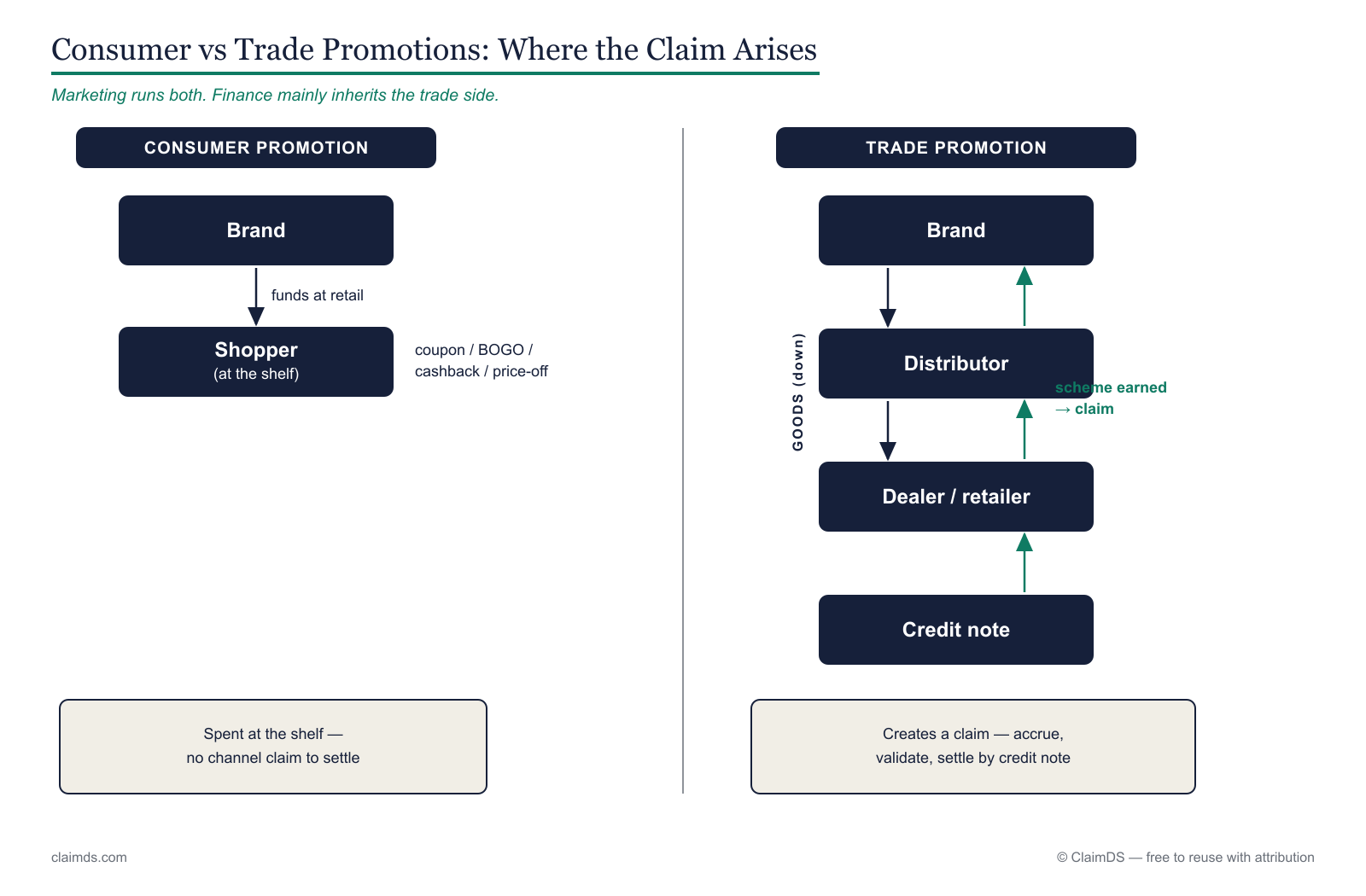 Where the claim arises: a consumer promotion is spent at the shelf, while a trade promotion comes back up the channel as a claim to accrue, validate and settle by credit note.
| Dimension | Consumer promotion | Trade promotion |
|---|---|---|
| Who it targets | The end shopper at the shelf | The channel — distributor, dealer, retailer |
| Who funds it | The brand, absorbed at point of sale | The brand, recovered by the channel |
| Where it is delivered | At retail, to the buyer | Through the route to market, to the partner |
| How it is measured | Redemption, uplift, trial, share gain | Volume achieved, slab crossed, secondary offtake, outlets executed |
| How it settles | At the point of sale — no channel claim | As a claim, settled by credit note |
| Finance / claims impact | Low — little to reconcile downstream | High — accruals, claims, deductions to track and settle |
The single row that matters most is how it settles. A consumer promotion is spent and gone at the shelf. A trade promotion is a live receivable in the channel's books and a liability the brand must accrue for and eventually clear. That difference is not cosmetic — it decides whether a promotion needs a settlement system at all.
Why the difference matters for finance
For a marketing team, both promotions are line items in a trade-spend plan. For a finance team, only one of them generates work after the campaign ends — and it generates a lot of it.
A trade promotion creates a chain of obligations. When the scheme is announced, finance should accrue the expected liability. When partners perform, they raise claims. Those claims arrive as deductions off payments or as fresh credit-note requests, each needing validation against agreed terms and actual sales. Get any link wrong and money leaks — unclaimed accruals overstate profit, over-claimed schemes drain margin, and unmatched credit notes break the GST trail. This is the exact territory of revenue leakage in rebate programs and the reason a defined claim and rebate approval workflow matters.
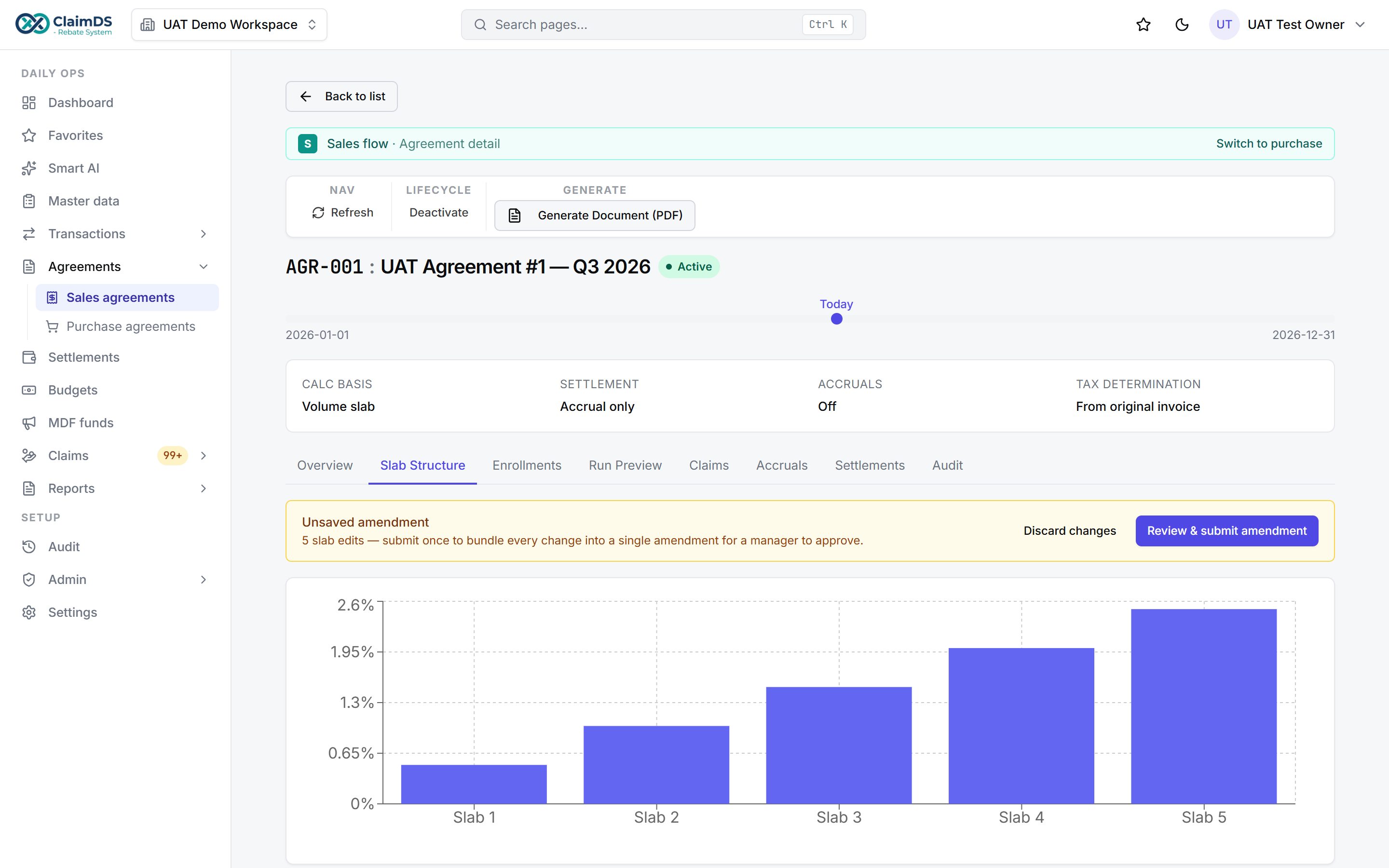 A trade promotion inside ClaimDS: a slab scheme whose tiers become accruals, claims and credit-note settlements — the downstream work a consumer promotion never creates.
Consumer promotions, by contrast, rarely reach the finance team as claims. They are costed up front and settled at retail, so there is no channel-side accrual to unwind and no credit note to reconcile.
This is why ClaimDS focuses on the trade side. Managing that lane well means running the full loop — planning and accruing spend, as in the trade promotion management step-by-step guide and trade promotion scheme budgeting; validating and settling what the channel earns, as in channel claims and rebates in Indian FMCG; and keeping the whole thing on rails with purpose-built rebate management software. If the terms rebate, accrual and credit note are unfamiliar, what is a rebate and the glossary define them, and the claim approval workflow shows how a claim moves from raised to settled.
Bringing it together
Consumer promotions and trade promotions share a budget line but live in different worlds. One targets the shopper and is spent at the shelf; the other targets the channel and comes back as a claim to be validated, matched and settled by credit note. Marketing runs both. Finance mainly inherits the second — the accruals, deductions and settlements that trade promotions leave behind.
That inheritance is the problem ClaimDS is built for: turning a portfolio of channel schemes into tracked accruals, validated claims and clean, GST-ready settlements — so the trade half of your promotion spend actually reconciles.
<!-- TODO: confirm capability wording with founder -->Want to see how trade-promotion claims get settled without the spreadsheet chaos? Book a demo.
Frequently asked questions
What is the difference between a consumer promotion and a trade promotion?
A consumer promotion targets the end shopper — coupons, cashback, price-off packs, BOGO, contests — and is funded at the point of sale. A trade promotion targets the channel — distributor, dealer and retailer schemes, volume slabs, display support. The sharpest practical difference: a trade promotion creates a claim the channel recovers from the brand, usually by credit note, while a consumer promotion mostly does not.
What is a consumer promotion?
A consumer promotion is an offer aimed directly at the shopper to pull a purchase at the shelf. Common Indian FMCG forms are coupons, price-off packs, buy-one-get-one, cashback, scratch cards and contests. It is funded by the brand but delivered at retail, so the benefit reaches the shopper at the point of sale rather than becoming a downstream claim the channel bills back.
What is a trade promotion?
A trade promotion is an incentive aimed at the channel — distributors, dealers, stockists and retailers — to push stock, hit volume targets or execute in-store visibility. Indian examples include quantity purchase schemes, volume slabs, secondary schemes, display and branding support, and dealer boards. The channel earns the benefit by performing, then claims it back from the brand, typically settled by a credit note.
Which one creates claims to settle?
Trade promotions create claims. Because the channel earns the benefit first and recovers it from the brand afterwards, each scheme generates an accrual, a claim and a settlement — usually a credit note — that finance must track, validate and reconcile. Consumer promotions are mostly funded at the point of sale and create no channel claim, which is exactly why the two need different systems.
Is a discount a consumer or trade promotion?
It depends on who receives it. A price-off pack or coupon that lowers what the shopper pays is a consumer promotion. A trade discount, volume slab or off-invoice scheme that lowers what the distributor or dealer pays is a trade promotion. The test is who the benefit is aimed at — the shopper at the shelf, or the channel partner in the route to market.
Do consumer promotions ever create channel claims?
Sometimes. When a consumer offer is executed and funded through the channel — a retailer coupon reimbursed later, or a scratch-card payout the distributor advances — it takes on the mechanics of a trade promotion and produces a claim to settle. The rule: if the channel lays out money first and recovers it from the brand afterwards, it behaves like a trade promotion regardless of who the offer targets.
See ClaimDS on your own claims data
A 30-minute walkthrough tailored to how your channel actually settles claims.
Related posts

Painter and Contractor Loyalty Programs in India
How painter and contractor loyalty programs work in India — points, rewards and redemption, why brands run them, and the Section 194R tax pointer.
MDF and Co-op Claims in India: A Practical Guide
How the MDF claim process works in India — allocation, pre-approval, proof of performance, utilization, and how co-op funds settle by credit note.
Trade Promotion Budget: Allocation and Budget vs Actual
How to allocate a trade promotion budget, track scheme-budget utilization, and run budget vs actual for Indian channel and FMCG trade schemes.