Painter and Contractor Loyalty Programs in India
How painter and contractor loyalty programs work in India — points, rewards and redemption, why brands run them, and the Section 194R tax pointer.

A painter loyalty program rewards the painters and contractors who recommend and apply a brand — they earn points on verified purchases or completed jobs, redeemable for gifts, gold, cash-equivalents or tours. Because the painter, not the homeowner, usually drives brand choice at the site, this influencer channel is where paint and building-material brands compete hardest. The mechanics look simple; the accrual, verification and tax questions underneath are where programs are actually won or lost. This article sits under the paints channel claims and rebates pillar.
What is a painter loyalty program?
A painter loyalty program is the paints industry's version of a channel loyalty program — but pointed at an influencer who never appears on the brand's invoice. The homeowner pays the bill; the painter decides the brand. So instead of rewarding the buyer, the brand rewards the person who sways the buyer.
The structure is consistent across the market:
- Enrolment. A painter registers once — phone number, KYC, sometimes a bank or UPI handle for cash-equivalent payouts. That registration turns an anonymous tradesperson into a trackable member with a points balance.
- Coded packs and QR codes. Buckets and packs carry a unique QR code or a coupon code printed inside the lid. The code is the proof-of-genuineness that ties a specific tin of paint to a specific painter.
- Points on verified purchase or application. When the painter scans the code or logs a completed job, points land in their balance. Earn rules vary — points per litre, per pack, per rupee of verified purchase, or a bonus for a full-site application.
- A redemption catalogue. Accumulated points convert into rewards: household goods, gold coins, mobile recharges, tool kits, cash-equivalents, or an annual foreign tour for top earners.
Unlike a dealer scheme — which opens and closes with a scheme period, as catalogued in types of trade schemes in India — a loyalty program runs continuously. Points earned this monsoon may be redeemed next Diwali, so the brand carries a standing points liability, not a period-bound one. The slab-and-target engine that powers period schemes lives in incentive management software; loyalty layers on top of it.
How points are earned and redeemed
Earning always hinges on one thing: verification. A point that cannot be traced back to a genuine purchase or a genuine job is a leak waiting to happen. Brands use three main verification routes, and most run all three at once.
| Earn / verify method | How it works | The verification challenge |
|---|---|---|
| QR scan on pack | Painter scans a unique code on the tin | Duplicate scans, codes shared across painters |
| Coupon code inside lid | Painter enters a code printed under the lid | Codes leaked before sale, bulk-entered by one member |
| App-logged job | Painter uploads site photos / job details | Ghost jobs, recycled photos, staged sites |
| Dealer-attested purchase | Counter records which painter bought | Collusion between dealer and painter |
| Application / litre bonus | Extra points for completing a full site | Overstated coverage, jobs that never happened |
Once points accrue, redemption runs off the member's balance. The painter picks from a catalogue and the brand fulfils in one of a few forms: merchandise and appliances, gold coins, experiential rewards like tours, or cash-equivalents (bank transfer, UPI, prepaid card). Influencer trades lean heavily toward gold and cash-equivalents; the reward is a real economic benefit, not a discount on their own bill.
The hard part is not the catalogue — it is trusting the earn data behind every redemption. Duplicate scans, leaked coupon codes, and ghost jobs are the classic fraud vectors, and they are exactly the kind of quiet outflow covered in revenue leakage in rebate programs. Every redemption is really a claim: someone must confirm the points were genuinely earned before value leaves the business, the same discipline any rebate management flow applies. Get verification wrong and the program funds fraud; get it right and the points ledger becomes a trustworthy liability. A glossary of the underlying terms sits in the help-centre glossary.
Why brands run them, and how they connect to claims
Paint brands run these programs because the influence economics are lopsided. A homeowner repaints once in several years and knows little about brands; the painter works daily and is trusted to "just pick a good one." Win the painter and you win a stream of purchases you never have to sell directly — which is why the influencer channel attracts more trade spend than almost any consumer promotion. The same logic runs through the invoiced chain too, from distributor rebate software to dealer rebate software.
But influence spend is still spend, and it has to reconcile like any other. A loyalty program connects to the claims and scheme system at three points:
- Budget. The points program draws from the same trade-spend pool as dealer schemes and MDF and co-op claims. It has to be planned and capped like any other line — the discipline in trade-promotion scheme budgeting.
- Accrual. Every unredeemed point is money owed. Finance needs a live view of the points liability — by member, net of expected breakage — the same way it books rebate accruals on any scheme. A points ledger nobody reconciles is an unbooked liability.
- Settlement. When a painter redeems, the payout has to be validated against earn evidence and recorded with an audit trail that survives years, because points earned in one financial year get redeemed in another. Cash-equivalent payouts especially need the same paperwork rigour as a secondary scheme settlement or a paints dealer claim settlement.
This is where a loyalty app alone falls short. The gamified front end drives engagement; the accrual, validation and settlement layer underneath is what keeps the program honest and auditable.
The tax pointer: Section 194R on rewards in kind
Here is the part most loyalty decks skip. When a brand hands a painter or contractor a reward in kind — a gold coin, an appliance, a foreign tour — and that painter or contractor is carrying on a business or profession, Section 194R can come into play. 194R is the TDS provision on benefits or perquisites arising from business or profession, and a loyalty reward to a trade professional can look exactly like such a benefit once the annual threshold is crossed.
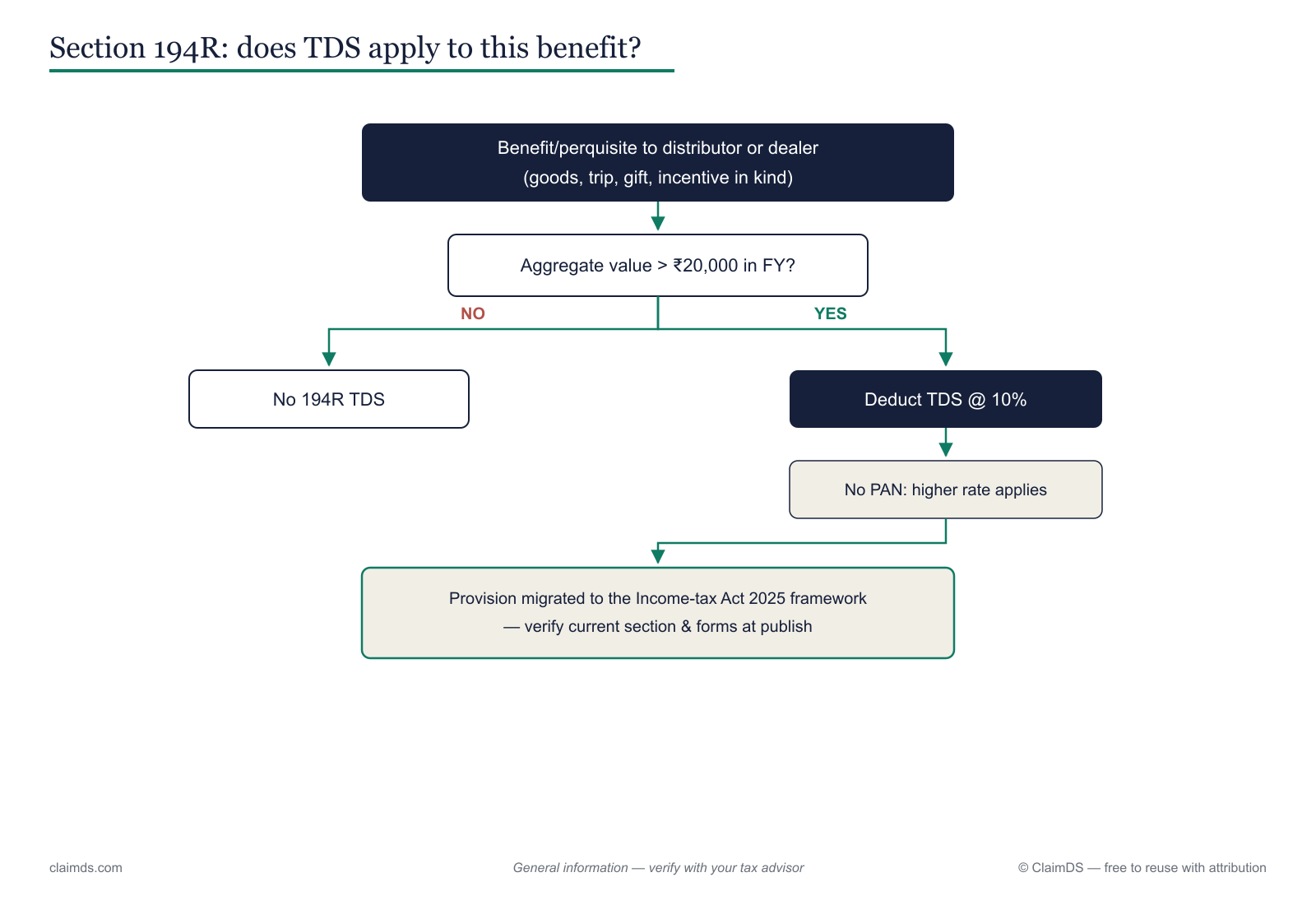
A reward in kind to a painter or contractor above the annual threshold can bring Section 194R into play — confirm the position with your advisor.
This is a pointer, not a determination. Whether and how 194R applies to a specific loyalty reward depends on the facts and the recipient — take it to your tax advisor.
<!-- TODO CA REVIEW: 194R on painter/contractor loyalty rewards — reviewer to confirm; do not assert -->The practical takeaway is that rewards in kind are not tax-free just because no cash changed hands — the in-kind nature is precisely what 194R was written for. For the deeper position specific to paints — how GST and TDS interact on dealer and painter incentives — route to GST and TDS on paints dealer and painter incentives. For the general mechanics of the provision, see Section 194R TDS on dealer and distributor incentives and the wider tax on rebates, chargebacks, billbacks and buybacks. Whether a payout is a discount or a benefit also shapes the credit-note question in financial vs. tax credit notes. None of this is tax advice.
Building materials too
The painter is the paints archetype, but the model is industry-wide. The same influencer-loyalty structure runs across building materials, aimed at the trades who decide the brand at the site:
- Cement and concrete — masons and contractors, rewarded on bags used or sites completed.
- Tiles, sanitaryware and adhesives — masons and tilers, earning on verified installations.
- Pipes and fittings — plumbers, logging jobs through a brand app.
- Wiring, switches and electricals — electricians, on verified purchases or installations.
- Boards, laminates and hardware — carpenters and interior contractors.
In each case the enrol-scan-earn-redeem loop is identical to paints, and so are the accrual and tax questions — the festival-heavy earn peaks are worth planning around using the festival index. Scheme design for these trades borrows straight from FMCG practice, catalogued in FMCG trade schemes explained and the purchase-incentive playbook, with the same GST treatment questions raised in GST treatment of claims and schemes.
Painter and contractor loyalty is the channel that quietly decides the Indian paints and building-materials market — but it only pays off when the points liability, redemption claims and tax pointers are tracked as rigorously as any dealer scheme. That tracking-and-settlement layer is exactly what ClaimDS provides. Book a demo to see how the accrual and claims engine underneath your loyalty program can settle rewards cleanly, with a full audit trail.
Frequently asked questions
What is a painter loyalty program?
A painter loyalty program is a long-running scheme where a paint brand rewards the painters and contractors who recommend and apply its products. Painters enrol, earn points on verified purchases or completed jobs, and redeem those points for gifts, gold, cash-equivalents or tours. Because painters shape which brand a homeowner buys, this influencer channel is where paint brands compete hardest.
How do painter loyalty points work?
Points accrue when a painter's activity is verified — usually by scanning a QR code on the pack, entering a coupon code from inside the lid, or logging a job in the brand's app. Each verified purchase or application adds points to the member's balance, which can later be redeemed from a reward catalogue. Verification is what separates genuine points from fraud.
Why do paint companies run painter loyalty programs?
Because the painter, not the homeowner, usually decides which brand goes on the wall. A painter trusted by a family can steer the purchase, so brands invest in standing relationships with painters and contractors rather than one-off consumer offers. Loyalty points reward that advocacy continuously, keeping the brand top-of-mind on the next job.
Are painter loyalty rewards taxable?
Possibly. A reward in kind — gifts, gold, tours — given to a painter or contractor who carries on a business can attract Section 194R TDS once the annual threshold is crossed. Whether and how 194R applies depends on the facts and the recipient, so treat this as a pointer only and confirm the position with your tax advisor.
What is a contractor incentive program?
A contractor incentive program is the same influencer-loyalty model aimed at contractors and site supervisors who buy or specify materials in bulk. They earn points or slabs on verified volumes and redeem for rewards, tools or cash-equivalents. In building materials, the contractor often outranks the painter as the person who decides the brand.
Do other building-material brands run loyalty programs?
Yes. The same model runs across cement, tiles, pipes, sanitaryware and electricals, aimed at masons, plumbers, electricians and carpenters. Each of these trades influences the brand chosen at the site, so manufacturers enrol them, award points on verified purchases or installations, and settle rewards through the same accrual and claims discipline paint brands use.
See ClaimDS on your own claims data
A 30-minute walkthrough tailored to how your channel actually settles claims.
Related posts

MDF and Co-op Claims in India: A Practical Guide
How the MDF claim process works in India — allocation, pre-approval, proof of performance, utilization, and how co-op funds settle by credit note.
Trade Promotion Budget: Allocation and Budget vs Actual
How to allocate a trade promotion budget, track scheme-budget utilization, and run budget vs actual for Indian channel and FMCG trade schemes.
How TPM Software Improves Sales Forecasting Accuracy & Promotion ROI
How trade promotion management software improves forecasting accuracy and promotion ROI — baseline vs incremental lift and true promotion return.