FMCG Trade Schemes Explained: QPS, Slab and Secondary
The trade schemes Indian FMCG companies actually run — QPS, slab, secondary, display and festive schemes — what each is calculated on and how it settles.
Indian FMCG companies do not run one trade scheme — they run a portfolio, refreshed every month and every festive window. The recurring types are the QPS (a per-case quantity purchase scheme), the slab scheme on monthly purchase value, the secondary scheme settled on distributor-to-retailer offtake, display and visibility schemes for in-store execution, festive/seasonal top-ups, combo/bundle offers, and retailer coupon/scratch-card schemes. Each is calculated on a different base — cases, purchase value, secondary offtake, outlets, or redemptions — and each settles differently. For the cross-industry view of scheme structures, see types of trade schemes in India; this article covers how these types actually behave in an FMCG channel. It sits under the FMCG pillar, channel claims and rebates in Indian FMCG.
All numbers below are illustrative, not benchmarks. Your scheme circular always governs.
What are the FMCG scheme types and what is each calculated on?
An FMCG company typically runs seven scheme types at once. The QPS pays per case above a quantity milestone. The slab scheme pays a percentage of monthly net purchase value. The secondary scheme pays on cases sold through to retailers. Display schemes pay per executed outlet; festive schemes stack a top-up on the base; combo offers bundle free cases with a purchase; and coupon/scratch-card schemes pay retailers on redemption. The base and the settlement instrument differ for each.
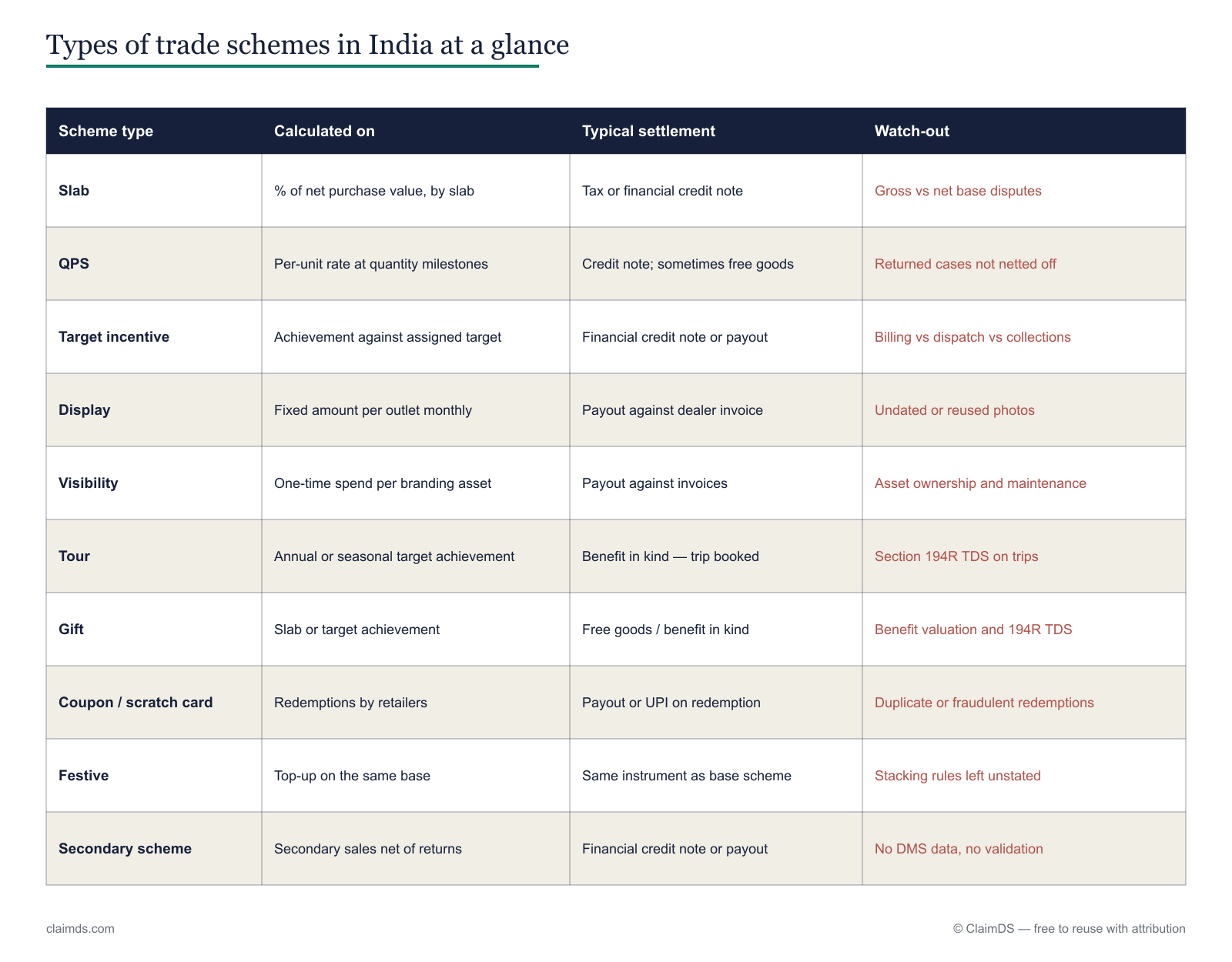
Trade scheme types at a glance — see the FMCG-specific mechanics below.
What is a QPS (Quantity Purchase Scheme)?
A QPS pays a fixed amount per case once the distributor's primary purchase quantity crosses a milestone in the period. Because it counts cases rather than rupees, it is immune to mid-period price revisions and trivially reconciled against your own dispatch data — the FMCG workhorse for pushing focus SKUs and new launches. The wider family of quantity-and-value structures is mapped in volume rebates.
Illustrative example. A monthly QPS on a biscuit SKU:
| Cases purchased in the month | Payout per case |
|---|---|
| 300 – 599 | ₹8 |
| 600 and above | ₹12 |
A distributor buys 720 cases, returns 20 → net 700 × ₹12 = ₹8,400.
- Calculated on: net primary purchase quantity (cases), not value.
- Who funds it initially: the company, accrued as trade spend against primary sales.
- How it settles: credit note (tax or financial), sometimes as free cases.
- The one pitfall: returned or damaged cases not netted off the count, so the distributor claims the higher milestone the company's net quantity does not support.
How is a slab scheme on monthly purchase value calculated?
A slab scheme pays a percentage of net purchase value that steps up across value slabs in the month. It is the base layer of most FMCG trade-spend structures because it is simple to communicate to a distributor and tunable by nudging slab boundaries. The build mechanics of slabs and scales are in rebate slabs and scales.
Illustrative example. Whole-base rate on monthly net purchases:
| Monthly net purchases | Rate |
|---|---|
| ₹8,00,000 – ₹11,99,999 | 1.0% |
| ₹12,00,000 – ₹19,99,999 | 1.5% |
| ₹20,00,000 and above | 2.0% |
Net purchases ₹14,50,000 → slab 2 → 1.5% × ₹14,50,000 = ₹21,750.
- Calculated on: net purchase value (gross primary minus returns).
- Who funds it initially: the company, accrued as achievement builds.
- How it settles: GST credit note where agreed before supply, else a financial credit note.
- The one pitfall: calculating on gross purchases, which lands the distributor one slab too high — the full arithmetic is in how to calculate FMCG distributor claims.
What is a secondary scheme settled on offtake?
A secondary scheme is calculated on secondary offtake — cases the distributor bills to retailers — not on primary purchases. It is FMCG's structural answer to pipeline-loading: it rewards stock that moved into the market, not stock parked in the godown. The tiering of primary, secondary and tertiary is unpacked in primary, secondary and tertiary sales.
Illustrative example. ₹15 per case on secondary sales of a brand:
| Metric | Cases |
|---|---|
| Billed to retailers (per DMS) | 5,200 |
| Less: retailer returns | 200 |
| Net secondary | 5,000 |
Payout = 5,000 × ₹15 = ₹75,000.
- Calculated on: net secondary sales from the distributor's DMS for the exact window.
- Who funds it initially: the company, but validation waits on distributor data.
- How it settles: almost always a financial credit note — post-computed, so it rarely meets the before-supply GST condition. Mechanics in secondary scheme settlement.
- The one pitfall: the data dependency — no clean DMS extract for the window means the claim can only be trusted, not verified; getting that data to flow reliably is an ERP and DMS integration problem.
What is a display / visibility scheme?
A display scheme pays a fixed amount per outlet per month for agreed in-store execution — an end-cap, a floor stack, a chiller facing — while a visibility scheme funds durable branding assets. Both are execution purchases, not discounts, and the claim is only as good as its dated photo evidence.
Illustrative example. ₹5,000 per outlet per month for an end-cap across 15 agreed outlets; the dated-photo audit passes 12:
| Item | Value |
|---|---|
| Agreed outlets | 15 |
| Outlets passing photo audit | 12 |
| Rate per outlet | ₹5,000 |
| Claim | 12 × ₹5,000 = ₹60,000 |
- Calculated on: verified executed outlets, not the agreed count.
- Who funds it initially: the company; the distributor often pays the retailer first and claims reimbursement.
- How it settles: payout against the distributor's invoice, or a credit note per policy.
- The one pitfall: undated or reused photos, and outlets swapped without amending the agreed list — there is no formula rescue for a missing photo.
What is a festive / seasonal scheme?
A festive scheme concentrates spend into a window — Diwali, Onam, the wedding or harvest season — usually as a top-up stacked on the running slab or QPS. It is designed to pull forward demand, which is exactly why it is dangerous: the top-up computes on the same base the base scheme already paid on.
Illustrative example. October: base slab pays 1.5%, plus a Diwali top-up of 1% on the same net purchases:
| Layer | On ₹18,00,000 net |
|---|---|
| Base slab (1.5%) | ₹27,000 |
| Festive top-up (1.0%) | ₹18,000 |
| Total | ₹45,000 |
- Calculated on: the same net purchase base as the base scheme.
- Who funds it initially: the company, from a seasonal budget line.
- How it settles: the same instrument as the base scheme it rides on.
- The one pitfall: the circular never says whether the top-up compounds, replaces, or caps against the base — so it settles by argument.
What are combo / bundle offers?
A combo offer bundles free cases with a purchase — the classic "buy 10 cases, get 1 free," or a mixed-SKU bundle at a blended price. The incentive is delivered in goods, not cash, so the cost is the value of the free stock plus its GST implications rather than a credit-note amount.
Illustrative example. Buy 10 cases at ₹1,200/case, get 1 free; a distributor takes 12 paid lots (120 cases) and earns 12 free cases:
| Item | Value |
|---|---|
| Free cases | 12 |
| Value per case | ₹1,200 |
| Scheme cost (goods) | 12 × ₹1,200 = ₹14,400 |
- Calculated on: paid quantity, delivered as a ratio of free goods.
- Who funds it initially: the company, as free stock dispatched with the order.
- How it settles: as free goods on the invoice, not a credit note.
- The one pitfall: the free-goods GST treatment and ITC position — routed to the tax reading below, not decided here.
What is a retailer coupon / scratch-card scheme?
These push the incentive one tier deeper: a scratch card or coupon inside the case, redeemable by the retailer who opens it. The economics are redemption-based — the cost is not the cards seeded but the cards that come back, so liability estimation is part of the design.
Illustrative example. 4,000 cards seeded, prizes ₹40–₹300:
| Metric | Value |
|---|---|
| Cards seeded | 4,000 |
| Cards redeemed | 2,400 (60%) |
| Average redemption | ₹110 |
| Scheme cost | 2,400 × ₹110 = ₹2,64,000 |
- Calculated on: actual redemptions, not cards issued.
- Who funds it initially: the company, via a redemption platform or the distributor.
- How it settles: UPI/recharge or payout to the retailer on redemption.
- The one pitfall: duplicate and out-of-territory redemptions — the same card code claimed twice.
Which schemes stack — and which should not
An FMCG distributor rarely earns from one scheme. In a single month the same primary purchases might carry a slab scheme, a QPS on a focus SKU, and a festive top-up, while the same stock later earns a secondary scheme on offtake. Some stacking is deliberate and healthy — a QPS on a launch SKU riding on a broad slab targets behaviour the slab alone does not. The danger is uncapped stacking on the same base. When a slab (1.5%), a festive top-up (1%), and an SKU QPS worth another ~1% all compute on the same purchases, the effective payout can quietly cross the product's channel margin — and nobody notices, because each scheme looks reasonable alone.
Two rules keep it safe. First, never let value-based layers on the same base run uncapped — set a combined ceiling per distributor per period, so total trade spend as a percentage of purchases cannot exceed a stated limit. Second, keep primary-linked and secondary-linked schemes separate, because paying richly on both for the same stock double-funds one movement. The leakage this creates is catalogued in revenue leakage in rebate programs, and building the budget so accruals track achievement is covered in trade promotion scheme budgeting and the CPG trade promotion guide. The claim, once earned across these layers, still moves through one settlement path — the FMCG claim settlement process, with sanction routed per claim and rebate approval workflows — governed by the agreement it sits under; that lifecycle is in the agreement lifecycle. The wider operating picture is in distributor claims management.
Tax pointers
Whether a scheme settles on a GST (tax) credit note or a financial one, whether free combo goods carry an ITC restriction, and whether benefits attract TDS all depend on the scheme type and when it was agreed — these are decided in the GST treatment of FMCG claims and schemes, not here. Treat this article as scheme mechanics only, and confirm any tax position with a qualified professional.
Bringing the portfolio into one place
Seven scheme types, four settlement instruments, and a stacking problem that only shows up when you total them — multiplied by every distributor, every month. ClaimDS defines each scheme with its own base and settlement mode, computes QPS and slab claims net of returns, settles secondary schemes against DMS offtake, and caps stacked layers before spend crosses margin. It is claims management software and rebate management software built for the Indian FMCG channel — the FMCG capability list is in rebate software features for FMCG, and the budgeting side in trade promotion management software.
GST note: Tax treatments touched on here are pointers, not positions, and the details move. This article is general information, not tax or legal advice; confirm the treatment of any scheme with a qualified professional before you design or settle it.
Frequently asked questions
What is QPS in FMCG?
QPS is a Quantity Purchase Scheme: a fixed per-case or per-piece payout that unlocks once a distributor's purchase quantity crosses defined milestones in the scheme period. FMCG companies favour it because the payout is stated in rupees per case, not as a percentage, so it is immune to price changes mid-period and easy to verify against primary purchase quantities.
What is a secondary scheme?
A secondary scheme settles on the distributor's sales to retailers — secondary offtake — rather than on what the distributor bought from the company. It rewards stock that actually moved into the market instead of stock loaded into the godown. The catch is data dependency: the claim can only be validated against retailer-wise secondary sales pulled from the distributor's DMS for the exact window.
What is the difference between a primary and secondary scheme?
A primary scheme is calculated on primary sales — the distributor's purchases from the company, visible on your own invoices. A secondary scheme is calculated on secondary sales — the distributor's billing to retailers, visible only in the distributor's DMS. Primary schemes are easy to verify but reward pipeline-loading; secondary schemes reward real offtake but depend on distributor data.
How is a slab scheme calculated?
Take the distributor's net purchase value for the period — gross primary purchases minus returns — find which value slab it lands in, and apply that slab's rate. The circular must state whether the achieved rate applies to the whole base or only to the value inside each tier, because whole-base and per-tier designs pay materially different amounts on the same purchases.
What is a display scheme in FMCG?
A display scheme pays a fixed amount per outlet per month for agreed in-store execution — an end-cap, a floor stack, a defined shelf facing — verified by dated, ideally geo-tagged photos. It is funded by the company but claimed by the distributor on the retailer's behalf, and it settles only against the outlets whose photo evidence passes audit, not the full agreed list.
How do festive FMCG schemes cause margin leakage?
Festive schemes are usually a top-up stacked on the running slab or QPS scheme for a Diwali or Onam window. Because each layer computes on the same net purchase base, an uncapped festive top-up multiplies spend on volume that would often have come anyway. Without a combined cap across stacked layers, the effective payout rate can quietly cross the product's channel margin.
See ClaimDS on your own claims data
A 30-minute walkthrough tailored to how your channel actually settles claims.
Related posts

Seasonal Schemes and Liquidation in Agri-Inputs
How seasonal schemes and liquidation claims work in Indian agri-inputs — schemes timed to Kharif and Rabi, sell-through targets and season-end settlement.
Types of Trade Schemes in India: The Complete Guide for Manufacturers and Channel Teams
Slab, QPS, target, display, visibility, tour, gift and secondary schemes — how each type is calculated, settled and taxed, with worked ₹ examples.
Channel Loyalty Programs for Dealers and Distributors: Design, Points and Settlement (India)
How channel loyalty programs work in the Indian route-to-market — earn rules, tiers, points economics, redemptions, and the settlement layer underneath.