
Trade Spend Management Software for Indian Brands and Distributors
See what your channel spend actually costs — schemes committed, claims settled, deductions taken and accruals trued up, with GST-compliant settlement.
In short
Trade spend is the money a brand commits to its channel — schemes, rebates, allowances, deductions and claims. Managing it means knowing what has been committed, what has been claimed, what has been settled and what remains accrued, during the period rather than after it closes.
Trade spend is the money a brand commits to its channel — schemes, rebates, allowances, deductions and distributor claims. Managing it means knowing what has been committed, what has been claimed, what has been settled and what remains accrued, during the period rather than after it closes.
That last part is the whole difficulty. Most businesses can tell you what they spent on the channel last year. Far fewer can tell you what they are committed to right now.
What trade spend management covers
Trade spend management is the money view of channel activity. It runs across five things:
- Budgeting spend by scheme and by partner, so a commitment is made against something finite.
- Tracking commitment as claims arrive against each scheme, rather than discovering the total at period-end.
- Settling claims correctly against the agreed terms — the distributor claim settlement side.
- Handling deductions customers take unilaterally, which are spend whether or not anyone approved them.
- Truing up accruals so the liability in the books matches what will actually be paid.
It is closely related to trade promotion management, and the two are often confused. The distinction is simple: trade promotion management is the process of designing and running promotions; trade spend is the money those promotions commit. The same underlying data, read for different questions — one asks "is the scheme running correctly?", the other asks "what is the channel costing us?"
The four questions a trade spend system should answer
| The question | Why it is hard in spreadsheets | What a system provides |
|---|---|---|
| What have we committed this period? | Commitments are made by sales, often in circulars and email, and are not totalled anywhere | The live committed value per scheme and per partner <!-- TODO: confirm capability wording with founder --> |
| What has been claimed against it? | Claims arrive weeks later, in different formats, and are matched by hand | Each claim reconciled against the scheme that authorised it <!-- TODO: confirm capability wording with founder --> |
| What has been settled, and how? | Settlement lives in the accounting system, disconnected from the scheme record | The settlement and its credit note linked to the original commitment <!-- TODO: confirm capability wording with founder --> |
| What remains accrued but unsettled? | Estimated at period-end from whatever is remembered | A running accrual that moves as claims land <!-- TODO: confirm capability wording with founder --> |
Those four questions are the job. A business that can answer all four at any point in the period is managing trade spend; one that answers them at quarter-end is reporting on it.
Why trade spend is hard to see
The reason is structural rather than a failure of effort: the four numbers come from four different sources of truth, and nothing joins them.
Commitments are made by the sales team — a scheme circular, a promise to a distributor, a rate agreed in a meeting. They are real money the moment they are made, and they usually exist as documents rather than as data.
Claims arrive weeks later, from partners, in whatever format each one uses. By the time they land, the person who agreed the scheme has moved on to the next quarter.
Deductions are taken unilaterally by customers against invoices — money leaving without anyone approving it. They are trade spend in every sense that matters, and they frequently sit in a completely different process from schemes, which is why deduction management so often runs as its own island.
Accruals are estimated at period-end by finance, from a combination of the above and judgement.
Four sources, four owners, four timelines. The gap between them is where revenue leakage lives — not usually as fraud, but as commitments nobody totalled, claims nobody validated and deductions nobody challenged. Bringing the four into one view is most of the work; the budget-versus-actual discipline is what you get once they are joined.
The India-specific part
Trade spend in India carries requirements a globally-built tool typically does not handle natively.
Settlement usually runs through a credit note. That forces a choice between a tax credit note and a financial or commercial one, and the two have different consequences for both parties' GST returns — the decision covered in GST credit notes for rebates. Getting it wrong is not a reporting inconvenience; it changes what each side can claim.
TDS questions arise on some channel payments depending on how the payment is characterised — whether it is a discount reducing price or consideration for a service. The characterisation drives the treatment.
The channel is multi-tier. Spend flows through C&F agents, super-stockists, distributors and retailers, and a scheme can commit money at more than one of those tiers at once — which is why secondary scheme settlement is its own discipline rather than a variation of the primary one.
And it runs in INR across an April–March financial year, which is the boundary your accruals and scheme windows have to respect.
What this does not do
Stated plainly, because the category is often assumed to be wider than it is. ClaimDS manages and settles trade spend: it holds the scheme terms, accrues against them, reconciles claims and produces the settlement. <!-- TODO: confirm capability wording with founder -->
It does not forecast promotion effectiveness, predict how much extra a promotion will sell, or optimise your promotional mix. Those need demand and consumption data a settlement system does not hold, and they belong to a different category of product.
Who it is for
Finance and commercial teams at Indian manufacturers and distributors who carry real channel spend and currently manage it across spreadsheets, email and the accounting system.
It suits both sides of the channel. A brand needs to know what it has committed and whether the claims against it are valid. A distributor needs to know what it is owed and whether it has been settled correctly — the same data, read from the other direction. Where a business runs both — buying under one set of schemes and selling under another — both views matter at once.
If your reporting on channel spend currently starts after the period closes, that is the gap this addresses.
General information, not accounting or tax advice. How trade spend is recognised in your accounts, and the GST or TDS treatment of a particular channel payment, depend on the facts and on current law. Confirm the position for your business with a qualified professional — the accounting treatment is set out separately.
Read next
- Trade promotion management software in India — the process side of the same activity.
- Trade spend vs advertising — two different budgets, two different owners.
- The CPG trade promotion guide — the consumer-goods view of channel schemes.
- Deduction management best practices — the spend customers take without asking.
Book a demo to see what your committed, claimed, settled and accrued trade spend looks like in one view.
Frequently asked questions
What is trade spend management?
Trade spend management is the practice of controlling the money a brand commits to its sales channel — schemes, rebates, allowances, deductions and distributor claims. It covers budgeting that spend, tracking commitments as claims arrive, settling those claims correctly, and truing up accruals, so the real cost of the channel is visible during the period rather than after it closes.
What is the difference between trade spend and trade promotion management?
Trade promotion management is the process of designing and running promotions — the scheme, the claim, the settlement. Trade spend is the money view of that same activity: what has been committed, claimed, settled and accrued. One is about running the promotion; the other is about knowing what the channel is costing you. Most businesses need both views.
What is the difference between trade spend and advertising spend?
Trade spend goes to the channel — distributors and retailers — to influence how much of your product they stock and push. Advertising spend goes to the consumer, to create demand. They are separate budgets, usually owned by different teams, and they are accounted for differently. The distinction is set out fully in our trade spend versus advertising guide.
How is trade spend accounted for?
Trade spend is generally accrued as the earning condition is met and then trued up on settlement, so the liability appears in the period the activity happened rather than when the claim is paid. The specific accounting treatment depends on the arrangement and the standards you report under — this article takes no accounting position; confirm yours with a qualified professional.
Does trade spend management software handle GST credit notes?
It should, if it is built for India, because most channel settlements run through a credit note. The important part is that the system supports the choice between a tax credit note and a financial or commercial one, since the two have different consequences for both parties' returns. The detailed GST treatment is covered in our credit-note guides.
Is trade spend the same as a rebate?
No — a rebate is one form of trade spend, not the whole of it. Trade spend also covers scheme payouts, display and visibility allowances, price protection, deductions taken by customers and other channel claims. A business that tracks only its rebates is seeing part of what the channel costs, which is usually how the total ends up larger than anyone expected.
See ClaimDS on your own claims data
A 30-minute walkthrough tailored to how your channel actually settles claims.
Related posts
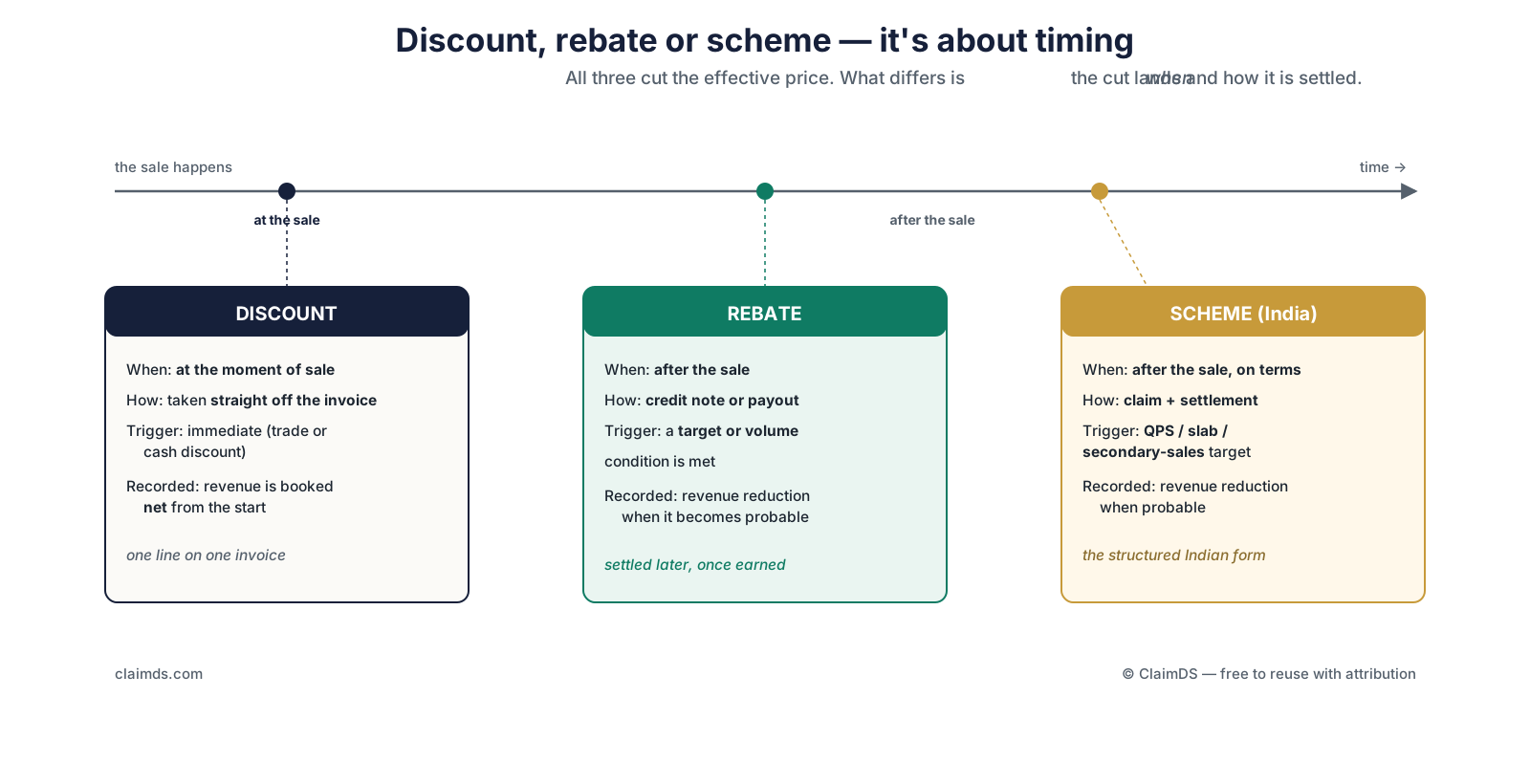
How to Model What a Trade Scheme Will Cost Before You Launch It
Before a scheme goes live, know its best, likely and worst-case cost. How to model scheme liability against budget, with worked examples in ₹.

Trade Spend vs Advertising: Where Your Promotion Money Actually Goes
Trade spend and advertising (A&P) are two different budgets that behave differently. What separates them, why finance teams confuse them, and how each is tracked.
Consumer Promotions vs Trade Promotions
Consumer promotions vs trade promotions — who each targets, who funds them, how they are measured, and why trade promotions create claims.