
Channel Claims and Rebates in Indian Agri-Inputs
How schemes, claims and rebates work across the Indian agri-input channel — fertilizers, crop-protection and seeds, seasonal schemes and expiry returns.
Agri-input companies — makers of fertilizers, crop-protection chemicals and seeds — sell through distributors and dealers down to farmers, paying seasonal schemes and settling claims by credit note rather than cheque. What sets the category apart is the calendar: the Kharif and Rabi season cycle and the limited shelf life of crop-protection stock make seasonal liquidation schemes and near-expiry returns the defining claims a finance team here has to manage. This pillar maps how the whole channel works.
The agri-input channel, tier by tier
The agri-input channel is a classic Indian multi-tier route to market, but it is bent around the crop calendar at every level. Product moves from the manufacturing plant to regional depots, out to distributors who cover a cluster of districts, down to the village-level dealer — the agri-input shop the farmer actually walks into — and finally into the field. Money for schemes and claims flows back up the same chain, and unsold or ageing stock flows back up as returns.
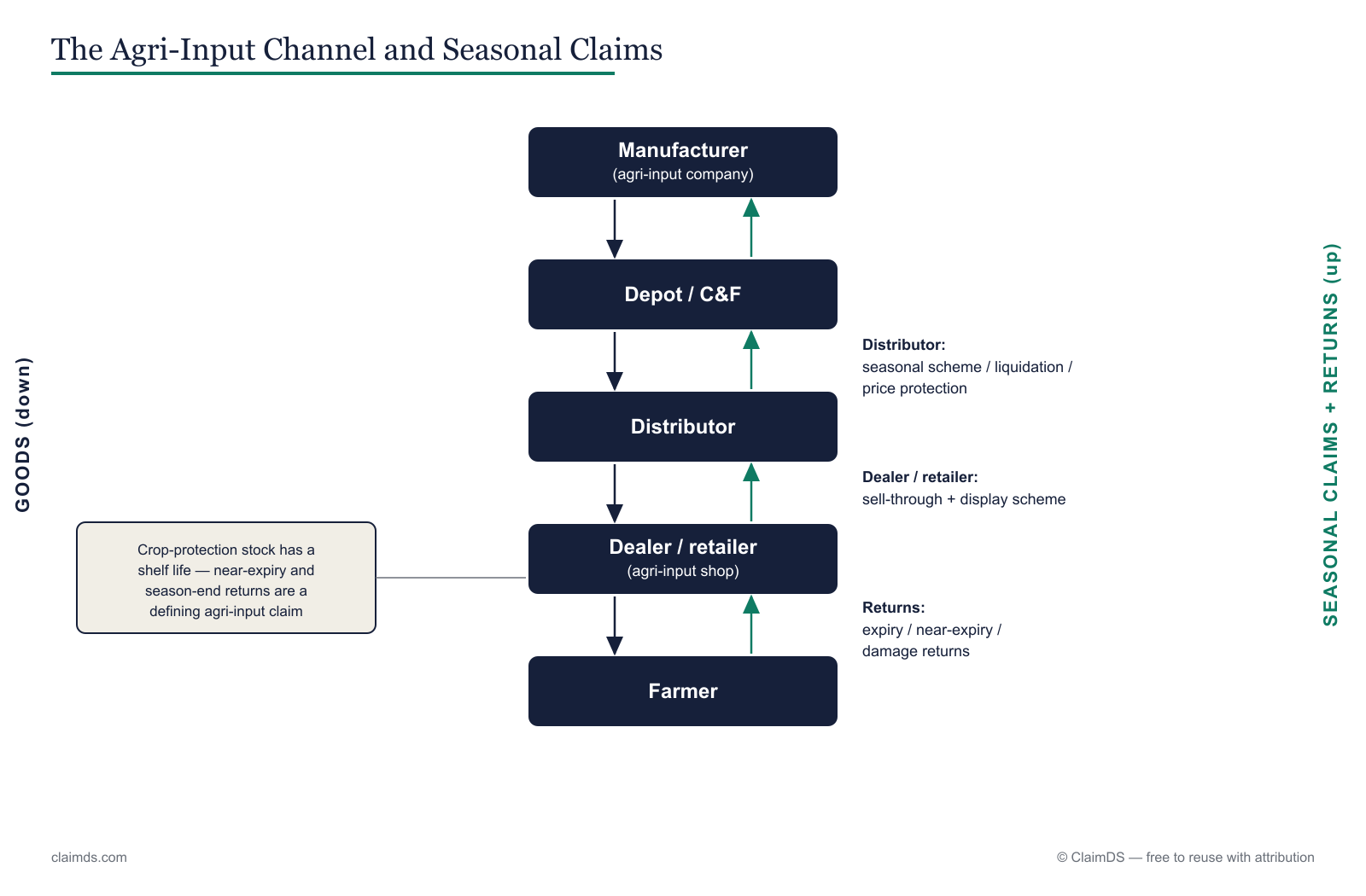 The agri-input channel is season-driven — schemes are timed to the crop calendar, and near-expiry stock flows back up as returns.
| Tier | Role in the agri-input channel |
|---|---|
| Manufacturer / marketer | Formulates or markets the fertilizer, molecule or seed; designs the season's schemes, sets targets and funds the credit notes. |
| Depot / C&F agent | Carrying-and-forwarding point that holds regional stock and invoices distributors; the first billing tier below the plant. |
| Distributor / wholesaler | Covers a district or cluster, buys in bulk ahead of season, extends credit to dealers and files the bulk of scheme claims. |
| Dealer / retailer (agri-input shop) | The point of sale the farmer visits; advises on product, sells at the counter and drives the sell-through that liquidation schemes reward. |
| Farmer | The end user, whose sowing window sets the timing of demand — and therefore of every scheme above. |
Because the network runs several tiers deep, sorting out who occupies which rung matters before any claim can be validated. The distributor vs dealer vs super stockist breakdown untangles the roles, and the broader India multi-tier channel claim map shows how claims attach to each link. The agri-input version of that map is simply the same structure read against a crop calendar rather than a fiscal one. For the settlement mechanics that run across every tier, our overview of channel rebates in India is the umbrella reference.
What kinds of claims does an agri-input company handle?
An agri-input company runs a wider spread of claim types than most channels, because it is fighting two clocks at once: the sowing window and the product's shelf life. The main families are seasonal and liquidation schemes (rewarding stock movement inside a season), sell-through incentives (rewarding actual off-take to farmers), early-bird or advance-booking schemes (rewarding the channel for committing stock before the season), price protection on price revisions, near-expiry and season-end returns, and damage or breakage claims. Each rests on different proof, and the category has its own vocabulary that finance teams must read fluently.
| Agri-input term | What it means |
|---|---|
| Kharif | The monsoon-sown crop cycle (roughly June–October); one of the two main scheme seasons. |
| Rabi | The winter-sown crop cycle (roughly October–March); the second main scheme season. |
| Liquidation | Clearing stock out of the channel by driving sell-through before it ages or expires. |
| Sell-through | The actual movement of product from the dealer counter to the farmer — as opposed to a purchase into the channel. |
| PoS / dealer | Point of sale — the village agri-input shop where the farmer buys and where sell-through happens. |
| Near-expiry | Stock approaching the end of its usable shelf life, eligible for return or an accelerated liquidation push. |
| Technical vs formulation | Technical is the raw active ingredient; formulation is the packed, ready-to-use product sold through the channel. |
| Early-bird / advance booking | A scheme rewarding the channel for committing and lifting stock ahead of the sowing window. |
| Price protection | Compensation to the channel for stock held when the company revises price downward. |
| Season-end return | Unsold stock taken back after the sowing window closes, to protect channel liquidity. |
| Primary sale | The sale from company to distributor — the invoice that primary schemes are measured on. |
| Secondary sale | The sale from distributor down to dealer or farmer — the base for secondary and liquidation schemes. |
Two of these families behave very differently from their equivalents in other channels. Price protection matters more here because the channel routinely holds weeks of stock ahead of a season; when a company revises price downward mid-season, the distributor is sitting on inventory bought at the old price, and a rate-difference claim compensates the gap. Damage and breakage claims carry their own weight because liquid formulations, dusty granules and treated seed all travel long rural distribution legs and are handled repeatedly at the counter. Each family rests on a different kind of proof, which is why a single validation rulebook rarely fits the whole category.
For the generic catalogue that sits behind these, see the types of trade schemes used in India; the agri-input list above is that catalogue timed to a crop calendar. The two claim families unique enough to warrant their own treatment — near-expiry returns and season-end liquidation — are covered in the agri-input expiry and season-return guide and the seasonal-scheme and liquidation guide.
Why the season cycle changes everything
In most channels, schemes run against a financial quarter. In agri-inputs they run against the weather. A Kharif scheme has to be announced, stocked, sold and claimed inside the narrow monsoon-sowing window; a Rabi scheme repeats the exercise a few months later against the winter crop. Miss the window and the scheme is worthless — a fertilizer or seed sold after sowing has no buyer until the next matching season, a full cycle away.
That timing forces the channel to stock ahead of the season. Distributors lift heavy inventory on the strength of early-bird incentives, betting on the sowing forecast. When the rains behave and demand lands, the bet pays off. When they do not — a delayed monsoon, a pest year, an acreage shift — the stock sits, and now two problems compound: the distributor's cash is locked, and crop-protection stock in particular is ticking toward expiry.
The season cycle also drives when claims physically arrive. A company can have two full scheme calendars live at once — a closing Kharif season still generating liquidation and return claims while the Rabi early-bird schemes are already being announced. Finance sees claim volume spike in tight bursts around each sowing window rather than spread evenly through the year, which strains any manual reconciliation process precisely when it can least afford errors. Provisioning for these payouts as sales accrue, rather than absorbing them as a season-end surprise, is what keeps the liability visible; the same discipline that underpins clean distributor claims management applies here, just compressed into two annual peaks.
This is where the liquidation scheme does its work. Rather than reward the distributor's original purchase, a liquidation scheme rewards sell-through — actual off-take from the dealer counter to farmers — during the season. It is a deliberate push to move ageing stock out of the channel before it becomes a return. The mechanic is powerful and hard to police at once: the reward depends on secondary sales data the company cannot see directly, which is exactly the validation problem covered in secondary scheme settlement. Get the liquidation push right and unsold stock clears at the counter; get it wrong and it flows back up the channel as a near-expiry return, the subject the next sections keep returning to. The seasonal-scheme and liquidation guide works through the mechanic in depth.
How agri-input schemes settle in India
Settlement in agri-inputs follows the same instrument as the rest of the Indian channel: the credit note, not the cheque. Once a claim is validated against its scheme, finance issues a credit note that reduces the distributor's outstanding balance, and the amount is netted against future invoices rather than paid out separately. Across a season with dozens of overlapping schemes per partner, that netting is what keeps the ledger sane — but only if each claim is reconciled back to the scheme that authorised it.
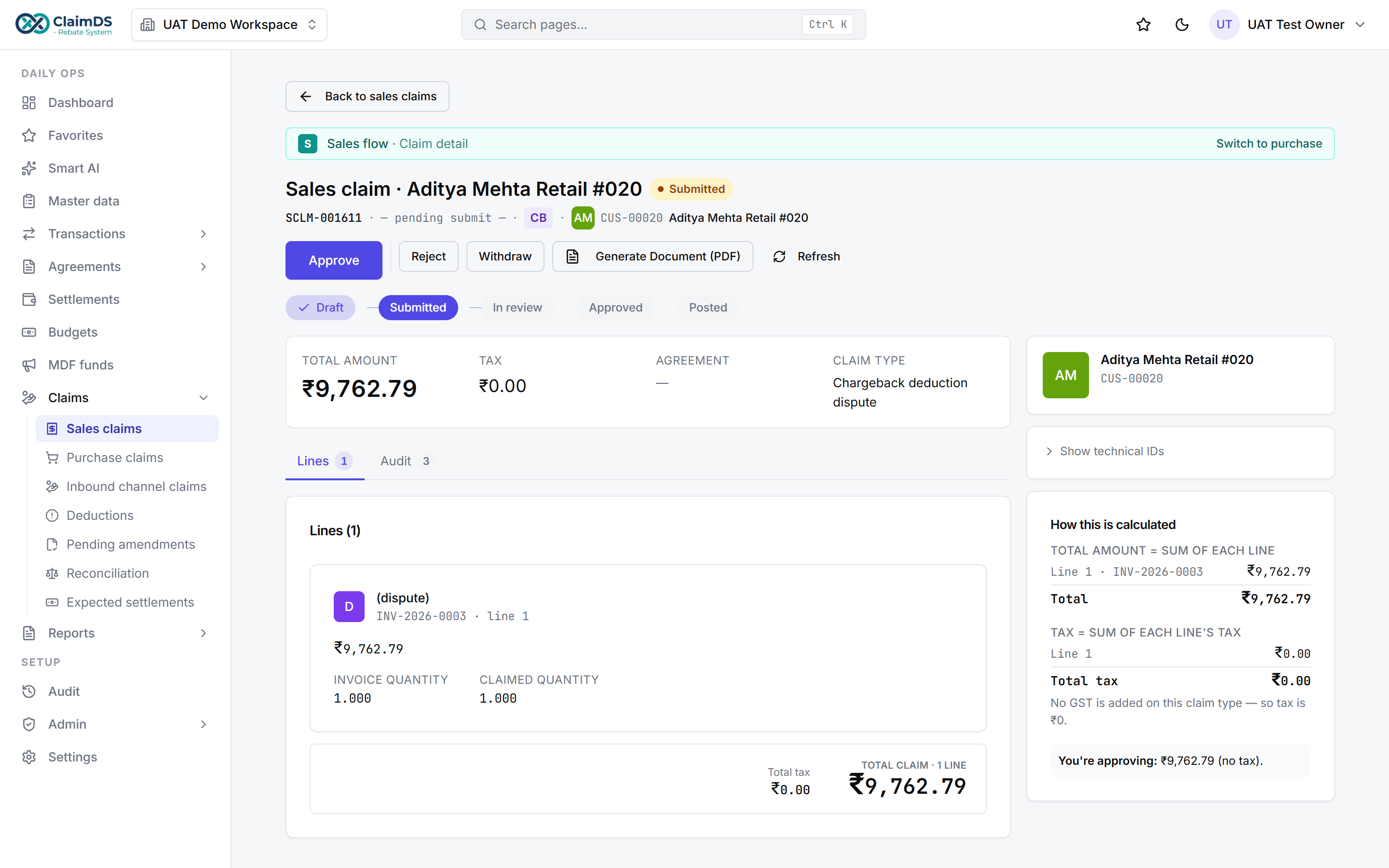 A seasonal claim validated against its scheme rules before a credit note is issued.
The credit note itself comes in two forms with very different tax effects. A tax credit note adjusts the supplier's output tax and forces the recipient to reverse input tax credit; a financial (commercial) credit note does neither. Choosing the wrong one creates real exposure at assessment — the mechanics are unpacked in financial vs tax credit notes under GST, and the return-specific version in credit notes for expired and damaged goods returns. Where a claim arises from a downward price revision, the price-protection and rate-difference credit note treatment applies instead.
One agri-input wrinkle deserves a flag rather than a full answer here: seeds, fertilizers and crop-protection chemicals are not taxed alike under GST, and a single order can mix categories on one invoice. That makes the credit-note tax treatment category-dependent in a way most channels never face. This pillar keeps tax at pointer level by design — for the actual rate treatment and how it shapes settlement, route to the GST treatment of agri-input claims and schemes.
GST note: This article is general information, not tax or legal advice. GST treatment of agri-input schemes, returns and credit notes — including the differing rate treatments across seeds, fertilizers and crop-protection chemicals — must be re-verified at publish time with a qualified professional before you rely on it.
The discipline that ties it together is a repeatable claim and rebate approval workflow: scheme, claim and settlement reconciled against one another, with the credit note traceable back to the return or invoice it adjusts. The claim approval workflow reference walks the stages, and the glossary keeps the terms straight.
Bringing it together
Channel claims in agri-inputs are the same idea as anywhere — pay the channel for performance, settle by credit note — but wrapped around two clocks the crop calendar and the product's shelf life keep running at once. Seasonal and liquidation schemes push stock through the window; near-expiry and season-end returns catch what does not clear; and the whole thing settles through GST credit notes whose tax treatment depends on which category — seed, fertilizer or molecule — is on the invoice. Left to spreadsheets, that combination is where revenue leaks out of rebate programs.
Get the season timing, the sell-through proof and the credit-note choice right, and the reconciliation gets dramatically simpler. From here, follow the deeper agri-input guides: the dealer claim settlement process, supplier and purchase rebates in agri-inputs, and the expiry and season-return mechanics.
<!-- TODO: confirm capability wording with founder -->ClaimDS is built for exactly this shape of channel — multi-tier, season-driven, credit-note settled. See how it handles distributor claim settlement end to end, with purpose-built dealer claims management software, dealer rebate software and broader rebate management software — or book a demo to walk through your own season calendar.
Frequently asked questions
What is an agri-input channel claim?
An agri-input channel claim is a request from a distributor or dealer to recover money promised under a scheme: a seasonal discount, an early-booking incentive, a price-protection adjustment or a near-expiry return. The manufacturer validates it against the scheme rules and settles the approved amount by credit note, netted against the partner's outstanding account.
How do seasonal schemes work in agri-inputs?
Seasonal schemes are timed to the crop calendar. Ahead of the Kharif or Rabi sowing window a company announces targets, early-booking rewards and liquidation incentives so the channel stocks and sells inside the window. Partners buy and sell under those terms, then file claims once the season closes, which finance validates against the scheme before issuing credit notes.
Why are near-expiry returns common in crop protection?
Crop-protection formulations carry a defined shelf life, and demand is compressed into short sowing windows. Stock loaded for a season that does not sell through ages toward expiry before the next matching season arrives. Companies accept near-expiry and season-end returns to protect the channel, so these returns become a defining, recurring claim in the category.
How are agri-input schemes settled in India?
Settlement is almost always by credit note, not cheque. The company issues a credit note that reduces the distributor's outstanding balance, and the claim is netted against future invoices. The note may be a GST tax credit note or a purely financial one, depending on whether output tax is being adjusted — a distinction with real compliance consequences.
Do agri-inputs have different GST rates?
Yes. Seeds, fertilizers and crop-protection chemicals are not taxed alike under GST — they sit in different rate treatments, and a single mixed invoice can carry more than one. Because the rate shapes how a credit note adjusts tax, agri-input settlements need category-aware handling. Our dedicated guide on the GST treatment of agri-input claims covers the detail.
What is the difference between Kharif and Rabi seasons?
Kharif is the monsoon-sown crop cycle, roughly June to October; Rabi is the winter-sown cycle, roughly October to March. Agri-input demand splits across these two windows, so companies run two distinct scheme calendars a year. Stock, targets and liquidation incentives are all timed to whichever season is opening, which shapes when claims arise.
What is a liquidation scheme in agri-inputs?
A liquidation scheme pushes sell-through — the movement of stock from the dealer down to farmers — before it ages or expires. Rather than reward the distributor's purchase, it rewards actual off-take at the counter during the season. It is the main tool companies use to clear seasonal and near-expiry stock, and it rests on sell-through data.
See ClaimDS on your own claims data
A 30-minute walkthrough tailored to how your channel actually settles claims.
Related posts

How to Settle Agri-Input Dealer Claims
The step-by-step process to settle agri-input dealer and distributor claims in India — seasonal schemes, liquidation claims and near-expiry returns.
Expiry and Season-End Returns in Agri-Inputs
How near-expiry, damage and season-end returns work in Indian agri-inputs — declaring returnable stock, the claim window and how each return settles.
Channel Claims and Rebates in Indian Automotive
How claims, incentives and warranty work in the Indian automotive channel — the OEM and dealer network, aftermarket parts, warranty claims and settlement.