
GST on Agri-Input Claims and Schemes
How agri-input dealer schemes, liquidation claims and near-expiry returns are treated under GST — credit-note choice, ITC reversal and mixed input rates.
An agri-input scheme settlement raises the same GST questions as any channel claim — a Section 34 tax credit note versus a financial or commercial credit note, ITC reversal on post-sale discounts, and how expired stock is treated — plus one industry-specific twist. Because a distributor's basket mixes categories that are not taxed alike — seeds, fertilizers and crop-protection chemicals — the GST consequence of a scheme credit note depends on what it is settling, not just the scheme label. That is the agri-input wrinkle this article works through.
Are agri-inputs taxed at one GST rate?
No. This is the first thing that separates an agri-input scheme from an FMCG or automotive one. A crop-input distributor's basket spans seeds, fertilizers and crop-protection chemicals (the agrochemicals — insecticides, herbicides, fungicides), and these categories do not share a single GST rate or treatment. They sit in different places on the tariff, and some may carry a concessional or nil position while others do not. <!-- TODO VERIFY + CA REVIEW: confirm current rate/treatment for seeds, fertilizers, crop-protection chemicals -->
We deliberately name the categories rather than quote percentages, because the numbers move and getting one wrong on a settlement document is expensive. If a specific rate has to appear on a credit note, confirm it against the current tariff at the moment of raising the document. <!-- TODO VERIFY AT PUBLISH + CA REVIEW: confirm current rate --> What matters for scheme design is the structural point: a single dealer invoice, and therefore a single seasonal scheme, can span goods at more than one effective rate.
That is what complicates a blanket scheme credit note. When a company runs a liquidation or seasonal push across a dealer's whole purchase — mixing fertilizer, seed and pesticide lines — a one-line credit note has no single rate to carry, because the underlying goods do not sit at one rate. The clean approach is to map the scheme benefit to the specific invoice lines it discounts, so each line's own treatment follows through, rather than averaging across a mixed basket. The same discipline governs GST adjustments on channel settlements and how the numbers later reconcile in scheme credit notes against GSTR-2B and 3B. The contrast with a single-rate industry is visible in the FMCG and pharma equivalents of this article, where one rate usually spans the basket. The pillar view of the crop-input channel sits in agri-input channel claims and rebates in India.
Which credit note settles a scheme?
The core question for any scheme is which document settles it — and that decides whether tax moves. A seasonal or liquidation scheme is settled after the original invoice, so it is a post-supply discount, and post-supply discounts have a specific gate. Under Section 15(3)(b) of the CGST Act, a discount can be excluded from the taxable value only where the discount was agreed before or at the time of supply, is linked to the relevant invoices, and the recipient reverses the ITC attributable to it. <!-- TODO VERIFY AT PUBLISH + CA REVIEW: Section 15(3)(b) conditions and recipient-ITC treatment -->
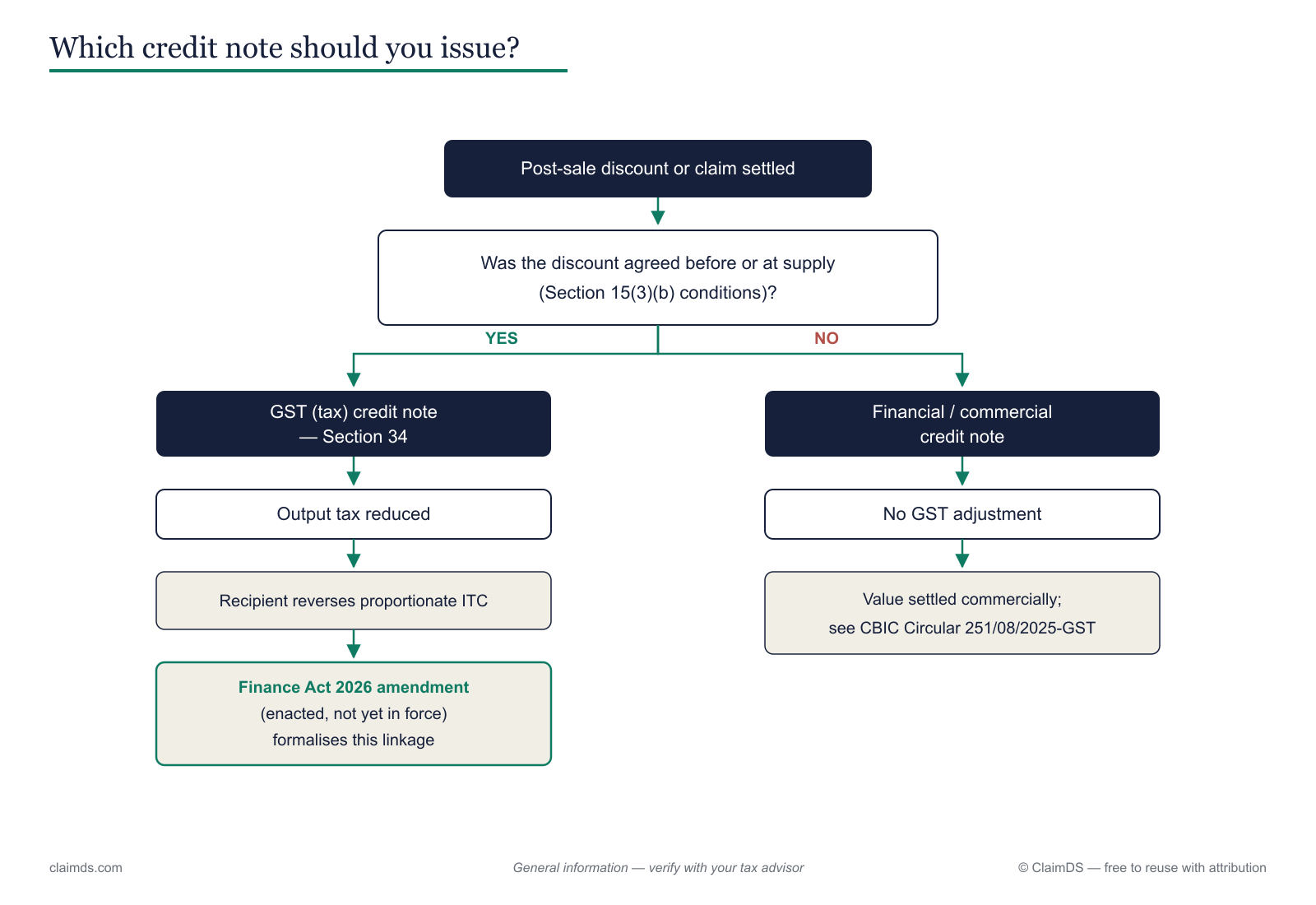
The document that settles a seasonal scheme decides whether it carries tax.
If those conditions are met, the company can raise a Section 34 tax credit note: it reduces the supplier's output tax, and the dealer reverses the proportionate credit — the two sides move together. We unpack that in financial vs. tax credit notes under GST and trace the reversal in ITC reversal on post-sale discounts and credit notes. If the conditions were not met — most in-season liquidation offers are agreed after stock has already shipped for the sowing window — the tax route is closed and the scheme settles through a financial or commercial credit note. CBIC Circular 251/08/2025-GST, described here at pointer level and conservatively, addresses whether a post-sale discount passed through a financial or commercial credit note obliges the recipient to reverse ITC; read it in full in CBIC Circular 251 on post-sale discounts. <!-- TODO VERIFY AT PUBLISH + CA REVIEW: Circular 251 position -->
For agri-inputs the mixed-basket point folds back in here: even where the tax route is open, the credit note must respect that the lines it settles may sit at different rates. Decide the credit-note type at design time, document the pre-supply agreement, and keep the invoice linkage. The detailed conditions live in the Section 15(3)(b) conditions, the documentation stack in the scheme settlement GST documentation playbook and rebate accounting with GST credit notes, and the general discount treatment in GST on trade discounts and dealer incentives. The operational flow is in the agri-input dealer claim settlement process.
Post-sale discounts and ITC reversal
Whether a post-sale discount forces an ITC reversal follows from which document you raised. A Section 34 tax credit note that reduces output tax pulls a matching reversal on the recipient side; a financial or commercial credit note leaves value and output tax untouched, so there is nothing to reverse. The reversal timing itself runs through Rule 37 and the 180-day mechanic, covered in Rule 37 and the 180-day ITC reversal. <!-- TODO VERIFY AT PUBLISH + CA REVIEW: Rule 37 mechanic and reversal timing -->
Liquidation and price-protection credit notes are where agri-input teams most often trip, because they are raised in bulk at season-end against fast-moving stock. If a price-protection credit note is structured as a value-reducing Section 34 document, the dealer's ITC must move with it; if it is a financial adjustment, it does not. Section 17(5)(h) is the other lever here — it blocks credit on goods disposed of by way of gift or free supply, which is why "extra bags free" liquidation mechanics need their ITC position checked before launch. <!-- TODO VERIFY AT PUBLISH + CA REVIEW: Section 17(5)(h) scope on free supply --> The wider reconciliation and the price-protection angle are in reconciling scheme credit notes to GSTR-2B and 3B and GST on distributor margin, commission and incentives. Free-goods valuation, where it applies, is handled in GST on free goods and BOGO schemes.
Expired and destroyed crop-protection stock
Crop-protection chemicals carry hard expiry dates, so a share of dealer stock is always written off at season-end. GST treats this differently from a discount. Under Section 17(5)(h) of the CGST Act, input tax credit is blocked on goods that are lost, stolen, destroyed or written off — so where a dealer or company has already claimed ITC on stock later destroyed on expiry, that credit must be reversed. <!-- TODO VERIFY + CA REVIEW: Section 17(5)(h) ITC block on destroyed/written-off goods -->
Two routes need to be kept apart. A near-expiry return, where saleable stock physically comes back up the channel before it expires, is a return or reversal transaction documented on its own footing — see returns, reversals and cancellations on channel claims and credit notes for expired and damaged goods returns. Destruction, where the stock is written off rather than returned, is the Section 17(5)(h) case above: the credit is blocked and must be reversed by whoever holds the goods. The commercial question of who funds the loss is set by the scheme terms and is separate from the tax question; clawbacks on cancelled schemes are handled in rebate clawbacks and scheme cancellations. The full season-return depth for this industry lives in the sibling piece, agri-input expiry, damage and season returns, and the distributor-side view in distributor claims management.
Section 194R on dealer incentives in kind
Not every incentive is a discount. When a company gives a resident dealer carrying on business a benefit or perquisite in kind — a foreign trip, gifts, gold, sponsored events — Section 194R can bring TDS into play at 10 percent on the value of the benefit, once the aggregate to a single dealer crosses ₹20,000 in a financial year; where the dealer has no PAN, a higher rate can apply. Application is fact-specific, so this is not a blanket position. <!-- TODO VERIFY AT PUBLISH + CA REVIEW: 194R rate, threshold, section mapping -->
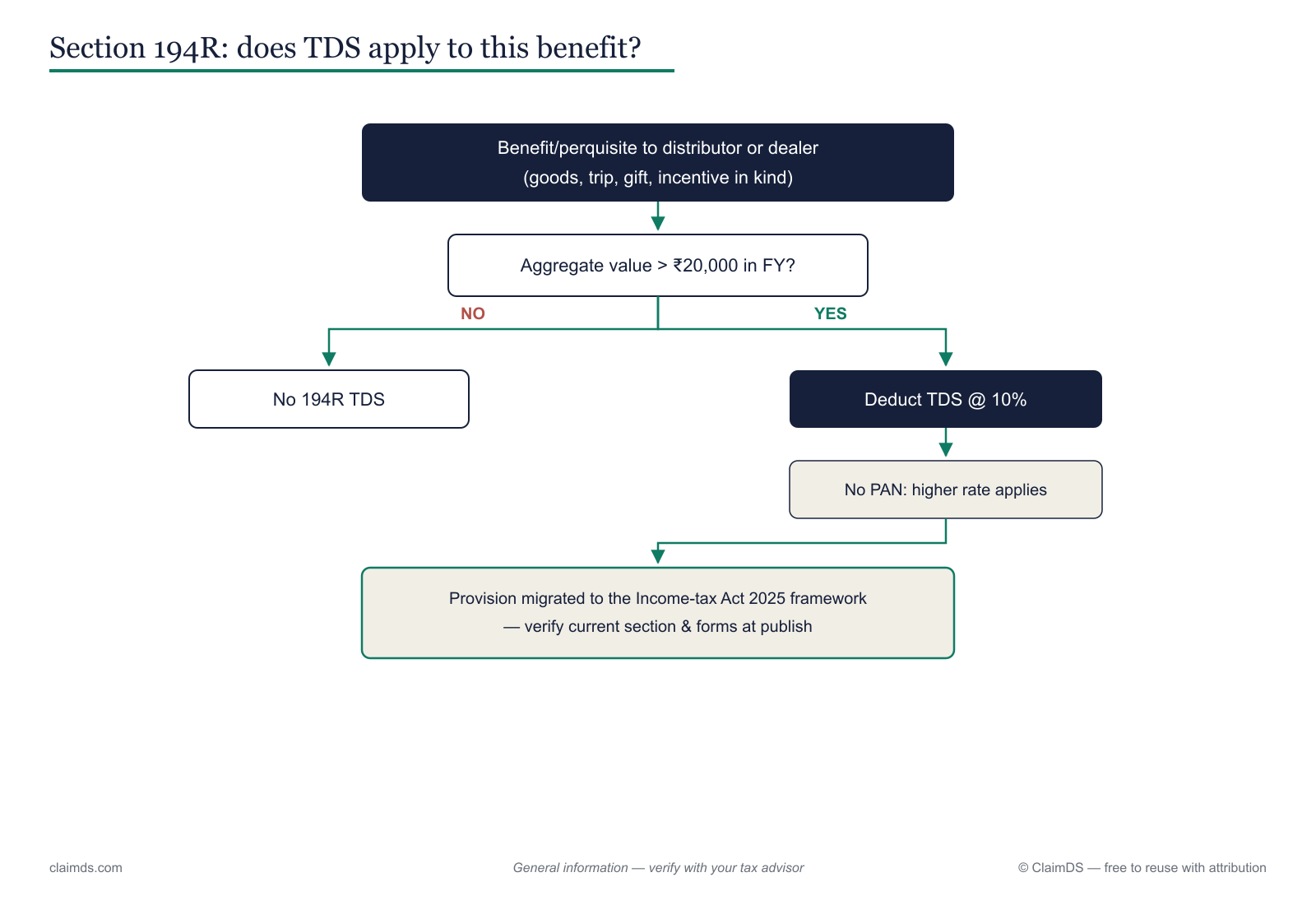
A reward in kind to a dealer above the annual threshold can attract Section 194R.
The catch that surprises finance teams is that a non-cash perk still attracts the deduction, so the company must arrange to recover or gross up the tax on an in-kind reward before it is announced. Note the framework change: Section 194R now sits within the Income-tax Act, 2025 framework, effective 1 April 2026, so the section mapping and cross-references should be re-checked against the new Act rather than assumed from older numbering. <!-- TODO VERIFY AT PUBLISH + CA REVIEW: 194R rate, threshold, section mapping --> The full mechanics are in Section 194R TDS on dealer and distributor incentives, the wider map in tax on rebates, chargebacks, billbacks and buybacks in India, and the practitioner note in /docs/tds-on-incentives.
The Finance Act 2026 note
One statutory piece is moving and should be flagged without over-reading it. The Finance Act 2026 enacted amendments touching Section 15(3)(b) and Section 34 of the CGST Act — the provisions that govern post-supply discounts and credit notes — and received assent on 30 March 2026. The critical point: the relevant provisions are not yet notified into force. Until a commencement notification issues, the existing Section 34 read with CBIC Circular 251/08/2025-GST is the operative position. Always confirm the current notification status before relying on the amended text. <!-- TODO VERIFY AT PUBLISH: Finance Act 2026 assent date and notification status -->
GST note: This article is general information, not tax or legal advice. Every position here — the Section 15(3)(b) conditions, Section 34 tax credit notes, Section 17(5)(h) ITC blocking, Rule 37, Section 194R, CBIC Circular 251/08/2025-GST, the Income-tax Act 2025 framework, and the Finance Act 2026 amendments assented but not yet notified — must be re-verified at publish time with a qualified CA or CMA. No specific GST rate for seeds, fertilizers or crop-protection chemicals is asserted here; any percentage used in an example is illustrative arithmetic only, not a rate assertion. <!-- TODO VERIFY AT PUBLISH + CA REVIEW -->
For an illustrative shape only: on a ₹1,00,000 line at an illustrative 18 percent GST, a tax credit note settling a 5 percent scheme reduces value by ₹5,000 and output tax by ₹900, and the dealer reverses ₹900 of ITC — whereas a financial credit note for the same ₹5,000 leaves the tax untouched. The number is arithmetic, not a rate claim for any agri-input. <!-- TODO VERIFY AT PUBLISH --> The documentation stack sits in GST credit notes for rebate schemes, the timing in GST credit-note time limits and reporting, and how ClaimDS enforces the credit-note decision in /docs/credit-note.
Every strand above — the mixed-rate basket, the credit-note choice, the reversal, the in-kind incentive — is one part of the same channel-finance problem. See the pillar guide, agri-input channel claims and rebates in India, and the broader channel rebates in India view. Ready to make agri-input scheme settlement GST-clean by design? Book a demo to see how ClaimDS picks the right credit note across a mixed basket, holds the pre-supply evidence, and keeps the reversal trail audit-ready.
Frequently asked questions
Are all agri-inputs taxed at the same GST rate?
No: agri-inputs do not share a single GST rate. Seeds, fertilizers and crop-protection chemicals fall under different treatment, so a distributor's basket mixes categories that are not taxed alike. That is why a blanket scheme credit note across the whole basket needs care — confirm each category's current rate with a professional before settling.
Which credit note settles an agri-input scheme?
Either route: a Section 34 tax credit note where the Section 15(3)(b) conditions agreed before supply were met, or a financial or commercial credit note where they were not. The choice also depends on what the scheme settles, because a mixed agri-input basket carries categories that are not taxed alike.
Does a post-sale discount need ITC reversal?
It depends on the document: a Section 34 tax credit note reduces the supplier's output tax, so the recipient reverses the proportionate ITC. A financial or commercial credit note leaves value and output tax unchanged, so there is nothing to reverse. CBIC Circular 251/08/2025-GST, read conservatively, describes this distinction.
How is destroyed or expired stock treated under GST?
Under Section 17(5)(h), input tax credit is blocked on goods that are destroyed or written off, so credit already taken on expired crop-protection stock must be reversed. Who bears that loss between company and distributor is a commercial matter set by the scheme terms, not by the statute.
Is TDS applicable on dealer incentives in kind?
Yes: Section 194R applies TDS to benefits or perquisites in kind — foreign trips, gifts, gold — given to a resident dealer carrying on business, at 10 percent once the aggregate crosses 20,000 rupees in a financial year. Application is fact-specific, so confirm the rate, threshold and section mapping before deducting.
What complicates a credit note across a mixed agri-input basket?
Because seeds, fertilizers and crop-protection chemicals are not taxed alike, a single scheme credit note spanning the whole basket has no one rate to carry. The GST consequence depends on what each line settles, so mixed-basket schemes are best split or mapped to the categories they discount.
Is the Finance Act 2026 change to credit notes in force?
Not yet: the Finance Act 2026 amendments touching Sections 15(3)(b) and 34 received assent on 30 March 2026 but are not yet notified into force. Enactment and commencement are separate steps, so until a notification issues the existing Section 34 read with CBIC Circular 251/08/2025-GST is the operative position.
See ClaimDS on your own claims data
A 30-minute walkthrough tailored to how your channel actually settles claims.
Related posts

Automotive Warranty Claims: Process and GST
How automotive warranty claims work and are taxed — the claim and reimbursement process, and the GST treatment of warranty replacements under Circular 216.
GST and TDS on Automotive Dealer Incentives
How automotive dealer incentives are taxed — credit-note choice under GST and Section 194R TDS on trips, gifts and benefits-in-kind given to dealers.
GST and TDS on Paints Dealer and Painter Rewards
How paints dealer schemes and painter loyalty rewards are taxed — GST credit-note choice and Section 194R TDS on rewards in kind to dealers and painters.