
GST Treatment of Pharma Claims and Returns
How pharma returns and schemes are taxed — the Circular 72/46/2018 routes for expired goods, ITC reversal on destroyed stock, and credit-note choices.
In pharma, the biggest GST question is how time-expired stock returns are treated. CBIC Circular 72/46/2018-GST sets out two routes: the return can be treated as a fresh supply, or it can move against the manufacturer's Section 34 credit note. Separately, where expired goods are destroyed, an ITC reversal is triggered. Which route applies depends on the timing of the return and whether the goods are ultimately destroyed rather than resold.
Time-expired goods: the two routes (Circular 72/46/2018)
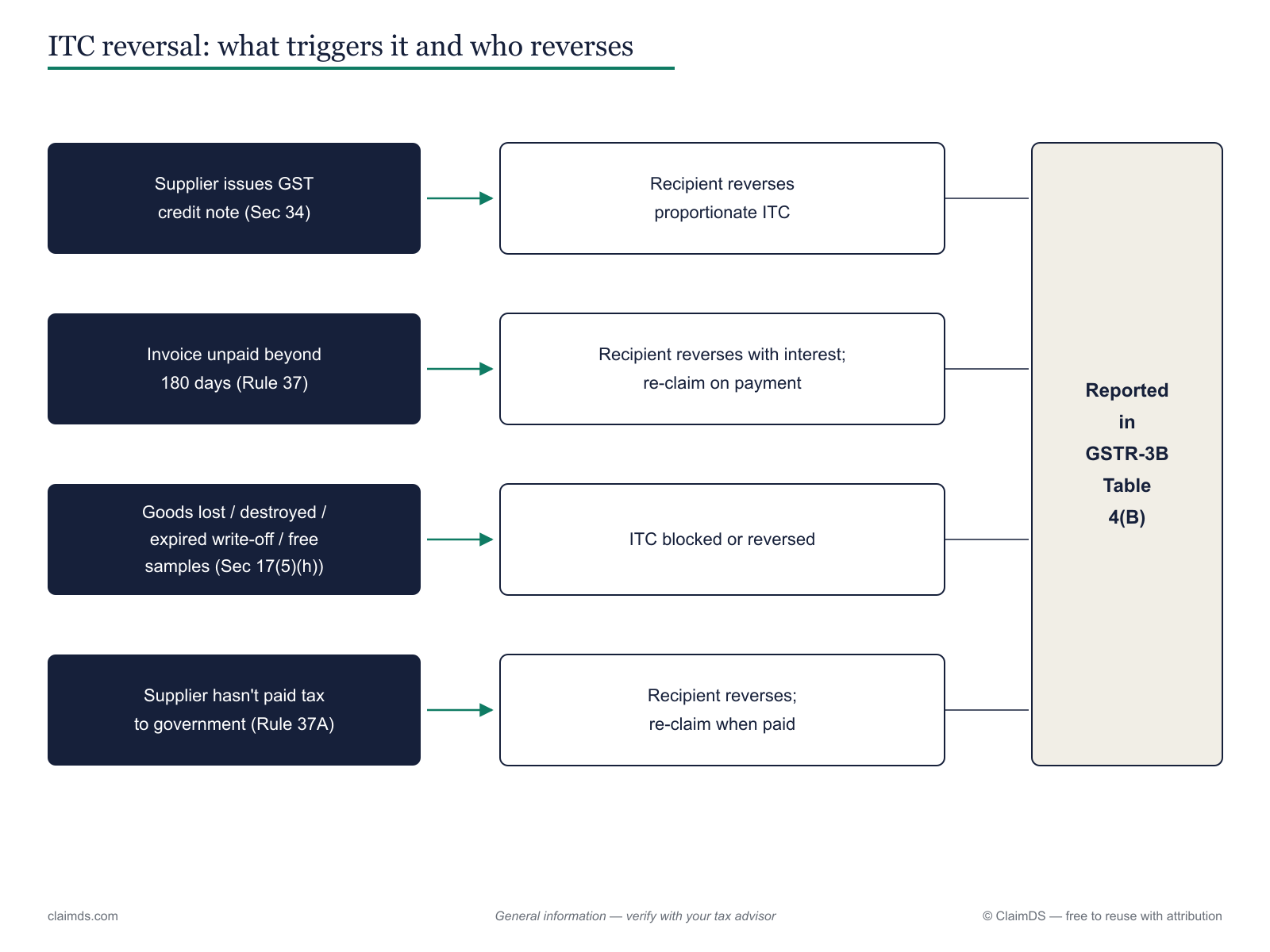
Destroyed time-expired stock triggers an ITC reversal under Section 17(5)(h); a return within the window can run through a credit note instead.
This is the core pharma question, and CBIC Circular 72/46/2018-GST answers it by laying out two distinct routes for time-expired medicines moving back up the channel. Described conservatively, both are legitimate — the difference is who raises the document and how the tax follows the goods. <!-- TODO VERIFY AT PUBLISH + CA REVIEW: Circular 72/46/2018 routes and the credit-note time limit -->
Route (a) — return treated as a fresh supply. Here the returning wholesaler or retailer treats the send-back of expired stock as an outward supply in its own right. The returning party issues a tax invoice to the manufacturer, charges GST on that return supply, and the manufacturer avails ITC on the goods coming back in. The return is, in effect, a mirror-image sale: the stock moves up the chain on a fresh invoice, and the input-tax credit follows it. This route does not depend on any credit-note time limit, because it is not a credit-note mechanism at all — it is a supply.
Route (b) — return against a Section 34 credit note. Alternatively, the manufacturer can issue a Section 34 credit note for the original outward supply, and the expired stock returns against it. Critically, this route is available only within the statutory time limit: the credit note must be issued before the September following the financial year in which the original supply was made, or the date of filing the relevant annual return, whichever is earlier. Once that window closes, the credit-note route is no longer open and the fresh-supply route (a) is the remaining path. <!-- TODO VERIFY AT PUBLISH + CA REVIEW: Circular 72/46/2018 routes and the credit-note time limit -->
The practical discipline is to fix the route at the point the return is initiated, because the two routes carry different documentation and different tax mechanics. A return inside the window can run cleanly through the credit note; a late return has to travel as a fresh supply. The choice interacts with the broader treatment of credit notes for expired and damaged-goods returns, and the timing rules mirror those in GST credit-note time limits and reporting. The stock-side flow that pharma teams run is set out in pharma expiry, breakage and returns, with the settlement steps in the pharma stockist claim settlement process.
Destroyed stock and ITC reversal (Section 17(5)(h))
The two routes above deal with stock that comes back into the channel. But much time-expired medicine is not resold — it is destroyed, and that changes the GST outcome. Under Section 17(5)(h) of the CGST Act, input tax credit is blocked on goods that are lost, stolen, destroyed or written off. So where a manufacturer or stockist has already claimed ITC on stock that is later destroyed on expiry, that credit must be reversed. <!-- TODO VERIFY AT PUBLISH -->
This is a separate question from the credit-note routing. A return can travel via route (a) or route (b); destruction of the expired goods is the event that triggers the reversal, regardless of how the return itself was documented. The party that holds and destroys the goods, and that had taken the credit, is the party that must reverse it. The reversal timing sits alongside the mechanics in ITC reversal on post-sale discounts and credit notes and the Rule 37 180-day rule. <!-- TODO VERIFY AT PUBLISH -->
The commercial question — who bears the loss — is distinct from the tax question. In many pharma arrangements the company compensates the stockist for expired stock, and that compensation is a matter of the scheme terms, not the statute. The company may fund the write-off, or it may physically take the stock back; the funding arrangement does not change the fact that the credit on destroyed goods is blocked under Section 17(5)(h). Conflating the compensation and the reversal is a common source of channel-finance leakage, and it is why the distributor claims management view keeps the money adjustment and the credit reversal on separate ledgers. The way returns and reversals are documented end to end is covered in returns, reversals and cancellations in channel claims.
Which credit note for a pharma scheme?
Not every pharma settlement is a return. Trade schemes, quantity offers and post-supply discounts to stockists raise a different question: which credit note carries the adjustment. As with FMCG, the GST outcome turns on the document, not the scheme's name.
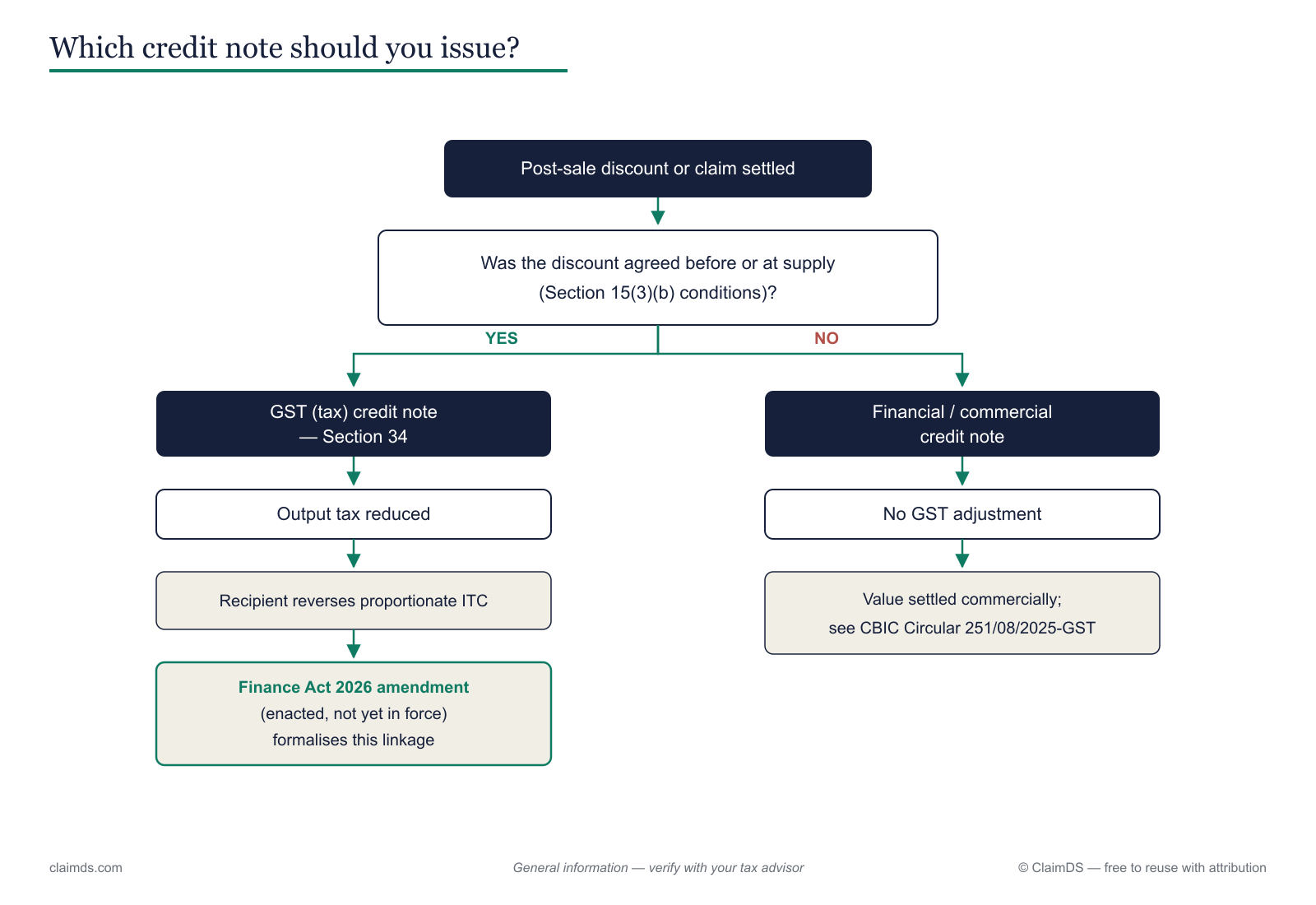
Which credit note applies to a scheme settlement depends on whether the discount met the Section 15(3)(b) conditions agreed before supply.
A Section 34 tax credit note adjusts both value and output tax, and it may be used for a post-supply discount only where the Section 15(3)(b) conditions are met: the discount was agreed before or at the time of supply, it is linked to the relevant invoices, and the recipient reverses the ITC attributable to it. If those conditions are satisfied, the manufacturer's output tax reduces and the stockist reverses the proportionate credit — the two sides move together. <!-- TODO VERIFY AT PUBLISH + CA REVIEW -->
If the conditions were not met — most schemes agreed after the goods have shipped fall here — the tax route is closed, and the settlement runs through a financial or commercial credit note that carries no GST adjustment: value, output tax and the recipient's credit stay untouched. CBIC Circular 251/08/2025-GST, at pointer level and described conservatively, addresses the recipient-ITC treatment where a post-sale discount is passed through a financial or commercial credit note. <!-- TODO VERIFY AT PUBLISH + CA REVIEW --> The full contrast is drawn out in financial vs. tax credit notes under GST and the Section 15(3)(b) conditions in detail, with the circular itself unpacked in CBIC Circular 251 on post-sale discounts. The reconciliation trail into the returns runs through GST adjustments on channel settlements and scheme credit notes against GSTR-2B and 3B, and the documentation stack sits in GST credit notes for rebate schemes.
TDS under Section 194R on stockist incentives
Not every incentive is a discount. When a company gives a stockist a benefit or perquisite in kind — free goods beyond the invoice, a conference trip, gifts, sponsored events — Section 194R brings TDS into play. The provision applies TDS at 10 percent on the value of such benefits, once the aggregate value to a single stockist crosses 20,000 rupees in a financial year. <!-- TODO VERIFY AT PUBLISH: rate, threshold, section mapping -->
The catch that surprises pharma finance teams is that the benefit need not be cash — a benefit in kind still attracts the deduction, so the company must arrange to recover or gross up the tax on a non-cash perk. That is why a stockist trip or a bulk-gift scheme needs the 194R position worked out before it is announced, not at year-end.
Note the framework change: Section 194R is being consolidated into the Income-tax Act, 2025 framework, effective 1 April 2026, so the section mapping and cross-references should be re-checked against the new Act rather than assumed from the older numbering. <!-- TODO VERIFY AT PUBLISH: rate, threshold, section mapping --> The full mechanics sit in Section 194R TDS on dealer and distributor incentives, and the wider tax map across settlement types is in tax on rebates, chargebacks, billbacks and buybacks in India.
The Finance Act 2026 change
There is one moving statutory piece to flag without over-reading it. The Finance Act 2026 enacted amendments touching Section 15(3)(b) and Section 34 of the CGST Act — the very provisions that govern post-supply discounts and credit notes, and therefore both the scheme route and the return route above. The Act received assent on 30 March 2026, but the relevant provisions are not yet notified into force. Enactment and commencement are separate steps under Indian law, and until a commencement notification issues, the amended wording does not operate. Until then, the position above — existing Section 34 read with Circular 72/46/2018-GST and CBIC Circular 251/08/2025-GST — is what applies. Always confirm the current notification status before relying on the amended text. <!-- TODO VERIFY AT PUBLISH: notification status -->
GST note: This article is general information, not tax or legal advice. Every GST position here — the two routes under CBIC Circular 72/46/2018-GST, the Section 34 credit-note time limit, Section 15(3)(b) conditions, Section 17(5)(h) ITC blocking, Rule 37, Section 194R, CBIC Circular 251/08/2025-GST, and the Finance Act 2026 amendments assented but not yet notified into force — must be re-verified at publish time with a qualified professional. Any 18 percent figure used is illustrative arithmetic only, not a rate assertion. <!-- TODO VERIFY AT PUBLISH -->
For a worked illustration: on a ₹1,00,000 return at an illustrative 18 percent GST, a Section 34 credit note issued within the window reduces value by ₹1,00,000 and output tax by ₹18,000, and the stockist reverses ₹18,000 of ITC — whereas the same stock returned late as a fresh supply travels on the returning party's own tax invoice instead. Where the expired goods are then destroyed, the Section 17(5)(h) reversal is a further, separate step. The documentation discipline behind all of this lives in the scheme settlement GST documentation playbook and rebate accounting with GST credit notes. <!-- TODO VERIFY AT PUBLISH -->
Where this fits in the pharma channel
Every settlement above — expiry returns, destroyed stock, schemes, incentives — is one strand of the same channel-finance problem: choosing the right route, proving the basis, and reversing credit where the law requires it. See the full picture in the pillar guide, pharma channel claims and rebates in India, with the chargeback angle in chargebacks in pharma distribution and clawbacks in rebate clawbacks and scheme cancellations. The parallel FMCG treatment is in GST treatment of FMCG claims and schemes. For how ClaimDS enforces the credit-note decision and the reversal trail, see /docs/credit-note and the ITC reversal lifecycle.
Ready to make pharma return and scheme settlement GST-clean by design? Book a demo to see how ClaimDS picks the right route, holds the pre-supply evidence, and keeps the reversal trail audit-ready.
Frequently asked questions
How are time-expired drugs treated under GST?
CBIC Circular 72/46/2018-GST sets out two routes for time-expired medicines: the return can be treated as a fresh supply on which the returning party raises a tax invoice, or it can move against the manufacturer's Section 34 credit note within the allowed time limit. Which route applies turns on timing and whether the goods are destroyed. Confirm the position with a professional.
Does returning expired stock need a credit note?
Not always: under Circular 72/46/2018-GST a return can instead run as a fresh supply, where the wholesaler or retailer issues a tax invoice and the manufacturer avails ITC. The Section 34 credit-note route is available only within the time limit — before the September following the financial year of supply, or the annual-return date, whichever is earlier.
Is ITC reversal required on destroyed pharma stock?
Yes: where time-expired medicines are destroyed, Section 17(5)(h) blocks input tax credit on goods that are written off or destroyed, so credit already taken must be reversed. Who bears that cost commercially between company and stockist is set by the scheme terms, not by the statute. Re-verify the attributable amount and mechanism before filing.
Which credit note is used for a pharma scheme?
It depends on the document, not the scheme label: a Section 34 tax credit note adjusts value and output tax where the Section 15(3)(b) conditions were met before supply, while a financial or commercial credit note carries no GST effect. The tax route also obliges the recipient stockist to reverse proportionate ITC. Decide the type at design time.
Is TDS applicable on stockist incentives?
Yes: Section 194R applies TDS to benefits or perquisites given to a stockist, including benefits in kind such as free goods, trips and gifts, at 10 percent once the aggregate crosses 20,000 rupees in a financial year. The provision is being consolidated into the Income-tax Act, 2025 framework effective 1 April 2026, so re-check the mapping.
What is the time limit to issue a GST credit note on a return?
Under Section 34 the credit-note route for a return is available only up to the earlier of two dates: the 30th of September following the financial year in which the original supply was made, or the date of filing the relevant annual return. Circular 72/46/2018-GST applies this window to time-expired goods; confirm the exact dates before relying on the route.
Is the Finance Act 2026 change to GST credit notes in force?
Not yet: the Finance Act 2026 amendments touching Sections 15(3)(b) and 34 received assent on 30 March 2026, but the relevant provisions are not yet notified into force. Until a commencement notification issues, the existing Section 34 read with Circular 72/46/2018-GST and Circular 251/08/2025-GST is the operative position for pharma returns and schemes.
See ClaimDS on your own claims data
A 30-minute walkthrough tailored to how your channel actually settles claims.
Related posts

Automotive Warranty Claims: Process and GST
How automotive warranty claims work and are taxed — the claim and reimbursement process, and the GST treatment of warranty replacements under Circular 216.
GST and TDS on Automotive Dealer Incentives
How automotive dealer incentives are taxed — credit-note choice under GST and Section 194R TDS on trips, gifts and benefits-in-kind given to dealers.
GST and TDS on Paints Dealer and Painter Rewards
How paints dealer schemes and painter loyalty rewards are taxed — GST credit-note choice and Section 194R TDS on rewards in kind to dealers and painters.