The Real Challenges of Implementing Rebate Management Software in India
Global implementation playbooks assume conditions Indian businesses do not have. The twelve things that actually make rebate software hard to adopt here.
In short
Most implementation guidance for trade-rebate software assumes an ERP with clean APIs, formal signed contracts, and rebate terms that change once a year. Indian channel businesses usually have none of those. The hard parts here are getting usable data out of the accounting package, capturing scheme terms that live in circulars, and settling through GST credit notes with statutory deadlines.
There is a great deal of published advice on implementing trade-rebate software, and most of it was written for a business that does not resemble an Indian mid-market manufacturer or distributor. This article is about the conditions that actually make the move hard here — including several with no clean solution. It is written by a company that sells this category, which makes the honest version more useful than the flattering one.
Two clarifications before the substance: "rebate" here means a trade or channel rebate — money earned back on trade terms, not the income-tax rebate — and "claims" means distributor and channel claims, not insurance.
Why global implementation advice does not transfer
The customer that most implementation guidance imagines has a recognisable shape: separate pricing and commercial-finance functions, an internal IT team that owns system connections, agreements signed annually and stored in a contract repository, and enough scale that multi-currency and multi-entity handling are the interesting problems.
The Indian mid-market customer usually has a different shape entirely. One finance team wears several hats and owns claims alongside statutory compliance and collections. Schemes change quarterly, sometimes monthly, and get amended mid-period by circular. The channel has more tiers than the software's data model expects. There is often no IT function to own a data connection, and the accounting package was chosen for statutory filing rather than for exposing transaction data to other systems.
None of that makes the advice wrong where it was written. It makes it inapplicable. Guidance that opens with "import your existing rebate agreements" assumes a repository of executed agreements exists; the first genuine task here is usually assembling scheme terms that have never lived in one place. Guidance that treats system connection as a configuration step assumes an API; here it is frequently a file-export routine somebody has to run on a schedule.
The result is that businesses arrive at implementation expecting a configuration exercise and discover a data-assembly exercise. That gap — not software capability — is where most of the difficulty sits.
The twelve challenges
| Challenge | Why it is specific to India | What it means for the implementation |
|---|---|---|
| 1. Scheme terms are not in contracts | Schemes are announced by circular, email and messaging app, not executed agreements | Nothing to import; terms must be assembled first |
| 2. Data lives in an accounting package | Tally, Busy, Marg, Zoho and similar are built for statutory filing, not data exchange | File export and upload is the realistic starting point |
| 3. Master data was never built for matching | Party names typed freely, items described not coded, patchy GSTIN discipline in older records | Matching fails here first; cleanup is the biggest task |
| 4. Settlement is a regulated instrument | GST credit notes carry statutory timing and reporting consequences | The settlement step cannot be generic |
| 5. The channel has more tiers | C&F agent, super-stockist, distributor, dealer, sub-dealer, retailer | Schemes funded at one tier and earned at another |
| 6. Secondary sales are reported, not observed | The manufacturer sees only its own invoices | Everything downstream depends on partner-supplied data |
| 7. Schemes change constantly | Quarterly or monthly cycles, frequently amended mid-period | Configuration must be changeable without specialist help |
| 8. There is a withholding layer | Channel payouts and benefits can raise TDS questions | A dimension many tools do not model at all |
| 9. Partners are unevenly digitised | Claim submissions arrive in whatever form the partner can manage | Portal-only designs stall on the least-ready partners |
| 10. The relationship predates the system | Long-standing, personal distributor relationships | Validation can read as suspicion; a change-management problem |
| 11. Someone owns the spreadsheet | One person holds the calculation, and often their standing with it | Working around that person is how implementations quietly fail |
| 12. Mid-market budget, enterprise-shaped problem | Claim complexity rivals far larger businesses; budget and time do not | Constrains what a first phase can reasonably cover |
1. Scheme terms do not live in contracts
In Indian trade, a scheme is typically announced rather than executed. A circular goes out, a sales manager forwards it, terms get clarified in a message thread, and the scheme runs. There may be no single document that states the base, the slab, the eligible partners and the window together.
This bites at the first step of every implementation. The instruction "import your rebate agreements" presumes a repository; here the honest first task is assembling scheme terms that have never coexisted in one place — going through a year of circulars and reconstructing what was actually offered, to whom, on what basis.
What addresses it is unglamorous: collect the circulars, write down each scheme's terms in a consistent structure, and get someone commercially senior to confirm the reconstruction is right. That exercise has value whether or not you buy anything, because it frequently surfaces schemes that were interpreted differently by the two sides all along. <!-- TODO: link the rebate/scheme agreement clause checklist article when built -->
2. The data is in an accounting package, not an ERP with APIs
Most Indian distributors run Tally, Busy, Marg, Zoho Books or something similar. These are built to produce statutory outputs correctly — not to expose transaction data to other systems on demand. Getting invoice-level data out is usually an export-and-upload exercise rather than a live connection.
This is worth stating plainly because it is often framed as a deficiency: it is not. A scheduled file exchange is a legitimate and durable starting point. Most such packages can export to CSV or Excel in some usable form, and a claim process running on a weekly upload is a working claim process. The practical questions are covered in file upload, direct connection or API and what the invoice upload file needs, field by field.
Package-specific starting points exist for Tally, Busy, Marg, Zoho and SAP Business One, with the general pattern in connected claims. The trap is treating a live connection as a prerequisite; it is an optimisation, and pursuing it first delays everything else.
3. Master data was never built for matching
The same distributor typed three ways across a year. Items carried as free-text descriptions rather than codes. GSTIN captured inconsistently in older records. None of this was a mistake when the data was created — it was adequate for billing and filing, which is what it was for.
It stops being adequate the moment a system has to attribute a claim automatically. Matching fails on identity before it fails on calculation, and no amount of engine sophistication compensates for not knowing that three party names are one party.
Cleaning it is the single most underestimated task in any implementation of this kind. It is manual at the start, it needs somebody who knows the business to adjudicate ambiguous cases, and it cannot be meaningfully outsourced to the software. The mitigation is scope, not tooling: clean the party and item master for the one partner group in your first phase rather than the whole book. Master data hygiene covers what "clean enough" actually means.
4. Settlement runs through GST credit notes with a statutory deadline
In most markets a rebate settlement is a commercial document. Here the settlement instrument is regulated: whether a tax or financial credit note is issued has consequences, the reporting window matters, and what the counterparty sees in their own GST statement follows from the choice.
This article asserts no position on any of that, and neither should a vendor. The treatment questions live in rebate accounting and GST credit notes, financial versus tax credit notes, GST credit notes for rebates under Rule 53(1A) and CBIC Circular 251 on post-sale discounts — and the position for your arrangements belongs with your CA.
What it means for implementation is narrower and worth being concrete about: the settlement step cannot be a generic "mark as paid". A tool designed for markets without this layer has nowhere to record which instrument was issued, against which claim, in which period — and that gap surfaces at the first audit rather than at go-live.
<!-- TODO CA REVIEW: confirm this section asserts no tax position. -->5. The channel has more tiers than the software expects
C&F agent, super-stockist, distributor, dealer, sub-dealer, retailer — not every business has all of them, but many have four or more. CFA here means carrying and forwarding agent, a party that holds and dispatches stock without taking title; its role is set out in what a CFA agent does.
The difficulty is not the number of tiers but the mismatch between funding and earning. A scheme funded by the manufacturer may be earned by a sub-dealer two tiers down, claimed by the distributor in between, and settled against an invoice that never involved the earning party. Data models that assume the buyer is the beneficiary cannot express that.
Primary, secondary and tertiary sales sets out the vocabulary, and sub-dealer and multi-tier scheme claims covers the case where the earner is not the buyer. For implementation: establish early which tier each of your schemes is funded at and earned at, because that single question determines whether your data can support the scheme at all.
6. Secondary sales data is reported, not observed
A manufacturer sees its own invoices. Everything below that — what the distributor actually sold onward, to whom, when — arrives only because a partner sends it. This is a structural condition, not a process weakness.
It means every secondary scheme depends on data whose quality, format and timeliness are outside your control. A partner sends a spreadsheet with a different column order each month; another sends nothing until chased; a third sends totals when the scheme needs line detail.
The realistic handling is to agree the format and cycle before the scheme launches rather than after the first disputed claim, which is what receiving secondary-sales data and what good secondary-sales data looks like set out. The partner's side of the bargain is covered in sharing secondary-sales data with brands. No software resolves this; it only makes the gap visible sooner.
7. Schemes change far more often than the software assumes
Where a global rebate agreement may run for a year, Indian trade schemes commonly change quarterly or monthly — and are frequently amended mid-period when a competitor moves or a quarter is running behind.
The implementation consequence is specific: any configuration that requires specialist help to change will not survive contact with a real scheme calendar. If adding a slab or shifting a window needs a support ticket and a three-day turnaround, the business will keep running the scheme in a spreadsheet alongside the system, and you now have two sources of truth.
The test to apply during evaluation is not whether the tool can model your current scheme — every tool demos that well — but whether your own team can change a scheme's terms without help, and whether an amendment mid-period is versioned so claims are validated against the terms that actually applied when the sale happened.
8. There is a withholding layer most tools have never encountered
Payouts and benefits to channel partners can raise withholding questions. Whether a given payout is a commission, a benefit or perquisite, or a trade discount affects the answer, and the characterisation follows the arrangement rather than the label on the payment.
This article states no position and no figure. The questions are covered in Section 194R and dealer incentives and TDS on commission and incentives, 192 versus 194H, and the answer for your arrangements is your CA's to give.
For implementation the point is simply that this dimension exists and a system designed elsewhere does not model it at all. If a payout may carry a withholding consequence, the claim record needs to hold enough about the arrangement for that question to be answerable later — which is a data-capture decision made at configuration time, not a reporting decision made at year-end.
<!-- TODO CA REVIEW: confirm this section asserts no tax position. -->9. Partners are not uniformly digitised
Claims arrive as photographs of hand-written statements, scanned PDFs, spreadsheets, and messages. Partners range from businesses with their own ERP to ones where the proprietor does the accounts personally.
An implementation that requires every partner to adopt a portal on day one will stall — and it will stall specifically on the partners least able to comply, who are frequently long-standing and commercially important. Mandating a channel that a fifth of your partners cannot use is a business decision disguised as a technical one.
The workable approach is to accept mixed submission formats at the start and let structure follow readiness: the partners who can submit a clean file do so, the rest continue as they are while somebody transcribes, and digitisation spreads as partners see the settlement speed difference. That is slower than a clean cutover and considerably more likely to survive.
10. The relationship is older than the system
Indian distributor relationships are frequently long-standing and personal — often predating the current management on both sides. Claims have been settled on trust and conversation for years.
Introducing systematic validation into that can be read as suspicion, and if it is introduced badly it will be. A partner who has claimed the same way for fifteen years and is suddenly asked for line-level evidence hears an accusation, not a process improvement.
This is a change-management problem, not a software problem, and pretending otherwise is how it goes wrong. The framing that works is settlement speed: validation exists so claims can be settled faster and disputes resolved with facts rather than seniority — the argument set out in reducing claim disputes. The framing that fails is control. Which framing your partners hear depends far more on who introduces it, and how, than on the software.
11. Someone owns the spreadsheet
In most businesses of this size, one person holds the calculation. They know which schemes apply to which partners, which exceptions were agreed verbally, and why last quarter's number was adjusted. Frequently their standing in the organisation is bound up with holding it.
Implementations that route around that person fail quietly. The calculation logic in their workbook contains years of accumulated business rules that exist nowhere else, and if they are treated as an obstacle they have no reason to surface them — and every reason to let the new system be found wrong.
The honest handling is to involve them as the source of truth during migration rather than as its subject: their workbook is the specification, their exceptions are requirements to be captured, and the parallel run is validated against their number. That is both the respectful approach and the accurate one, since their number is usually right.
12. The budget is mid-market but the problem is enterprise-shaped
An Indian FMCG business with a few hundred crore of turnover can carry claim complexity rivalling a far larger Western business: more scheme types, more tiers, more partners, a regulated settlement instrument. The budget and the available implementation time do not scale with that complexity.
This is a genuine constraint rather than a complaint, and it should shape expectations honestly. It means "implementation" here cannot reasonably mean a multi-month programme with dedicated staff. It means a phased start on one scheme type, run by people who also have other jobs, extended as it proves itself.
A vendor promising full coverage in the time and budget available is either scoping something narrower than it sounds or has not understood the channel. The realistic version is smaller and slower — and worth more, because it survives.
What a realistic first phase looks like
The method for the migration itself is already covered step by step in migrating rebate claims off spreadsheets, and there is no value in restating it here. What this article adds is the scoping discipline that the twelve conditions above force:
- Pick one scheme type and one partner group. Not your most complex scheme and not your largest partner — the one where the terms are clearest and the data is best.
- Fix party and item master data for that group only. Cleaning the whole book first is how phase one becomes a six-month data project.
- Agree one export format and one submission cycle with that group, and hold to it.
- Run the current process and the new one in parallel for a full cycle — a complete scheme period, not a sample.
- Reconcile the two and investigate every difference before switching. A difference is either a bug or an undocumented business rule, and both are worth knowing.
- Only then widen — next scheme type, or next partner group, not both.
The most common cause of a stalled implementation is attempting every scheme at once. It fails for an unglamorous reason: each scheme type surfaces its own master-data and terms problems, and hitting all of them simultaneously means nothing reaches working state, so there is never a success to build confidence on.
What software genuinely cannot fix
This section matters more than any capability list, because these limits do not move:
Software cannot write the scheme terms that were never agreed. If the base was ambiguous when the circular went out, no system resolves it retrospectively — it can only record which interpretation was applied, and make the ambiguity visible next time.
Software cannot verify secondary sales it has no visibility of. If a partner reports sell-through, the system validates the arithmetic and the format; it cannot confirm the sales happened. That is an audit and commercial question, not a data-processing one.
Software cannot decide the tax characterisation of a payout. Whether a settlement is a discount, a commission or a benefit follows from the arrangement, and the determination belongs to your CA. A system can hold the evidence for the decision; it cannot make it.
Software cannot resolve a commercial disagreement about whether a scheme was fair. It can remove the factual disputes — which terms applied, which invoices counted, what the calculation produced. Whether a target was achievable, or whether a partner deserves discretionary support, is a conversation between two businesses. A tool that claims to settle those has only relocated the argument.
Any evaluation that does not surface these limits is incomplete, whoever is running it.
The questions to ask before you start
Useful in any vendor conversation, including ours:
- Where do our scheme terms currently live, and can we produce a year of them in one place?
- What can our accounting system export, in what format, and what do the fields actually contain — not what the manual says they contain?
- Is our party master usable? How many distinct names should be one party?
- How will settlement documents be produced, and who checks the instrument is the right one?
- Which single scheme type will we run first, and why that one?
- Who owns the current calculation, and are they part of this?
- What happens when a scheme changes mid-period — can our own team make the change, and are claims validated against the terms that applied at the time?
A business that can answer those seven has already done the hard part of the preparation, whoever it eventually buys from. ClaimDS is built for the conditions described above — file-based data exchange, scheme terms captured with versions, GST credit-note settlement, multi-tier attribution. <!-- TODO: confirm capability wording with founder --> It does not remove the master-data work, the terms-assembly work, or the conversation with your partners, and any vendor telling you otherwise is describing a different business than yours.
If you want to work through the seven questions against your own schemes, book a demo and bring a quarter of circulars rather than a requirements document.
Related: what to evaluate in distributor claims software, the claim lifecycle end to end, claims management software and the channel finance category.
Note: This article is general information about implementation practice, not legal, tax or accounting advice. Tax and withholding references route to the linked articles and take no position; confirm any treatment with your own CA.
Frequently asked questions
What makes rebate management software hard to implement in India?
Three conditions the global playbooks do not assume. Scheme terms live in circulars and messages rather than signed contracts, so there is nothing to import. Transaction data sits in an accounting package that exports files rather than serving APIs. And settlement runs through GST credit notes with statutory timing, which tools built for other markets have nowhere to put.
Do I need an ERP with an API to use rebate software?
No. A scheduled file exchange — export invoice and sales data to CSV or Excel, upload it on an agreed cycle — is a legitimate and durable starting point, not a failure or a stopgap. Most Indian accounting packages can export in some usable form. A live connection is an optimisation you can pursue later, once the claim process itself is working.
Why is master data cleanup the biggest task?
Because automated matching fails on party and item identity before it fails on anything else. If the same distributor is typed three different ways across a year of invoices, or items carry descriptions instead of codes, no calculation engine can reliably attribute a claim. Cleaning that is unglamorous, entirely manual at the start, and consistently the most underestimated task in any implementation.
How long does a rebate software implementation take?
It depends almost entirely on two things you can assess before signing anything: how many scheme types you run and how ready your party and item master data is. A business with one scheme type and clean masters is a different exercise from one with twelve scheme types and inconsistent party names. Any timeline quoted before those are known is guesswork.
Should we migrate all our schemes at once?
No, and attempting it is the most common cause of a stalled implementation. Start with one scheme type and one partner group, get that settling correctly end to end, then widen. A narrow first phase that actually works is worth more than a broad one that is still being debugged when the next scheme period opens.
What if our distributors are not digitised?
Design for the partners you have, not the ones you want. Claims will arrive as photographs, scans, PDFs and messages, and an implementation that requires every partner to adopt a portal on day one will stall on the partners least able to comply. Accept mixed submission formats first, and let digitisation follow the partners who are ready for it.
Why do implementations fail?
Rarely because the software cannot calculate. They fail on data readiness — master data too inconsistent to match — on scope taken too wide at the start, and on the ownership question, where the person who has always held the calculation is worked around rather than involved. All three are visible before you begin, which is what makes them worth checking.
What should we prepare before evaluating vendors?
Four things, and they are useful whoever you buy from. Collect a year of scheme circulars in one place. Export a month of invoice data from your accounting package and look at what the fields actually contain. Count how many distinct party names should be one party. And decide which single scheme type you would run first.
See ClaimDS on your own claims data
A 30-minute walkthrough tailored to how your channel actually settles claims.
Related posts

What a Distributor Actually Earns After Rebates
Your invoice margin is not your real margin. How supplier rebates, schemes and claims change what a distributor earns — and why the timing hides it.
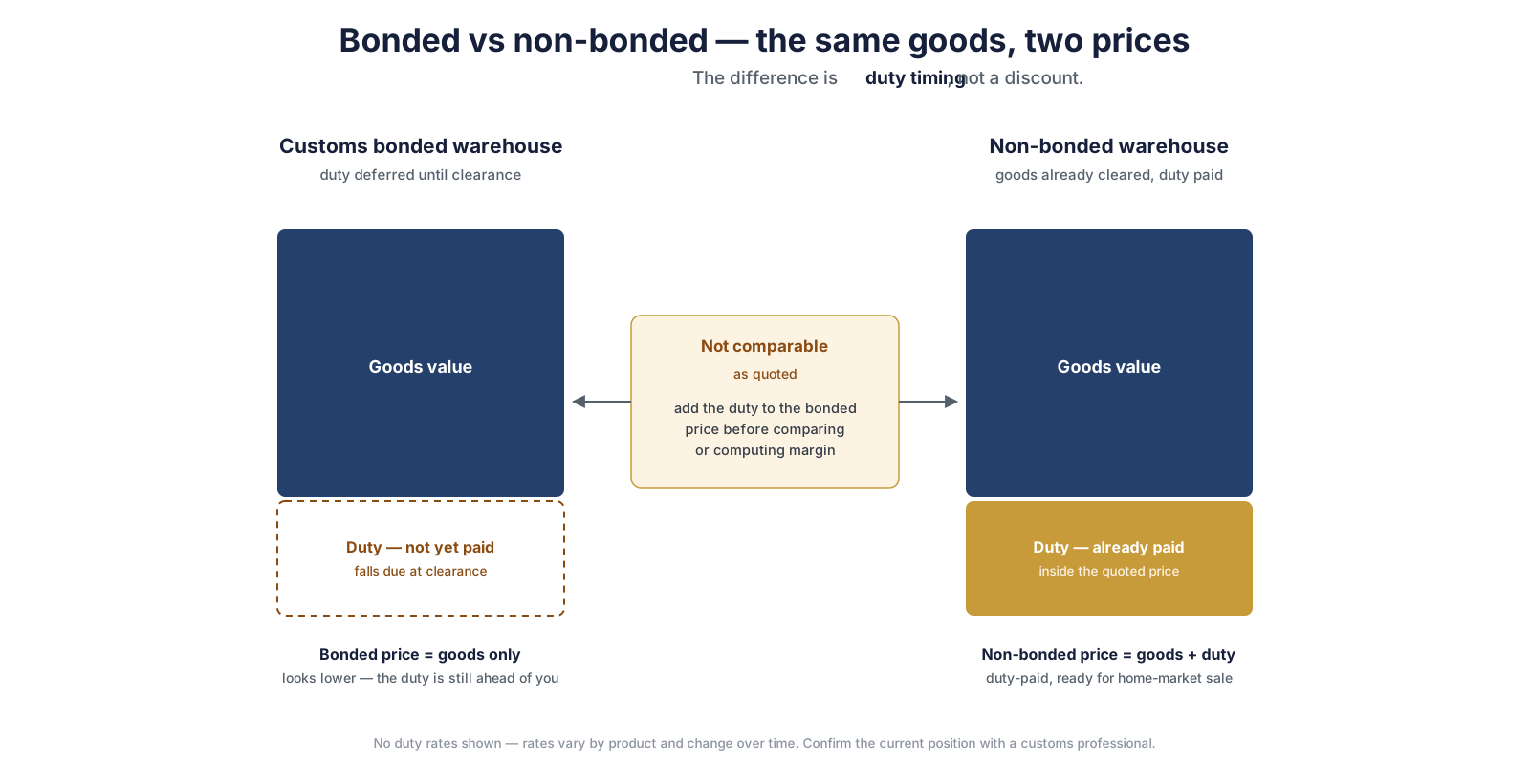
Bonded vs Non-Bonded Warehouse Pricing: Why the Same Goods Carry Two Prices
Why the same imported goods carry different prices in a bonded and a non-bonded warehouse, and what that means for quoting, costing and margin.
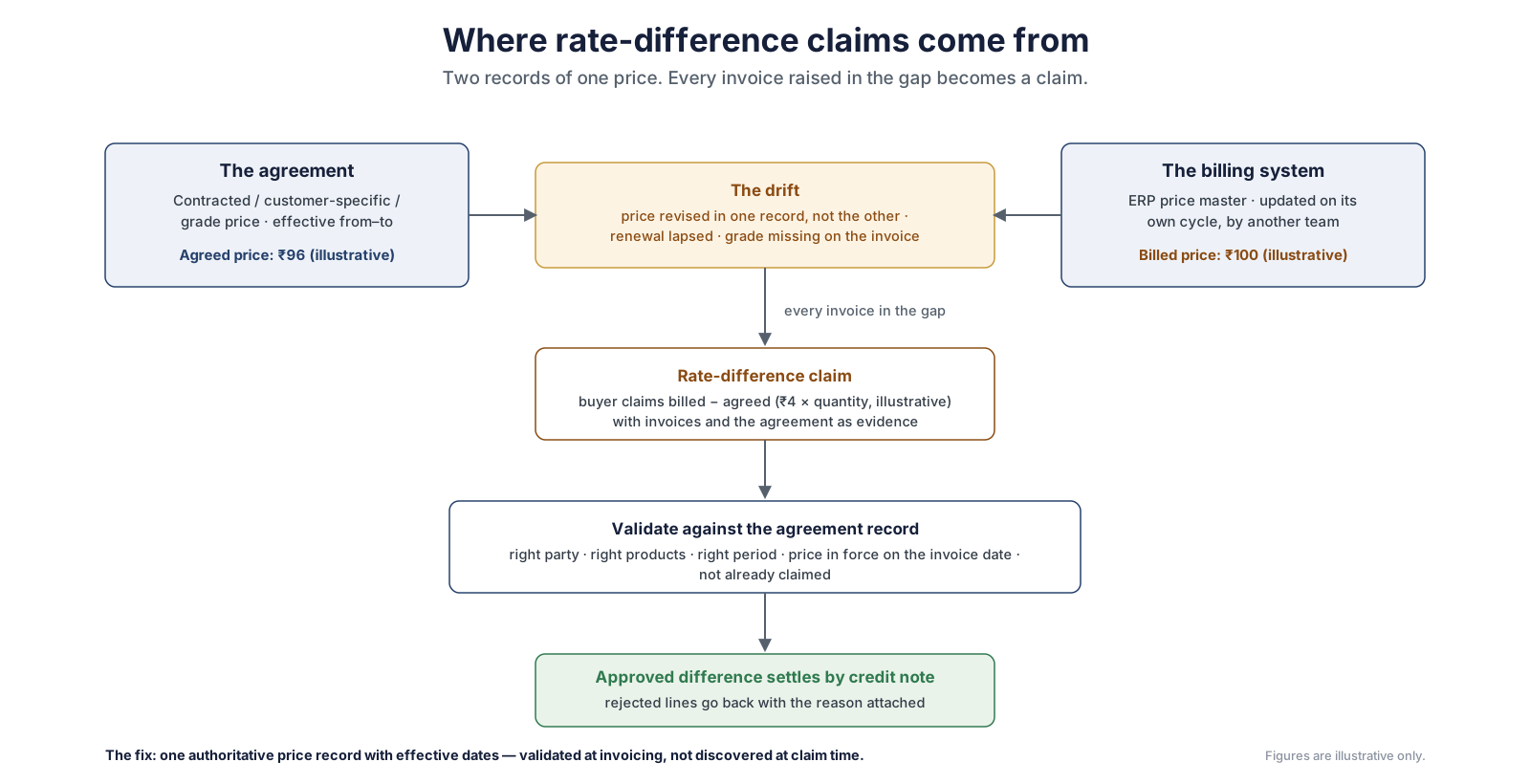
Contracted, Customer-Specific and Grade Pricing: How Negotiated Prices Work
Negotiated prices — contracted, customer-specific and grade-based — and the claims and reconciliation work each one creates.