Master Data Hygiene: Why Claims Fail Before Anyone Checks the Scheme
Most claim reconciliation failures are master-data failures. How party codes, GSTINs and SKU mapping decide whether a scheme claim settles cleanly or gets disputed.
In short
Most claim disputes are not disagreements about the scheme — they are mismatches in master data. If the same distributor is spelled three ways, or the same product carries different codes in two systems, the claim cannot be matched automatically and someone reconciles it by hand.
Most claim disputes are not disagreements about the scheme — they are mismatches in master data. If the same distributor is spelled three ways, or the same product carries different codes in two systems, the claim cannot be matched automatically and someone reconciles it by hand.
| Master data set | What it is | How it goes wrong | The claim failure it causes |
|---|---|---|---|
| Parties | Distributors, dealers, retailers and their identities | Free-text names typed differently; branches and head office conflated; group companies merged | Claims can't be attributed to the right partner; entitlement is computed on a partial base |
| Products | SKU codes, pack sizes, units of measure | Descriptions used instead of codes; pack changes mid-scheme; new launches unmapped | Scheme product scope applied wrongly — in-scope items missed, out-of-scope counted |
| Schemes | Terms, periods, eligibility, slabs | Terms live in circulars, emails and trackers; two versions in circulation | Validation becomes opinion; two sides apply different terms to the same claim |
| Tax identifiers | GSTIN, HSN | Missing for smaller parties; branch registrations used inconsistently | Party matching fails; settlement documents carry wrong particulars |
The party problem
The single most expensive data problem in Indian channel claims is deciding who a claim belongs to.
The same distributor arrives as "Sharma Traders", "Sharma Traders Pvt Ltd", "M/s Sharma Traders" and "Sharma Trdrs" across four months of files — four parties to any matching process, one party to everyone who works there. Add the branch question and it compounds: a distributor billing from two locations under separate registrations is genuinely two counterparties for tax purposes and often one commercial relationship for scheme purposes. Which one the scheme rewards is a commercial decision that has to be made explicitly, not discovered at settlement.
GSTIN is the reliable anchor because it is unique, verifiable and stable — it does not depend on who typed it, and it distinguishes branches that share a trading name. Names remain useful for humans reading a report; they should never be the identifier a system matches on. That is why GSTIN sits in the essential column of the invoice upload file specification.
The product problem
Schemes are scoped by product, so product identity decides the claim base.
Codes versus descriptions. A scheme covering a shampoo range is applied by code. Free-text descriptions vary by operator and over time — "Shampoo 180ml", "Shmp 180 ML", "180ml shampoo btl" — so scope application becomes guesswork. Descriptions belong in the file as labels for humans; codes are what the matching runs on.
Pack size and unit changes. When a pack changes mid-scheme, quantity-based schemes break quietly: the same physical volume now counts as a different number of units, and a slab computed on units shifts without anyone deciding it should. This hits quantity-based and slab schemes hardest, because their arithmetic depends entirely on comparable quantities.
New SKUs launched inside a scheme period. Without a mapping and an explicit eligibility decision, the launch falls into a gap — counted by one side, not the other. The fix is procedural, not technical: a rule that says every new SKU gets a scheme-eligibility decision and a mapping entry before it is billed.
The scheme problem
Scheme terms are master data too, and they are the set most often left informal.
Terms living in a circular PDF, a WhatsApp forward, a sales tracker and someone's email means there is no single authority to validate against — so validation becomes opinion, and two versions of "the scheme" circulate simultaneously. The mid-period amendment makes it worse: if a slab is revised in week six and the revision reaches the field but not finance, claims arrive under one set of terms and are checked against another.
One authoritative, versioned record fixes this — versioned specifically so that a claim is checked against the terms that applied when it was earned, not the terms as they read today. That is the foundation the trade schemes explained mechanics assume, and what makes a claim validation defensible rather than arguable.
A practical clean-up sequence
Order matters here — doing these out of sequence wastes the work.
- Fix parties first, anchored on GSTIN. Build the definitive party list, resolve duplicates, decide the branch-versus-head-office treatment explicitly, and record which registration each scheme relationship attaches to.
- Agree one product master, plus a mapping table per counterparty. You will not persuade every partner to adopt your codes; you can maintain a mapping from theirs to yours. Treat that mapping as a shared, maintained asset, not a one-off exercise.
- Put scheme terms in one authoritative place, with versions. Every scheme: reference, period, eligibility, slabs, caps, exclusions, and what changed when.
- Only then automate the matching. This ordering is the whole point — automating on top of messy master data multiplies the mess rather than fixing it. Matching applies your inconsistencies at speed and with confidence, turning errors a human would have queried into settled numbers nobody questions.
Keeping it clean
Clean-up is a project; hygiene is a process. Three things keep it from decaying:
Named ownership for each data set — parties, products, schemes — with the owner sitting where the consequences land.
A change process for new SKUs and new parties: who requests, who approves, what has to be decided (scheme eligibility, mapping, GSTIN capture) before the first transaction.
Periodic review — a quarterly pass over new parties added, unmapped item codes seen in files, and claims that needed manual matching. That last number is the honest health metric: if it is rising, master data is decaying regardless of what the process says.
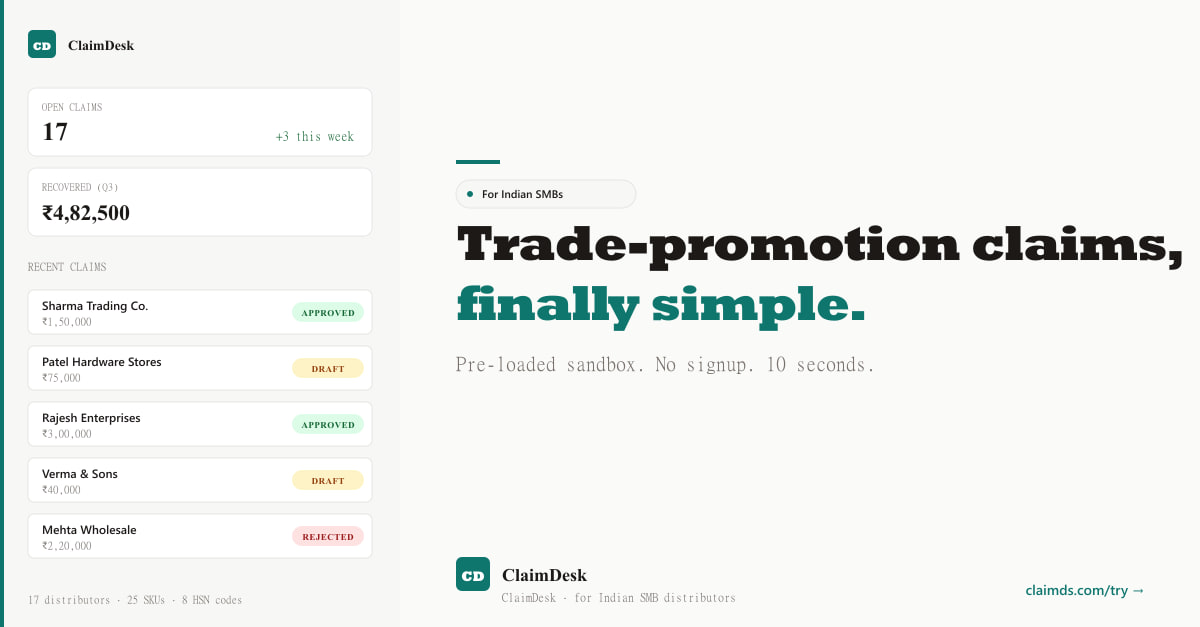
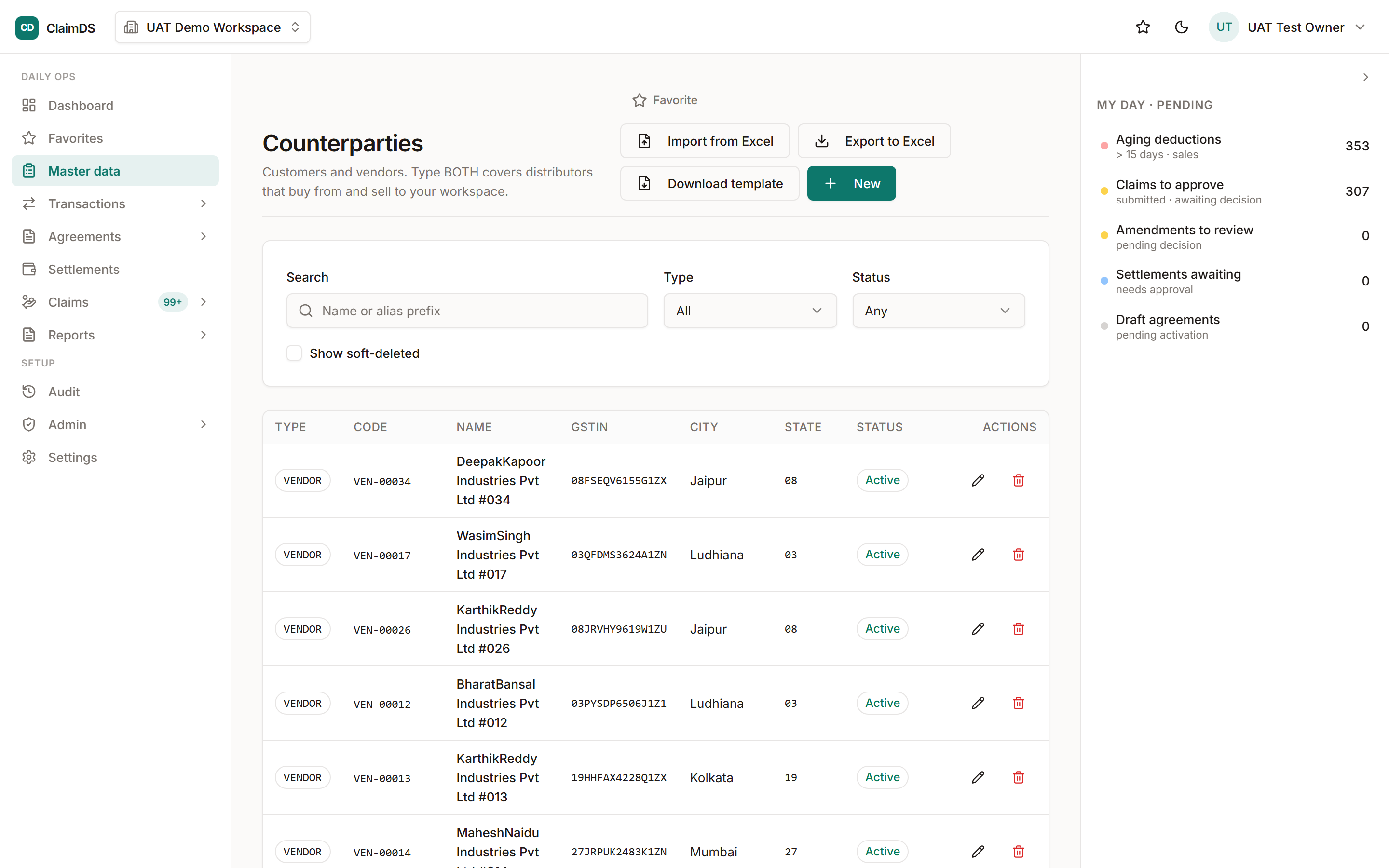
ClaimDS holds counterparties, materials and agreement terms as maintained master records, matches incoming claim and invoice data against them, and surfaces unmatched rows as exceptions for review rather than silently dropping or guessing them — so the decay shows up as a visible queue instead of a settlement surprise. The wider data-movement picture is in connected claims.
To pressure-test your own master data against a live claim run, book a demo.
Note: General information about data management practice. GSTIN is referenced here only as a party identifier — for its tax significance, see our GST and compliance articles and confirm positions with your adviser.
Frequently asked questions
Why do distributor claims fail to reconcile?
Usually because the data on each side cannot be matched, not because the scheme is in dispute. The same distributor appears under different names or registrations, products carry different codes in the two systems, or units differ between files. Matching then falls to a person, which is slow, inconsistent between months, and the origin of most settlement arguments.
Why use GSTIN as the party identifier?
Because it is unique, verifiable and stable, where a party name is none of those things. Names get typed differently by different operators, abbreviated inconsistently, and changed after a rebranding — so name-based matching quietly fails. Anchoring on GSTIN also distinguishes branches and group companies that share a trading name but are separate registrations.
What is SKU mapping and why does it matter for claims?
SKU mapping is the agreed table linking the codes one party uses for a product to the codes the other party uses for the same product. It matters because a scheme's product scope is applied by code — without a mapping, in-scope items get missed and out-of-scope items get counted, so the claim base is wrong before any scheme logic runs.
What happens when a new SKU launches mid-scheme?
Unless it is added to the product master and the mapping, and its scheme eligibility decided explicitly, it falls into a gap — counted by one side and not the other, which surfaces as a disputed claim at settlement. New launches inside a live scheme period need a defined rule: in scope or out, from which date, and who updates the mapping.
Should master data be cleaned before automating claims?
Yes. Automating matching on top of inconsistent master data does not fix the inconsistency — it applies it faster and more confidently, producing wrong answers at scale rather than obvious errors a person would have caught. Fix parties first, then products, then put scheme terms in one authoritative place, and only then automate the matching.
Who should own master data?
One named owner per data set, sitting with the team that feels the consequences — commonly finance or commercial operations for parties and schemes, and the product or supply-chain team for SKUs. What matters more than the department is that additions and changes follow a defined process rather than being made ad hoc by whoever notices a gap first.
See ClaimDS on your own claims data
A 30-minute walkthrough tailored to how your channel actually settles claims.
Related posts

What Faster Claim Settlement Is Worth: Claims, Cash and Working Capital
An unsettled claim is your money sitting in someone else's system. How settlement speed affects a distributor's working capital, with worked examples in rupees.
Connected Claims: How Invoice and Sales Data Moves Between Your ERP, Your Brands and Your Claims
How invoice and secondary-sales data moves between a distributor's ERP, the brand, and the claim settlement — file upload, direct connection, and what each is good for.
Exporting Sales and Purchase Invoices from Tally for Claim Settlement
How to get invoice data out of Tally in a form a claims workflow can use — what to export, which fields matter, and how to keep the data clean enough to reconcile.