Connected Claims: How Invoice and Sales Data Moves Between Your ERP, Your Brands and Your Claims
How invoice and secondary-sales data moves between a distributor's ERP, the brand, and the claim settlement — file upload, direct connection, and what each is good for.
In short
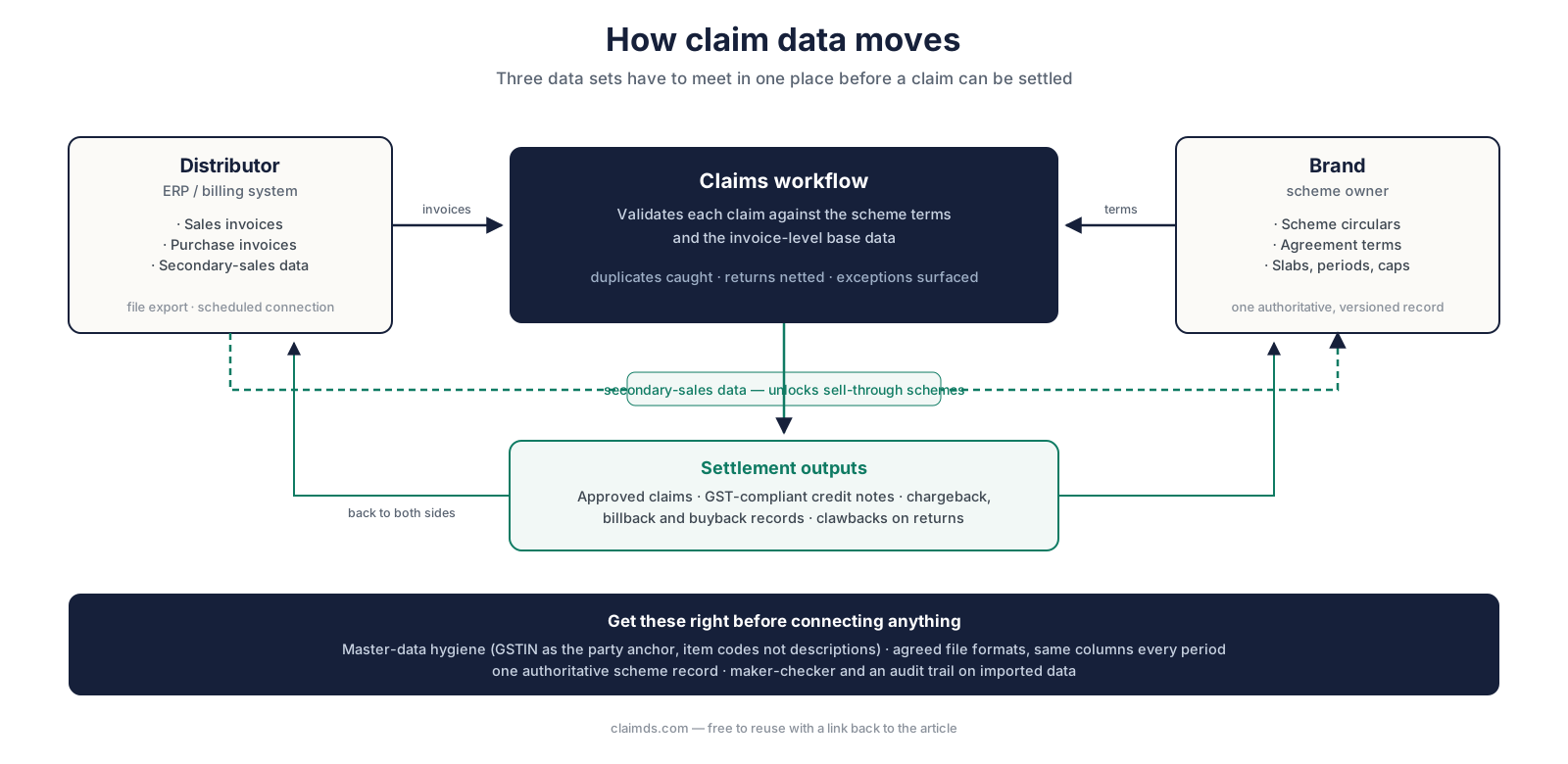
Claim settlement needs three data sets to meet in one place — the invoices from whatever ERP the distributor runs, the scheme terms from the brand, and the secondary-sales data the brand wants to see. Connecting them means moving that data reliably, by file upload or direct connection, so settlement becomes a reconciliation rather than an argument.
Claim settlement needs three data sets to meet in one place — the invoices from whatever ERP the distributor runs, the scheme terms from the brand, and the secondary-sales data the brand wants to see. Connecting your ERP for claims means moving that data reliably, by file upload or direct connection, so settlement becomes a reconciliation rather than an argument.
| What data moves | From where | To where | Why it matters |
|---|---|---|---|
| Sales invoices | Distributor's ERP or billing system | Claims workflow | Establishes what was sold, to whom, at what value |
| Purchase invoices | Distributor's ERP | Claims workflow | Establishes what was bought from the brand, and at what price |
| Scheme and agreement terms | Brand | Claims workflow | Establishes entitlement — what was earned, under which conditions |
| Secondary-sales data | Distributor | Brand | Unlocks schemes that reward sell-through rather than stocking |
| Settlement outputs — claims, credit notes, chargeback and billback records | Claims workflow | Brand and distributor | Closes the loop and returns the accounting entries |
The two foundations this depends on now have their own references: the invoice upload file, field by field and master data hygiene.
Why is claim settlement really a data problem?
Nothing about a trade scheme is intellectually difficult. A circular states terms; a partner achieves something; a payout follows. The difficulty is that the three pieces of evidence needed to prove all that live in three different places, owned by different people, in different formats.
The invoices sit in the distributor's accounting system — one of dozens in use across an Indian channel, from single-user billing packages to full ERPs. The scheme terms sit with the brand, often as a PDF circular plus a sales-team tracker. The secondary-sales data, where a scheme needs it, sits in the distributor's billing system or a DMS and reaches the brand only if someone sends it.
Every manual reconciliation is a join across those three sources, done by hand, usually under month-end pressure. That join is where the delay comes from, and where the disputes come from — not because anyone is being difficult, but because two parties recomputing the same number from different data will reach different answers. The pattern repeats at every tier of the Indian multi-tier channel, and it is the structural gap behind why distributor claims slip through the cracks and much of the margin leakage that follows.
What are the three ways data moves?
Manual file export and upload. Someone exports a register from the accounting system to CSV or Excel and uploads it to the claims workflow on an agreed cycle. This is universal — most systems can export invoice data to CSV or Excel — and needs no technical project on either side. Its cost is human: someone repeats it every period, and the data must be consistent enough to load without hand-fixing. For most Indian distributors and mid-sized brands this is the right place to start.
A scheduled direct connection. The two systems exchange data on a schedule with no person in the loop. Less recurring effort, more setup: both sides agree formats, access and error handling. It suits higher volumes and stable relationships.
Structured GST data. Where e-invoicing applies, invoice data has already been validated and structured as a by-product of compliance — an India-specific starting point most markets don't have, and the subject of your e-invoice and GSTR data is already your claims dataset.
None is right in every case. Volume, frequency, technical capacity on both sides and the stability of the format decide — the trade-offs are set out plainly in file upload, direct connection or API.
What does the distributor get?
Less re-keying, first. A distributor who exports invoice data once and uploads it does not then retype the same figures into a claim format — and the claim carries its evidence with it, which stops the query loop before it starts.
Second, claims computed from actual data rather than reconstructed estimates. When a claim is built from the same invoices the distributor's own books carry, the number claimed and the number the brand recomputes come from the same base, and a large share of disputes never arise.
Third, visibility of what is claimed versus what is settled. The most common distributor complaint is not that a claim was rejected but that nobody knows where it is. A claims workflow with a status view answers that without a phone call, and the ageing of open claims becomes something both sides can see. ClaimDS keeps claims, their evidence, their status and their settlement history in one place for exactly that reason — the discipline described in how to submit a rebate claim.
What does the brand get?
Claims arriving in a consistent format with the underlying invoice data attached. That single change converts claims processing from investigation into validation: the team checks a computation against terms instead of assembling the base data first.
Faster validation follows. Where claims arrive with invoice-level detail, the routine majority can be checked mechanically — party eligibility, period, product scope, slab, duplicates, returns netted — and only genuine exceptions reach a person. That is the throughput pattern behind any high-volume FMCG claim settlement process.
And secondary-sales visibility, where partners share it, makes verification-dependent schemes fundable at all. A brand that cannot see offtake either under-funds sell-through schemes or funds them blind — the sell-in versus sell-through distinction becomes practical rather than theoretical only when the data arrives.
Connect what you already run — don't replace it
The honest positioning: a claims settlement layer sits beside the ERP and the DMS, not above either.
Your ERP remains the accounting system of record. It records invoices, holds the ledger and produces your statutory reporting. What it generally does not hold natively is scheme terms as they are actually written, per-partner entitlement across a period, a claim approval trail, or clawback logic when goods come back. Those are the objects a claims workflow exists to carry — the argument set out in ERP integration for claims and rebates, and in practice for teams running claims beside their accounting system.
A DMS, similarly, runs the front of the channel — ordering, field force, beat coverage, stock and secondary-sales capture. It answers what happened in the market. A claims settlement system answers what is owed, to whom, under which scheme, and how it was paid. Companies routinely run both, with secondary-sales data flowing from the DMS into the settlement layer.
Other vendors also offer connectors and data exchange; this is not a unique capability and should not be evaluated as one. The useful question is narrower: does the connection exist to produce a reconciled, GST-compliant settlement at the end of it, or does it stop at moving files around?
What to get right before you connect anything
Connecting systems on top of messy foundations multiplies the mess rather than fixing it. Four things come first:
Master-data hygiene. Parties anchored on GSTIN rather than free-text names, product codes rather than descriptions, and an agreed mapping where two systems use different codes. This is the single largest cause of failed reconciliation.
Agreed file formats. The same columns, in the same order, with the same date and number conventions, every period. Inconsistency between one month's file and the next breaks more uploads than any technical fault.
One authoritative scheme record. Terms in one versioned place, not spread across circulars, emails and trackers — otherwise validation is opinion rather than checking, and the settlement factsheet that should end a dispute has nothing firm to cite.
Maker-checker on imported data. Once data arrives from another system rather than being keyed in, controls move to the boundary: what was loaded, by whom, covering what period, what was rejected, and what changed after loading.
Get those right and the connection method almost stops mattering. Get them wrong and no amount of technical sophistication makes the claims reconcile.
To see invoice data, scheme terms and settlement running as one flow on your own schemes, book a demo.
Note: General information about data and process design, not tax or legal advice. Where settlement runs through GST credit notes, the treatment is covered in our tax treatment of rebates and claims pillar and should be confirmed with your adviser.
Frequently asked questions
What does it mean to connect an ERP to a claims system?
It means invoice data leaves the accounting or billing system and reaches the claims workflow in a usable form — by exporting a file and uploading it, by a scheduled transfer, or by a direct connection between the two. The ERP stays the accounting record; the claims workflow holds the scheme terms, entitlement and settlement history the ERP was never designed to carry.
Can I use my existing ERP for claim settlement?
Your ERP remains the source of invoice data and the accounting record, and most schemes can be settled without replacing it. What ERPs generally lack is a native home for scheme terms, per-partner entitlement, claim approval trails and clawback logic. The practical pattern is to keep the ERP and run claim settlement beside it, exchanging invoice data and settlement outputs.
What data does a brand need to settle a distributor claim?
At minimum the invoices behind the claim — number, date, party with GSTIN, item code, quantity, rate, taxable value and document type — plus the scheme reference being claimed under. Schemes rewarding sell-through additionally need secondary-sales data showing onward sales to retailers. Without invoice-level detail a brand can only trust the claimed figure or dispute it.
What is secondary-sales data used for in claims?
It evidences what a distributor sold onward to retailers, which is what secondary, coverage and liquidation schemes reward. Purchase data alone shows only what a distributor bought, so a brand funding schemes on offtake cannot verify them from its own invoices. Sharing secondary data in an agreed format is usually what makes verification-dependent schemes settleable at all.
Do I need an API to share claim data?
No. A file export uploaded on an agreed cycle works for most Indian distributors and mid-sized brands, and every common accounting system can produce one. An API reduces manual effort at higher volumes but needs technical setup on both sides. Data consistency matters far more than the transfer method — a clean monthly file reconciles better than a messy live feed.
Does a claims system replace a DMS?
No — they cover different parts of the channel. A distributor management system runs the front end: ordering, field-force activity, stock and secondary-sales capture. A claims settlement system takes the resulting scheme claims and settles them against agreement terms, producing credit notes and an audit trail. Many companies run both, with secondary-sales data flowing from one to the other.
What is the difference between a DMS and a claims settlement system?
A DMS is built around the movement of goods and field activity through the channel — orders, beats, stock, secondary sales. A claims settlement system is built around entitlement and money — scheme terms, validation against those terms, approvals, credit notes and clawbacks. The DMS answers what happened in the market; the settlement system answers what is owed, and why.
See ClaimDS on your own claims data
A 30-minute walkthrough tailored to how your channel actually settles claims.
Related posts

What Faster Claim Settlement Is Worth: Claims, Cash and Working Capital
An unsettled claim is your money sitting in someone else's system. How settlement speed affects a distributor's working capital, with worked examples in rupees.
Exporting Sales and Purchase Invoices from Tally for Claim Settlement
How to get invoice data out of Tally in a form a claims workflow can use — what to export, which fields matter, and how to keep the data clean enough to reconcile.
File Upload, Direct Connection or API: How Claim Data Actually Moves
Three ways invoice and claim data moves between systems — plain English, no jargon, with the trade-offs of each for an Indian distributor or brand.