Your E-Invoice and GSTR Data Is Already Your Claims Dataset
E-invoicing already produces validated, structured invoice data. The same data can reconcile distributor claims and scheme settlements — here's how it fits together.
In short
If you are covered by e-invoicing, every B2B invoice you issue is already validated and carries an IRN — structured, machine-readable data. Your GSTR-1 is auto-populated from it, and your buyer sees it in GSTR-2B. That same dataset is what a claim must be reconciled against, so much of the evidence a scheme settlement needs already exists.
If you are covered by e-invoicing, every B2B invoice you issue is already validated and carries an IRN — structured, machine-readable data. Your GSTR-1 is auto-populated from it, and your buyer sees it in GSTR-2B. That same dataset is what a claim must be reconciled against, which means much of the evidence a scheme settlement requires already exists inside your compliance process.
| What e-invoicing produces | An IRN, a digitally signed JSON of the invoice, and a QR code — the invoice's particulars in a standard structure |
| Where it flows | Auto-populates your GSTR-1; the counterparty sees the supply in their GSTR-2B |
| Who it applies to | Businesses whose aggregate turnover exceeded ₹5 crore in any financial year from 2017-18 onwards, for B2B supplies (exemptions apply) |
| The 30-day rule | From 1 April 2025, taxpayers with aggregate annual turnover of ₹10 crore or more cannot report a document to the IRP more than 30 days after its issue date |
| Why claims care | Invoice-level, validated data already reconciled to GST — the exact base a scheme claim has to be computed from |
Confirm every threshold, date and rule above against the current position with your tax adviser before relying on it operationally.
What does e-invoicing actually produce?
Written for a finance manager rather than a developer: when you raise a B2B invoice under e-invoicing, your billing system sends the invoice particulars to the government's Invoice Registration Portal. The portal checks the structure, registers it, and returns three things — a unique Invoice Reference Number (IRN), a digitally signed version of the invoice data, and a QR code encoding its key fields.
The important part is not the paperwork; it is what happens to the data. Because the invoice was registered in a standard structure, your outward-supplies return is auto-populated from it, and your customer sees the same supply in their own statement.
So, as a by-product of compliance, you now hold an invoice-level dataset that is structured, validated, and already agreed with the tax system. That is an unusual asset. Most businesses designing a claims process assume the invoice data has to be assembled and cleaned first — and where e-invoicing applies, a large part of that work has already happened.
Why does that matter for claim settlement?
A scheme claim asks one question: which invoices qualify, at what value, in what period? That is precisely what invoice-level data answers.
Consider where claim disputes actually begin. Two parties compute a scheme payout and reach different numbers. Almost always, the divergence is in the base — which invoices were counted, whether returns were netted off, where the period boundary fell, whether a dispatch belonged to this quarter or the next. Both sides are arguing about the underlying transactions, not about the scheme.
Using validated invoice data as the claim base removes that argument. The transactions are not in dispute, because they are the same transactions both sides reported to the GST system. What remains is the real commercial question — did this achievement earn that slab under those terms? — which is a conversation worth having, unlike a three-week reconciliation between two spreadsheets.
This is why invoice-level validation underpins calculating distributor claims correctly, and why loose claim-to-invoice mapping sits behind so much margin leakage.
Where do GSTR-1 and GSTR-2B fit?
Your GSTR-1 carries your outward supplies; your counterparty's GSTR-2B shows what their suppliers reported inward, and the input tax credit available to them. For claims, the interesting flow is at the settlement end: when a claim is settled through a tax credit note, the supplier reports it and the recipient sees it in GSTR-2B as a reduction of available credit.
That mutual visibility is a control, not a nuisance. A settlement your counterparty can see in their own statement is one they can verify without asking you — and, equally, an error they will notice even when you don't. Matching the claims register against what actually reached the returns is the month-end discipline in reconciling scheme credit notes across GSTR-2B and 3B, and the recipient-side consequences are in ITC reversal on post-sale discounts.
Which route a settlement takes — tax credit note or commercial credit note — is a separate decision with its own consequences, covered in CBIC Circular 251 and the tax-versus-financial credit-note guide. This article asserts no new position on that choice.
Why does the 30-day rule make claim timing matter more?
For taxpayers with an aggregate annual turnover of ₹10 crore or more, a document cannot be reported to the IRP more than 30 days after its issue date — the portal simply will not generate an IRN. That applies to credit notes as much as to invoices.
The operational consequence is narrow but real: back-dated documentation is not available as a fallback. A settlement that should have been documented in one period cannot be quietly papered over months later with a back-dated document, because the reporting window has closed. Set alongside the separate Section 34 time limits governing when a tax credit note can still be declared — and the rate that applies when a settlement lands after a GST rate change — the message is consistent: late settlement is not only a cash problem, it is a documentation risk. Confirm the rule's applicability to you, and its current form, with your adviser.
What this does not do
Being honest about the limits matters more here than the promise.
E-invoice data tells you what was invoiced. It does not tell you what scheme applied — scheme terms live in circulars and agreements, not in invoice data. It does not tell you what secondary sales happened, because a distributor's onward sales to retailers are their transactions, not yours. And it does not tell you whether a claim qualifies — eligibility, slab conditions, caps and exclusions are commercial terms no tax dataset carries.
E-invoice data removes the arithmetic argument. It does not remove the entitlement question. Anyone presenting it as the whole answer to claim settlement is overselling it.
Putting it together
A working settlement takes three inputs: the invoice data (validated and invoice-level — increasingly a by-product of e-invoicing), the scheme terms (one authoritative, versioned record), and, where the scheme depends on it, secondary-sales data from the partner. Bring those together and settlement becomes a reconciliation rather than a negotiation.
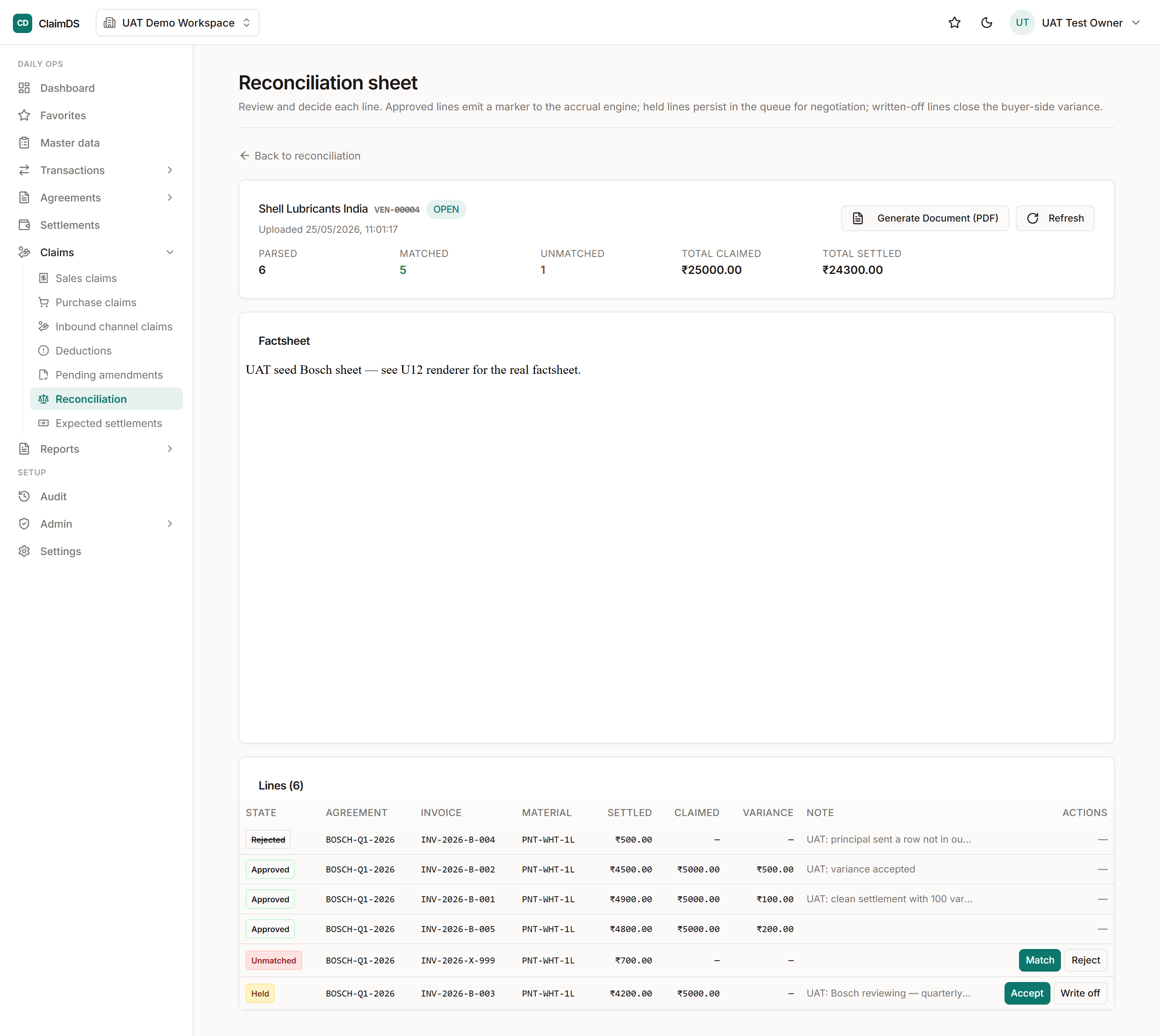
That is the shape of ClaimDS: rebate agreements holding the scheme terms, claims validated against those terms and the invoice-level base data, exceptions surfaced for review rather than buried, and settlement through a credit note linked back to the claim it settles — the whole chain kept in a tamper-evident audit log. It runs alongside the ERP or billing system that produces your invoices rather than replacing it. To see it against your own scheme data, book a demo.
GST note: This article describes how existing compliance data can be reused operationally. It asserts no new tax position and is not tax advice. Every threshold, date and rule stated above — the ₹5 crore applicability, the 30-day IRP restriction for ₹10 crore-plus taxpayers, and the GSTR flows — must be confirmed as current with a qualified professional before you rely on them. Broader positions are tracked in our tax treatment of rebates and claims pillar.
Frequently asked questions
What is an IRN?
An Invoice Reference Number is the unique identifier the Invoice Registration Portal returns when it validates a B2B invoice under e-invoicing. The portal digitally signs the invoice data and generates a QR code alongside it. Its practical significance for claims is that the invoice's particulars now exist in a standard, validated structure rather than only inside your billing software.
Who has to issue e-invoices in India?
E-invoicing applies to businesses whose aggregate turnover has exceeded ₹5 crore in any financial year from 2017-18 onwards, for their B2B supplies. Specific categories remain exempt regardless of turnover. Because the threshold has moved several times since 2020 and exemptions are category-specific, confirm your own applicability with your tax adviser rather than inferring it from turnover alone.
Can e-invoice data be used for claim reconciliation?
Yes, as the invoice base. E-invoice data is invoice-level, structured and already validated against GST requirements — exactly what a scheme claim must be computed from: the qualifying invoices, their values, quantities and dates. It settles the arithmetic question between two parties. It does not decide entitlement, because it carries nothing about which scheme applied.
What is the 30-day e-invoice reporting rule?
From 1 April 2025, taxpayers with an aggregate annual turnover of ₹10 crore or more cannot report a document to the Invoice Registration Portal more than 30 days after its issue date — the portal will not generate an IRN for it. It covers invoices, credit notes and debit notes alike. Confirm your applicability and the current position with your adviser.
Does GSTR-2B show credit notes?
Yes. A supplier's tax credit notes flow through their GSTR-1 into the recipient's GSTR-2B, where they appear as reductions of the input tax credit available for that period. That visibility is why a settlement issued as a tax credit note is something both sides can see — and why a mismatch between your claims register and your returns surfaces at the counterparty's end.
Is e-invoice data enough to settle a scheme claim?
No — it proves the invoices, not the entitlement. E-invoice data establishes what was sold or bought, at what value, on what date. A scheme claim additionally needs the scheme's terms, its qualifying conditions, and often secondary-sales evidence that invoice data cannot contain. It removes the argument about the numbers and leaves the genuine question of what was earned.
What is the difference between GSTR-1 and GSTR-2B?
GSTR-1 is your outward-supplies return — what you sold, auto-populated from e-invoice data where e-invoicing applies. GSTR-2B is a statement generated for the recipient showing inward supplies their suppliers reported, and the input tax credit available on them. In a claim context, one side reports the settlement credit note and the other side sees it.
See ClaimDS on your own claims data
A 30-minute walkthrough tailored to how your channel actually settles claims.
Related posts

Rebate Credit Notes After a GST Rate Change: Original Rate or New Rate?
Settling a rebate against an invoice issued before a GST rate change? Which rate the credit note carries, why it anchors to the original supply, and what to check.
Discount or Commission? The Section 194H Line That Decides the Tax
Whether a channel payment is a discount or a commission decides the tax — credit note or 194H, ITC or GST. The principal-to-principal test, explained for India.
Section 194H Becomes Section 393: What Changes for TDS on Commission from 1 April 2026
From 1 April 2026, TDS on commission moves from Section 194H to Section 393 (Income-tax Act 2025) — what changes, what doesn't, and the new payment code.