
Revenue Leakage in High-Volume, Low-Margin Distribution: Where the Money Actually Goes
In high-volume, low-margin businesses like FMCG distribution, small leaks decide profitability. Where revenue actually leaks, and how to find it before year-end.
In short
In a high-volume, low-margin business, revenue rarely leaks in one big place — it leaks in many small ones: schemes claimed wrongly or not at all, deductions taken without validation, credit notes that never reconcile, accruals that never true up, and returns that don't claw back what was already paid. On thin margins, those small leaks decide profitability.
Where does revenue leak in a high-volume, low-margin business? Rarely in one big place — it leaks in many small ones: schemes claimed wrongly or not at all, deductions taken without validation, credit notes that never reconcile, accruals that never true up, and returns that don't claw back what was already paid. On thin margins, those small leaks decide profitability. This article maps where the money actually goes in Indian distribution — and how to find yours before year-end.
Why are high-volume, low-margin businesses hit hardest?
The answer is arithmetic, not carelessness. In a thin-margin business, every leak is measured against the profit pool, not the revenue line — and the profit pool is small.
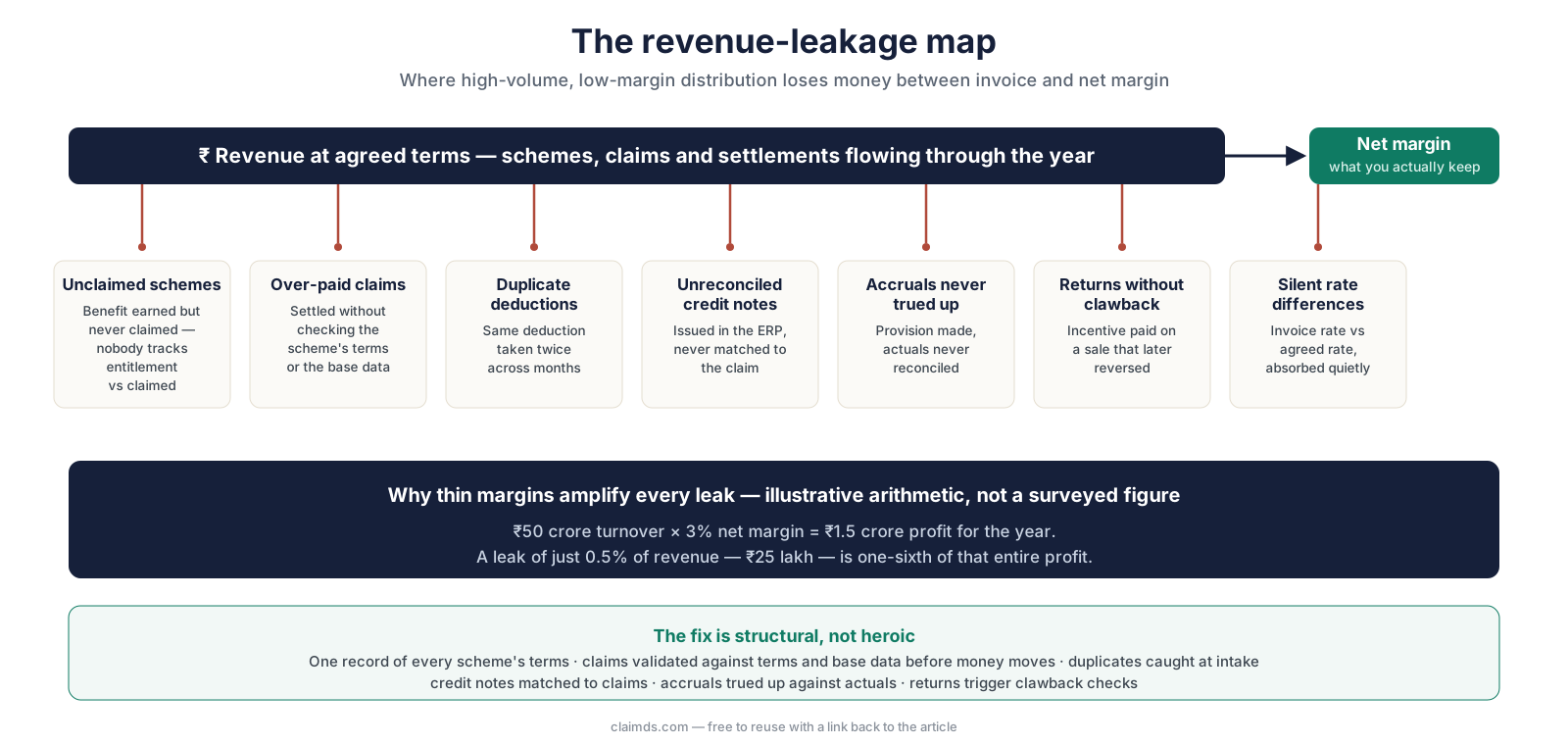
Illustrative example — all figures invented for arithmetic, not surveyed: a distributor doing ₹50 crore of turnover at a 3% net margin earns ₹1.5 crore for the year. A leak of just 0.5% of revenue — ₹25 lakh — never shows up in any sales report, but it is one-sixth of the year's entire profit. The same ₹25 lakh inside a 30%-margin software business would be a rounding error. Inside FMCG, pharma or electricals distribution it is the difference between a good year and a flat one.
This is why leakage matters most exactly where it is hardest to see. High volume means thousands of claim lines, scheme circulars and credit notes per year — too many for anyone to eyeball. Low margin means no single line item looks big enough to chase. The combination is a business model in which money leaks precisely because each individual leak is too small to justify attention, in channels where primary, secondary and tertiary sales each settle on different data.
Where does the leakage actually happen?
The map below is the one to hold in your head. None of these leaks announces itself; each looks like normal business until you reconcile the numbers.
| Leak | What it looks like | Why spreadsheets miss it |
|---|---|---|
| Unclaimed schemes | The business earned a scheme benefit and never claimed it | Nobody tracks entitlement vs claimed — only what was filed |
| Over-paid or invalid claims | Claims settled without checking the scheme's terms | Validation happens after payment, if at all |
| Duplicate deductions | The same deduction taken twice across months | Each month's file is reconciled alone; duplicates live across files |
| Unreconciled credit notes | Credit notes issued but never matched to claims | The notes sit in the ERP; the claims sit in a spreadsheet |
| Accruals that never true up | Provision made at scheme launch, actuals never reconciled | The accrual and the settlement are owned by different teams |
| Returns without clawback | Incentive paid on a sale that later reversed | Returns processing never looks back at what the sale earned |
| Rate differences absorbed silently | Rate on the invoice vs rate in the agreement | The comparison requires both documents open at once — so it never happens |
Unclaimed schemes are the leak distributors feel most: a quarter's target scheme earned but never filed because the claim window closed while the paperwork was being assembled. It is common enough to have its own failure pattern — why distributor rebate claims slip through the cracks walks through it — and on the brand side it reappears as accrued liability that never resolves.
Over-paid and invalid claims are the mirror image, and the brand-side leak the CFO's claims-and-deductions playbook quantifies: a claim settled at the top slab rate when the volume earned the lower one, or settled twice because it arrived once by mail and once through the portal. Calculating FMCG distributor claims shows how quickly slab and growth boundaries produce wrong numbers when computed by hand.
Duplicate and unauthorised deductions hide in accounts receivable: a partner short-pays against a scheme, then short-pays again next month against the same scheme. Deduction-management best practices covers the validation discipline, and deduction management in AR covers where the process should live.
Unreconciled credit notes and untrued accruals are finance-side leaks: the provision was booked, the credit note was issued, and nobody ever matched the two against the claim — so the balance sheet carries a liability that was already settled, or a settlement that was never provisioned. The forecast, true-up and write-back discipline is covered in rebate accrual management.
Returns without clawback close the loop: the sale earned an incentive, the incentive was paid, the goods came back — and the incentive stayed paid. Clawbacks and scheme cancellations covers the recovery mechanics.
Why does the leakage hide in spreadsheets?
Not because anyone is careless — because the data is disconnected by construction.
Scheme terms live in a circular PDF and a sales-team tracker. Claims live in a second spreadsheet, often one per region. Credit notes live in the ERP. Deductions live in the AR ledger. Nothing links a scheme's terms to the claims filed under it, the claims to the credit notes that settled them, or the settlements back to the accrual that provisioned them. Every reconciliation is a manual join across files that were never designed to join.
The timing makes it worse. Validation — where over-payment, duplication and ineligibility get caught — happens after money has moved, at month-end, if the close leaves time. A wrong settlement discovered six weeks later is an awkward recovery conversation; the same error caught before payment is a routine correction. The pattern repeats at every tier of the Indian multi-tier channel, and each tier's spreadsheets disagree with the next tier's.
How do you find your leakage before year-end?
A finance team can run this sequence without new software — the point is to quantify the problem while the current year is still recoverable:
- List every active scheme and its terms in one place. Circular reference, period, slabs, eligibility, claim window. Most teams discover schemes in this step that finance did not know were running — the trade-spend vs advertising split usually surfaces here too.
- Reconcile entitlement vs claimed vs settled for the top 20 distributors. Three numbers per scheme per partner. Gaps between the first two are unclaimed or lapsed benefit; gaps between the last two are settlement backlog or over-payment.
- Match deductions taken against approvals. Every short-payment in AR should trace to an approved claim or agreement. The unmatched residue is your duplicate-and-unauthorised-deduction leak.
- True up accruals against actuals for the last two quarters. Provision by scheme vs what actually settled. Persistent over-provision hides margin; under-provision hides liability.
- Check settled claims against subsequent returns. Sample the largest settled claims and ask whether any of the underlying sales reversed — and whether anything was clawed back when they did.
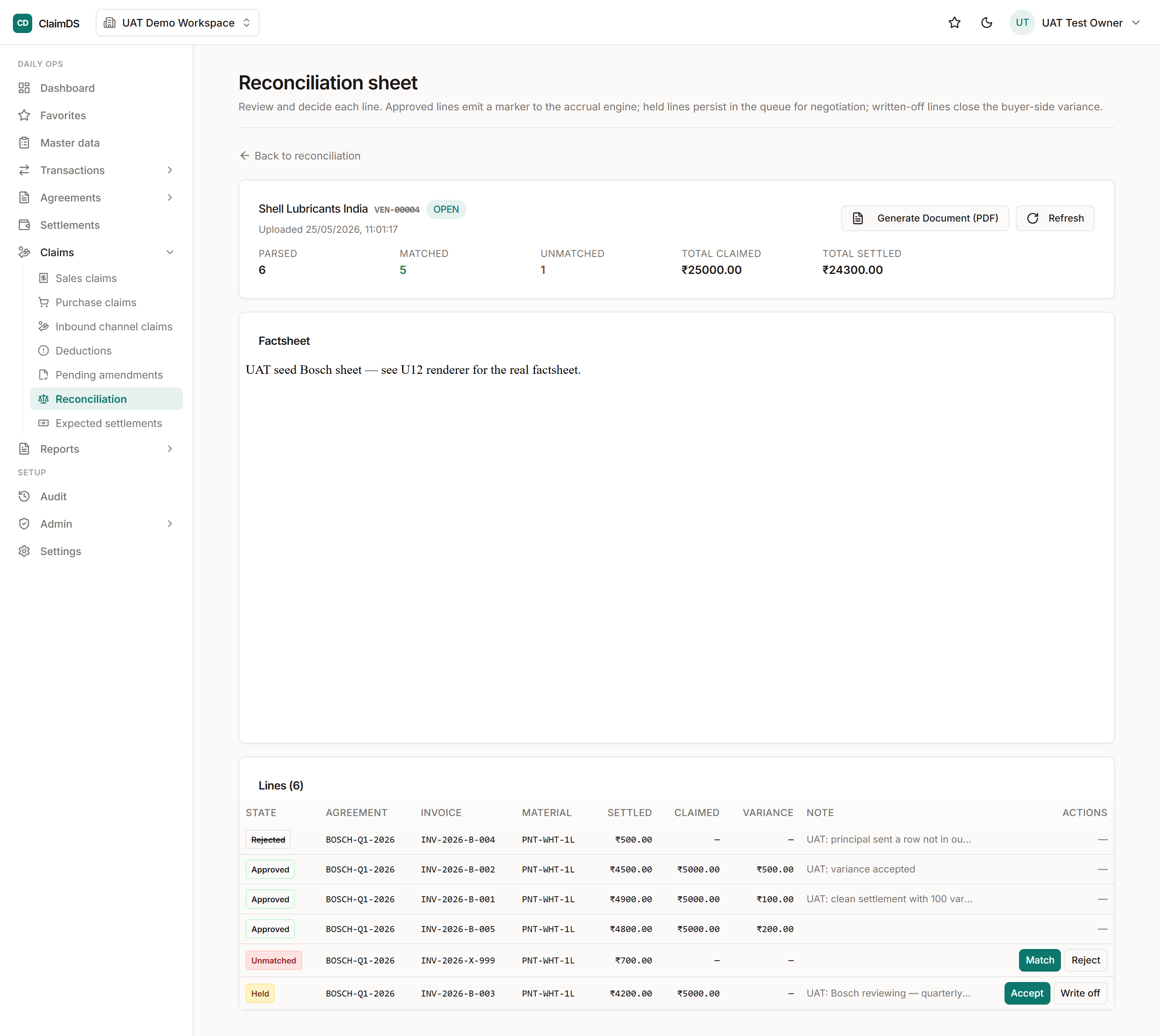
The output of the exercise is a rupee number per leak. That number — not a software pitch — is what makes the fix conversation easy, and it is the same method a free rebate recovery audit applies to up to twelve months of scheme data.
Is this a pricing problem?
No — and keeping the distinction clean matters. Revenue leakage in the channel sense is an execution and settlement problem: schemes, claims, deductions and credit notes not reconciling. Fixing it is about claim, scheme and deduction discipline. Pricing strategy — what your price and margin structure should be — is a different discipline with different tools. A business can price perfectly and still leak a sixth of its profit through settlement gaps; tightening settlement does not require touching price at all.
Fixing the plumbing
Everything in the leakage map traces to one structural cause — scheme terms, claims, credit notes and accruals living in disconnected files. The fix is the corresponding structure: one system where the scheme's terms are the record, every claim is validated against those terms and the underlying sales data before settlement, duplicates are caught at intake, credit notes match to claims, accruals true up against actuals, and returns trigger clawback checks automatically.
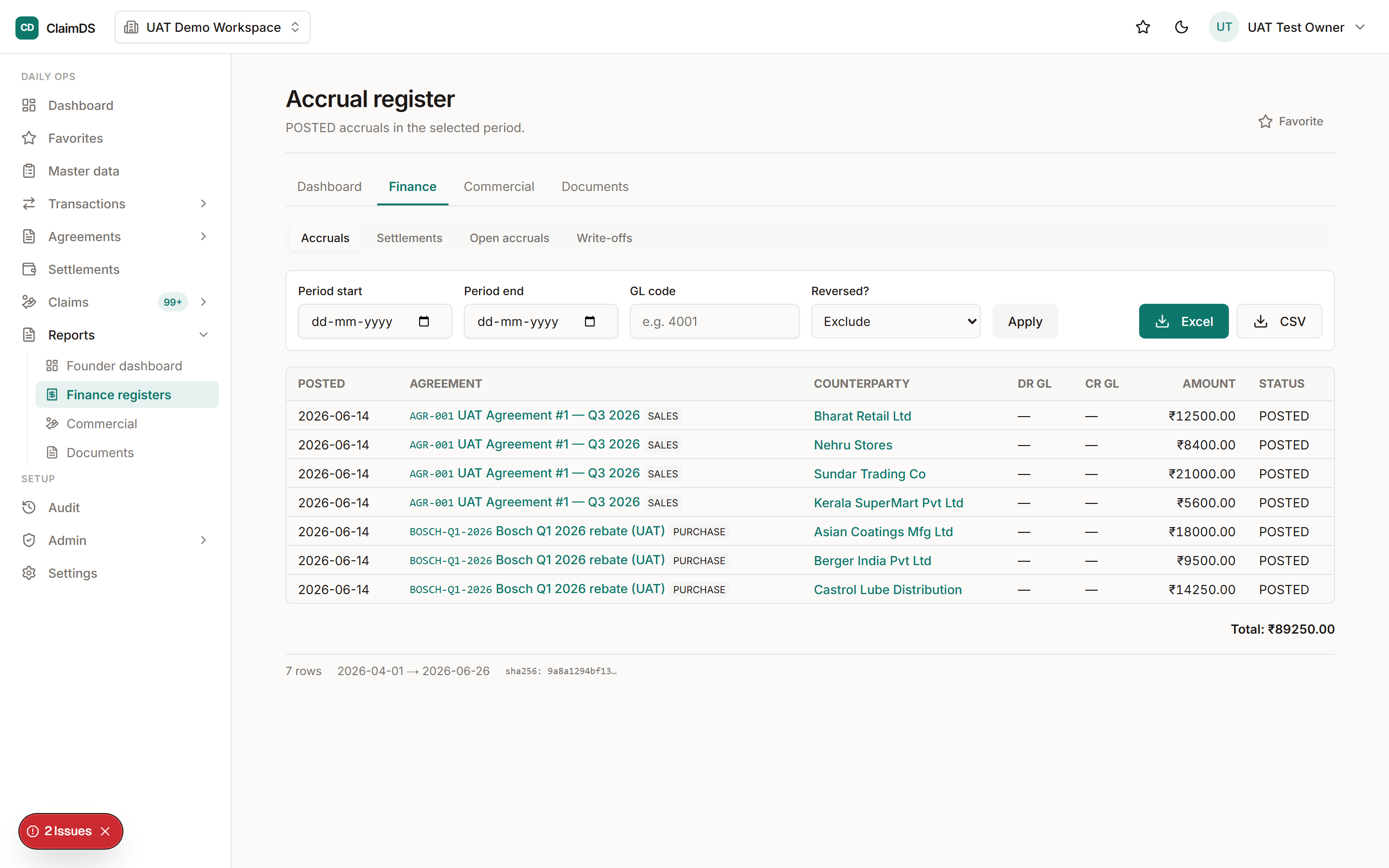
That is the shape of ClaimDS: scheme and rebate agreements as the single record, claim intake with evidence, rule-based validation and duplicate detection before money moves, GST-compliant credit-note settlement, and live accrual tracking with true-up — built Excel-first for Indian mid-market teams, working alongside the ERP rather than replacing it.
To put a rupee number on your own leakage map, book a demo — or start with the reconciliation sequence above and bring the gaps.
Note: This article is general information, not accounting or tax advice. Where leakage involves credit notes, the GST treatment (tax vs commercial credit note, ITC reversal) has its own rules — see the tax treatment of rebates and claims and confirm positions with your adviser.
Frequently asked questions
What is revenue leakage?
Revenue leakage is money a business has earned but never collects, or pays out without a matching obligation — not fraud, and not one large error, but many small structural gaps: schemes claimed wrongly or not at all, deductions taken without validation, credit notes that never reconcile, and incentives paid on sales that later reversed. In thin-margin distribution these small gaps compound into a material share of profit.
Why is revenue leakage worse in low-margin businesses?
Because leakage is lost profit measured against a thin profit pool, not against revenue. Illustratively, a distribution business earning a 3% net margin keeps ₹3 of every ₹100 of sales — so a leak of just ₹0.50 per ₹100, invisible in any revenue report, is one-sixth of the year's entire profit. A high-margin business absorbs the same leak without noticing; a thin-margin one cannot.
What are the most common sources of revenue leakage in distribution?
Seven recur: schemes the business earned but never claimed; claims settled without checking the terms; the same deduction taken twice across months; credit notes issued but never matched to claims; accruals provisioned but never trued up against actuals; incentives paid on sales that were later returned with no clawback; and rate differences between the invoice and the agreement absorbed silently. Each is small per line and material in aggregate.
How do you identify revenue leakage?
Reconcile three numbers per scheme — entitlement, claimed, settled — starting with your top twenty distributors; any persistent gap between them is leakage in one direction or the other. Then match deductions taken against approvals, true up the last two quarters of accruals against actuals, and check settled claims against subsequent returns. Run this quarterly: leakage found at year-end is usually too old to recover.
Is revenue leakage a pricing problem?
In channel businesses, usually not. Leakage in distribution is an execution and settlement problem — schemes claimed wrongly, deductions unvalidated, credit notes unreconciled, accruals never trued up — so fixing it is about claim, scheme and deduction discipline, not price optimisation. Pricing strategy decides how much margin you should earn; settlement discipline decides how much of it you actually keep.
How do spreadsheets contribute to revenue leakage?
Structurally: scheme terms live in one file, claims in another, credit notes in the ERP, and nothing links them — so nobody can compare entitlement, claimed and settled for the same scheme without rebuilding the picture by hand. Validation happens after money has moved, month-end reconciliation finds problems weeks late, and version-controlled copies quietly diverge. The leak isn't carelessness; it is disconnection.
How does trade spend affect cash flow visibility?
Schemes, claims and deductions settle weeks or months after the sale they reward, so at any moment a slice of your cash is committed to trade spend that hasn't yet landed as a credit note or payout. When that pipeline is unreconciled, committed cash is invisible. Tracking entitlement, open claims and settlements in one place restores the picture of what is genuinely available.
How do you improve cash flow visibility in a distribution business?
Reconcile schemes, claims, credit notes and accruals continuously instead of at month-end. Keep one record of every scheme's terms, an ageing view of open claims and deductions against it, and a running match between credit notes issued and claims settled — so the trade-spend pipeline between sale and settlement is always quantified, and finance knows how much cash is committed today rather than discovering it at close.
See ClaimDS on your own claims data
A 30-minute walkthrough tailored to how your channel actually settles claims.
Related posts

General Trade vs Modern Trade in India: What's the Difference?
General trade and modern trade are the two faces of Indian retail distribution. What separates them, and why your claims, schemes and margins work differently in each.
ASM and Field-Force Incentive Structures for Indian Distribution
How to structure incentives across a field sales hierarchy — sales officer, ASM and RSM — in Indian distribution, so each tier is paid on the right base.
How to Calculate Sales Incentives in Excel (and Where It Breaks)
A step-by-step way to calculate sales incentives in Excel — mapping, slabs, gates and payout — and the point at which a spreadsheet stops being safe to run on.