
General Trade vs Modern Trade in India: What's the Difference?
General trade and modern trade are the two faces of Indian retail distribution. What separates them, and why your claims, schemes and margins work differently in each.
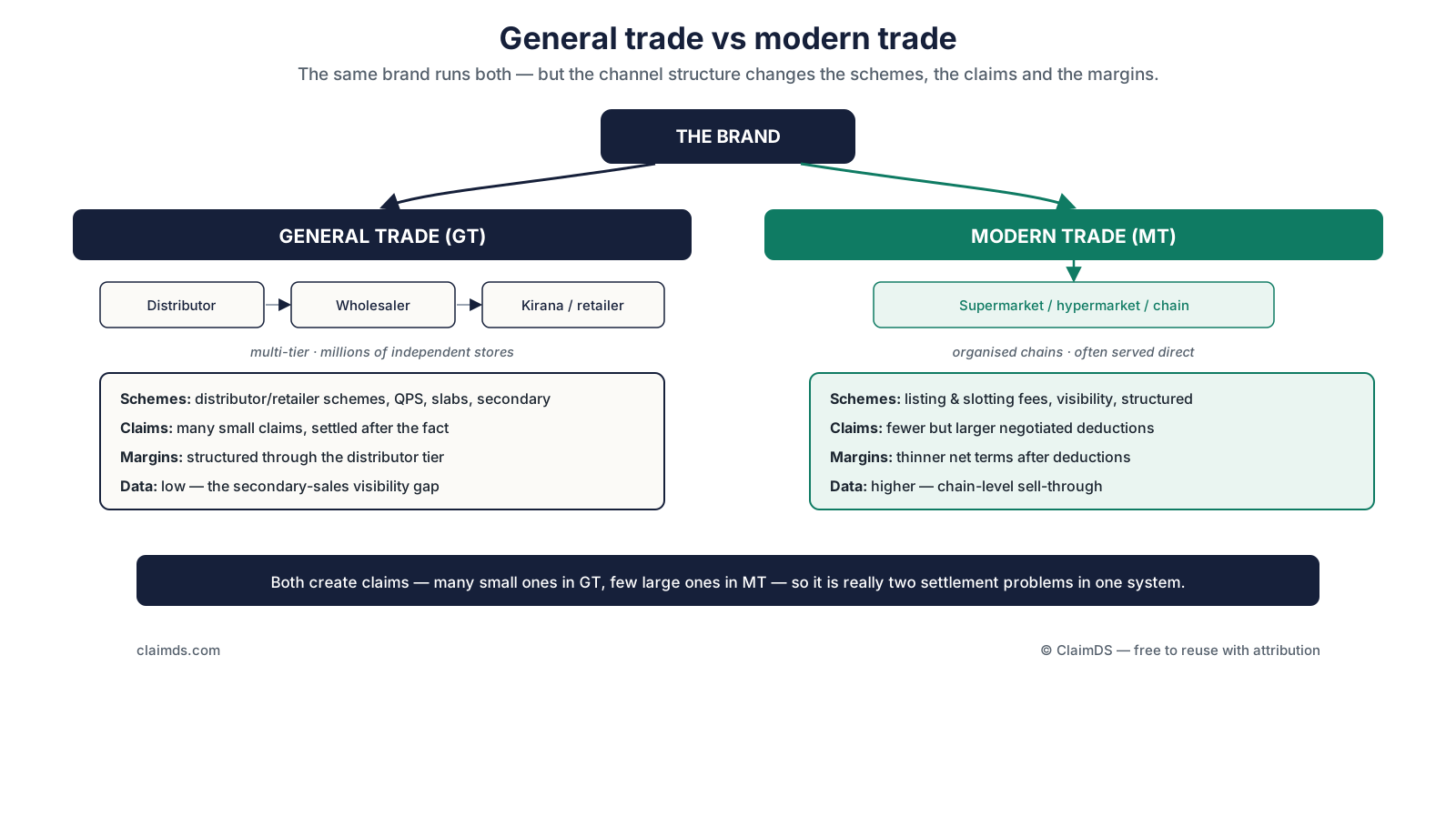
The short answer: general trade (GT) is India's traditional channel — the millions of independent kirana stores and small retailers reached through distributors. Modern trade (MT) is organised retail — supermarkets, hypermarkets and chain stores, often dealt with directly. They differ in structure, margins, payment terms, and the kind of schemes and claims each generates.
Most Indian consumer brands run both at once — and that is the real point. The two channels don't just look different; they generate different shapes of claim, which is why a brand's settlement problem is really two problems living in one system.
General trade vs modern trade at a glance
| General trade (GT) | Modern trade (MT) | |
|---|---|---|
| What it is | Kirana / independent retailers | Organised chains |
| How it's served | Via distributors (multi-tier) | Often direct |
| Scheme type | Distributor/retailer schemes, QPS, slabs | Listing fees, slotting, visibility |
| Payment & claims | Many small claims | Large negotiated deductions |
| Data visibility | Low — secondary-sales gap | Higher |
What is general trade?
General trade is the traditional, multi-tier channel that still carries most of Indian retail. A brand sells to distributors, who sell to wholesalers and retailers, who sell to the kirana stores and small independent outlets where a large share of the country actually shops. The brand rarely touches the last mile directly; it reaches it through the tiers.
That structure gives general trade its defining traits. Reach is enormous — millions of outlets — but data visibility is low: the brand can see what it ships to its distributors (primary sales) far more clearly than what those distributors sell onward (secondary sales), and even less of what reaches the final shelf. This secondary-sales visibility gap is the central challenge of general trade, and it drives everything from scheme design to claim disputes. Telling these layers apart is the whole subject of primary, secondary and tertiary sales, and the CPG trade-promotion guide covers how schemes are run across the tiers.
What is modern trade?
Modern trade is organised retail — the supermarket, hypermarket and chain formats that operate under a single corporate management across many stores. Instead of reaching them through the traditional tiers, brands usually serve modern trade directly, or through a dedicated modern-trade distributor, and deal with a professional buying team rather than thousands of independent owners.
That changes the commercial relationship completely. Terms are negotiated account by account, and the money moves through listing and slotting fees (paid for shelf placement and range), visibility charges, and structured deductions the chain applies against invoices. Where general trade is a long tail of small, similar arrangements, modern trade is a smaller set of large, individually negotiated ones — with the leverage sitting more with the retailer. The deductions that result are their own discipline; managing them is covered in deduction management best practices.
How schemes and claims differ between GT and MT
This is where the distinction stops being academic. General trade generates many small claims: distributor and retailer schemes, quantity purchase schemes, slabs and secondary-sales schemes, each raised and settled across a wide base of partners. The individual amounts are modest; the volume of claims is enormous, and the reconciliation load is in the count.
Modern trade generates fewer but much larger items: negotiated listing and slotting fees, visibility spends, and chargebacks and deductions the chain applies, often unilaterally, against what it owes. The individual amounts are large, the terms are bespoke, and the reconciliation load is in the complexity and the dispute. Both channels create claims — but of completely different shapes, which is why calculating and validating each claim looks so different in each. ClaimDS is built to handle both shapes in one system — the long tail of small GT scheme claims and the heavy, negotiated MT deductions — each validated against its own terms.
Why margins and terms differ
The two channels reach a different net position by different routes. In modern trade, the headline price may look healthy, but listing fees, slotting charges and negotiated deductions erode it, so the channel often runs on thinner net terms than the gross suggests — the cost sits in what the chain deducts. In general trade, margin is structured through the tiers: each level — distributor, wholesaler, retailer — takes a defined margin, and the brand designs its scheme rates knowing money has to be shared down the chain.
Neither is inherently more profitable; they are different mechanisms. The risk is comparing them on gross terms and missing where the money actually goes — the deductions in MT, the tier margins and scheme leakage in GT. Seeing the true net in each is the same gross-to-net discipline applied to two very different channel shapes.
Why this matters for tracking trade spend
Because a brand runs both channels at once, with different scheme structures in each, its trade-spend and claims problem is really two problems in one system. General trade's long tail of small scheme claims and modern trade's heavy negotiated deductions have to be accrued, validated and settled side by side, against different terms, in the same books — and reconciled to the same net-revenue number.
That is hard to do in spreadsheets, because the two channels don't share a shape: what works for validating a thousand small QPS claims is not what works for disputing a single large MT chargeback. ClaimDS holds both in one auditable settlement record — GT scheme claims and MT deductions measured, validated and reconciled in the same place — so the total cost of selling through both channels is visible rather than scattered.
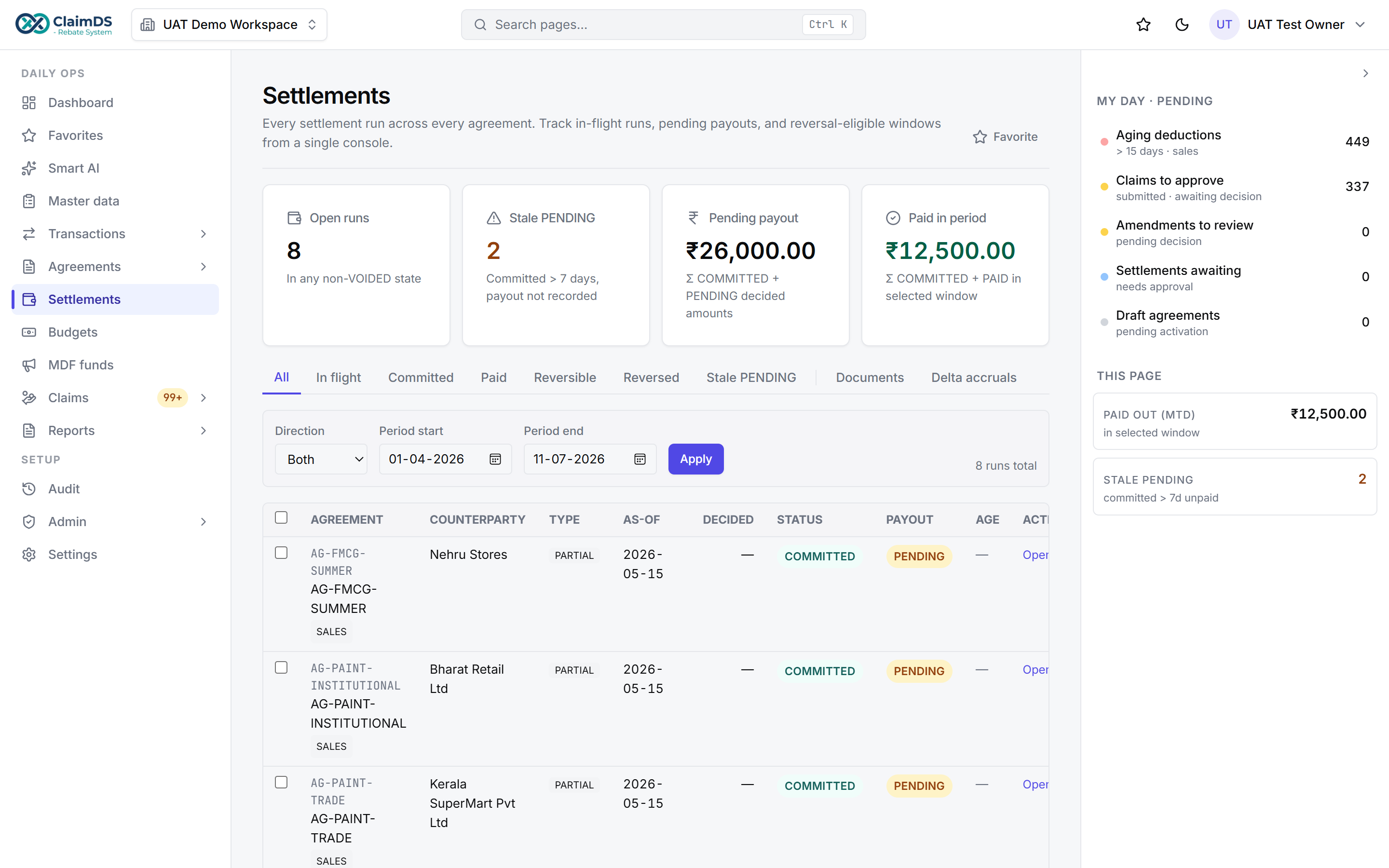
The ClaimDS settlement view — general-trade scheme claims and modern-trade deductions, settled in one place.
General information, not advice. This article describes distribution and commercial patterns in general terms; it does not quantify margins, market shares or terms, which vary widely by category and company. Treat it as an orientation, not a benchmark.
Read next
- Primary, secondary and tertiary sales — the visibility layers behind the general-trade gap.
- CPG trade-promotion guide — how schemes are designed and run across the channel.
- Deduction management best practices — handling the negotiated deductions modern trade generates.
- How to calculate FMCG distributor claims — validating the many small claims general trade creates.
- Trade spend vs advertising — the budget behind the schemes in both channels.
Whether the money moves as a thousand small GT scheme claims or a handful of large MT deductions, it still has to reconcile. ClaimDS tracks your channel schemes, claims and deductions across both channels in one auditable record.
Book a demo to see how ClaimDS settles general-trade and modern-trade claims in one place.
Frequently asked questions
What is the difference between general trade and modern trade?
General trade (GT) is India's traditional channel — millions of independent kirana stores and small retailers reached through a multi-tier distributor network. Modern trade (MT) is organised retail — supermarkets, hypermarkets and chain stores, often served directly. They differ in structure, margins, payment terms and the kind of schemes and claims each generates: many small claims in GT, fewer but larger negotiated deductions in MT.
What is general trade in FMCG?
General trade in FMCG is the traditional distribution channel of independent, unorganised retailers — the kirana stores, paan shops and small outlets that make up most of Indian retail. Brands reach them through a multi-tier network of distributors and wholesalers rather than dealing with each store directly. It is high in reach but low in data visibility, especially on secondary sales.
What is modern trade in FMCG?
Modern trade in FMCG is organised retail — supermarket and hypermarket chains and large format stores that operate under a single management. Brands often serve modern trade directly or through a dedicated modern-trade distributor, on negotiated terms. It brings higher data visibility and larger volumes per account, but also listing and slotting fees and structured, negotiated deductions.
Is a kirana store general trade or modern trade?
A kirana store is general trade. Kirana stores are independent, owner-run neighbourhood shops reached through the traditional multi-tier distributor network, which is the defining feature of general trade. Modern trade refers instead to organised retail chains — supermarkets, hypermarkets and large format stores — which operate under corporate management and are usually served on negotiated terms.
Why are modern trade margins different from general trade?
Modern trade often runs on thinner net terms because organised chains negotiate listing fees, slotting charges and structured deductions that erode the realised price. General trade margins are instead built through the distributor tier, with each level taking a defined margin. So the two channels reach a different net position by different routes — negotiated deductions in MT, structured tier margins in GT.
Do general trade and modern trade have different schemes?
Yes. General trade typically runs distributor and retailer schemes — quantity purchase schemes, slabs and secondary-sales schemes — generating many small claims. Modern trade runs on negotiated terms with listing and slotting fees, visibility charges and larger structured deductions. A brand usually operates both at once, so it has to manage two very different scheme and claim structures in parallel.
See ClaimDS on your own claims data
A 30-minute walkthrough tailored to how your channel actually settles claims.
Related posts

ASM and Field-Force Incentive Structures for Indian Distribution
How to structure incentives across a field sales hierarchy — sales officer, ASM and RSM — in Indian distribution, so each tier is paid on the right base.
How to Calculate Sales Incentives in Excel (and Where It Breaks)
A step-by-step way to calculate sales incentives in Excel — mapping, slabs, gates and payout — and the point at which a spreadsheet stops being safe to run on.
Paying C&F and DSA Partners: Commission for Carrying-and-Forwarding and Direct-Selling Agents
How carrying-and-forwarding (C&F) agents and direct-selling agents (DSA) are paid commission in India — two external partner types, clearly explained.