Section 194H Becomes Section 393: What Changes for TDS on Commission from 1 April 2026
Reviewed by CA Ramya · Last reviewed 16 Jul 2026
From 1 April 2026, TDS on commission moves from Section 194H to Section 393 (Income-tax Act 2025) — what changes, what doesn't, and the new payment code.
From 1 April 2026, the Income-tax Act 2025 replaces the Income-tax Act 1961. TDS on commission and brokerage — previously Section 194H — is carried into Section 393. The rate (2%) and the ₹20,000 aggregate threshold per payee are unchanged: the reform is a renumbering, not a rate change.
Key facts at a glance
| Item | Position |
|---|---|
| Old section | Section 194H (Income-tax Act 1961) |
| New section | Section 393, Table Sl. No. 1(ii), "Other Brokerage or Commission" (Income-tax Act 2025) |
| Rate | 2% |
| Threshold | ₹20,000 aggregate per payee per financial year |
| Rate if PAN not furnished | 20% |
| Return form | Form 26Q |
| Effective date | 1 April 2026 |
| New TDS payment code | Reported as 1006 — not yet settled; verify on the portal |
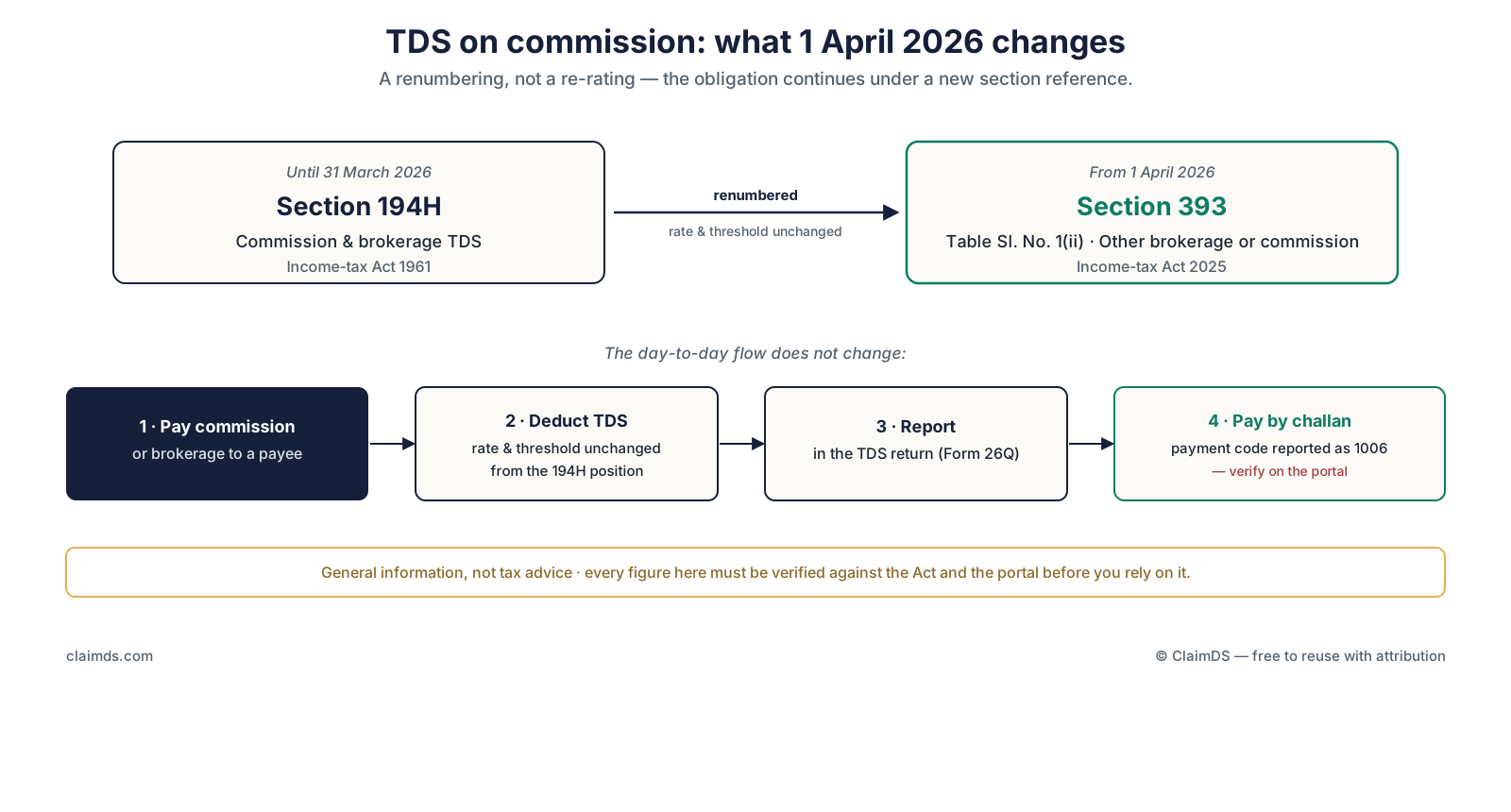
Source: ClaimDS — free to reuse with a link back to this article.
What is Section 393 of the Income-tax Act 2025?
The Income-tax Act 2025 replaces the Income-tax Act 1961 from 1 April 2026, and one of its structural changes is how it organises tax deducted at source. The old Act scattered non-salary TDS across a long run of separate sections — Section 194H for commission and brokerage among many others. The new Act consolidates most of that non-salary TDS into a single Section 393, built around a table where each type of payment sits at a numbered entry.
Commission and brokerage sit at Section 393, Table Sl. No. 1(ii) — the entry for other brokerage or commission. Salary TDS moves to its own provision, Section 392.
So the phrase you have used for years — "TDS under 194H" — becomes "TDS under Section 393" from 1 April 2026. The wider set of non-salary TDS on channel benefits makes the same journey into the new Act's table. The obligation does not change; the map is redrawn.
Does the TDS rate or threshold change?
No. The move to Section 393 carries the existing position across unchanged:
- Rate: 2%.
- Threshold: ₹20,000 aggregate per payee per financial year.
- No PAN: 20% can apply under the general TDS machinery.
There is no new rate, no new threshold and no new return form tied to the renumbering — you continue to report commission and brokerage TDS in Form 26Q. Because these are the numbers that decide what you actually deduct, treat each one as provisional until you have confirmed it against the notified Act.
What is the new TDS payment code?
When you pay deducted TDS by challan, the payment is tagged with a code that tells the department which kind of TDS it is. Under the new regime, the code reported for commission and brokerage is reported as 1006 by tax publishers.
This is the one genuinely unsettled detail in this article. Do not treat the code as certain: confirm it against the live challan dropdown on the income-tax portal at the moment you pay.
What does a business need to do differently?
Day to day, very little. The rate, the threshold and the Form 26Q return are the same on 1 April 2026 as they were on 31 March 2026. The practical to-do list is short:
- Update the section reference in your accounting and TDS software, and on your challans, from Section 194H to Section 393 from 1 April 2026.
- Confirm the challan payment code on the portal before your first post-April payment, given the point above.
- Brief your finance and accounts-payable team so the change in reference does not cause a filing to be tagged under the old section.
That is the whole of it. This is a renumbering to absorb, not a reform to re-engineer around — a calmer change than most in the new Act. Where a payment might not be commission at all — for example a genuine post-sale discount to a partner who buys and resells on their own account — the analysis is different, and the wider gross-to-net picture of what leaves your top line is the place to see how these payouts fit together.
Section 393 vs Section 194H at a glance
In prose, the comparison is short. Until 31 March 2026, TDS on commission and brokerage is deducted under Section 194H of the 1961 Act. From 1 April 2026, the same TDS — same 2% rate, same ₹20,000 aggregate threshold, same Form 26Q — is deducted under Section 393, Table Sl. No. 1(ii) of the 2025 Act.
The reference changes; the deduction does not. If your process was compliant under 194H, it stays compliant under 393 once the section label is updated and the payment code confirmed.
Read next
- TDS on dealer and distributor benefits in kind — the neighbouring non-salary TDS provision.
- The treatment of post-sale discounts and financial vs tax credit notes — where a payout is a discount, not commission.
- Input-tax-credit reversal on credit notes and credit notes for rebates — the channel-settlement side.
- Distributor margin, commission and incentives and how rebates, chargebacks and buybacks are taxed.
- Rebate management — the product basics.
Tax note. This article is general information, not tax or legal advice. Every statutory reference and figure above — Section 194H, Section 393 (Table Sl. No. 1(ii)), Section 392, the 2% rate, the ₹20,000 threshold, the 20%-without-PAN rate, Form 26Q, the 1 April 2026 effective date and the reported payment code — must be verified against the notified Income-tax Act 2025 and the income-tax portal, and reviewed by a qualified chartered accountant or cost accountant, before it is relied upon.
ClaimDS settles channel claims, rebates and trade schemes in one auditable trail, with the credit note and GST reconciled — the same record-keeping discipline that keeps commission and brokerage TDS defensible when the section changes underneath it.
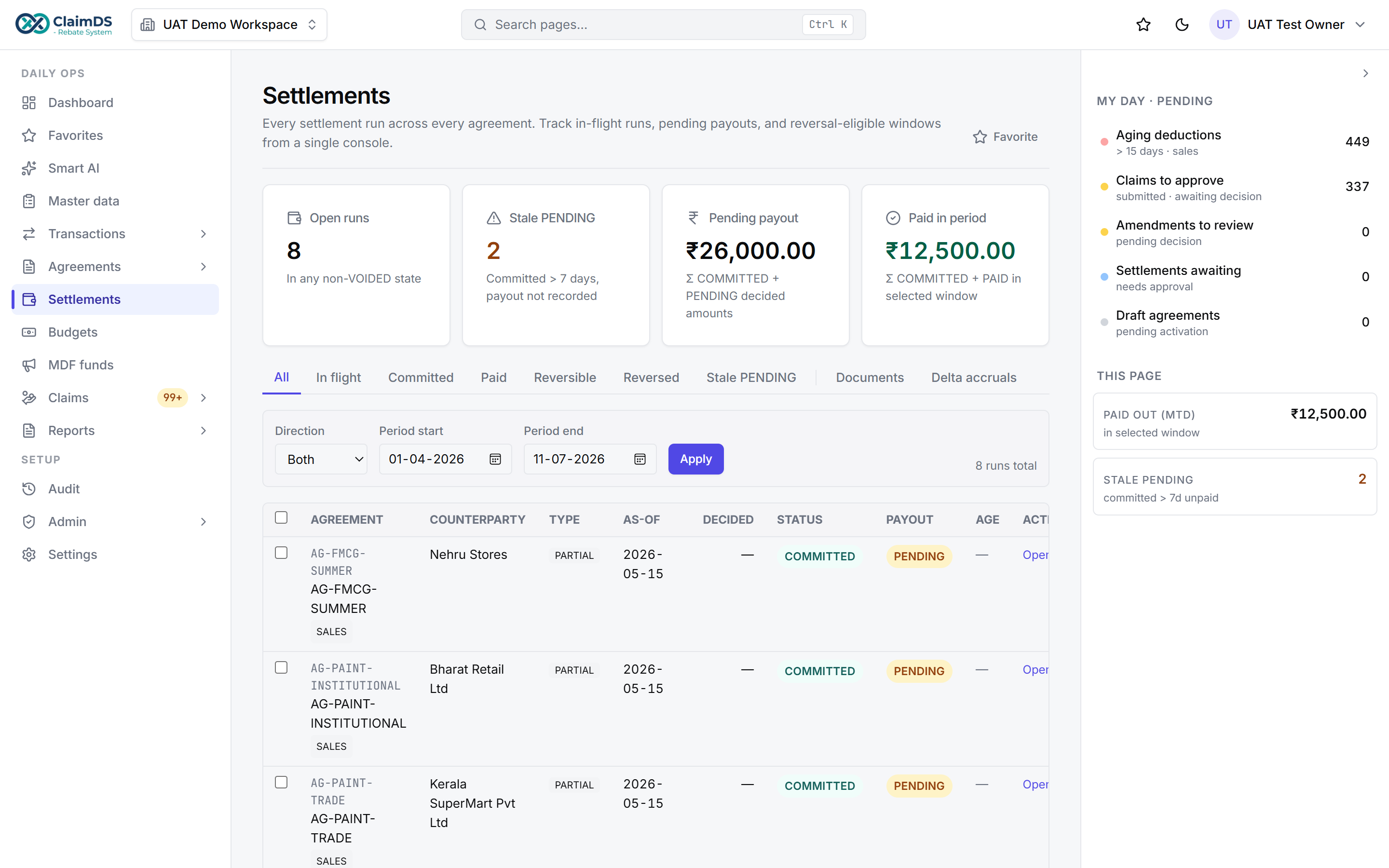
The ClaimDS settlement view — payouts calculated, approved and settled in one place.
Book a demo to see how commission and incentive payouts are calculated and settled with the right tax treatment on each.
Frequently asked questions
What is Section 393 of the Income-tax Act 2025?
Section 393 is the provision in the new Income-tax Act 2025 that consolidates most non-salary TDS obligations — including commission and brokerage — into a single section built around a table. From 1 April 2026, the commission and brokerage TDS that was under Section 194H of the 1961 Act is carried into Section 393, Table Sl. No. 1(ii).
Is Section 194H still applicable?
Section 194H applies up to 31 March 2026 under the Income-tax Act 1961. From 1 April 2026, the Income-tax Act 2025 replaces the 1961 Act and the same commission and brokerage TDS is carried into Section 393. It is a renumbering: the obligation continues, under a new section reference rather than a new rule.
What is the TDS rate on commission under Section 393?
The TDS rate on commission and brokerage is 2%, carried unchanged from Section 194H into Section 393 from 1 April 2026. Where the payee has not furnished a PAN, a higher rate can apply under the general TDS machinery. Confirm the current rate against the Act before you rely on it for any payment.
What is the threshold for TDS on commission in 2026?
TDS on commission and brokerage applies once the aggregate paid to a payee crosses ₹20,000 in a financial year, a threshold carried unchanged into Section 393 from 1 April 2026. Below that aggregate in a financial year, no TDS is required on that payee's commission. Aggregate across the year, not per bill.
What is the TDS payment code for commission under the new Act?
The challan payment code reported for commission and brokerage under the new regime is reported as 1006 by tax publishers — but this is the one detail still being confirmed. Verify the exact code against the live income-tax portal's challan dropdown before you use it, rather than treating it as settled.
Does Section 393 change how much TDS I deduct?
No. The move from Section 194H to Section 393 on 1 April 2026 is a renumbering, not a rate change. The 2% rate and the ₹20,000 aggregate threshold per payee per financial year carry over unchanged. What changes in practice is the section reference you cite on challans and in your TDS software.
See ClaimDS on your own claims data
A 30-minute walkthrough tailored to how your channel actually settles claims.
Related posts

Discount or Commission? The Section 194H Line That Decides the Tax
Whether a channel payment is a discount or a commission decides the tax — credit note or 194H, ITC or GST. The principal-to-principal test, explained for India.
TDS on Commission and Incentive in India: Section 192 vs Section 194H
Whether TDS on a commission or incentive falls under Section 192 (salary) or Section 194H/393 depends on who you pay and why. The employee-vs-agent test, explained.
TDS on the GST Component of Commission: Deduct on the Base, Not the GST
When a partner invoices commission plus 18% GST, TDS is deducted on the base commission only — not on the GST. Why, and how to get the calculation right.