TDS on the GST Component of Commission: Deduct on the Base, Not the GST
Reviewed by CA Ramya · Last reviewed 16 Jul 2026
When a partner invoices commission plus 18% GST, TDS is deducted on the base commission only — not on the GST. Why, and how to get the calculation right.
When a commission agent or partner raises an invoice for commission plus 18% GST, TDS under Section 194H (Section 393 from 1 April 2026) is deducted on the base commission amount only — not on the GST component — provided the GST is shown separately on the invoice. Deducting on the GST-inclusive total over-deducts.
The calculation, right and wrong
All figures below are illustrative.
| Right — TDS on the base | Wrong — TDS on the total | |
|---|---|---|
| Base commission | ₹1,00,000 | ₹1,00,000 |
| GST at 18% | ₹18,000 | ₹18,000 |
| Invoice total | ₹1,18,000 | ₹1,18,000 |
| TDS at 2% | on ₹1,00,000 = ₹2,000 | on ₹1,18,000 = ₹2,360 |
| Effect | Correct | Over-deducts by ₹360 |
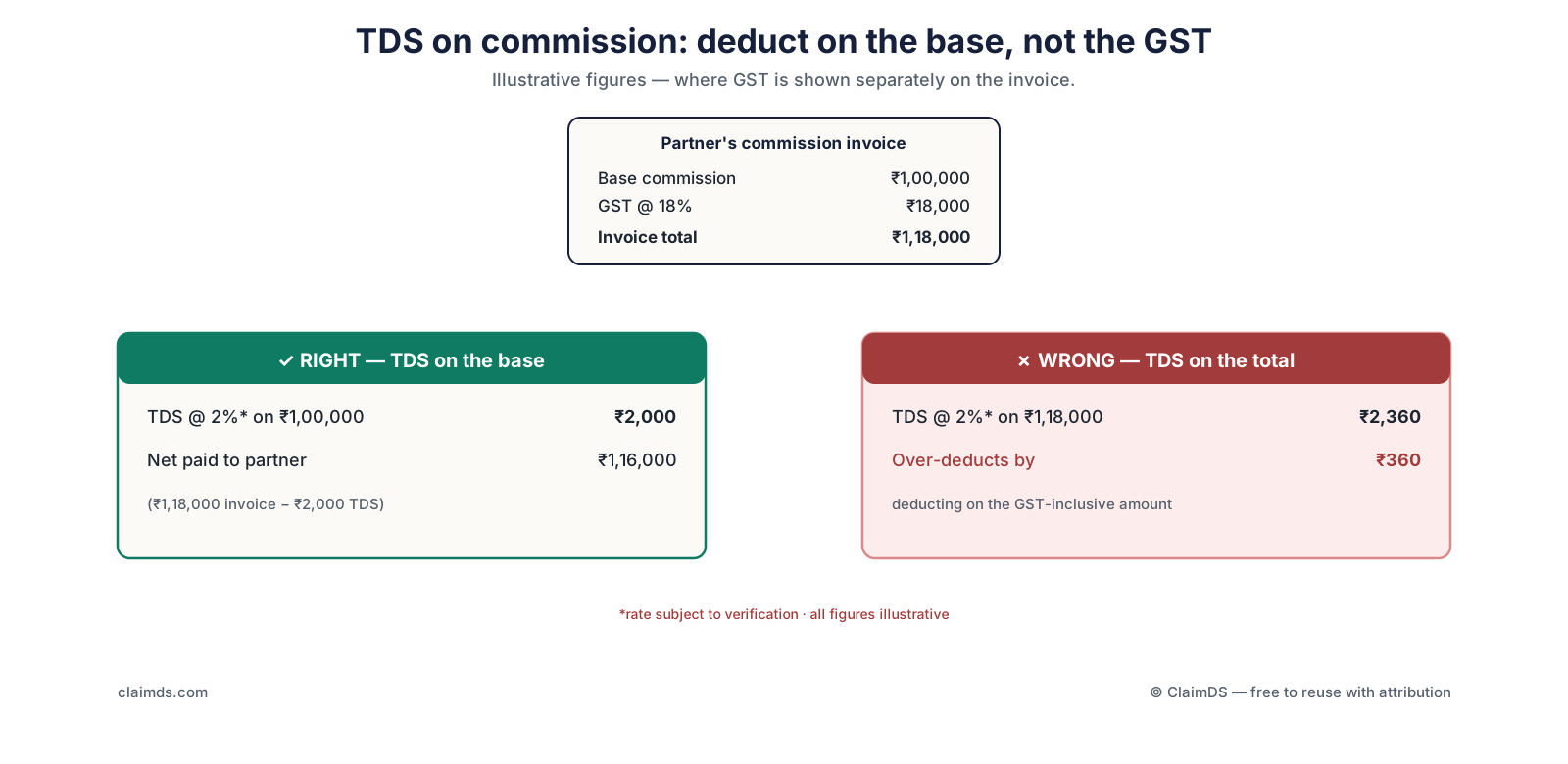
Source: ClaimDS — free to reuse with a link back to this article.
Why TDS is on the base, not the GST
TDS on a service is deducted on the value of the service — the consideration for the work done — and the separately-shown GST is a tax collected on top of that value, not part of it. When a partner's commission invoice sets out the base commission and the 18% GST as distinct lines, the base commission is the identifiable value of the service, and the TDS under Section 194H is applied to that base.
The principle is intuitive once stated: you are withholding tax on what you are paying the partner for their service, not on the GST they are passing through to the government. Frame it carefully and confirm it against the notified position, but the working rule for a clean invoice is: TDS on the base, GST on top, and never TDS on the GST.
What if GST is not shown separately?
The rule above depends on the base value being identifiable on the invoice. If a partner's invoice states a single figure without separating the GST — "commission ₹1,18,000" with no breakup — then the base is not visible, and TDS may fall on the whole amount.
So the invoice format is not a clerical detail; it decides how much you deduct. The practical fix is upstream: ask partners to invoice the base commission and the GST separately, so the correct base is always on the document.
The commission invoice checklist
A clean partner commission invoice should show, at minimum:
- The base commission amount, before GST.
- The GST rate and amount shown separately (typically 18%).
- The partner's GSTIN and PAN.
- The service description and period, so the payment is clearly a commission for a service.
With those in place, TDS is computed on the base, the GST is accounted for correctly, and there is no over-deduction to reconcile later.
Does this apply under Section 393 too?
Yes. The base-versus-GST principle is about the value of the service, and it is unaffected by the renumbering of Section 194H into Section 393 on 1 April 2026. The section reference on your challan changes — as set out in Section 194H becomes Section 393 — but the calculation does not. Whether a payee is even subject to this at all, rather than being an employee taxed as salary, is the subject of the employee-versus-agent pillar.
Read next
- TDS on commission and incentive: employee vs agent — the pillar of this cluster.
- Section 194H becomes Section 393 — the renumbering and the new payment code.
- Distributor margin, commission and incentives — the channel-side view.
- Rebate management — the product basics.
Tax note. This article is general information, not tax or legal advice, and all monetary figures are illustrative. Every statutory reference and figure above — Section 194H, Section 393, the 2% rate and the 18% GST rate — must be verified against the notified law and reviewed by a qualified chartered accountant or cost accountant before it is relied upon.
ClaimDS settles channel claims, rebates and schemes with the credit note and GST reconciled in one auditable trail — the same reconciliation discipline that keeps a commission invoice's base-not-GST deduction right the first time.
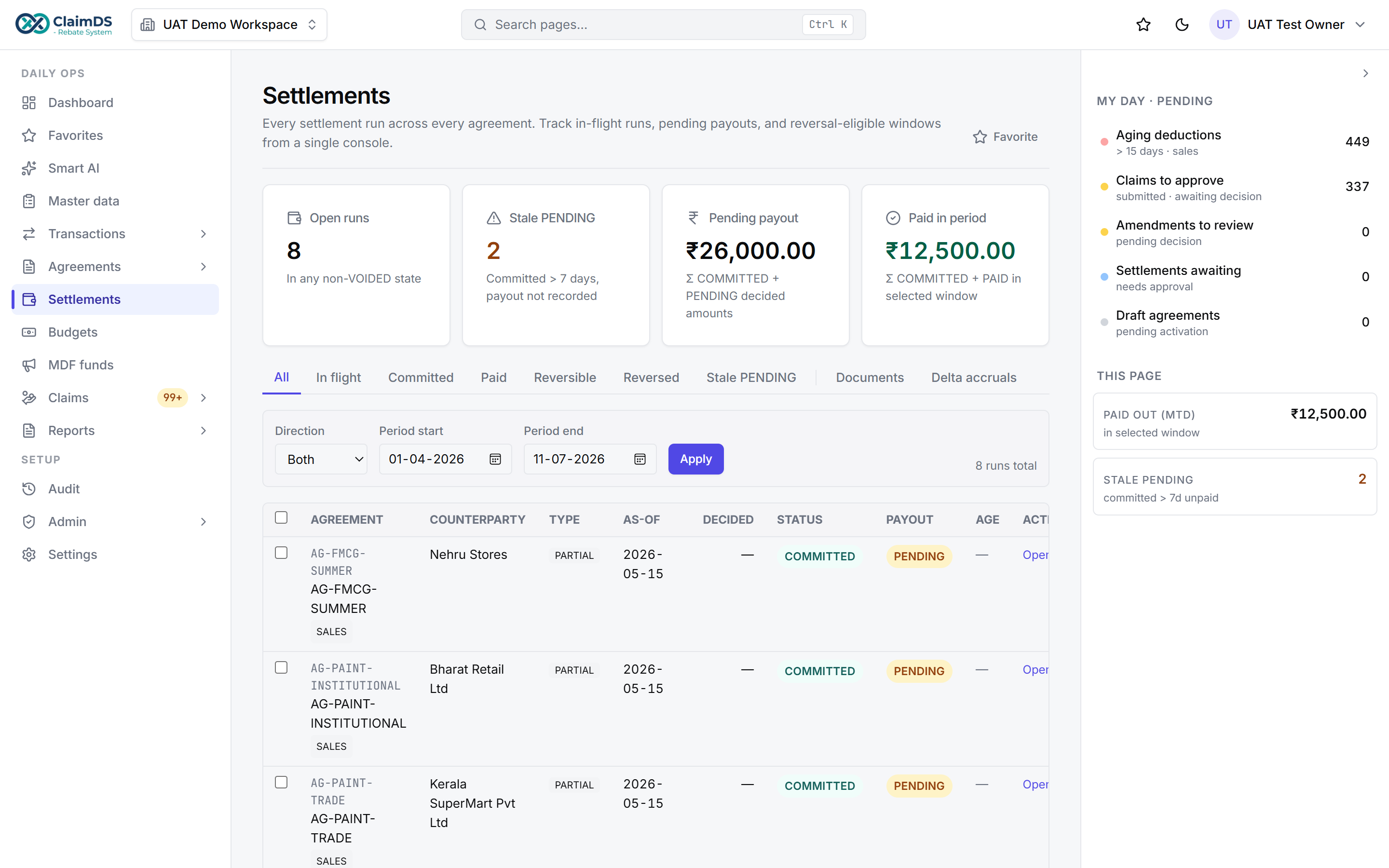
The ClaimDS settlement view — payouts calculated, approved and settled in one place.
Book a demo to see how ClaimDS calculates commission, TDS and the partner's GST correctly.
Frequently asked questions
Is TDS deducted on the GST component of a commission invoice?
No, provided the GST is shown separately on the invoice. When a commission agent invoices a base commission plus 18% GST, TDS under Section 194H is deducted on the base commission only, not on the GST component. Deducting on the GST-inclusive total over-deducts. If GST is not shown separately, the position can differ.
How do you calculate TDS on a commission invoice with GST?
Take the base commission before GST, and apply the TDS rate to that figure alone. For example, on a base commission of ₹1,00,000 with GST at 18% (₹18,000) and an invoice total of ₹1,18,000, TDS at 2% is deducted on ₹1,00,000, giving ₹2,000 — not on the ₹1,18,000 total. These figures are illustrative.
What happens if GST is not shown separately on the invoice?
If the invoice does not show the GST separately from the base commission, TDS may fall on the whole amount, because the base value is not identifiable. This is why the invoice format matters. A clean commission invoice that separates the base commission and the GST lets TDS be deducted correctly on the base alone.
What rate of TDS applies to commission?
Commission and brokerage attract TDS at 2% under Section 194H, once the aggregate paid to a payee crosses ₹20,000 in a financial year. From 1 April 2026 this obligation moves to Section 393 of the Income-tax Act 2025, with the rate unchanged. Verify the current rate against the notified law before relying on it.
Does this change under Section 393?
No. The base-versus-GST principle is about the value of the service, so it is unaffected by the renumbering of Section 194H into Section 393 on 1 April 2026. TDS continues to be deducted on the base commission, not the separately-shown GST, under the new section reference just as under the old one.
Is there an HSN or SAC code for commission or incentive?
HSN codes classify goods; SAC codes classify services. A commission or brokerage is a service, so it is classified under a SAC, not an HSN. Agents' and brokers' services are commonly classified under the SAC heading for such services, taxed at 18% GST. The correct code depends on the exact nature of the service, so confirm the applicable SAC with your chartered accountant.
See ClaimDS on your own claims data
A 30-minute walkthrough tailored to how your channel actually settles claims.
Related posts

Discount or Commission? The Section 194H Line That Decides the Tax
Whether a channel payment is a discount or a commission decides the tax — credit note or 194H, ITC or GST. The principal-to-principal test, explained for India.
Section 194H Becomes Section 393: What Changes for TDS on Commission from 1 April 2026
From 1 April 2026, TDS on commission moves from Section 194H to Section 393 (Income-tax Act 2025) — what changes, what doesn't, and the new payment code.
TDS on Commission and Incentive in India: Section 192 vs Section 194H
Whether TDS on a commission or incentive falls under Section 192 (salary) or Section 194H/393 depends on who you pay and why. The employee-vs-agent test, explained.