Discount or Commission? The Section 194H Line That Decides the Tax
Reviewed by CA Ramya · Last reviewed 16 Jul 2026
Whether a channel payment is a discount or a commission decides the tax — credit note or 194H, ITC or GST. The principal-to-principal test, explained for India.
The same distinction decides tax on both sides of a business. A payment to someone who buys and resells on their own account is usually a discount — settled by credit note, with no commission TDS. A payment to someone who acts on your behalf to win business is a commission — Section 194H (now Section 393) plus 18% GST.
Discount vs commission at a glance
| Discount (principal-to-principal) | Commission (principal-to-agent) | |
|---|---|---|
| Relationship | Payee buys and resells on own account | Payee acts on your behalf for a fee |
| Who owns the deal | The payee owns the goods they resell | You own the sale; the payee procures it |
| Documented by | Credit note | Commission invoice |
| TDS | Generally none under Section 194H | 2% under Section 194H → 393 |
| GST | Credit-note / ITC mechanics | 18% on the commission |
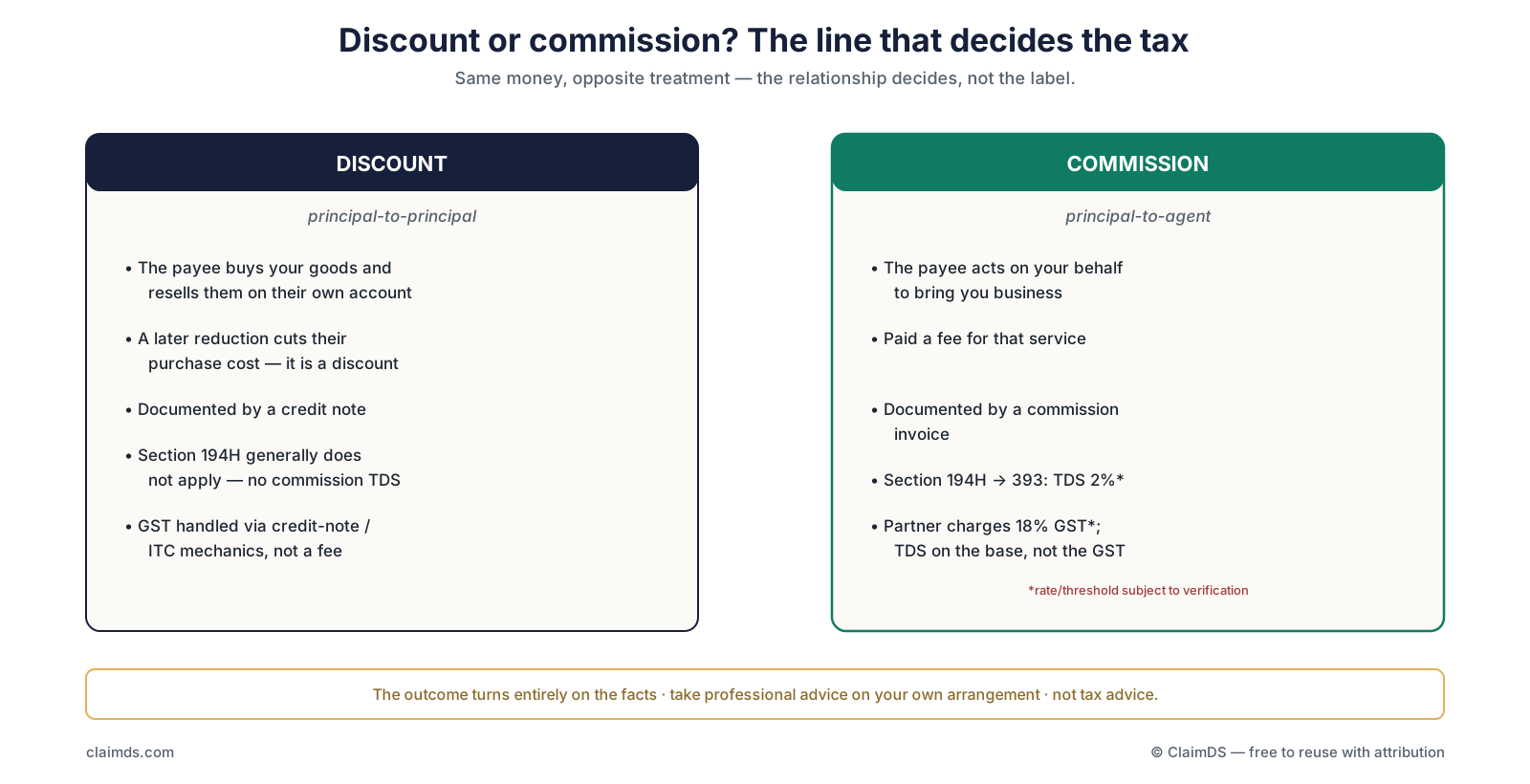
Source: ClaimDS — free to reuse with a link back to this article.
Why this one question decides the tax
Substance over label is the whole of it. The same rupee can be a discount or a commission depending on the relationship it flows through, and the word the parties write on the paperwork does not control the answer. Two businesses can each pay "₹1,00,000 of incentive" (illustrative) to a channel partner and land in completely different tax positions — one a price reduction, the other a fee for a service — because one partner bought and resold on their own account and the other acted as an agent.
So the useful question is never "what do we call this?" It is "what is the relationship, and what does the payee actually do?" Answer that, and the documentation (credit note or commission invoice), the TDS (none under Section 194H, or 2%), and the GST treatment all follow from it.
The principal-to-principal case: it's a discount
Where the payee takes title to your goods and resells them on their own account, they are a principal in their own right. A later reduction in what they paid — a volume rebate, a target scheme, a price adjustment — reduces their cost of purchase. It is a discount, not a fee for a service, so commission TDS under Section 194H generally does not arise.
Because the underlying sale is being adjusted, the reduction is typically documented by a credit note, and the GST consequences run through the credit-note and input-tax-credit mechanics of that original sale rather than as a fresh 18% charge. The difference between a financial and a tax credit note decides whether GST actually moves, and the treatment of post-sale discounts sets out the conditions. This is the channel-rebate world — the same reductions the rebate management side of a business runs every quarter.
The agency case: it's a commission
Where the payee acts on your behalf to procure a sale and is paid for that service, they are your agent. The fee is a commission — Section 194H, at 2%, and from 1 April 2026 Section 393, as set out in Section 194H becomes Section 393.
Because the agent is rendering a service, they generally raise an invoice charging 18% GST, and the TDS is deducted on the base commission, not the GST. Whether that agent is your own employee or an outside party changes the section entirely, which is the subject of the employee-versus-agent pillar.
What the courts have looked at
Indian courts have treated a concessional price to agents in a principal-to-principal sale as a discount, and a manufacturer-funded dealer incentive tied to onward sales as commission — but the outcome turns entirely on the facts, so take professional advice on your own arrangement.
The practical lesson from that contrast is not a rule you can apply mechanically; it is that the facts and documentation carry the outcome. Two arrangements that look alike on a slide can be taxed differently. This is exactly why the honest answer to "is my payment a discount or a commission?" is "it depends — have it reviewed."
The same logic runs through channel rebates
This is why a commission module and a rebate module are two faces of one question. A channel scheme or rebate settled by credit note is the discount case. A payout to a partner who books business for you is the commission case. The computation — a target, an achievement, a rate, an approval, a payout — is the same on both sides; only the relationship, and therefore the tax, differs. ClaimDS settles the discount case today — the channel scheme or rebate by credit note — applying the same computation discipline a commission-and-TDS payout demands.
<!-- TODO: link "Rebates and incentives: one engine, two payees" (#149) once it is out of draft -->Read next
- TDS on commission and incentive: employee vs agent — the pillar of this cluster.
- Section 194H becomes Section 393 — the renumbering on 1 April 2026.
- Financial vs tax credit notes, the treatment of post-sale discounts and input-tax-credit reversal on credit notes — the discount side.
- How rebates, chargebacks and buybacks are taxed and distributor margin, commission and incentives.
- Rebate management — the product basics.
Tax note. This article is general information, not tax or legal advice, and it asserts no position on how any court decision applies to any particular facts. Every statutory reference and figure above — Section 194H, Section 393, the 2% rate, the 18% GST rate and the credit-note / input-tax-credit concepts — must be verified against the notified law and reviewed by a qualified chartered accountant or cost accountant before it is relied upon.
ClaimDS settles the channel discount case — the credit-note route — with the basis recorded in one auditable trail, the same discipline the commission-and-TDS route depends on.
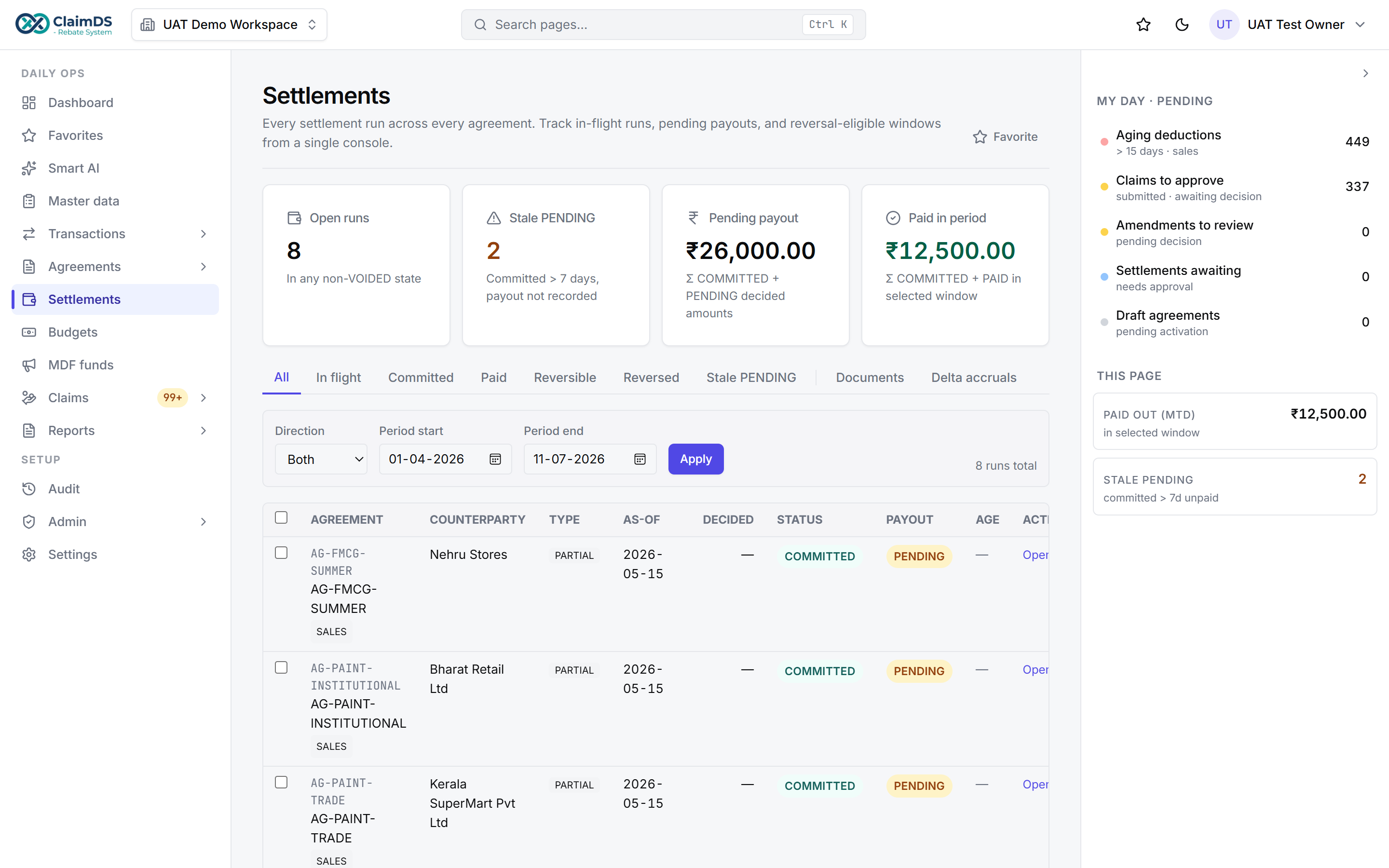
The ClaimDS settlement view — payouts calculated, approved and settled in one place.
Book a demo to see how ClaimDS settles both discounts and commissions with the right treatment on each.
Frequently asked questions
What is the difference between a discount and a commission for tax purposes?
A discount is a price reduction given to someone who buys your goods and resells them on their own account — a principal-to-principal sale. A commission is a fee paid to someone who acts on your behalf to bring you business — a principal-to-agent relationship. The relationship, not the label, decides which applies and how it is taxed.
Is TDS deducted on a trade discount?
Generally no under Section 194H. A genuine trade discount to a party who buys and resells on their own account is a reduction in their purchase price, not a fee for a service, so commission TDS under Section 194H does not usually arise. The treatment depends on the facts, so confirm your own arrangement with a professional.
When is a dealer incentive treated as commission?
A dealer incentive can be treated as commission where, on the facts, the dealer is acting as an agent to procure business for the manufacturer rather than buying and reselling on their own account. Because the outcome turns on the specific relationship and documentation, it is a fact-specific question for a qualified professional, not a fixed rule.
Does a principal-to-principal discount attract Section 194H?
Generally not. Where the payee takes title to the goods and resells on their own account, a later reduction is usually a discount on their purchase, not a commission for a service, so Section 194H may not apply. This depends on the facts of the arrangement, so take professional advice before treating any payment this way.
Is GST charged on a discount?
A discount is generally handled through the credit-note and input-tax-credit mechanics of the original sale, not as a separate 18% service charge. That is different from a commission, where the agent charges GST on their service. The GST treatment follows whether the payment is a price reduction or a fee — confirm the position for your facts.
How do I know if my payment is a discount or a commission?
It depends on the relationship and the facts: does the payee buy and resell on their own account (pointing to a discount), or act on your behalf to win business (pointing to a commission)? The label you use does not decide it. Because it is fact-specific and can be litigated, take professional advice on your own arrangement.
See ClaimDS on your own claims data
A 30-minute walkthrough tailored to how your channel actually settles claims.
Related posts

Section 194H Becomes Section 393: What Changes for TDS on Commission from 1 April 2026
From 1 April 2026, TDS on commission moves from Section 194H to Section 393 (Income-tax Act 2025) — what changes, what doesn't, and the new payment code.
TDS on Commission and Incentive in India: Section 192 vs Section 194H
Whether TDS on a commission or incentive falls under Section 192 (salary) or Section 194H/393 depends on who you pay and why. The employee-vs-agent test, explained.
TDS on the GST Component of Commission: Deduct on the Base, Not the GST
When a partner invoices commission plus 18% GST, TDS is deducted on the base commission only — not on the GST. Why, and how to get the calculation right.