TDS on Commission and Incentive in India: Section 192 vs Section 194H
Reviewed by CA Ramya · Last reviewed 16 Jul 2026
Whether TDS on a commission or incentive falls under Section 192 (salary) or Section 194H/393 depends on who you pay and why. The employee-vs-agent test, explained.
TDS on a sales incentive or commission depends on who receives it. Pay your own employee an incentive and it is salary — TDS under Section 192 at their applicable rate. Pay an outside agent, consultant or referral partner a commission and it is Section 194H (2%), now Section 393 from 1 April 2026, plus 18% GST on their invoice.
Key facts at a glance
| Employee incentive | Partner / agent commission | |
|---|---|---|
| Section | Section 192 (salary) | Section 194H → Section 393 |
| How it is taxed | As salary, at the employee's applicable rate | TDS 2% on the base commission |
| Threshold | Part of salary | ₹20,000 aggregate per payee per FY |
| GST | Outside GST (Schedule III) | Partner raises an 18% GST invoice |
| Where it shows | Payslip / Form 16 | Commission invoice; TDS on base, not GST |
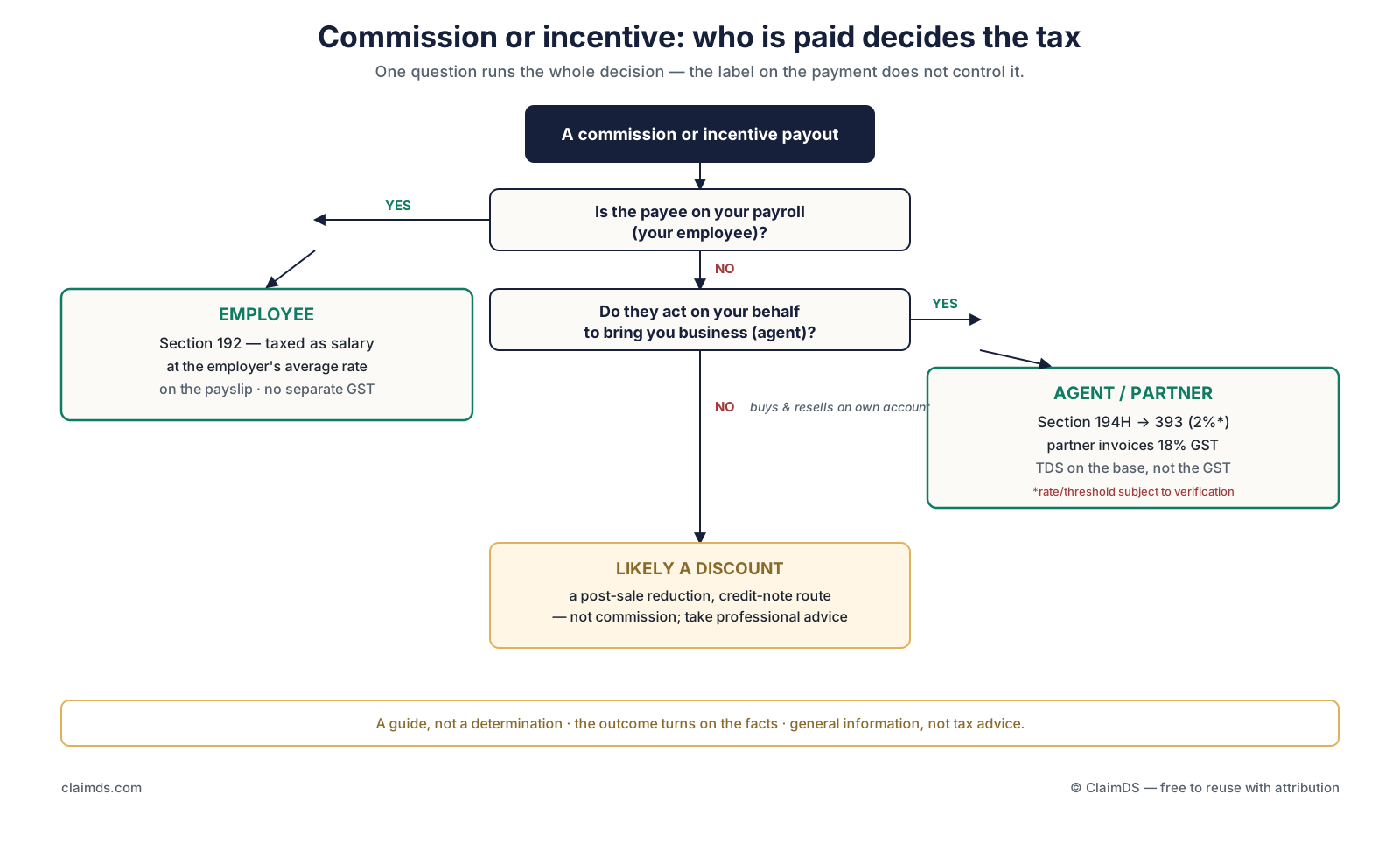
Source: ClaimDS — free to reuse with a link back to this article.
The one question that decides everything: is the payee an employee or an agent?
Almost every mistake in this area comes from starting with the wrong question. People ask "what rate of TDS applies to an incentive?" when the question that actually governs the answer is "who is being paid, and in what relationship?"
There are two relationships that matter. In an employer-employee relationship, whatever you pay for the work — salary, bonus, incentive, commission-by-name — is remuneration for employment. In a principal-to-agent relationship, you pay an independent person a fee for a service they render on your behalf. The tax treatment follows the relationship, and the relationship follows the substance.
This is why the label does not control the outcome. Calling a payment an "incentive", a "referral support" or a "business promotion payout" does not change its character. If it is paid to your employee for their work, it is salary however you name it. If it is paid to an outside party for procuring business for you, it is a commission however you name it. Get the relationship right and the section, the rate and the GST position all follow.
Paying an employee: Section 192 (salary)
An incentive, bonus or commission paid to your own employee under an employment relationship is salary. TDS is deducted under Section 192, at the employee's applicable rate, and it appears on the payslip and in Form 16 like the rest of their pay.
Two things do not apply to an employee incentive, and both are common sources of error:
- Section 194H does not apply. Section 194H is about commission or brokerage paid to a non-employee. A payment inside the employment relationship is salary, not 194H commission.
- Section 194R does not apply. Section 194R deals with benefits or perquisites provided to a non-employee in the course of business; it does not reach the employer-employee relationship.
Whether a particular incentive also affects other payroll obligations — provident fund, for instance — is a separate, fact-specific question that turns on how the incentive is structured; it is taken up, at pointer level, in the companion article on incentives and PF wages.
<!-- TODO: link "Is a sales incentive part of PF wages?" (#154) when it exists -->Paying an external agent or partner: Section 194H, now Section 393
Commission or brokerage paid to a non-employee — an agent, a referral partner, a consultant who books business for you — is dealt with under Section 194H. The core figures:
- Rate: 2%.
- Threshold: ₹20,000 aggregate per payee per financial year.
- No PAN: 20% can apply.
- Return: Form 26Q.
From 1 April 2026, this obligation is carried into Section 393 of the Income-tax Act 2025 — the rate and threshold unchanged. That renumbering, and the new challan payment code, are covered in full in Section 194H becomes Section 393.
Alongside the TDS, the partner is rendering you a service, so they generally raise an invoice charging 18% GST. The TDS is deducted on the base commission, not on the GST component, where the GST is shown separately on the invoice — the calculation that is most often got wrong.
<!-- TODO: link "TDS on the GST component of commission" (#153) when it exists -->When is it a discount, not a commission at all?
There is a third case that looks like the second but is taxed like neither: the principal-to-principal sale. Where the payee buys your goods and resells them on their own account, a later reduction in what they paid is a discount on their purchase price — not a fee for a service — and commission TDS under Section 194H may not arise. This is the bridge from the sales-partner world to the channel-rebate world, where the same reduction is settled by a credit note rather than a commission.
Indian courts have looked at both sides of this line on similar-looking facts — treating a concessional price to agents in a principal-to-principal sale as a discount, and a manufacturer-funded dealer incentive tied to onward sales as commission — but the outcome turns entirely on the facts, so take professional advice on your own arrangement.
<!-- TODO: link "Discount or commission? The Section 194H line" (#152) when it exists -->GST: the employee/agent split again
The same employee-vs-agent line runs through GST. An employee's incentive is outside GST — services by an employee to an employer in the course of employment are neither a supply of goods nor of services under Schedule III — so there is no GST invoice and no GST on it.
An external partner's commission is a taxable service at 18%; the partner invoices the GST and, in most cases, accounts for it. One carve-out to confirm case by case: for certain individual agents providing services to a bank or NBFC, the reverse-charge mechanism can place the GST liability on the recipient rather than the agent.
A quick decision guide
Read it as guidance, not a determination — the outcome always turns on your facts:
- Is the payee on your payroll (your employee)? → It is salary. TDS under Section 192 at their applicable rate; no separate GST.
- Not on payroll — do they act on your behalf to get you business (an agent)? → It is commission. Section 194H → 393, 2%, ₹20,000 threshold, plus 18% GST on their invoice; TDS on the base, not the GST.
- Do they buy your goods and resell on their own account? → It is likely a discount, settled by credit note — not commission. Take advice.
Read next
- Section 194H becomes Section 393 — the renumbering and the new payment code (required reading for the agent case).
- TDS on dealer and distributor benefits in kind — the benefits-and-perquisites provision, for non-employees.
- Financial vs tax credit notes and the treatment of post-sale discounts — the discount side of the line.
- Distributor margin, commission and incentives and how rebates, chargebacks and buybacks are taxed.
- Rebate management — the product basics.
Tax note. This article is general information, not tax or legal advice. Every statutory reference and figure above — Sections 192, 194H, 393, 194R (referenced only to note it does not apply to employees), Schedule III, the 2% rate, the ₹20,000 threshold, the 20%-without-PAN rate, the 18% GST rate, the reverse-charge point, Form 26Q, the Income-tax Act 2025 and the 1 April 2026 effective date — must be verified against the notified law and reviewed by a qualified chartered accountant or cost accountant before it is relied upon.
ClaimDS settles the channel-side money — claims, rebates and trade schemes — in one auditable place, with each payout's basis and treatment recorded and reconciled: the discipline a clean split between an employee incentive and a partner commission depends on.
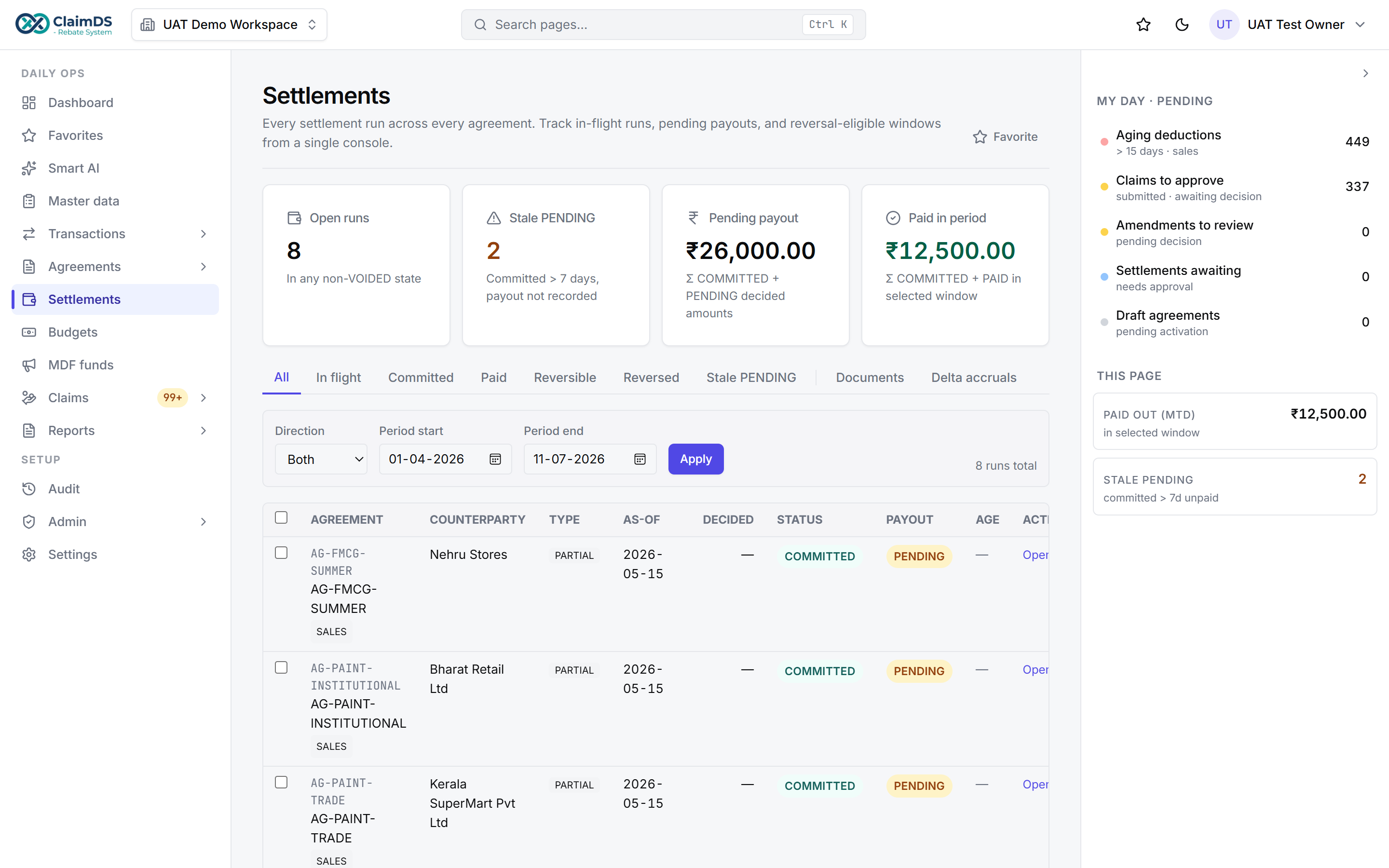
The ClaimDS settlement view — payouts calculated, approved and settled in one place.
Book a demo to see how employee incentives and partner commissions are calculated and settled with the right tax treatment on each.
Frequently asked questions
Is TDS on a sales incentive deducted under Section 192 or 194H?
It depends on who receives it. An incentive paid to your own employee is part of salary, so TDS is deducted under Section 192 at the employee's applicable rate. A commission paid to an external agent or partner falls under Section 194H (Section 393 from 1 April 2026). The relationship decides it, not the label.
Is a commission paid to an employee taxed as salary?
Yes. A commission or incentive paid to your own employee under an employment relationship is treated as salary and taxed under Section 192 at the employee's applicable rate, appearing on the payslip and in Form 16. Section 194H, which applies to commission paid to non-employees, does not apply to an employer-employee payment.
What is the TDS rate on commission to an agent?
Commission or brokerage paid to an external agent attracts TDS of 2% under Section 194H, once the aggregate to that payee crosses ₹20,000 in a financial year. From 1 April 2026 this sits in Section 393 of the Income-tax Act 2025. A higher rate can apply where the payee has not furnished a PAN. Verify current figures before relying on them.
Does Section 194R apply to employee incentives?
No. Section 194R deals with benefits and perquisites provided in the course of business to a non-employee, such as a dealer or distributor. It does not apply to the employer-employee relationship. An incentive to your own employee is dealt with as salary under Section 192, not under Section 194R.
Is GST applicable on a sales incentive paid to an employee?
No. Services by an employee to an employer in the course of employment are treated as neither a supply of goods nor of services under Schedule III of the GST law, so an incentive paid to your own employee is outside GST. There is no GST invoice and no GST on an employee incentive.
Is GST applicable on commission paid to an external partner?
Generally yes. Commission for a service rendered by an external agent or partner is a taxable supply of service, so the partner typically raises an invoice charging 18% GST. TDS under Section 194H/393 is then deducted on the base commission, not on the GST component, where the GST is shown separately.
What is the difference between a discount and a commission for TDS?
A discount is a price reduction in a principal-to-principal sale to someone who buys and resells on their own account — generally not commission, so Section 194H may not apply. A commission is paid to someone who acts on your behalf to bring you business. The relationship and the facts decide which one applies.
Has Section 194H changed in 2026?
The rule continues, but the section number changes. From 1 April 2026 the Income-tax Act 2025 replaces the 1961 Act, and TDS on commission and brokerage that was under Section 194H is carried into Section 393. The 2% rate and ₹20,000 threshold carry over unchanged; it is a renumbering, not a rate change.
See ClaimDS on your own claims data
A 30-minute walkthrough tailored to how your channel actually settles claims.
Related posts

Discount or Commission? The Section 194H Line That Decides the Tax
Whether a channel payment is a discount or a commission decides the tax — credit note or 194H, ITC or GST. The principal-to-principal test, explained for India.
Section 194H Becomes Section 393: What Changes for TDS on Commission from 1 April 2026
From 1 April 2026, TDS on commission moves from Section 194H to Section 393 (Income-tax Act 2025) — what changes, what doesn't, and the new payment code.
TDS on the GST Component of Commission: Deduct on the Base, Not the GST
When a partner invoices commission plus 18% GST, TDS is deducted on the base commission only — not on the GST. Why, and how to get the calculation right.