Scheme and Claim Management Beside Your Accounting System
What belongs in your accounting system and what belongs in a claims system beside it — schemes, claims, accruals and settlements, whatever ERP you run.
Your accounting system — Tally, Busy, Zoho Books, SAP, or any ERP you run — is the system of record for transactions: invoices, credit notes, ledgers, GST returns. Trade schemes and distributor claims are a different kind of problem. They are a rules-and-evidence question — what was promised, on what base, with what proof, within what window — and that question sits beside the accounts, not inside them. Knowing what belongs where is the whole game.
What belongs in the accounting system vs beside it
The split is cleaner than most teams expect. Anything that represents money that has already moved — a raised invoice, a posted credit note, a ledger balance, a filed GST return — is the accounting system's job. It is the authoritative record of transactions, and nothing here proposes changing that.
Everything that decides whether money is owed in the first place sits in a claims system beside it. A scheme circular is a rule, not a transaction. A distributor claim is a piece of evidence, not a posting. An accrual is a computed expectation against an agreement, not a balance you can read off a ledger. These are the working parts of rebate management and distributor claims management, and they need their own home.
| Accounting system | Claims system beside it |
|---|---|
| Transactions and invoices | Scheme circulars and rules |
| Credit notes (issued and posted) | Accruals against agreements |
| Ledgers and GST returns | Claim capture and validation |
| Stock and inventory | Secondary-sales data |
| — | Dispute and deduction workflow |
| — | Settlement computation |
Read the table as a division of labour. The accounting system holds the final, posted truth about money. The claims system holds the reasoning that produces those postings — the types of trade scheme in play, the claims coming in against them, the accruals tracking what you expect to pay, and the deduction workflow when a partner disputes a figure. Put every row in its right column and both systems stay simple. Blur the two and you end up forcing scheme logic into a ledger that was never designed to carry it — which is where revenue leakage starts.
Why the ledger is the wrong home for scheme rules
This is a structural point, and it holds whatever ERP you run.
A scheme circular is not a journal entry. It is a conditional agreement — "2% on primary billing above ₹X during Q3, subject to a valid claim within 30 days of quarter-end." A ledger records what happened; it has no place to store what should happen under a rule that hasn't triggered yet.
A claim is evidence, not a posting. Before anything hits the books, someone has to check that the claimed quantity matches the scheme, that the base is right, that the window is open, and that the proof holds up. That validation typically spans four separate data sources — the scheme master, primary sales, secondary or sell-through data, and the claim document itself. An accounting system holds one of those four and has no native way to reconcile across the rest.
And accruals have to be computed against agreements, continuously, as sales accumulate — so you always know your true liability before settlement. That is a modelling job, not a bookkeeping one. None of this is a criticism of any accounting product; it is simply outside what a ledger is built to do. For a fuller treatment of how a claims tool exchanges data with your ERP, see ERP integration for claims and rebate software.
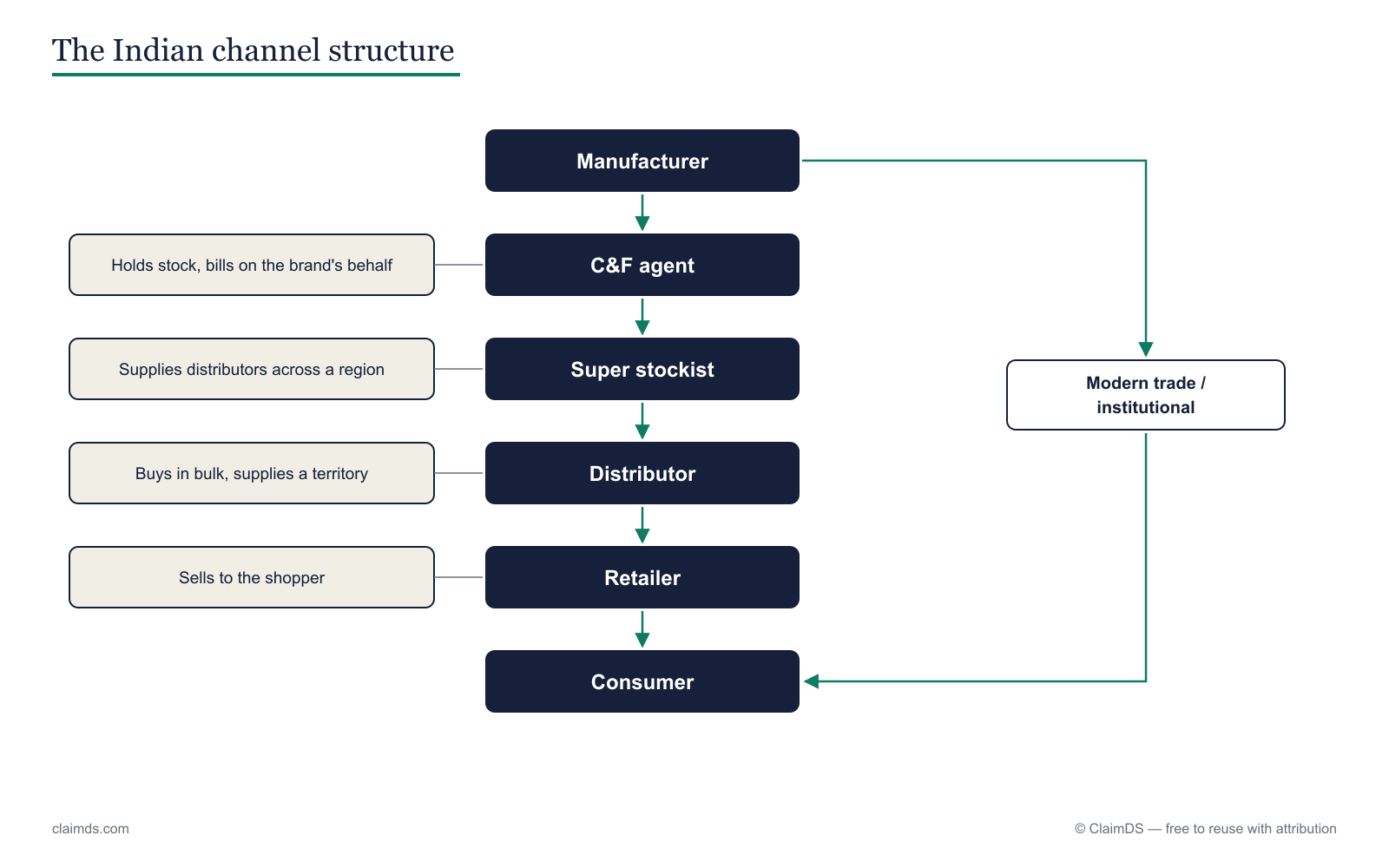 Whatever ERP records the invoice, the scheme and claim rules live beside it.
The credit note is the join
So if the two systems are separate, where do they meet? At the credit note.
The sequence is clean. The claims system decides what is owed and why — it holds the rules, the evidence and the sales base, so it produces the amount and the justification. The accounting system then issues and posts the credit note against that decision, with the correct GST treatment. The credit-note document number becomes the join key: it ties the claims-side decision to the accounting-side posting. You reconcile once, between the two systems, and the same reference later helps you match against GSTR-2B and 3B.
The connection itself is Excel or CSV file exchange, at a pointer level — primary sales and masters out of the ERP, approved settlement amounts and credit-note references back. That keeps each system doing what it does best without either becoming a data-entry screen for the other. <!-- TODO: confirm capability wording with founder --> This file-exchange model is what makes ClaimDS ERP-agnostic: it works the same way regardless of which accounting product issues the credit note. <!-- TODO: confirm capability wording with founder --> For the reconciliation mechanics, see claims and deduction reconciliation and GST credit-note reconciliation.
Running on a specific accounting system?
The principle above is deliberately generic — it holds for any ERP. But if you run one of the common Indian accounting systems, we have written the same story in your specific terms:
- Rebate and scheme claims for Tally users
- Rebate and scheme claims for Busy users
- Rebate and scheme claims for Zoho users
Each sibling walks through the same beside-the-accounts model, the same credit-note join, and the same file-exchange connection, so you can see exactly how it maps onto the system you already use. The underlying channel-rebate logic, the approval workflow, and the settlement steps are identical whatever your ERP — only the file-exchange details differ. For terminology, the glossary and the claim approval workflow fill in the rest.
The takeaway is simple: keep transactions in your accounting system, keep schemes and claims beside it, and let the credit note tie the two together.
Frequently asked questions
Should trade schemes be managed in the accounting system?
No. An accounting system records transactions — invoices, credit notes, ledgers and GST. A trade scheme is a set of rules and evidence: what was promised, on what base, with what proof, within what window. That logic doesn't fit a ledger, so schemes belong in a claims system beside the accounts, not inside them.
What is the difference between an accounting system and a claims system?
An accounting system is the system of record for money that has already moved — invoices, credit notes, ledgers, GST returns. A claims system is the system of record for money that is owed under a scheme: it captures claims, validates them against agreements and sales data, computes accruals, and decides what to settle.
Do I need separate software for distributor claims?
Usually yes, once claim volume grows. Accounting systems post transactions well but weren't built to hold scheme rules, validate claims against secondary sales, or track accruals and disputes. A dedicated claims system beside the accounts handles that rules-and-evidence work and hands clean figures back for posting.
How does a claims system connect to my ERP?
At a pointer level, through Excel or CSV file exchange. Primary sales, partner and item masters flow out of the ERP into the claims system; approved settlement amounts and credit-note references flow back for posting. This keeps each system doing what it is built for without either becoming the other's data-entry screen.
Does the accounting system or the claims system decide what a distributor is owed?
The claims system decides. It holds the scheme rules, the claim evidence and the sales base, so it computes what is owed and why. The accounting system then issues and posts the credit note against that decision. One system determines the amount; the other records it in the books.
See ClaimDS on your own claims data
A 30-minute walkthrough tailored to how your channel actually settles claims.
Related posts

How to Move Rebate and Claim Work Off Spreadsheets
A practical guide to migrating rebate, scheme and claim work off spreadsheets — what to extract, how to map schemes, handle history, and cut over.
How Much Does Rebate and Claims Software Cost in India?
What Indian manufacturers actually pay for scheme and claims software — pricing models, what drives cost, the costs quotes leave out, and how to compare.
Managing Rebates, Schemes and Claims When You Run Busy
How Indian distributors and manufacturers on Busy handle rebates, trade schemes and claims — where the ledger ends and the claims workflow begins.