
What Is a Settlement Factsheet — and Why Does It End Claim Disputes?
A settlement factsheet is the single document that shows how a rebate payout was calculated — terms, achievement, workings, approvals. Why it ends disputes.
In short
A settlement factsheet is a single, self-contained record of how one payout was calculated — the scheme terms that applied, the payee's actual achievement, the calculation step by step, any deductions or clawbacks, and who approved it. When anyone asks why the number is what it is, the answer is one document, not an argument.
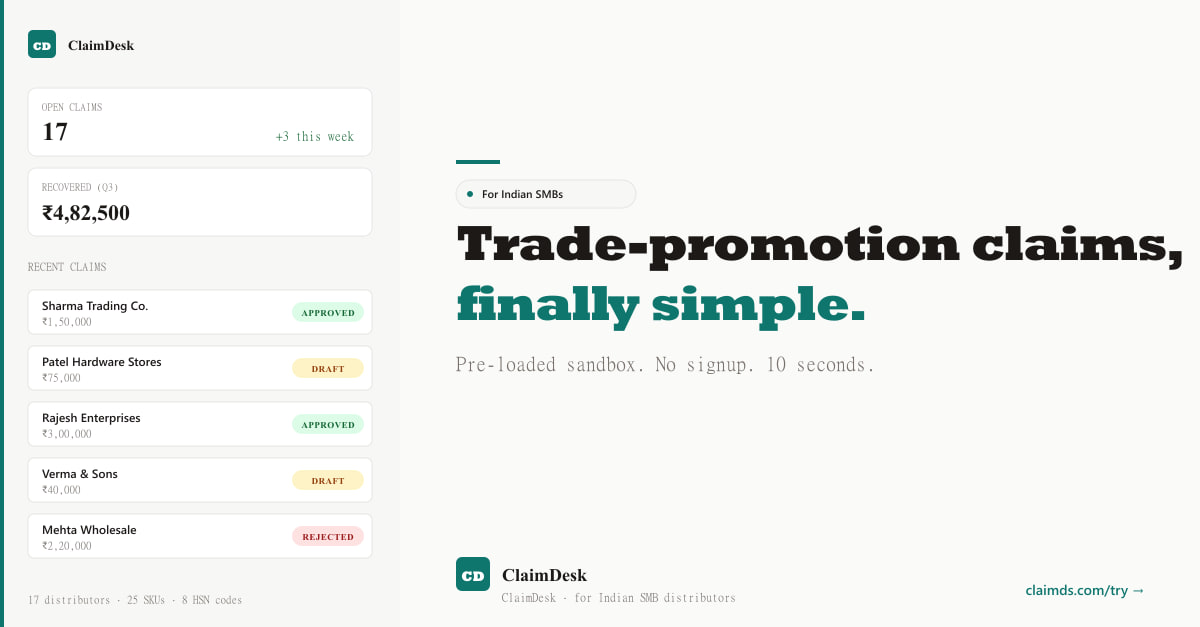
What is a settlement factsheet? A single, self-contained record of how one payout was calculated — the scheme terms that applied, the payee's actual achievement, the calculation step by step, any deductions or clawbacks, and who approved it. Its job is simple: when anyone asks "why is this number ₹X?", the answer is one document, not an argument.
Not to be confused with a mutual-fund fact sheet — "factsheet" here is a claim-settlement document in trade schemes, and "settlement" means claim and scheme settlement, not securities settlement.
What problem does it solve?
Picture a spreadsheet-run settlement operation. The distributor's number differs from yours by ₹18,000. The calculation lives in one analyst's Excel file, in a version nobody else can reproduce. The scheme terms were communicated as a WhatsApp-forwarded circular, and which slab applied depends on which forward you read. The argument runs for weeks over email, burns goodwill on both sides, and ends in a compromise number that satisfies no one and explains nothing — the anatomy of why distributor claims slip through the cracks.
Every one of those failure points is an assertion standing where evidence should be. The factsheet exists to invert that: the calculation is shown, not asserted. Terms, counted data, workings, adjustments, approvals — laid out once, in one place, for one settlement. Disputes don't vanish because everyone becomes agreeable; they vanish because there is nothing left to dispute except specific, checkable lines.
What does a good factsheet contain?
| Section | What it shows | The dispute it prevents |
|---|---|---|
| Scheme reference & terms | Which scheme, its period, the rate or slab table applied | "We were on a different scheme" |
| Qualifying data | The payee's actual purchases or sales counted, with source | "You counted the wrong invoices" |
| Calculation workings | Step by step from achievement to gross payout | "Your math is wrong" |
| Adjustments | Deductions, recoveries, clawbacks from returns, TDS where applicable | "Why is the amount lower?" |
| Approvals & audit trail | Who checked, who approved, when | "Who signed this off?" |
| Net payable & settlement mode | The final amount and its credit-note or payout reference | "Where is the money?" |
Three of the six rows carry most of the dispute weight. Qualifying data is where the two sides' numbers usually diverge — the payee counts a dispatch the payer counts in the next period, and the primary-vs-secondary sales distinction decides who is right. Adjustments is where surprise lives: a clawback from a returned sale or a netted deduction that was never itemised reads as an arbitrary haircut until the factsheet shows its arithmetic. And approvals is what turns the document from a claim into a record — the difference an audit trail makes when the auditor arrives months later.
How does each side use it?
The payer's finance team uses the factsheet as its maker-checker artefact: the checker reviews the workings rather than re-deriving them, approval authority is exercised against a complete picture, and at year-end the settlement file is audit-ready because every payout already carries its justification — the discipline behind a clean claim settlement process.
The payee — the distributor or dealer reading it — uses it to verify their own earnings without calling anyone. They check the counted invoices against their purchase register, follow the slab arithmetic, see why the net differs from the gross, and raise specific lines if something looks off. That self-service verification is what transparent claim submission promises from the other direction.
One honest note: a factsheet is a discipline, not a software feature. A rigorous team can produce one from a spreadsheet for every settlement — some do. What software changes is consistency and cost: the document is generated from the same data that computed the settlement, for every settlement, rather than assembled by hand for the contested ones after the argument has started.
How does ClaimDS handle this?
ClaimDS keeps every element of the factsheet on the settlement record itself, because each one is already part of how a claim moves through the system: the rebate agreement holds the scheme terms; the claim carries its evidence and the invoice-level base data it was validated against; the reconciliation shows matched and exception lines; approvals are recorded step by step in a tamper-evident audit log; and the settlement links to the credit note that executed it. The result is that "why is this number ₹X?" is answerable from one screen — and exportable to Excel when the payee wants to check it against their own records.
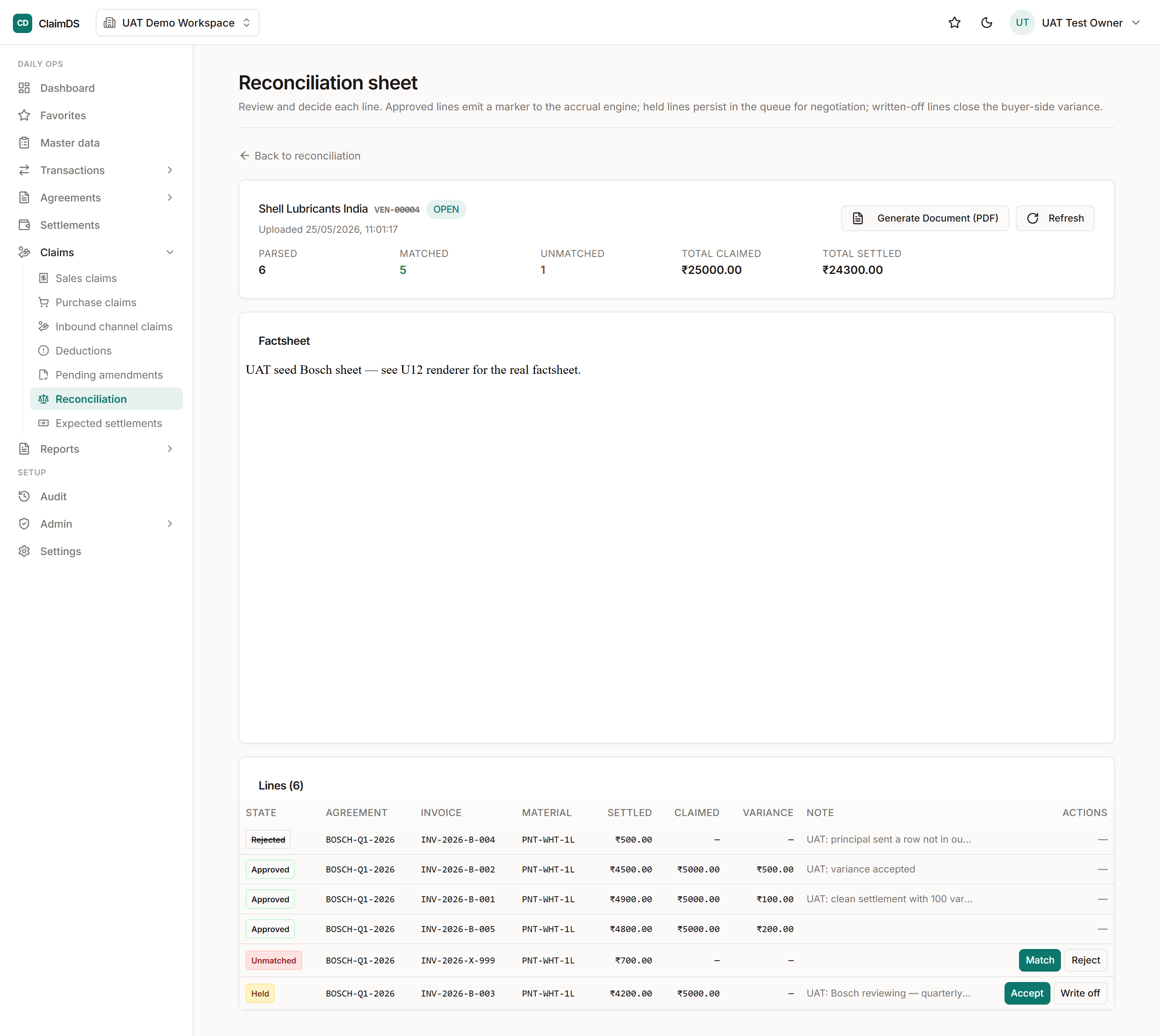
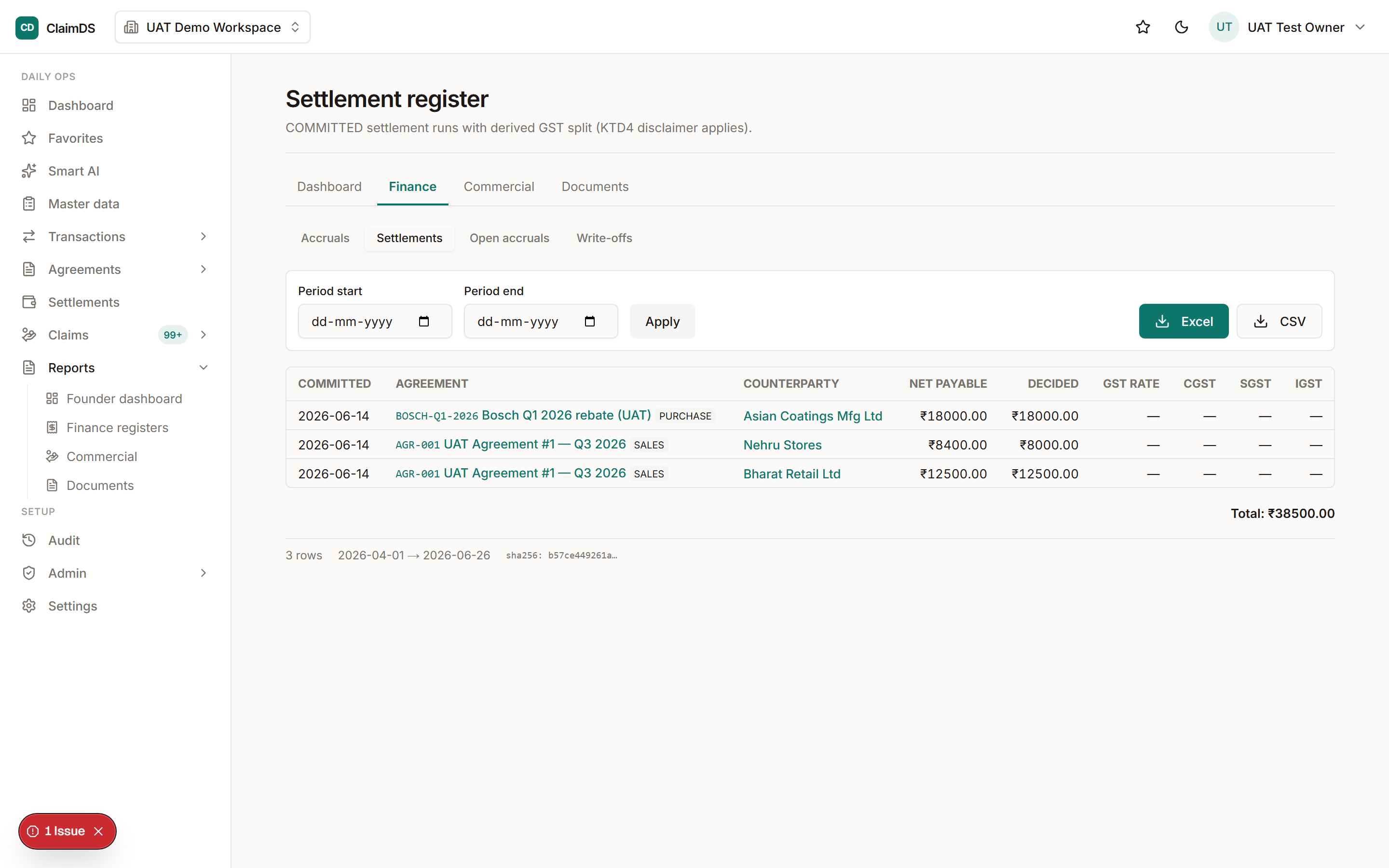
To see a settlement traced from scheme terms to credit note on live data, book a demo.
Where does tax fit?
The factsheet records what was settled; the tax treatment follows from who the payee is and what the arrangement says. Whether the settlement runs through a tax or commercial credit note is the Circular 251 question; whether TDS applies, and under which section, turns on the agency-vs-principal distinction — and none of it changes what the factsheet must show. Record the settlement completely, and the tax working has everything it needs.
Note: This article is general information about a documentation practice, not tax or legal advice. Tax positions belong to the linked guides and to your adviser.
Frequently asked questions
What is a settlement factsheet?
A settlement factsheet is a single document recording how one claim or scheme payout was calculated: the scheme reference and terms applied, the qualifying data counted, the step-by-step workings from achievement to gross payout, any adjustments such as deductions, clawbacks or TDS, the approvals behind it, and the net amount with its settlement reference. Its purpose is that the calculation is shown, not asserted.
What should a rebate settlement statement include?
Six sections: the scheme reference with its period and rate or slab table; the qualifying data actually counted, with its source; the calculation workings step by step; adjustments — deductions, recoveries, clawbacks from returns, and TDS where applicable; the approval trail showing who checked and approved; and the net payable with the credit-note or payout reference that settled it. Each section pre-answers a specific dispute.
How does a factsheet reduce claim disputes?
Because most settlement disputes are not disagreements about the scheme — they are disagreements about what was counted and how the number was reached. A factsheet shows the counted data and the arithmetic, so the conversation moves from "your number is wrong" to "this specific invoice is missing" — a checkable claim that resolves in minutes rather than a weeks-long argument between two spreadsheets.
Can a distributor verify a claim settlement without a factsheet?
Only by reconstructing the calculation themselves — pulling their own purchase data, interpreting the scheme circular, and re-deriving the payout — which is exactly the duplicated effort that produces two different numbers and starts the dispute. A factsheet removes the reconstruction: the payee checks the counted data and workings directly against their records, and flags specific lines rather than contesting the total.
Is a settlement factsheet the same as a credit note?
No — they answer different questions. The credit note is the settlement instrument: the document that actually adjusts the account, with the particulars GST rules prescribe. The factsheet is the explanation of the number on it: which scheme, what achievement, what workings and adjustments produced the amount. The credit note settles; the factsheet justifies. A clean settlement needs both, linked.
See ClaimDS on your own claims data
A 30-minute walkthrough tailored to how your channel actually settles claims.
Related posts

Channel Claims and Rebates in Indian Agri-Inputs
How schemes, claims and rebates work across the Indian agri-input channel — fertilizers, crop-protection and seeds, seasonal schemes and expiry returns.
How to Settle Agri-Input Dealer Claims
The step-by-step process to settle agri-input dealer and distributor claims in India — seasonal schemes, liquidation claims and near-expiry returns.
Expiry and Season-End Returns in Agri-Inputs
How near-expiry, damage and season-end returns work in Indian agri-inputs — declaring returnable stock, the claim window and how each return settles.