
Supplier Rebate Agreements: Types, Key Terms & How to Negotiate Better Ones
A buy-side guide to supplier rebate agreements — agreement types, the key terms to scrutinise (measurement basis, returns, clawback), and how to negotiate better rebates.
Supplier rebate agreements are the buy-side contracts that decide what rebates you earn from your suppliers — and whether you ever actually get paid. This guide covers the agreement types, the key terms to scrutinise, and how to negotiate better ones. It's the buy-side companion to supplier rebates and vendor rebate management.
Agreement types
| Type | Rewards |
|---|---|
| Volume / tiered | Crossing purchase-volume thresholds |
| Growth | Beating a prior-period baseline |
| Retrospective vs prospective | Whole-turnover vs marginal application |
| Product-mix | Breadth across a basket |
| Early-payment / settlement | Fast payment of invoices |
| Marketing / MDF-linked | Participation in supplier programs |
The retrospective-vs-prospective distinction alone changes the payout materially — see volume rebates — and it all sits under the rebate management software pillar.
The key terms to scrutinise (checklist)
| Term | Why it matters |
|---|---|
| Measurement basis (gross vs net) | Decides whether returns/discounts reduce the base |
| Returns treatment | Are returned goods clawed back from the rebate? |
| Qualification period | The window over which volume is measured |
| Payment timing | When the credit note actually lands |
| Evidence requirements | What you must produce to claim |
| Audit rights | Can either side audit the calculation? |
| Clawback clause | Conditions that reverse a paid rebate |
| Termination | What happens to accruals if the deal ends |
The measurement basis is the term that most often surprises buyers — accruing on gross purchases when the agreement measures net (of returns/discounts) over-states the receivable every period, a classic error covered in how to calculate supplier rebate accruals.
Negotiating better agreements
- Bring data-backed forecasts. A credible volume projection lets you argue for reachable thresholds.
- Place thresholds realistically. A tier you can't hit is worth nothing.
- Avoid all-or-nothing cliffs. Graduated tiers protect you if you fall just short.
- Nail down disputed quantities and returns in writing, before signing.
India context: settlement
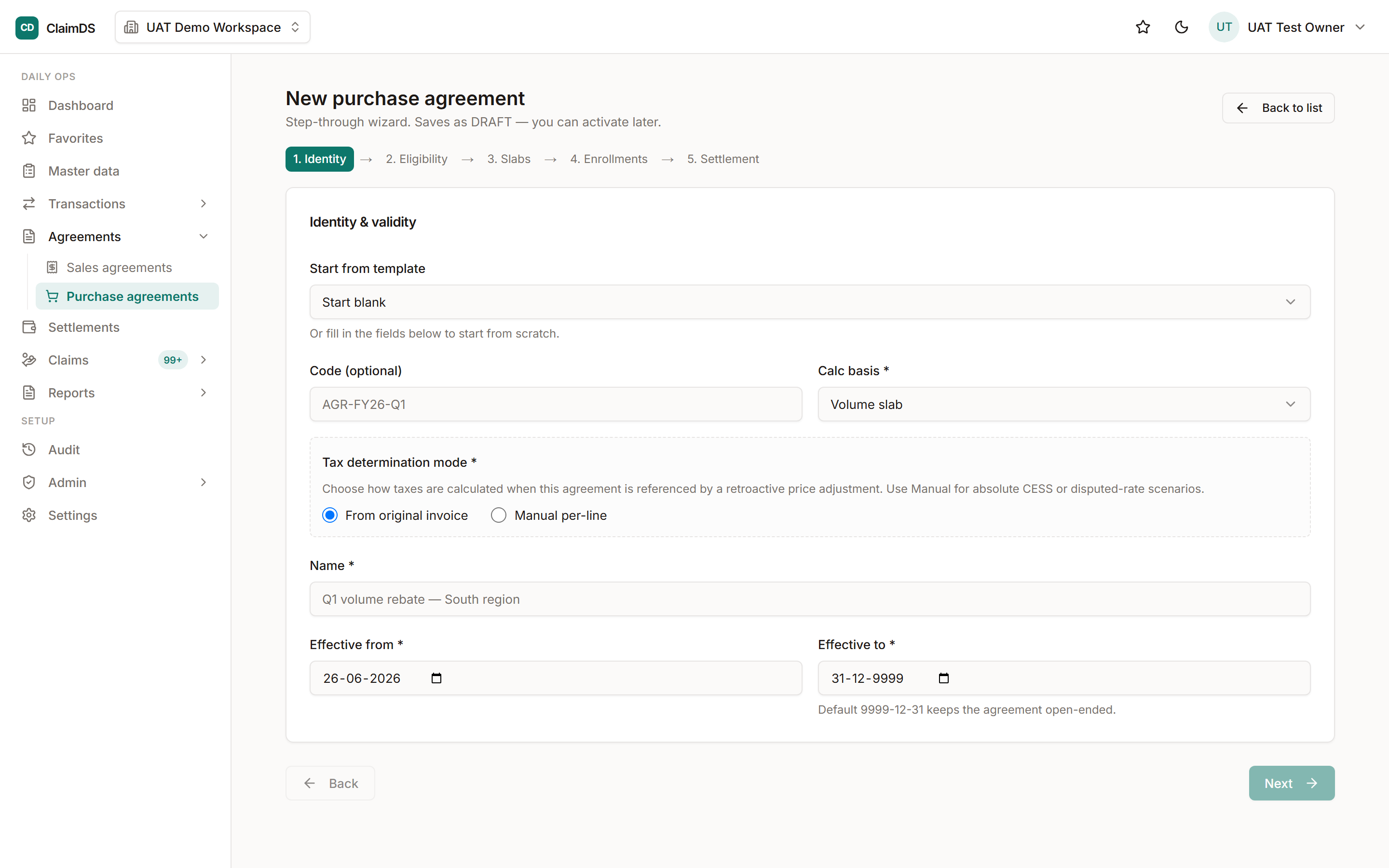
Supplier rebate agreements in India settle via credit notes, and the type affects ITC on the receiving side — the recognition and reconciliation mechanics are in rebate accounting, and the buy-side incentive framing in purchase incentives.
Where ClaimDS fits
ClaimDS models supplier rebate agreements as structured rules — measurement basis, returns, tiers — and accrues against purchases so what you earned is visible and reconcilable, India-first at a mid-market price (a ClaimDS-supplied ~₹3–5 lakh/yr figure, positioning not a benchmark).
GST note: Supplier rebates settle via credit notes — see financial vs. tax credit notes. General information, not tax advice.
Frequently asked questions
What are the common types of supplier rebate agreements?
Volume/tiered, growth, retrospective vs prospective, product-mix, early-payment/settlement, and marketing/MDF-linked. Each rewards a different buying behaviour — volume rewards scale, growth rewards year-on-year increase, mix rewards breadth, and early-payment rewards fast settlement.
What terms should you scrutinise in a supplier rebate agreement?
The measurement basis (gross vs net purchases), returns treatment, qualification period, payment timing, evidence requirements, audit rights, clawback clauses and termination. These decide whether the rebate you think you earned actually gets paid — the fine print matters more than the headline rate.
How do you negotiate better supplier rebates?
Bring data-backed volume forecasts, place tier thresholds where you can realistically reach them, avoid all-or-nothing cliffs in favour of graduated tiers, and get clear written treatment of disputed quantities and returns. Negotiate the terms, not just the percentage.
See ClaimDS on your own claims data
A 30-minute walkthrough tailored to how your channel actually settles claims.
Related posts

How Rebate Schemes Work for Online Sellers & E-Commerce Channels in India
How rebate and incentive schemes work for India's e-commerce channel — brands running schemes for marketplace/D2C sellers, and sellers reconciling rebates against platform deductions.
Rebate Software Pricing in India: Cost Models, TCO & How to Compare Plans
How to compare rebate software pricing in India — the common cost models, what drives price, hidden costs, a TCO worksheet, and where to find independent reviews.
Sell-In Rebate Strategy: How to Incentivize Channel Partners Without Channel Stuffing
How sell-in rebates motivate channel partners — and how to design one without channel stuffing, using sell-through conditions, caps, healthy-inventory clauses and growth structures.