
How to Calculate Supplier Rebate Accruals Accurately (Step-by-Step)
A step-by-step method for calculating supplier rebate accruals (rebates receivable) — measurement basis, attainment estimation, reconciliation to supplier statements, and true-up.
To calculate supplier rebate accruals accurately, map each agreement's basis, pull qualifying purchases net of returns, estimate attainment for tiered schemes, compute the period accrual, reconcile to supplier statements, and true-up at settlement. This is buy-side (rebates receivable), which is why the basis and attainment estimate matter so much.
Finance/GST note: This is general information, not accounting or tax advice. Accrual treatment and the GST/ITC dimension on the receiving side carry real consequences — confirm your approach with a qualified professional (CA/CMA). Professional review pending. GST positions including CBIC Circular 251/08/2025-GST must be re-verified at publish time.
Buy-side vs sell-side — the distinction
This complements, and does not duplicate, rebate accounting, which centres on sell-side rebates payable. Here the rebate is an asset you're owed by a supplier, recorded as a receivable — see supplier rebates and the terms in supplier rebate agreements.
The six-step method
- Map the agreement. Capture structure (volume/growth/mix) and, critically, the measurement basis — gross or net of returns and discounts.
- Pull qualifying purchases net of returns. Use the basis the agreement specifies, not the one that's easiest to pull.
- Estimate attainment for tiered/retrospective schemes. Use a supportable estimate — probability-weighted, or only recognise a tier once threshold-confirmed. Don't assume the top tier.
- Compute the period accrual. Apply the correct rate to the correct base for the period.
- Reconcile to supplier statements. Match your accrual to what the supplier reports; investigate gaps.
- True-up at settlement. Adjust the accrual to the confirmed, settled amount and record the credit note.
The live-accrual discipline is in rebate tracking software.
Common errors
- Accruing gross when the agreement measures net.
- Missing returns, which inflates the base.
- Over-accruing unconfirmed tiers (assuming the top slab).
- Mismatched periods between purchase data and the qualification window.
A worked (illustrative) example
Illustrative only. Net qualifying purchases for the quarter are ₹2,00,00,000 at a confirmed 1.5% tier → accrual ₹3,00,000. If a higher 2% tier is possible but unconfirmed, recognise the 1.5% and disclose the upside rather than accruing 2% and truing-down later.
The GST/credit-note dimension
On receipt, the supplier's credit-note type affects your input tax credit — a tax credit note may require ITC adjustment, a financial one may not. The mechanics are in financial vs. tax credit notes; the analytics view is rebate analytics, and the leadership framing is in the CFO revenue-leakage playbook.
Where ClaimDS fits
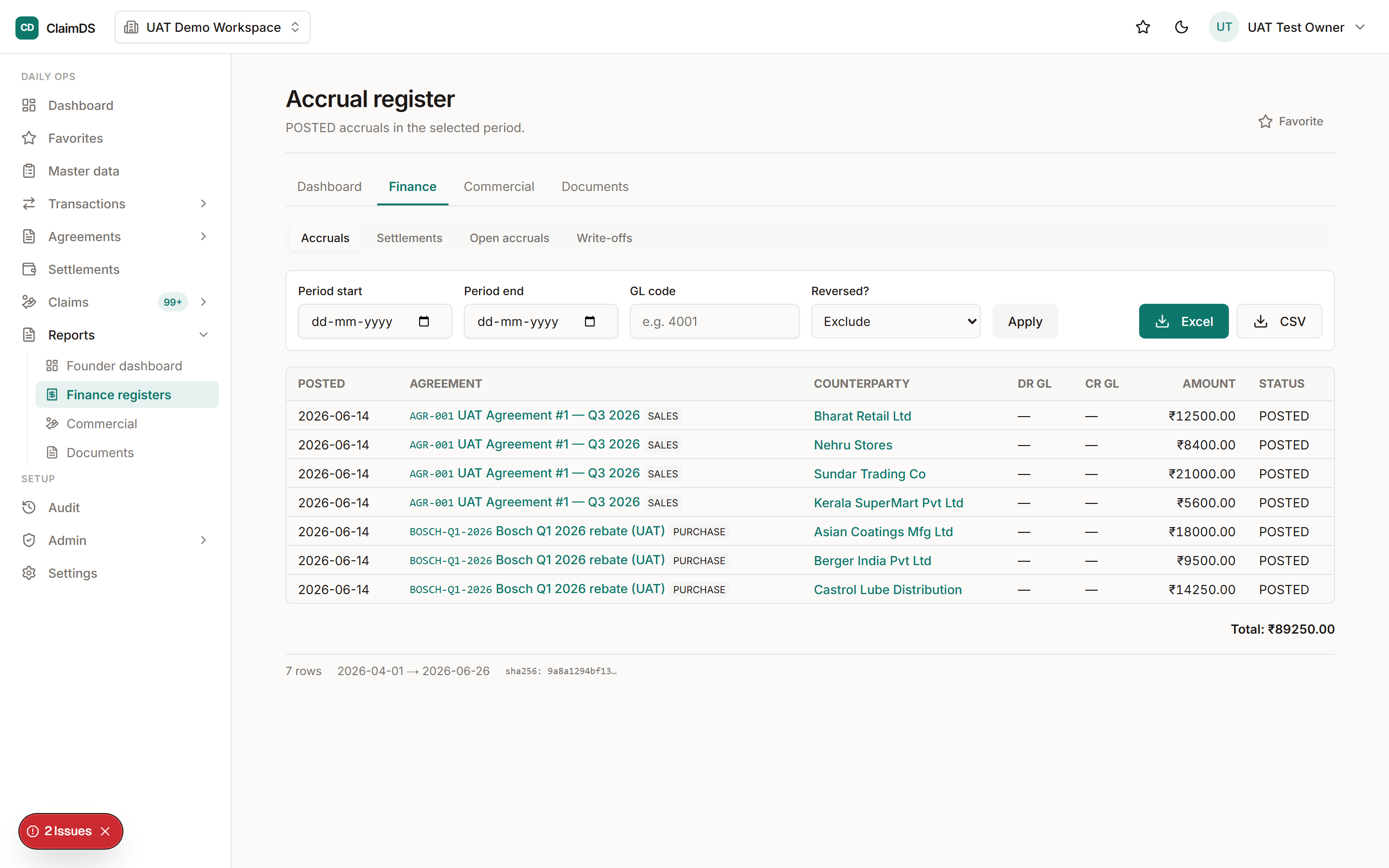
ClaimDS accrues supplier rebates on the agreement's actual basis, holds the attainment estimate, and reconciles to supplier statements with an audit trail — India-first at a mid-market price (a ClaimDS-supplied ~₹3–5 lakh/yr figure, positioning not a benchmark).
Frequently asked questions
How do you calculate supplier rebate accruals?
Map each agreement's structure and measurement basis, pull qualifying purchase data net of returns, estimate attainment for tiered or retrospective schemes, compute the period accrual, reconcile it to supplier statements, and true-up at settlement. The order matters — accruing on the wrong basis is the most common error.
What is the difference between accruing gross and net?
If an agreement measures qualifying purchases net of returns and discounts, accruing on gross purchases over-states the rebate receivable every period. Always accrue on the basis the agreement actually specifies — gross vs net is the single most common accrual mistake.
How do you handle tiered or retrospective supplier rebates in an accrual?
For unconfirmed tiers, use a supportable attainment estimate — probability-weighted or threshold-confirmed — rather than assuming the top tier. Over-accruing an unconfirmed retrospective tier inflates the receivable and forces a painful true-down later.
See ClaimDS on your own claims data
A 30-minute walkthrough tailored to how your channel actually settles claims.
Related posts

ERP Integration for Claims, Rebate & TPM Software: What Indian Businesses Should Check
Why ERP integration decides claims/rebate/TPM software success in India — the data flows that matter, integration patterns, the Indian ERP landscape, and a readiness checklist.
Rebate Analytics: Reporting, Dashboards & Opportunity Analysis
What rebate analytics should deliver — real-time accrual dashboards, liability forecasting, scheme profitability, partner performance and slab-proximity opportunity analysis.
How Rebate Software Improves Financial Reporting Accuracy
How manual rebates corrupt financial reporting — under/over-accrued liabilities, period-close surprises, misstated margins — and how rebate software fixes each.