
What Faster Claim Settlement Is Worth: Claims, Cash and Working Capital
An unsettled claim is your money sitting in someone else's system. How settlement speed affects a distributor's working capital, with worked examples in rupees.
In short
An approved but unsettled claim is working capital you have earned and cannot use. Every extra settlement cycle means that money is financed by someone — usually the distributor, through borrowing or through stock not bought. Faster settlement does not increase margin; it releases cash you were already owed.
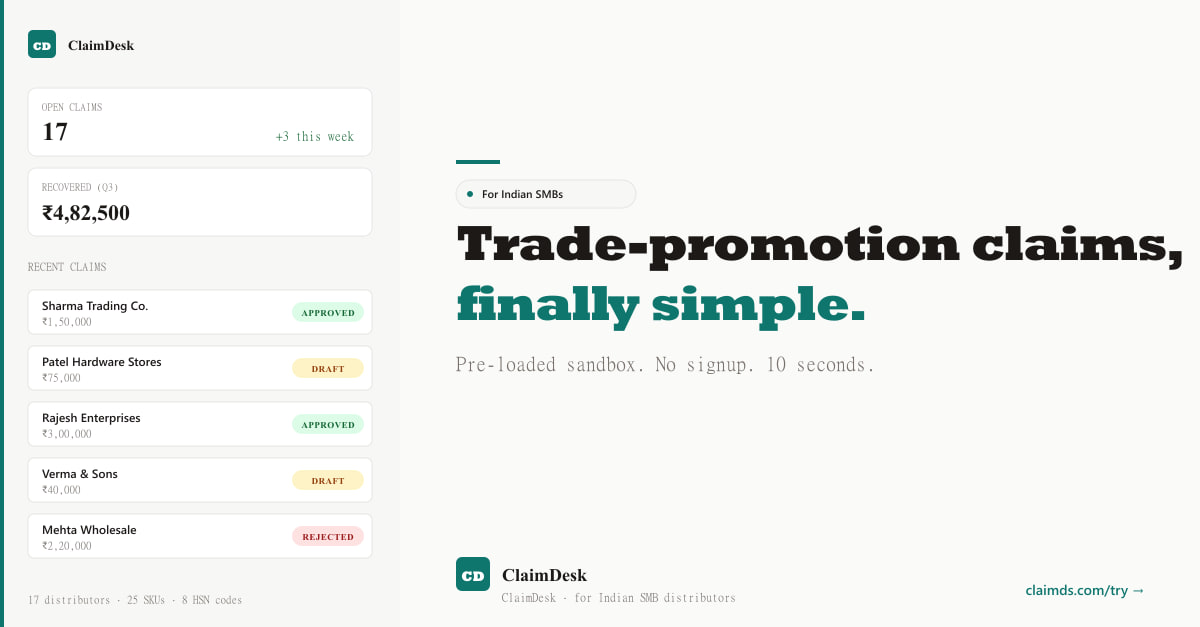
An approved but unsettled claim is working capital you have earned and cannot use. Every extra settlement cycle means that money is financed by someone — usually the distributor, through borrowing or through stock not bought. Faster settlement does not increase margin; it releases cash you were already owed.
A note on the anchor: this is about the cash tied up in unsettled claims, not about loan or credit products. "Working capital" here means your own money held in the settlement process, not financing you take on.
Why this matters more in Indian distribution than elsewhere
The arithmetic of thin margins is what makes settlement timing a first-order issue rather than a housekeeping one.
According to AICPDF, the All India Consumer Products Distributors' Federation, distributor margins in the FMCG channel are around 3.5–5%, and the federation has publicly sought a review of them — arguing that inflation across the cost base has made those margins difficult to sustain. By its own internal assessment, AICPDF has said logistics, basic manpower and secondary transportation alone can absorb up to ₹57 of every ₹100 before warehousing, bank interest, compliance or damage are even counted. (Confirm these figures and their current status before relying on them; they reflect the federation's stated position.)
Traditional trade — the distributor-served channel this describes — remains the bulk of Indian FMCG. NielsenIQ has reported traditional trade at around 81.8% of FMCG sales, across roughly 11.5 million offline stores. (Attributed to NielsenIQ; confirm the figure and date at the point of use.)
Put those together and the point is stark: a channel that moves most of the country's FMCG runs on margins of a few percent, with more than half of every hundred rupees consumed by logistics and manpower before other costs. On a margin that thin, cash tied up in unsettled claims is not a rounding issue — its carrying cost is a meaningful slice of what little margin remains.
The worked example
Every figure below is illustrative — invented to show the mechanism, not drawn from any survey. Run your own numbers.
Take a distributor with monthly purchases of ₹1,00,00,000 and schemes worth 3% of purchases — so about ₹3,00,000 of scheme money is earned each month. Compare two settlement speeds:
| Settled one cycle later | Settled two cycles later | |
|---|---|---|
| Scheme earned per month | ₹3,00,000 | ₹3,00,000 |
| Cash held up at any time (approx.) | one month's worth ≈ ₹3,00,000 | two months' worth ≈ ₹6,00,000 |
| Financing cost at an assumed 12% per year | ≈ ₹3,000 per month on the held amount | ≈ ₹6,000 per month on the held amount |
The extra cycle roughly doubles the cash standing in the claims process and, with it, the financing cost of carrying it. The figures are illustrative and the interest rate assumed; the mechanism is not. Slower settlement means more of your own money is financed for longer — and on a 3.5–5% margin, that carrying cost competes directly with the profit on the underlying sales. This is the cash-timing cousin of the revenue-leakage problem, and it compounds the same thin-margin arithmetic.
Where the cash actually sits
"Unsettled claims" is not one pool — it is four, and each has a different fix:
- Raised but not approved — stuck in the query loop; the fix is faster, first-time-right claims.
- Approved but not settled — the credit note or payout hasn't issued; the fix is prompt settlement runs.
- Settled by credit note but not adjusted — the note exists but hasn't been applied against the account; the fix is reconciliation.
- Disputed and ageing — contested and sitting; the fix is validation and evidence, the domain of deduction management.
Knowing which pool your outstanding cash sits in tells you which fix to apply. Lumping them together as "claims take too long" hides the specific bottleneck.
What a brand gains from settling faster
This is not only the distributor's concern. A brand that settles faster gets cleaner accruals — less scheme liability ageing on the books and truing up unpredictably; fewer disputes, because current claims are easier to agree than stale ones; and healthier distributors, who with better liquidity can buy more stock and fund more of the brand's schemes. Faster settlement is a channel-health investment, not a concession. It is not charity and it need not be framed as one — it improves the numbers on both sides of the relationship.
Measure your own number
Skip the benchmarks and calculate it from your records. Two figures give you the picture:
Claims outstanding — total the claims raised but not yet settled, split by the four pools above.
Average days to settle — from claim raised to cash or credit received, taken from your own history.
Multiply the outstanding balance by your own cost of funds and you have the annual carrying cost of the cash held in your claims process — a real number, specific to you, and usually larger than expected. That figure, not any industry statistic, is what justifies the effort of settling faster.
Where a system helps
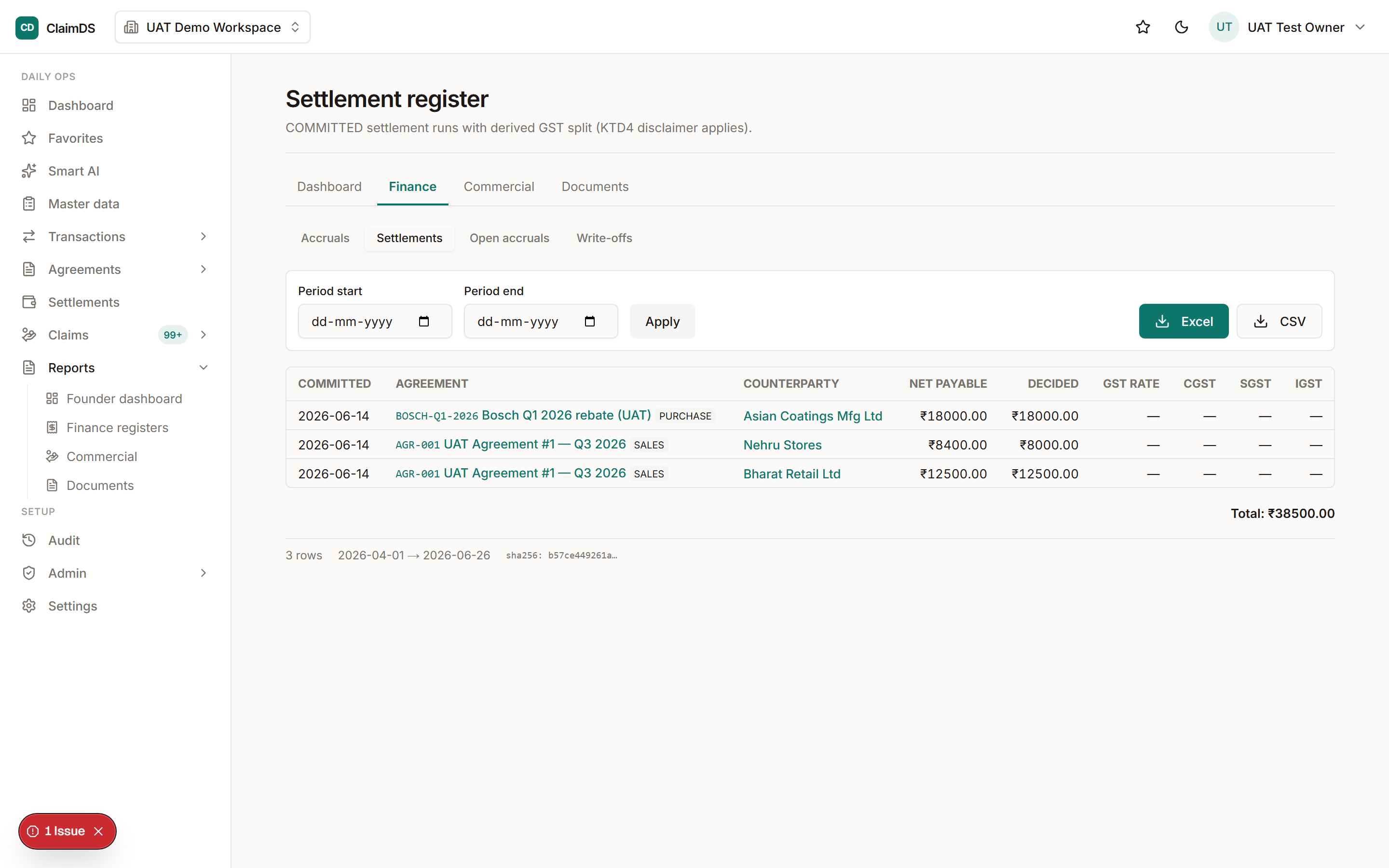
A claims workflow reduces cash tied up by attacking each pool: it raises first-time-right rates so fewer claims stall before approval, keeps settlement runs prompt, and links credit notes back to claims so nothing sits "settled but unadjusted". ClaimDS keeps claims, approvals and settlements linked with an ageing view across all four pools, so the cash-in-process number is visible rather than reconstructed at quarter-end. The wider picture is in connected claims.
To measure the cash held in your own claims process, book a demo.
Note: General information, not financial or investment advice. The AICPDF and NielsenIQ figures reflect those organisations' stated positions and should be confirmed as current before use; every other number here is an explicitly illustrative example, not a benchmark. GST treatment of settlements is covered in our tax articles.
Frequently asked questions
How do unsettled claims affect working capital?
An approved but unsettled claim is cash you have earned but cannot deploy — it sits in the counterparty's process instead of your bank account. While it sits there, your working capital is lower by that amount, so it is funded either by borrowing, at an interest cost, or by not buying stock you would otherwise have bought. Either way it has a real cost.
What is the cost of a delayed claim settlement?
The financing cost of the cash tied up for the extra time. If a settlement arrives one cycle later than it could, the amount owed is effectively financed for that cycle — through interest on borrowing, or through the opportunity cost of stock not purchased and sales not made. The cost is not a lost margin; it is the carrying cost of your own money held elsewhere.
How do I calculate claims outstanding?
Total the claims you have raised that are not yet settled, and split them by stage — raised but not approved, approved but not settled, settled by credit note but not yet adjusted, and disputed. Track the total and the median days from claim to settlement from your own records. That figure, not any industry benchmark, tells you how much of your cash is held in the claims process.
Do faster settlements improve distributor margins?
No — they release cash already earned rather than increasing the margin on a sale. The scheme rate is unchanged; what changes is how quickly the money you were owed reaches you. That improves liquidity and reduces financing cost, which matters greatly on thin margins, but it should not be described as a margin increase. It is a cash-timing benefit, not a pricing one.
Why are distributor margins under pressure in India?
Rising costs against structurally thin margins. AICPDF, the distributors' federation, has publicly sought a review of distributor margins it describes as around 3.5–5%, arguing that inflation across logistics, manpower, rent and financing has made them hard to sustain. On margins that thin, the carrying cost of cash tied up in unsettled claims is proportionally large — confirm current figures before relying on them.
What is the difference between revenue leakage and delayed settlement?
Revenue leakage is money you never collect — a claim wrongly rejected, a duplicate deduction, a scheme never claimed. Delayed settlement is money you do collect, but later than you should. Leakage is a loss; delay is a financing cost. Both matter on thin margins, but the fixes differ: leakage needs validation and completeness, delay needs faster, cleaner settlement.
See ClaimDS on your own claims data
A 30-minute walkthrough tailored to how your channel actually settles claims.
Related posts

Connected Claims: How Invoice and Sales Data Moves Between Your ERP, Your Brands and Your Claims
How invoice and secondary-sales data moves between a distributor's ERP, the brand, and the claim settlement — file upload, direct connection, and what each is good for.
Exporting Sales and Purchase Invoices from Tally for Claim Settlement
How to get invoice data out of Tally in a form a claims workflow can use — what to export, which fields matter, and how to keep the data clean enough to reconcile.
File Upload, Direct Connection or API: How Claim Data Actually Moves
Three ways invoice and claim data moves between systems — plain English, no jargon, with the trade-offs of each for an Indian distributor or brand.