
Reducing Distributor Claim Turnaround Time: Where the Days Actually Go
A distributor claim passes through submission, validation, approval and settlement. Each stage adds days — here is where they accumulate and how to compress them.
In short
A claim's turnaround is the sum of its stages — preparing and submitting it, validating it against scheme terms, resolving queries, approving it, and issuing the settlement document. Most delay sits in query resolution and evidence-gathering, not in the approval itself.
A claim's turnaround is the sum of its stages — preparing and submitting it, validating it against scheme terms, resolving queries, approving it, and issuing the settlement document. Most delay sits in query resolution and evidence-gathering, not in the approval itself.
| Stage | What happens | What adds days | What removes them |
|---|---|---|---|
| Preparation and submission | Distributor assembles and files the claim | Reconstructing data by hand; unclear scheme terms | Terms published once; evidence attached at source |
| Receipt and completeness check | Brand confirms the claim is complete | Gaps found late, after it entered the queue | Immediate completeness validation at intake |
| Validation against scheme terms | Claim tested against eligibility and slabs | Manual matching of parties and items | Automatic matching on clean master data |
| Query and evidence exchange | Missing or mismatched data chased | Each round trip costs a full cycle | Fewer, more complete first submissions |
| Approval | Authorised sign-off | Waiting behind incomplete evidence | Complete claims approve quickly |
| Settlement document | Credit note or payout issued | Manual preparation, batching delays | Generated from the approved claim |
| Reconciliation and closure | Settlement tied back and closed | Unmatched credit notes reopened later | Linkage kept from claim to settlement |
Why the delay is rarely the approval
It is tempting to attack turnaround by pushing approvers to sign faster. It rarely helps, because the approval is seldom the bottleneck.
An approval is quick when the evidence in front of the approver is complete — the invoices are there, the parties and items match, the slab is correctly applied, the claim is inside the window. The approver reads a coherent claim and signs it. The days do not accumulate there. They accumulate before the claim ever reaches a clean approvable state: in the back-and-forth to get the missing invoice, to resolve the outlet that doesn't match, to clarify which scheme version applied.
So the lever is not approval speed. It is reducing the number of claims that need a query at all — raising the first-time-right rate — which attacks the stage where the time genuinely lives.
The query loop is the real cost
Picture a claim that arrives missing a piece of evidence. The brand raises a query; the distributor receives it a few days later; they gather the missing data over a week; it comes back; it is re-checked; a second gap surfaces; the loop runs again. Each round trip costs roughly a full cycle of everyone's attention, and a claim that needs three rounds can take many times longer than the same claim submitted complete.
Illustrative, not a benchmark: a claim that needs three query rounds at about a week each takes on the order of a month longer than the identical claim submitted complete and settled in the first cycle. The numbers will differ in every business — the point is the shape, not the figure: each avoided round trip removes a cycle, and completeness at submission is what avoids round trips.
The way to collapse the loop is to make claims complete before they are filed — evidence attached at source, parties and items already matched, the scheme reference correct. That is what submitting a claim with its evidence is for, and what a validated invoice upload file makes possible.
What both sides can fix
Brand side: publish scheme terms in one authoritative place so claims are prepared against the right rules; define exactly what evidence each claim type needs; and give distributors a status view so they can see where a claim is instead of phoning to ask. Validate completeness at intake and return incomplete claims quickly with clear reasons, rather than letting them sit and discovering gaps deep in the queue.
Distributor side: submit complete data on the agreed cycle, using consistent master data so parties and items match on the first pass. A claim filed complete is a claim that skips the query loop entirely.
Measuring it honestly
You cannot improve what you do not measure, and you should measure your own numbers rather than trusting any published figure — turnaround varies too much between businesses for an industry statistic to mean anything for yours.
Three measures are enough:
- Median days from submission to settlement — the headline, and use the median rather than the average so a few stuck claims don't distort it.
- First-time-right rate — the share of claims settled with no query back. This is the leading indicator; when it rises, turnaround falls.
- Ageing of open claims — bucketed by how long they've been outstanding, so the oldest surface for action.
Measure your baseline before changing anything, then watch those three move. That is more honest, and more useful, than any benchmark — the same discipline behind the claims ROI benchmark you set for yourself.
Where a system helps
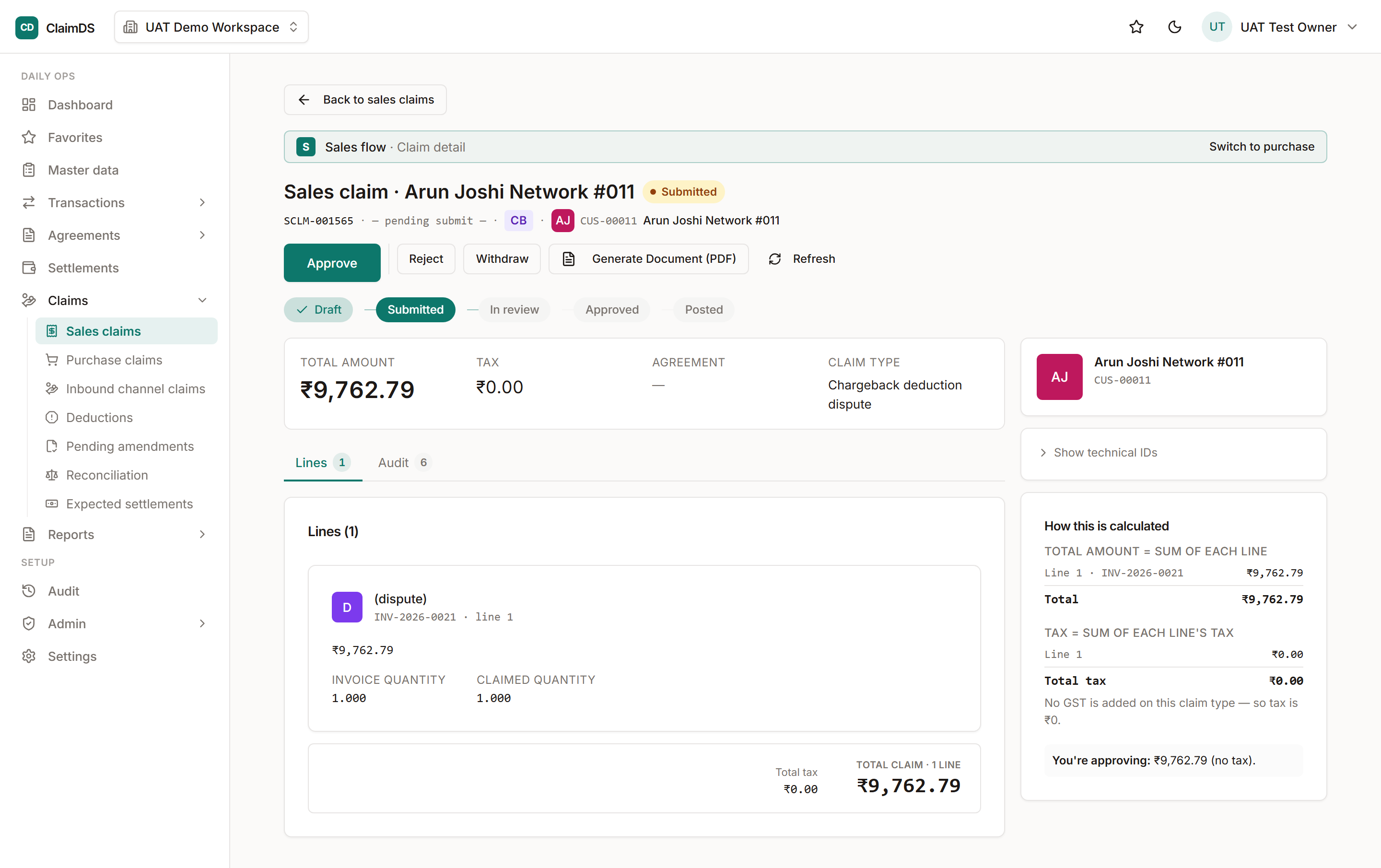
A claims workflow compresses turnaround by attacking the query loop directly: it validates completeness at intake, matches parties and items against master data automatically, surfaces exceptions for a fast decision rather than a slow round trip, and gives both sides a status view. ClaimDS does this and keeps each claim linked from submission through validation, approval and settlement, so the ageing and first-time-right numbers are visible rather than reconstructed. The wider picture is in connected claims.
To measure your own turnaround on live claims, book a demo.
Note: General information about process. The only numeric example here is explicitly illustrative and not a benchmark; measure your own baseline. GST treatment of any settlement is covered in our tax articles.
Frequently asked questions
How long does a distributor claim take to settle?
It varies widely by company, scheme type and the quality of the evidence submitted, so no single figure is meaningful — and any published industry number should be treated with caution. The honest approach is to measure your own baseline: median days from submission to settlement, and the share settled first time without a query. That number is worth more than any benchmark.
Why do claim settlements get delayed?
Rarely at the approval step. Most delay accumulates in the query loop — a claim submitted with incomplete evidence triggers a request for more, which triggers a wait, which repeats. Missing invoice detail, unmatched parties or items, and unclear scheme terms are the usual triggers. Approvals are quick once the evidence is complete; assembling complete evidence is where the days go.
What is claim turnaround time?
Claim turnaround time is the elapsed time from when a distributor submits a claim to when it is settled — the sum of receipt and completeness checking, validation against scheme terms, any query and evidence exchange, approval, and issuing the settlement document. Measuring it end to end, rather than just the approval step, is what reveals where the delay actually sits.
How can a brand speed up claim settlement?
By removing the causes of the query loop. Publish scheme terms in one place so claims are prepared correctly, define exactly what evidence a claim needs, and give distributors a status view so they aren't chasing by phone. On the intake side, validate completeness immediately and return incomplete claims fast with clear reasons, rather than discovering gaps late.
What is a first-time-right claim?
A first-time-right claim is one that passes validation and approval without needing a query back to the distributor — complete evidence, matched parties and items, correct scheme reference, inside the window. The share of claims that are first-time-right is the single most useful turnaround metric, because raising it attacks the query loop where most delay lives, rather than rushing approvals.
How should claim ageing be tracked?
As a bucketed view of open claims by how long they have been outstanding, so the oldest and most at-risk surface for action rather than sitting unnoticed. Track the median days to settle and the first-time-right rate alongside it. Ageing tells you what is stuck now; the other two tell you whether the process is improving over time.
See ClaimDS on your own claims data
A 30-minute walkthrough tailored to how your channel actually settles claims.
Related posts

What Faster Claim Settlement Is Worth: Claims, Cash and Working Capital
An unsettled claim is your money sitting in someone else's system. How settlement speed affects a distributor's working capital, with worked examples in rupees.
Connected Claims: How Invoice and Sales Data Moves Between Your ERP, Your Brands and Your Claims
How invoice and secondary-sales data moves between a distributor's ERP, the brand, and the claim settlement — file upload, direct connection, and what each is good for.
Exporting Sales and Purchase Invoices from Tally for Claim Settlement
How to get invoice data out of Tally in a form a claims workflow can use — what to export, which fields matter, and how to keep the data clean enough to reconcile.