Sub-Dealer and Multi-Tier Schemes: When the Earner Isn't the Buyer
When the partner who earns the reward is not the partner you invoice, claims get complicated. How multi-tier and sub-dealer schemes work, and what they need.
In short
In a multi-tier scheme the partner who earns the reward is not always the partner the manufacturer invoices. A sub-dealer may earn a scheme funded by the manufacturer while buying only from a dealer. The claim therefore travels up the tiers, and each tier must be able to evidence what happened below it.
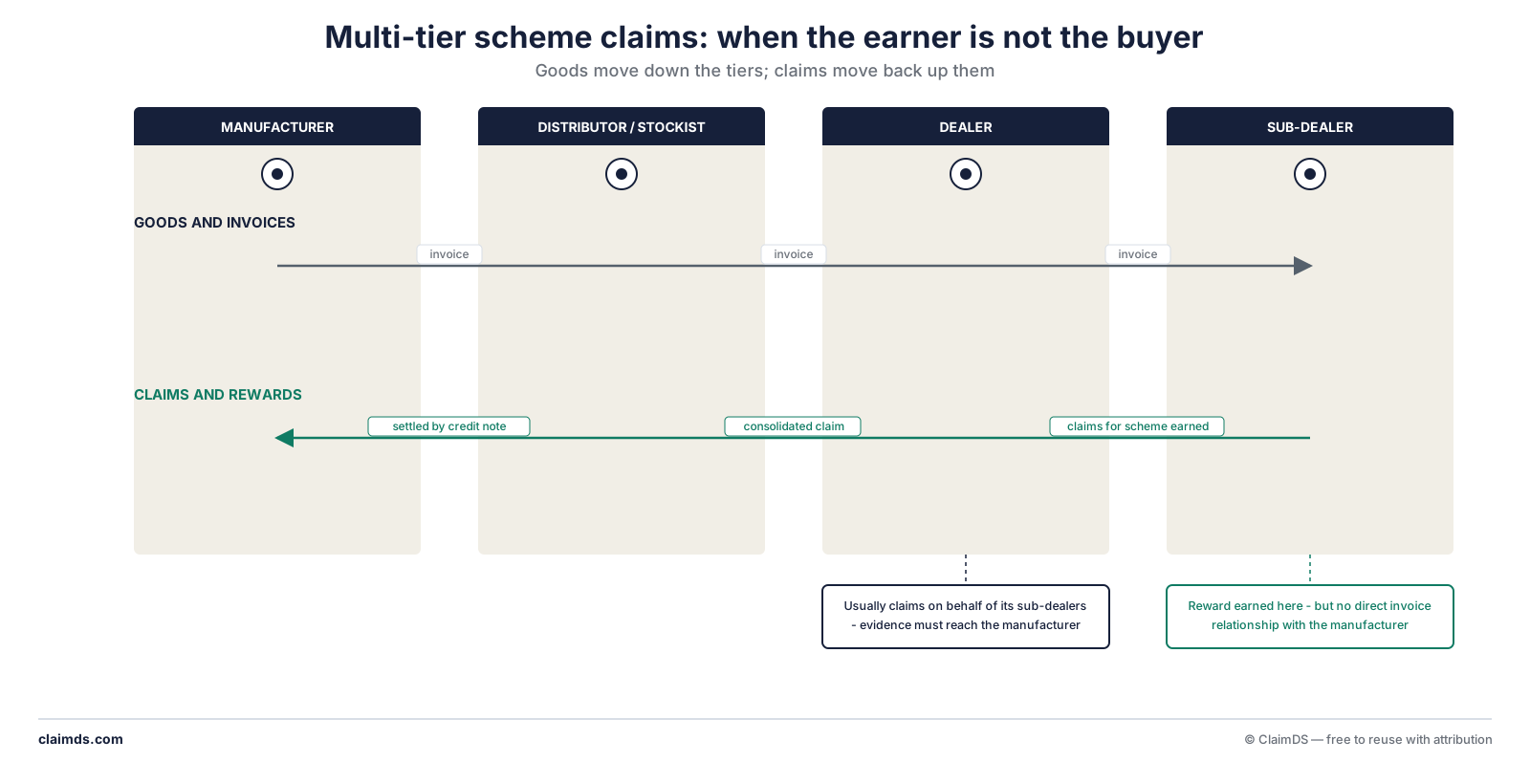
In a multi-tier scheme the partner who earns the reward is not always the partner the manufacturer invoices. A sub-dealer may earn a scheme funded by the manufacturer while buying only from a dealer. The claim therefore travels up the tiers, and each tier must be able to evidence what happened below it.
That single structural fact — the earner is not the buyer — is what makes these schemes harder to run than direct ones, and it is why they generate a disproportionate share of disputes. Throughout, claims means distributor and channel claims, and scheme means a trade or dealer scheme.
Who earns what, and who claims it
| Tier | Buys from | Earns what | Claims from | Evidence it must provide |
|---|---|---|---|---|
| Distributor / stockist | Manufacturer | Schemes on its own purchases | Manufacturer directly | Its own purchase invoices |
| Dealer | Distributor or manufacturer | Schemes on its purchases, plus schemes it administers for the tier below | The tier it buys from | Purchase records, plus its sub-dealers' evidence |
| Sub-dealer | Dealer | Schemes funded by the manufacturer but earned here | Its dealer, who passes the claim up | Purchase records from the dealer, and sales evidence where the scheme depends on it |
| Retailer or end applicator | Sub-dealer or dealer | Loyalty or application-linked rewards | Whoever enrolled them | Proof of purchase or application — codes, invoices, scans |
Read down the "Claims from" column: nobody below the first row claims from the party that funds the scheme. That mismatch between who funds and who evidences is the whole subject of this article.
Why multi-tier schemes exist
The commercial logic is straightforward. A manufacturer wants to influence behaviour at the tier where the product actually moves — and in a deep channel, that tier is often two or three steps removed from anyone it invoices.
Selling into a distributor influences what the distributor buys. It does not, by itself, influence which brand a sub-dealer recommends to a farmer, a contractor or a site engineer. If that decision is made at the sub-dealer counter, then a scheme aimed only at the distributor is aimed at the wrong person.
This shape recurs wherever the channel is deep and the last-mile advisor matters: agri-inputs, where dealer-to-sub-dealer-to-farmer is the standard route; building materials and electricals, where the counter influences specification; paints, where the applicator does; and lubricants, where the mechanic does. The scheme structures differ by sector, but the problem is identical — and it sits alongside the other trade-scheme types rather than replacing them.
The structural problem
Here is the constraint that shapes everything else: the manufacturer holds invoice-level data only for its own direct partner. Everything below that tier is reported, not observed.
In a direct scheme, entitlement can be computed from the manufacturer's own billing. Nobody has to be believed. In a multi-tier scheme the entitlement depends on transactions the manufacturer was not party to and cannot see in its own records — the dealer's sales to sub-dealers, and sometimes the sub-dealer's sales onward.
The consequence is not that these schemes cannot work. It is that they rest on a different evidentiary basis, and pretending otherwise is what causes trouble. A manufacturer that treats reported sub-dealer data as if it were first-party billing data will eventually find it is paying on numbers nobody checked.
This is the same dependency that makes secondary sales data load-bearing, and the same reason a data specification matters more than goodwill: what the distributor shares and what the brand can do with it on receipt determine whether the scheme is settleable at all. Where a C&F agent holds stock it never owns, the picture gets one layer more indirect again.
Who claims from whom
Two models dominate, and they trade off against each other.
Model A — the dealer claims on behalf of its sub-dealers. The manufacturer deals with one party, receives one consolidated claim, and settles to the dealer. The dealer is then responsible for passing the benefit down.
This is administratively simple and matches the invoice relationships that already exist. Its weakness is that the manufacturer is dependent on the dealer actually passing the benefit on, and has limited visibility into whether that happened. A scheme intended to motivate a sub-dealer does nothing if the sub-dealer never sees it.
Model B — sub-dealers are enrolled with the manufacturer, claiming more directly with the dealer acting as a conduit for evidence and settlement.
This gives the manufacturer visibility of who earned what, and confidence that the intended tier received the benefit. Its cost is administrative load: an enrolment list to maintain, more claim lines, more identities to keep clean, and a dealer who may see the direct relationship as bypassing them.
Neither is correct in the abstract. Model A suits schemes where the dealer relationship is strong and the amounts modest; Model B suits schemes where the behaviour being bought genuinely sits at the lower tier and the spend justifies the overhead. What matters is choosing deliberately and writing the choice down — the failure mode is a scheme designed as Model B and administered as Model A, where nobody can say whether the money reached its target.
What the scheme terms must state
These clauses are optional in a single-tier scheme and load-bearing here. The rebate agreement should state:
- Which tiers are eligible, and how a member of each tier is identified.
- What evidence each tier must supply — and in what format, since inconsistent formats are what makes consolidation expensive.
- Who submits the claim, and to whom.
- How the benefit reaches the earning tier, especially under Model A where it passes through an intermediary.
- The deadline at each level — a sub-dealer deadline that leaves the dealer no time to consolidate is not a deadline, it is a trap.
- What happens if a sub-dealer is enrolled with more than one dealer, which is common and is the single most productive source of double-claiming.
The last two are the ones most often missing. Deadlines are usually written for the direct partner only, and multi-dealer enrolment is usually not contemplated until it causes a duplicate.
Enrolment and identity
Everything above depends on knowing who a sub-dealer is — reliably, across periods, and across dealers.
That means stable codes. Where the sub-dealer is a registered business its GSTIN is the most reliable identifier available, because it is issued once and does not vary with how somebody types a trading name. Where it is not registered, the scheme needs its own enrolment identifier, issued centrally rather than by each dealer.
The failure this prevents is worth naming precisely: ambiguous identity is the most common cause of double-claiming in these schemes. The same sub-dealer, spelt two ways, appearing under two dealers, produces two claims on the same purchases — and neither dealer is doing anything wrong. It is not fraud; it is a master-data problem wearing a fraud costume, which is why master-data hygiene does more for scheme integrity here than any amount of claim scrutiny, and why the fields captured at invoice level decide whether consolidation is arithmetic or guesswork.
Where tax questions arise
How a benefit that passes through an intermediate tier is documented and settled can raise GST and income-tax questions — including how the intermediary treats an amount it receives and passes on, and what document accompanies it at each step. The answers depend on the arrangement.
This article takes no position on any of it. Route those questions to the existing coverage — financial versus tax credit notes, CBIC Circular 251 on post-sale discounts and GST on distributor margin, commission and incentives — and confirm the treatment for your own scheme with a qualified professional.
<!-- TODO CA REVIEW: confirm this routing paragraph asserts no position. -->Making it administrable
Three things carry most of the load:
One authoritative enrolment list, centrally issued, with stable codes — not a list per dealer.
Evidence requirements set before launch, in the format you will actually consume, so consolidation is a merge rather than a rekeying exercise.
Settlement traceable to the earning tier, so the question "did the sub-dealer who earned this actually receive it?" has an answer that does not depend on asking the dealer.
ClaimDS holds the scheme terms and the enrolment record together and validates each claim against them, so a claim arriving through a dealer can still be traced to the tier that earned it. <!-- TODO: confirm capability wording with founder --> The wider process sits inside distributor claims management and the claims software category; the arithmetic of the underlying entitlement is in how distributor claims are calculated, and the sell-through variant in secondary scheme settlement.
This article is general information about commercial and operational practice, not legal, tax or accounting advice. Where a scheme, benefit or settlement has GST or income-tax consequences, confirm the treatment for your business with a qualified professional.
Read next
- Primary, secondary and tertiary sales — the tiers this article builds on.
- Master-data hygiene for claims reconciliation — the identity problem, in general form.
- Secondary scheme settlement — settling on sell-through rather than sell-in.
- Supplier rebate agreements — where the multi-tier clauses belong.
Book a demo to see how ClaimDS traces a multi-tier claim back to the tier that earned it.
Frequently asked questions
What is a sub-dealer scheme?
A sub-dealer scheme is a trade scheme funded by the manufacturer but earned at a tier below its direct customer — typically a sub-dealer who buys from a dealer rather than from the manufacturer. The reward is aimed at the tier where the product actually moves, which means the claim has to travel back up through the tiers to reach the funder.
How do claims work in a multi-tier distribution network?
Goods and invoices move down the tiers; claims move back up them. The tier that earns the reward evidences what it sold or bought, the tier above consolidates and submits, and the manufacturer validates and settles — usually by credit note to its direct partner, who is then responsible for passing the benefit down.
Who claims a scheme earned by a sub-dealer?
Usually the dealer, on behalf of its sub-dealers, because the dealer is the party the manufacturer has an invoice relationship with. Some schemes instead enrol sub-dealers directly with the manufacturer and use the dealer as a conduit. Both models are used; the scheme terms should state which one applies and how the benefit reaches the earning tier.
How does a manufacturer verify sub-dealer sales?
Not by direct observation — it has invoice-level data only for its own customer. Everything below that tier is reported rather than observed. Verification therefore rests on evidence requirements set in the scheme terms: what each tier must supply, in what format, by when. That is weaker than first-party data, and worth designing for honestly.
What causes double-claiming in sub-dealer schemes?
Ambiguous identity, most often. A sub-dealer trading under slightly different names across two dealers, or enrolled with more than one dealer, can have the same purchases claimed twice through different routes. Stable codes and a single authoritative enrolment list prevent it; matching on names rather than codes is what allows it.
What should a multi-tier scheme agreement include?
Which tiers are eligible and how they are identified, what evidence each tier must supply, who submits the claim, how the benefit reaches the earning tier, the deadline at each level, and what happens if a sub-dealer is enrolled with more than one dealer. Each of these is optional in a single-tier scheme and load-bearing here.
See ClaimDS on your own claims data
A 30-minute walkthrough tailored to how your channel actually settles claims.
Related posts

How to Build a Claim and Scheme Simulator in Excel
The workbook structure behind every channel claim model — four tabs, codes not names, terms off the formula, and the control totals that catch silent errors.
Build a Buyback and Expiry Return Simulator in Excel
Buyback and expiry claims price returned stock by how old it is. How to band by age in Excel, apply the right rate, and keep batch data straight.
Build a Chargeback and Billback Simulator in Excel
Chargebacks and billbacks are the same calculation — a price difference on qualifying units. How to model both in Excel, and the traps in defining "qualifying".