
Channel Claims and Rebates in Indian Electricals
How schemes, claims and rebates work in the Indian electricals channel — wires, switchgear and lighting, volume slabs and electrician loyalty programs.
Electricals brands — wires and cables, switchgear and MCBs, fans, lighting and switches — reach the market through a deep distributor, dealer and retailer channel plus a parallel project route to contractors and builders. They pay volume-slab schemes to move stock and run electrician loyalty programs that reward the person who recommends the brand at site. Almost everything settles by credit note, not cheque. This pillar maps how the whole electricals channel works, tier by tier, and where each claim attaches.
The electricals channel, tier by tier
The electricals channel is a classic Indian multi-tier route to market, with one distinctive feature: the person who decides which brand gets installed is often not the person who buys it. Product moves from the manufacturer to a depot or carrying-and-forwarding (C&F) agent, out to distributors covering a territory, then to dealers and sub-dealers, and finally across the counter to retailers, electricians and small contractors. In parallel, a project route supplies large contractors and builders directly or through a project distributor. Scheme money and claims flow back up the same chain; damaged or defective stock flows back up as returns.
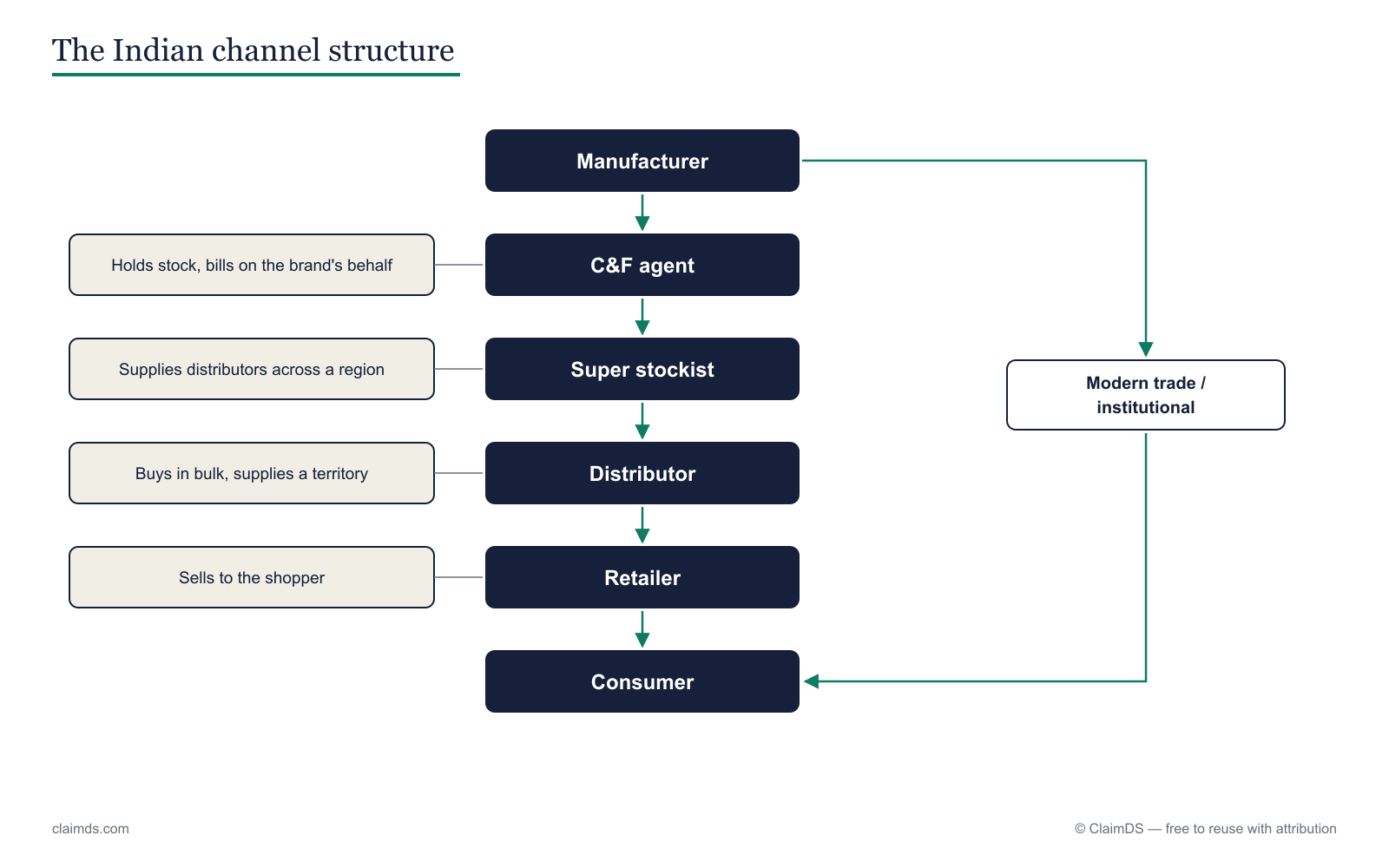 Electricals run a deep dealer channel, with electricians as influencers and a parallel project route.
| Tier | Role in the electricals channel |
|---|---|
| Manufacturer | Makes or markets the wire, switchgear, fan or luminaire; designs schemes, sets pricing and funds the credit notes. |
| Depot / C&F agent | Holds and forwards stock regionally on the brand's behalf; the first link below the factory. |
| Distributor | Buys in bulk for a territory, extends credit to dealers and files the bulk of scheme claims. |
| Dealer / sub-dealer | The electrical wholesaler and its smaller offshoots; stocks range and sells onward at the counter. |
| Retailer / counter | The shop the electrician and walk-in buyer reach; drives retail sell-through. |
| Electrician / contractor | The influencer who recommends and installs the brand at site — rewarded, not billed. |
| Project distributor / contractor | The parallel route supplying builders and large sites at negotiated project rates. |
| End user | The household, builder or facility that finally consumes the product. |
Because the network runs several tiers deep and forks into a counter route and a project route, sorting out who occupies which rung matters before any claim can be validated. The distributor vs dealer vs super stockist breakdown untangles the roles, and the broader India multi-tier channel claim map shows how claims attach to each link. For the settlement mechanics common to every tier, the overview of channel rebates in India is the umbrella reference.
What claims does an electricals company handle?
An electricals company runs a broad spread of claim types because it is managing bulk-commodity products like wire alongside branded, influence-driven products like switches and fans. The main families are volume and slab schemes (buy or sell a target quantity, earn a better rate), electrician loyalty rewards to the recommender, display and branding payouts to shops and showrooms, rate difference on stock held through a price change, and damage claims on breakage or defective returns. Each rests on different proof, and the category has its own vocabulary a finance team must read fluently.
| Electricals term | What it means |
|---|---|
| Volume / slab scheme | A tiered incentive paying a higher rate once a partner crosses a purchase or sell-through band. |
| Slab | One target band in a scheme; the slab reached decides the payout rate. |
| Electrician loyalty | A rewards program for the electrician who recommends and installs the brand at site. |
| Project sales | Direct or project-distributor supply to contractors and builders at negotiated site rates. |
| Counter / retail | Over-the-counter selling to electricians, small contractors and walk-in buyers. |
| SKU | A single stock-keeping unit — one exact cable gauge, switch model or fan variant. |
| Rate difference | The per-unit gap a claim reimburses when stock is held through a price change. |
| Display / branding scheme | A payout to a shop or showroom for giving the brand shelf, signage or demo space. |
| Damage / breakage claim | Compensation for broken, defective or dead-on-arrival stock moving back up the channel. |
| Secondary sales | Movement from distributor to dealer, or dealer to end user, on which many schemes are measured. |
An electricals channel claim is a partner's request to be paid what a scheme promised — most often a volume-slab incentive on wire, switchgear or lighting, plus electrician-loyalty rewards, display payouts, rate-difference adjustments and damage claims — validated against the scheme rules and settled by credit note.
Two families give electricals its distinctive shape. Volume-slab schemes dominate the commodity end, where a dealer's payout depends entirely on which slab the quarter's purchases reach. Electrician loyalty is the influencer claim unique to categories like this one — covered in its own section below. For the generic catalogue behind all of these, see the types of trade schemes used in India; the electricals list above is that catalogue read against a mix of commodity wire and branded fittings. Display and branding spend sits alongside MDF and co-op claims, and rate-difference and damage claims follow the same mechanics as price-protection rate-difference credit notes and credit notes for expired and damaged goods returns.
Electrician loyalty: the electricals influencer claim
Electricals shares a trait with paints, tyres and building materials: the person who chooses the brand is often a tradesperson, not the buyer. When a household or builder needs wiring done, the electrician usually decides which cable, switchgear or fan gets fitted — the customer rarely specifies the brand. So brands run electrician loyalty programs that reward the recommender directly. The electrician registers, earns points for verified purchases or scanned codes on packs, and redeems them for gifts, tools, cash or trips. It is the exact same influencer logic behind painter and contractor loyalty programs and the wider family of channel loyalty programs.
Brands run these because influence at site is where the sale is really won. A dealer scheme moves stock into the shop; electrician loyalty moves it off the shelf and onto the wall, and it builds a habit that outlasts any single quarter's slab. The catch is that these programs generate a distinct claims and settlement stream: enrolments to validate, points to verify against genuine purchases, redemptions to fund, and reconciliation back to the sales that earned them. Run on spreadsheets across thousands of electricians, that reconciliation is exactly where revenue leaks out of a rebate program — through duplicate claims, unverified points and rewards paid on sales that never happened.
There is also a tax dimension worth flagging. Rewards given in kind to an electrician who carries on a business or profession can attract deduction obligations on business benefits and perquisites — the area addressed at pointer level in Section 194R on dealer and distributor incentives. This pillar names the issue only; it does not state any rate or threshold, and the treatment depends on the reward, the recipient and current rules.
<!-- TODO CA REVIEW: 194R on electrician rewards — pointer only, confirm before promoting -->The practical takeaway is simpler: an electrician loyalty program is a real claims engine, not a giveaway, and it needs the same validation discipline as any dealer scheme.
How electricals schemes settle under GST
Settlement in electricals follows the same instrument as the rest of the Indian channel: the credit note, not the cheque. Once a claim is validated against its scheme, finance issues a credit note that reduces the partner's outstanding balance, and the amount is netted against future invoices rather than paid out separately. Across a quarter with volume-slab payouts, display incentives, rate-difference adjustments and damage claims all live per partner, that netting is what keeps the ledger sane — but only if each claim is reconciled back to the scheme that authorised it.
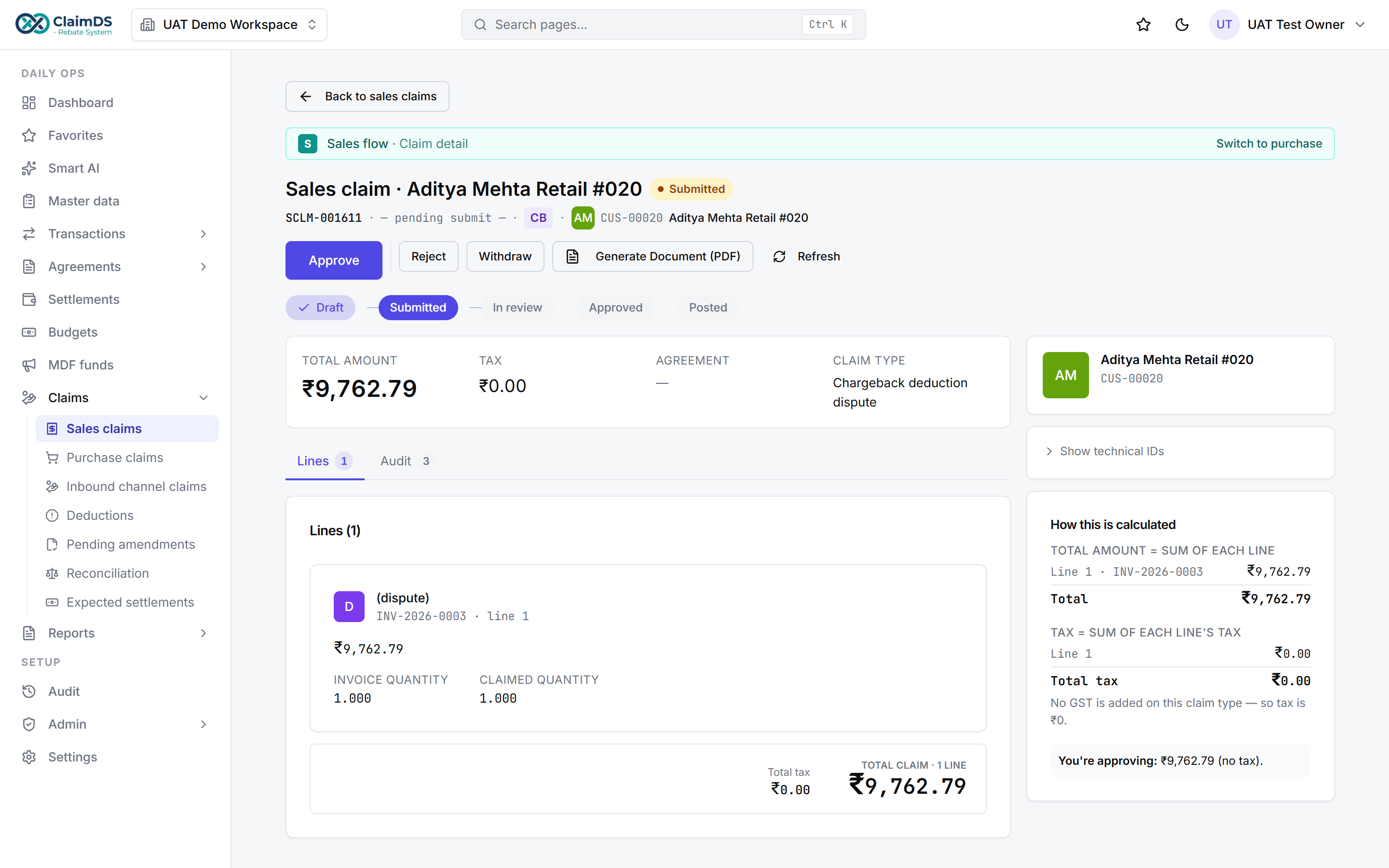 An electricals channel claim validated before a credit note is issued.
The credit note itself comes in two forms with very different tax effects. A tax credit note adjusts the supplier's output tax and forces the recipient to reverse input tax credit; a financial (commercial) credit note does neither. Choosing the wrong one creates real exposure — the mechanics are unpacked at pointer level in financial vs tax credit notes under GST, and the broader picture in tax on rebates, chargebacks, billbacks and buybacks in India.
GST note: This article is general information, not tax or legal advice. GST treatment of electricals schemes, electrician rewards, returns and credit notes must be re-verified at publish time with a qualified professional before you rely on it.
The discipline that ties it together is a repeatable claim and rebate approval workflow: scheme, claim and settlement reconciled against one another, with each credit note traceable back to the slab, display, rate change or return it adjusts. The claim approval workflow reference walks the stages, and the glossary keeps the terms straight.
Bringing it together
Channel claims in electricals are the same idea as anywhere — pay the channel for performance, settle by credit note — but shaped by two features unique to the vertical. Volume-slab schemes drive the commodity end, where the slab a partner reaches decides the payout; electrician loyalty rewards the influencer who decides what gets installed at site; display and branding spend, rate-difference and damage claims fill in the rest; and the project route runs on its own negotiated terms alongside the counter. All of it settles through GST credit notes that must be reconciled back to the scheme that authorised them.
<!-- TODO: confirm capability wording with founder -->ClaimDS is built for exactly this shape of channel — deep, multi-route, credit-note settled, with an influencer-loyalty stream running alongside the dealer schemes. See how it handles distributor claim settlement end to end, with purpose-built dealer claims management software, dealer rebate software and broader rebate management software — or book a demo to walk through your own scheme calendar.
Frequently asked questions
What is an electricals channel claim?
An electricals channel claim is a request from a distributor, dealer or retailer to recover money a scheme promised: a volume-slab incentive on wires, switchgear or lighting, a display or branding payout, a rate-difference adjustment, or a damage claim. The brand validates it against the scheme rules and settles the approved amount by credit note.
What is an electrician loyalty program?
An electrician loyalty program rewards the electrician who recommends and installs a brand's products — not the shop that sells them. The electrician earns points or rewards for verified purchases or codes, redeeming them for gifts, cash or tools. Because the electrician steers what gets fitted at site, the brand pays to keep that influence on its side.
How do volume-slab schemes work in electricals?
A volume-slab scheme sets purchase or sell-through targets in bands, with a higher rate paid once a partner crosses each slab. A dealer buying more wire or switchgear earns a better per-unit incentive at the top slab than the bottom. The slab reached over the scheme period decides the payout, settled later as a credit note.
How does project sales differ from retail?
Retail, or counter sales, is over-the-counter selling to electricians, small contractors and walk-in buyers through the dealer channel. Project sales supplies large contractors and builders directly or through a project distributor, at negotiated rates for a specific site. The two routes carry different pricing, scheme structures and claim proofs, so brands track them separately.
How are electricals schemes settled in India?
Settlement is almost always by credit note, not cheque. Once a claim is validated against its scheme, the brand issues a credit note that reduces the partner's outstanding balance, netted against future invoices. The note may be a GST tax credit note or a purely financial one, depending on whether output tax is being adjusted.
Are electrician loyalty rewards taxable?
Rewards given in kind to an electrician who carries on a business or profession can attract tax-deduction obligations on business benefits and perquisites, an area finance teams must review before running a program. Treatment depends on the reward, the recipient and current rules, so the tax position must be confirmed with a qualified professional before you rely on it.
See ClaimDS on your own claims data
A 30-minute walkthrough tailored to how your channel actually settles claims.
Related posts

Channel Claims and Rebates in Indian Agri-Inputs
How schemes, claims and rebates work across the Indian agri-input channel — fertilizers, crop-protection and seeds, seasonal schemes and expiry returns.
How to Settle Agri-Input Dealer Claims
The step-by-step process to settle agri-input dealer and distributor claims in India — seasonal schemes, liquidation claims and near-expiry returns.
Expiry and Season-End Returns in Agri-Inputs
How near-expiry, damage and season-end returns work in Indian agri-inputs — declaring returnable stock, the claim window and how each return settles.