Channel Claims and Rebates in Indian Lubricants
How schemes, claims and rebates work in the Indian lubricants channel — the bazaar market, volume schemes and mechanic loyalty programs.
Lubricant companies in India sell through two lanes at once: a genuine-oil channel tied to OEM and franchise workshops, and a much larger bazaar or open-market channel of distributors, dealers and retailers feeding independent garages. Down both lanes the company pays volume and slab schemes, protects rate on price revisions, and — distinctively — runs mechanic loyalty programs, because the mechanic is the person who recommends the brand at the point of service. Almost all of it settles the same way: a credit note against the partner's account, checked against the scheme terms first.
The lubricants channel, tier by tier
Lubricants reach a vehicle owner along two parallel routes that rarely meet, and mapping them is the prerequisite for understanding every claim that follows. The product is the same litre of oil; what differs is who sells it, who recommends it, and who claims what from whom.
The genuine-oil channel is the OEM or franchise route. Here the vehicle maker specifies or co-brands a recommended oil, and its authorised workshops fit it during scheduled service. Volumes are steadier and traceable — the workshop's service records show which oil went into which vehicle — but the channel is narrower, and the schemes tend to ride on the vehicle maker's own dealer terms.
The bazaar or open-market channel is where most of the volume moves. A manufacturer ships to a depot or C&F (carrying-and-forwarding) agent, who serves a distributor, who redistributes to dealers and retailers. Those retailers sell across the counter to independent workshops, mechanics and fleets, who fit the oil for the end user. This lane is fragmented, price-sensitive, and driven by whoever the mechanic trusts — which is exactly why mechanic loyalty programs exist here and barely at all in the genuine-oil lane.
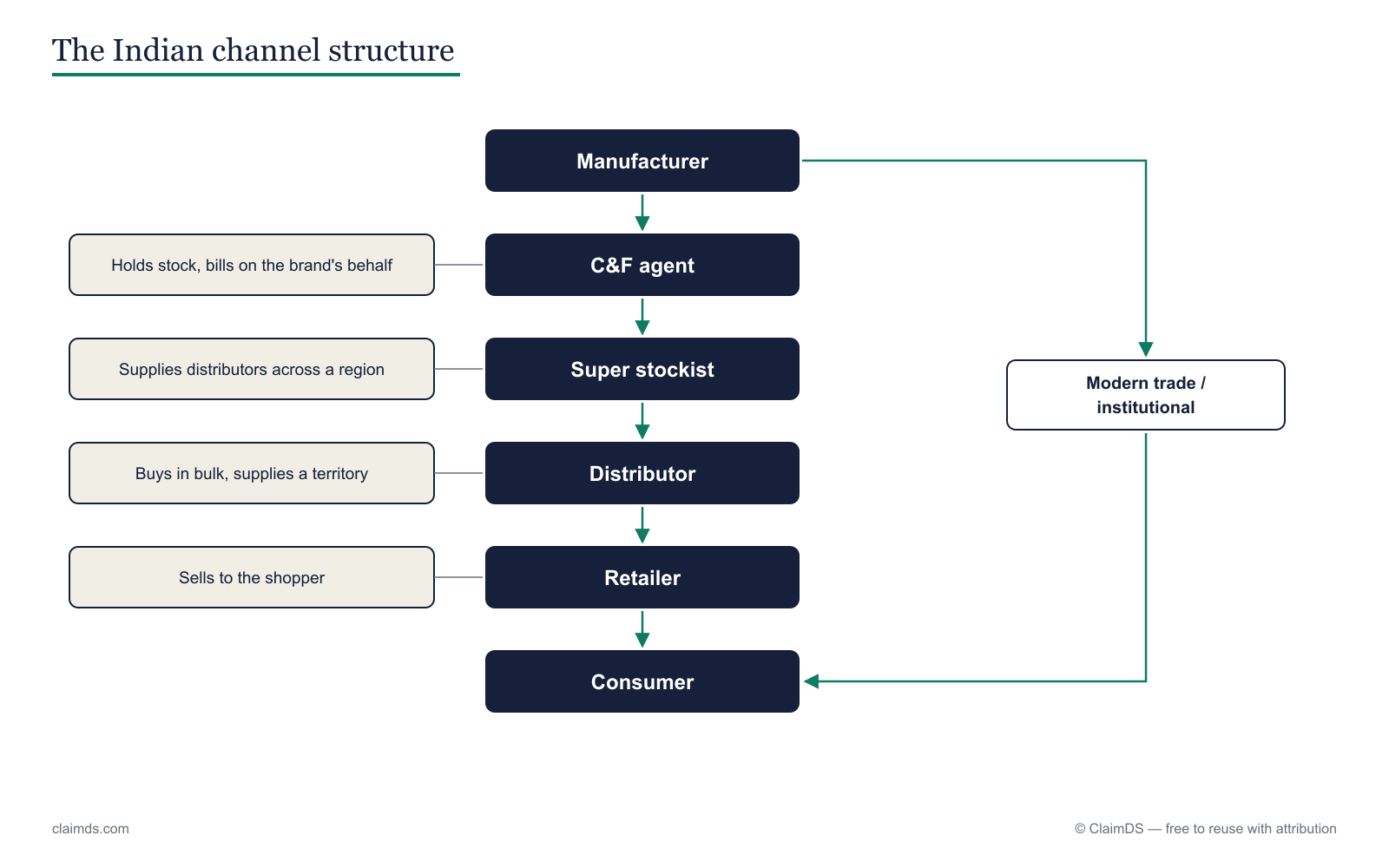 Lubricants run a genuine-oil channel and a larger bazaar-market channel side by side.
| Tier | What it does | What it claims | From whom |
|---|---|---|---|
| Manufacturer | Makes and grades the oil, declares schemes | Nothing (settles claims) | — |
| Depot / C&F | Stocks and forwards to distributors | Handling, freight settlements | Manufacturer |
| Distributor | Redistributes across a territory | Volume schemes, rate difference, margin | Manufacturer |
| Dealer / retailer | Sells across the counter | Volume benefit, display and branding | Distributor / company |
| Workshop / mechanic | Recommends and fits the oil | Mechanic loyalty rewards | Company (via program) |
| Fleet | Buys in bulk for its own vehicles | Bulk volume rebate | Distributor / company |
| End user | Owns and runs the vehicle | — | — |
If the boundary between a distributor, a dealer and a super stockist blurs in your own network, the difference between a distributor, dealer and super stockist explainer untangles it, and India's multi-tier channel claim map shows how these tiers connect across industries. The broader pattern sits in channel rebates in India.
What claims does a lubricants company handle?
Lubricant companies pay their channel through several distinct claim types, and treating them as one bucket is the first mistake most manual processes make. Each has its own evidence, its own validation rule, and its own settlement path.
Volume and slab schemes are the backbone: buy or sell a defined quantity of a grade in a window, cross a slab, and a per-litre or percentage benefit applies. Mechanic loyalty rewards the recommender who fits the oil at the workshop — the signature claim of this channel, covered in depth below. Display and branding allowances pay a retailer or workshop for stocking, siting and signage that keep the brand visible at the counter. Rate difference protects unsold stock when the company revises its price list downward. Damage and leakage covers oil that arrives or turns unsaleable — burst packs, leaked drums, damaged cartons.
A lubricants channel claim is the money a company pays back down its channel for performance or protection — volume schemes, mechanic loyalty, display, rate difference and damage — validated against the scheme terms and settled, in almost every case, by credit note.
The vocabulary below keeps the terms straight before the mechanics that follow.
| Term | What it means |
|---|---|
| Bazaar market | The independent open-market channel of distributors, dealers and retailers, distinct from the OEM genuine-oil route — where most lubricant volume moves. |
| Genuine oil | Oil sold through the OEM or franchise channel, fitted at authorised workshops as the vehicle maker's recommended or co-branded grade. |
| Mechanic loyalty | A program that rewards the mechanic or workshop for recommending and fitting a brand, since the mechanic influences the buyer's choice. |
| Workshop | A garage or service point that fits oil during a vehicle service — the point where the recommendation is made. |
| SKU / grade | A specific oil variant — viscosity, spec and pack size — that a scheme is written against; schemes often target particular grades. |
| Slab scheme | A tiered incentive where the per-unit rate rises as purchase or sales volume crosses defined thresholds. |
| C&F | Carrying-and-forwarding agent — a depot that stocks and forwards company product to distributors on a handling fee. |
| Rate difference | Reimbursement of the gap between old and new price on stock a partner already holds when the price list is revised. |
| Fleet | A bulk buyer running its own vehicles, usually on direct bulk-volume terms rather than counter schemes. |
| Credit note | The settlement document that offsets a claim against the partner's account instead of paying cash. |
The full menu of scheme shapes — QPS, slab, secondary and turnover — sits in types of trade schemes in India, and the aftermarket cousin of this channel is covered in automotive spare parts and aftermarket claims.
Mechanic loyalty: the lubricant influencer claim
Here is what makes lubricants different from almost every other channel. The person who chooses the brand is usually not the person who owns the vehicle — it is the mechanic. A vehicle owner walks into a workshop for a service and asks the mechanic which oil to use; the mechanic's recommendation decides the sale. That makes the mechanic an influencer, the same structural role that the painter plays in paints and the electrician plays in electricals. Brands that understand this pay to keep that recommendation loyal.
A mechanic loyalty program is how they do it. The mechanic enrolls, and every time a genuine pack is fitted the mechanic logs it — scanning a code inside the pack or under the cap, or recording the pack through an app. Each logged pack earns points, and points redeem for rewards: cash-equivalent value, gift items, tools, phone recharges or trips. The brand gets a running signal of who is recommending it and how often, and the mechanic gets a reason to reach for that brand at the next service. The channel loyalty programs guide covers the general mechanics, and the painter and contractor loyalty programs article is the closest influencer-loyalty parallel in another industry.
The claims connection is direct: a loyalty program is a claim-and-settlement engine wearing a rewards badge. Every scanned pack is effectively a micro-claim that has to be validated — is the code genuine, is the mechanic enrolled, has this pack already been counted — before the points, and later the reward, are released. Run at scale across thousands of mechanics, that is exactly the volume-of-small-claims problem a manual process cannot keep honest, which is why loyalty settlement belongs in the same discipline as the rest of the channel's claims.
One tax point deserves a flag rather than an answer here. Rewards given in kind to a mechanic who carries on a business or profession can fall within the scope of Section 194R of the Income-tax Act, which deals with benefits and perquisites. Whether it applies, from what point, and how it is measured depends on the facts and the current rules — so this article names it at pointer level only. For the actual treatment, route to Section 194R TDS on dealer and distributor incentives and the loyalty-specific angle in channel loyalty programs.
<!-- TODO CA REVIEW: 194R on mechanic rewards — pointer only, confirm before promoting -->How lubricant schemes settle under GST
Once a scheme, loyalty reward or rate-difference claim is approved, it has to become a document — and in India that document is almost always a credit note. The distinction that matters is which kind. A financial credit note adjusts the commercial account without touching the original GST on the invoice; a tax credit note issued under the GST rules also reverses a proportionate slice of the tax, which changes the input-tax-credit position on both sides. Which one is correct depends on how the scheme was structured and what was agreed up front, and getting it wrong is a common source of reconciliation pain.
This article keeps that at pointer level by design. For the decision itself, route to financial vs. tax credit notes under GST, and for the wider treatment of how rebates, chargebacks and buybacks are taxed, see tax on rebates, chargebacks, billbacks and buybacks in India. Damage, leakage and expired-stock returns follow the same credit-note logic, detailed in credit notes for expired, damaged goods and returns.
GST note: This article is general information, not tax or legal advice. The credit-note treatment of lubricant schemes, loyalty rewards and returns — and whether a financial or tax credit note applies — must be re-verified at publish time with a qualified professional before you rely on it.
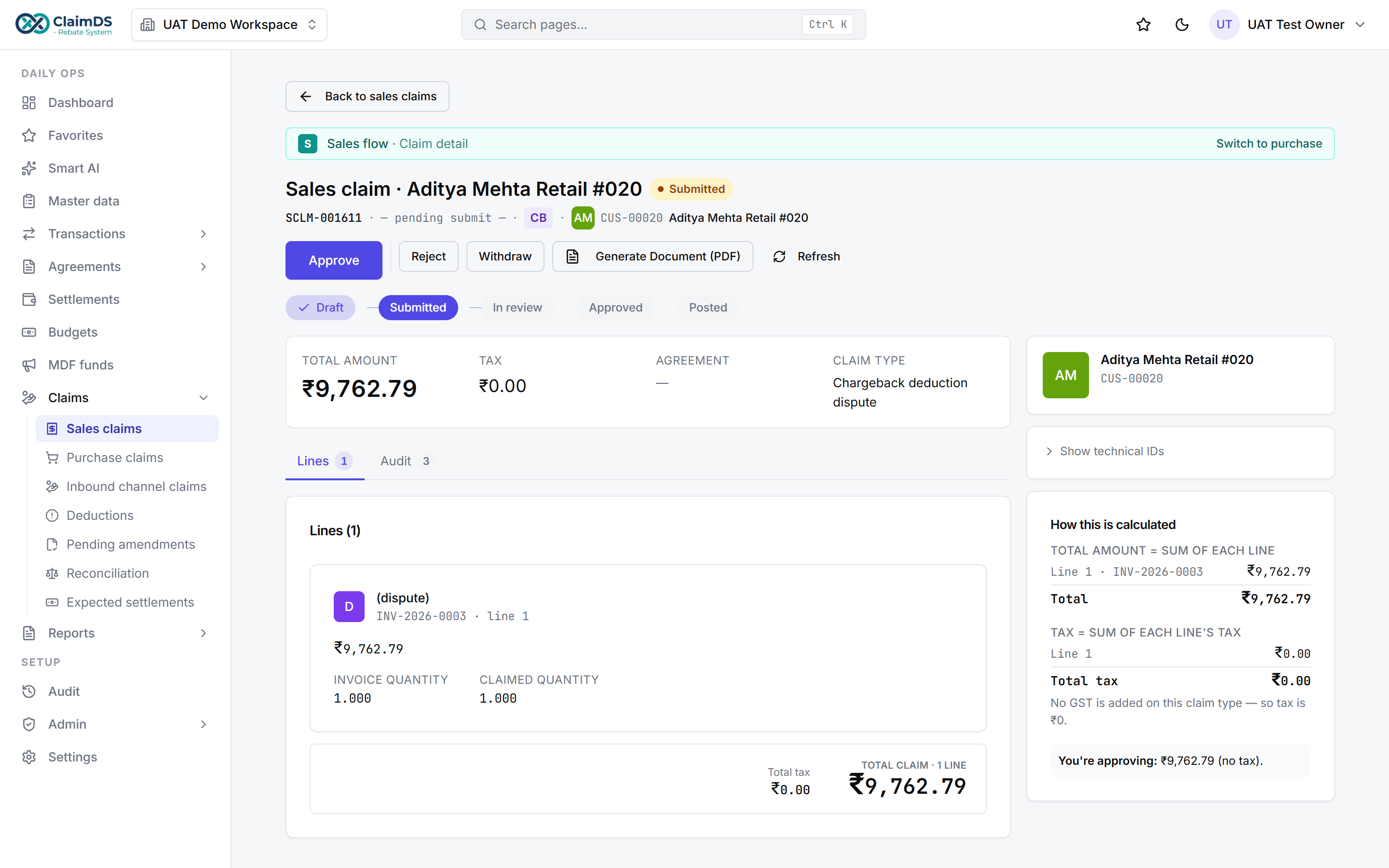 A lubricant channel claim validated before a credit note is issued.
The discipline that ties it together is a repeatable claim and rebate approval workflow: scheme, claim and settlement reconciled against one another, with the credit note traceable back to the invoice or scheme it adjusts. The claim approval workflow reference walks the stages, and the glossary keeps the terms straight.
Bringing it together
Lubricant channel claims are the same idea as anywhere — pay the channel for performance, settle by credit note — but with one feature no other channel shares as sharply: the mechanic decides the brand, so a large part of the spend flows through a loyalty program aimed at the recommender, not the buyer. Add a bazaar market that dwarfs the genuine-oil lane, volume and rate-difference schemes running across grades, and credit-note settlement whose tax treatment has to be chosen deliberately, and the reconciliation load is real. Left to spreadsheets, it is exactly where revenue leaks out of rebate programs.
<!-- TODO: confirm capability wording with founder -->ClaimDS is built for exactly this shape of channel — multi-tier, influencer-driven, credit-note settled. See how it handles distributor claims management end to end, with purpose-built dealer claims management software, dealer rebate software and broader rebate management software — or book a demo to walk through your own scheme calendar. The automotive cousin of this channel, where lubricants ride alongside parts and tyres, is in automotive channel claims and rebates in India.
Frequently asked questions
What is a lubricants channel claim?
A lubricants channel claim is a distributor, dealer or retailer's request to be reimbursed for a benefit it earned — a volume scheme, a display allowance, a rate difference or damaged stock. The company checks the claim against the scheme terms and the sales evidence, then settles it, most often by issuing a credit note against the claimant's account rather than paying cash.
What is a mechanic loyalty program?
A mechanic loyalty program rewards the mechanic or workshop who recommends and fits a lubricant brand during a service. The mechanic collects points — often by scanning a code or logging a pack — and redeems them for rewards. Because the mechanic influences which oil the vehicle owner buys, the brand pays to keep that recommendation loyal, similar to painter and electrician loyalty schemes.
How does the bazaar market differ from the genuine-oil channel?
The genuine-oil channel is the OEM or franchise route, where authorised workshops fit the vehicle maker's recommended or co-branded oil. The bazaar or open market is the far larger independent route — distributors, dealers and retailers selling to independent garages and mechanics. The bazaar channel carries most of the volume, runs its own schemes, and is where mechanic loyalty programs matter most.
How are lubricant volume schemes settled?
A lubricant volume or slab scheme rewards a channel partner for crossing a purchase or sales threshold in a defined window. Once the period closes, the company matches the achieved volume against the slab table, calculates the earned benefit, and settles it. Settlement is usually a credit note against the partner's account, offsetting future purchases rather than moving cash.
What is a rate-difference claim in lubricants?
A rate-difference claim protects stock a channel partner already holds when the company revises its price list. If the price drops, the distributor or dealer is reimbursed the difference between the old and new rate on unsold stock, so it is not left carrying inventory bought dear. The claim is validated against stock records and settled by credit note.
Do mechanic rewards attract TDS under Section 194R?
Rewards given in kind to a mechanic who carries on business or profession can fall within Section 194R of the Income-tax Act, which deals with benefits and perquisites. Whether it applies, and at what point, depends on the facts and the current rules. Treat it as a flag to confirm with a qualified professional before you build it into a program, not as a settled rate.
See ClaimDS on your own claims data
A 30-minute walkthrough tailored to how your channel actually settles claims.
Related posts

Channel Claims and Rebates in Indian Agri-Inputs
How schemes, claims and rebates work across the Indian agri-input channel — fertilizers, crop-protection and seeds, seasonal schemes and expiry returns.
How to Settle Agri-Input Dealer Claims
The step-by-step process to settle agri-input dealer and distributor claims in India — seasonal schemes, liquidation claims and near-expiry returns.
Expiry and Season-End Returns in Agri-Inputs
How near-expiry, damage and season-end returns work in Indian agri-inputs — declaring returnable stock, the claim window and how each return settles.