SAP Business One and Channel Claims: Exchanging Data Without a Big Project
Running SAP Business One and still settling schemes in spreadsheets? How claim data can move between a mid-market ERP and a claims workflow without a long project.
In short
A mid-market ERP records invoices well but rarely holds scheme terms, claim entitlement and settlement history in one place. The practical answer is not a long ERP customisation project — it is exchanging invoice data with a claims workflow that already understands schemes, claims and credit notes.
A mid-market ERP records invoices well but rarely holds scheme terms, claim entitlement and settlement history in one place. The practical answer is not a long ERP customisation project — it is exchanging invoice data with a claims workflow that already understands schemes, claims and credit notes.
| Capability | What an ERP is designed for | What scheme settlement additionally requires |
|---|---|---|
| Invoices and ledgers | Core purpose — the accounting record | Consumed as the claim's base data |
| Scheme terms and slabs | Not a native object; terms are commercial, not accounting | One authoritative, versioned record to validate against |
| Entitlement per party per period | Not natively computed | Accrued continuously as transactions land |
| Claim status and approval trail | Document approvals exist; claim workflow generally does not | Maker-checker over a claim's lifecycle, with evidence attached |
| Credit-note linkage to specific claims | Credit notes exist as documents | The link back to the claim and the invoices it adjusts |
| Clawback on returns | Returns are recorded as transactions | Automatic reversal of incentive already paid on a reversed sale |
This table describes what ERPs as a category are architected for. What any specific version or configuration supports is a question for your implementation partner.
Why is customising the ERP usually the expensive path?
Not because ERPs are badly built — because of a mismatch between how often the two things change.
An ERP is configured to be stable. Its value comes from being the reliable, audited record, and changes to it are deliberately governed: specified, tested, released. Trade schemes are the opposite. They change every quarter by design — new slabs, new qualifying products, a growth condition this quarter that wasn't there last, a mid-period revision when a competitor moves.
Encode scheme logic into the ERP and you have coupled a quarterly-changing commercial instrument to a system whose change process is measured in weeks and change requests. Every scheme revision becomes a small project. The cost is rarely visible in the original business case, because the business case models building it once — not maintaining it four times a year, indefinitely.
The structural conclusion is not "your ERP is inadequate". It is that scheme terms belong somewhere designed to be reconfigured by the commercial team without a release cycle, while the ERP keeps doing what it is good at. That is the same argument set out for ERP integration in claims and rebates.
The data exchange approach
Three flows, and none of them requires touching the ERP's configuration:
Invoice data out. Export or connect the sales and purchase registers for the period. This is the claim's base — the field-level specification is in the invoice upload file.
Scheme terms and claim logic held outside the ERP. In the claims workflow, versioned, editable by the commercial team when a scheme changes. Claims are validated against those terms and the invoice-level base data.
Settlement outputs back to the ERP. Approved claims become credit notes or payout instructions, posted as accounting entries with the claim reference carried through so any entry can be traced back to the claim and the invoices behind it.
The transfer mechanism for the first and third flows is a separate decision — file exchange, scheduled connection or API, with the trade-offs in how claim data actually moves. File-based exchange is a legitimate starting point at this size and requires no technical build on either side.
What to agree before you start
Five things, all of them commercial rather than technical:
Which documents move — sales registers, purchase registers, credit notes, and whether secondary-sales data is in scope.
How often — matched to the settlement cycle, with clean period boundaries so nothing is double-counted or missed.
In what format — the column set, the date convention, the unit convention, fixed and documented so month twelve looks like month one.
Who owns master data — parties anchored on GSTIN, one product master with a mapping table per counterparty. The full case is in master data hygiene, and skipping it is the most common reason these arrangements underdeliver.
How settlement outputs get back into the books — the posting format, who posts, and what reference ties the entry to its claim.
Where this leaves your ERP
Unchanged and authoritative. It continues to hold invoices, ledgers and statutory reporting, and it receives the settlement entries as accounting documents like any other. Nothing about the claims layer displaces it.
What changes is that scheme terms, entitlement, claim approvals and clawback logic now live somewhere built for them — reconfigurable each quarter without a change request, with the audit trail that makes a settlement reconstructable. ClaimDS is designed to run in exactly that position: beside the ERP, taking invoice data as Excel or CSV, validating claims against rebate agreements, and returning settlements as files to post. The wider picture is in connected claims.
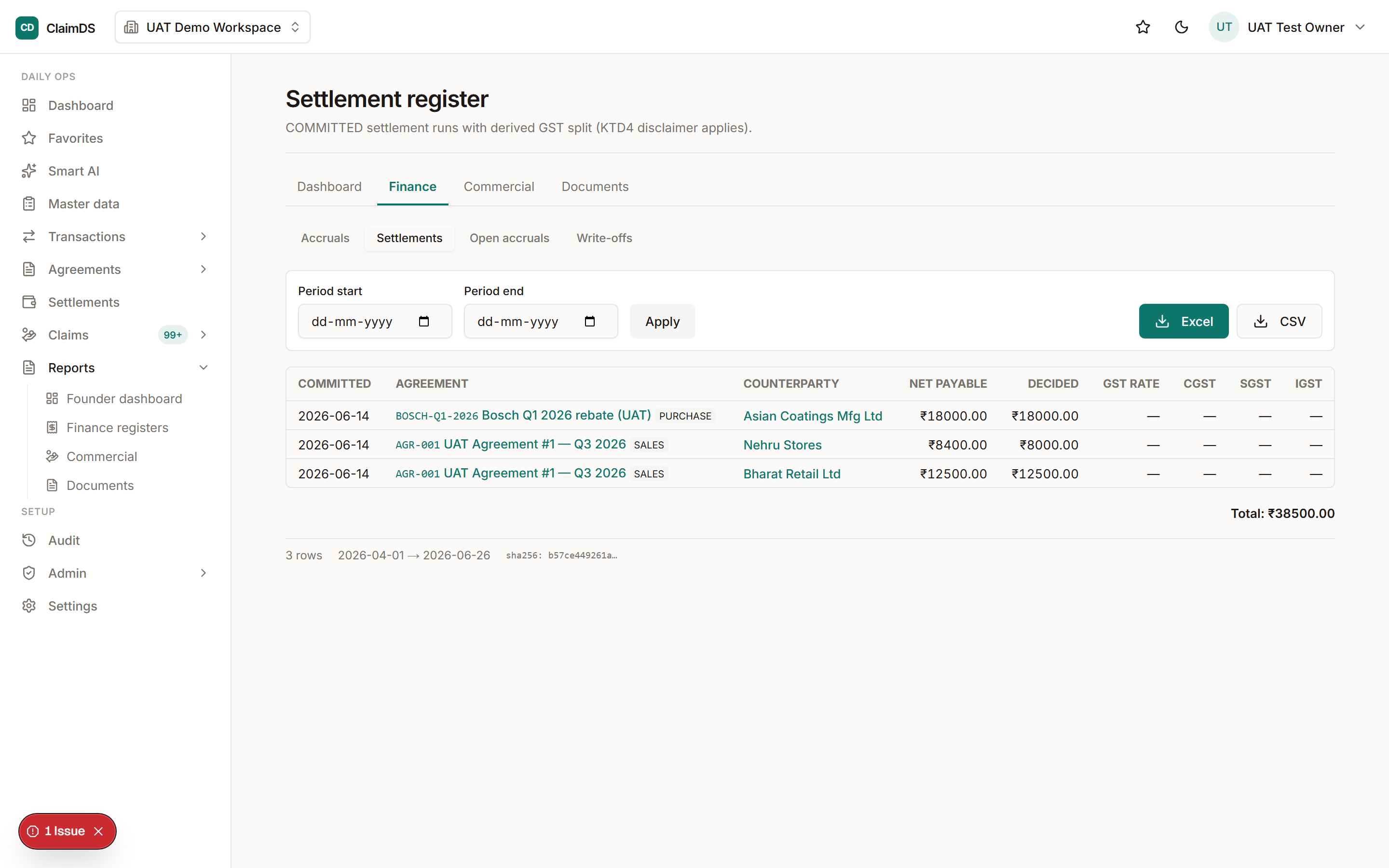
To map the exchange against your own ERP and scheme set, book a demo.
Note: General information about system architecture and data exchange. This article makes no claim about the features, versions, licensing or cost of any named ERP — those questions belong with your implementation partner. Nothing here is a promised implementation timeline.
Frequently asked questions
Can SAP Business One manage channel schemes and claims?
ERPs are designed around transactions, ledgers and documents rather than around scheme entitlement, so the scheme layer usually sits outside whichever mid-market ERP a company runs. What any particular version or configuration supports is a question for your implementation partner. Architecturally, the common pattern is the ERP as system of record with claim settlement running beside it.
Do I need to customise my ERP to manage rebates?
Usually not, and the customisation path carries a recurring cost that is easy to underestimate. Scheme terms change every quarter, so encoding them into an ERP means a change request each time they move. Holding scheme logic in a system built to be reconfigured, and exchanging data with the ERP, avoids paying an implementation cost per scheme revision.
How does claim data get back into the ERP?
As accounting entries, most commonly a settlement file the finance team posts — credit notes against the partner's account, with the claim reference carried through so the entry can be traced back. The claims workflow computes and documents the settlement; the ERP remains the accounting record. Agreeing that posting format up front is part of the setup.
Is a claims system a replacement for an ERP?
No. The ERP remains authoritative for accounting: invoices, ledgers, statutory reporting. A claims workflow adds the layer the ERP does not natively carry — scheme terms as written, per-partner entitlement over a period, claim approval trails and clawback on returns — and returns settlement outputs to the ERP for posting. They sit beside each other.
What data does a claims workflow need from an ERP?
Invoice-level data: document number and date, document type, party with GSTIN, item code, quantity with its unit, rate, taxable value, tax rate and amount. Schemes rewarding sell-through additionally need secondary-sales data. That set lets the claim be recomputed from source rather than accepted as claimed, which is what makes validation meaningful.
How long does it take to start?
It depends on scheme complexity and how ready your data is, so no honest answer is a fixed number. File-based exchange can begin as soon as an export format is agreed, because it needs no technical build on either side. Direct or scheduled connections take longer, since access, formats and error handling all need agreement and testing.
See ClaimDS on your own claims data
A 30-minute walkthrough tailored to how your channel actually settles claims.
Related posts

What Faster Claim Settlement Is Worth: Claims, Cash and Working Capital
An unsettled claim is your money sitting in someone else's system. How settlement speed affects a distributor's working capital, with worked examples in rupees.
Connected Claims: How Invoice and Sales Data Moves Between Your ERP, Your Brands and Your Claims
How invoice and secondary-sales data moves between a distributor's ERP, the brand, and the claim settlement — file upload, direct connection, and what each is good for.
Exporting Sales and Purchase Invoices from Tally for Claim Settlement
How to get invoice data out of Tally in a form a claims workflow can use — what to export, which fields matter, and how to keep the data clean enough to reconcile.