The Claim Lifecycle: From Scheme Published to Settlement Reconciled
The full journey of a channel claim — scheme published, transaction, claim raised, validated, approved, settled, reconciled, clawed back. With a process diagram.
In short
A channel claim passes through nine stages: the scheme is published, the distributor transacts, a claim is raised with evidence, completeness is checked, the claim is validated against the scheme terms, it is approved, it is settled by credit note or payout, the ledgers are reconciled, and any later return triggers a clawback.
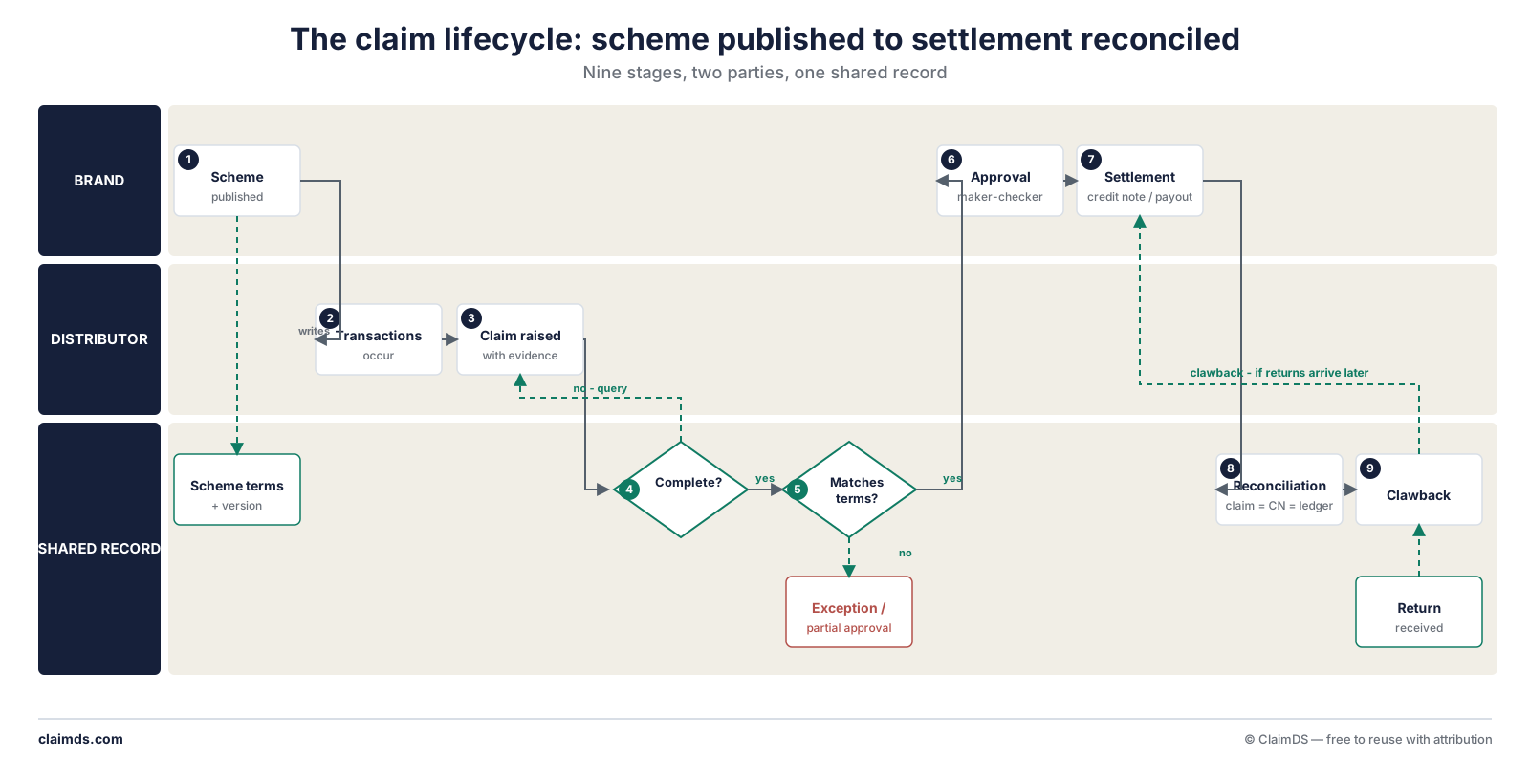
A channel claim passes through nine stages. The scheme is published, the distributor transacts, a claim is raised with evidence, completeness is checked, the claim is validated against the scheme terms, it is approved, it is settled by credit note or payout, the ledgers are reconciled, and any later return triggers a clawback.
The diagram above is free to reuse with attribution — embed it, put it in a deck, mark it up for your own process. Throughout this article, claims means distributor and channel claims, and settlement means claim or scheme settlement.
The nine stages at a glance
| Stage | Who acts | What must exist for it to work | Where it commonly fails |
|---|---|---|---|
| 1. Scheme published | Brand | Terms with scope, rate, base, period and version | Circulated by email or messaging app; two versions in the field |
| 2. Transactions occur | Distributor | Purchase and secondary-sales records with codes | Names instead of codes; secondary data late or absent |
| 3. Claim raised | Distributor | Evidence attached, line detail not just a total | Totals submitted with no supporting detail |
| 4. Completeness check | Shared record | A defined list of what a complete claim contains | No definition, so completeness is judged case by case |
| 5. Validation against terms | Shared record | The scheme version in force for those dates | Validated against the current version, not the one in force |
| 6. Approval | Brand | Thresholds and a second pair of eyes | One person raises, approves and settles |
| 7. Settlement | Brand | The instrument, referenced to the claim | Credit note issued with no reference back |
| 8. Reconciliation | Shared record | Claim, settlement and ledger tied together | Never done; the claim is assumed closed |
| 9. Clawback | Shared record | Returns treatment written into the terms | Returns arrive and nothing recalculates |
The nine stages in detail
1. Scheme published
The brand defines what it will pay for and publishes it: which partners, which products, which period, what rate, and — the part most often omitted — what base the rate applies to. The distributor sees a circular, an email, or a message.
The stage produces one thing that matters downstream: a scheme record with a version and effective dates. Every later stage refers back to it. When validation asks "did this claim match the terms", the terms it means are the ones in force on the transaction dates, not the ones in force today.
The common failure is that the scheme exists as correspondence rather than as a record. A rate is revised in week six and communicated to some partners; a scope question is answered by phone. Six weeks later nobody can say authoritatively what the terms were. Writing these into the rebate agreement rather than a circular is what makes the rest of the lifecycle checkable, and scheme design is where the base and boundaries get decided.
2. Transactions occur
The distributor buys, and sells onward. Nothing claim-shaped happens yet — but this is where the raw material for every later stage is created, and its quality is fixed at this moment rather than at claim time.
What the brand sees is its own billing: what it invoiced to the distributor. What it usually cannot see is the sell-through. If the scheme pays on secondary sales, the entitlement depends on data only the distributor holds, arriving on a cycle the brand does not control.
The common failure is identity. Partner and product records that match on codes reconcile cleanly; ones that match on names do not, because a name varies by a spelling, a suffix or a trailing space. That single inconsistency silently drops rows from every later total — and it produces no error, just a smaller number. The fields captured at invoice level determine whether stage 5 is arithmetic or archaeology.
3. Claim raised
The distributor computes what it believes it is owed and submits it with supporting evidence: the scheme reference, the qualifying transactions, and whatever proof the terms require.
What the brand sees is a submission it must now assess. What the distributor sees is money it has often already funded — a promotional price given, stock taken, a cost absorbed — so the elapsed time from here is working capital.
The common failure is a total without line detail. A single figure cannot be checked, so it generates a query by necessity rather than suspicion. A claim submitted with the underlying lines can be verified; one submitted as an amount can only be negotiated. This is the cheapest stage at which to prevent a dispute, and the claim submission discipline is almost entirely within the distributor's control.
4. Completeness check
Before anything is validated, the claim is checked for whether it can be validated: is the scheme referenced, are the transactions listed, is the required evidence attached?
This is a gate, not a judgement. Nothing here decides whether the claim is right — only whether it is assessable. If it is not, it goes back as a query and the distributor supplies what is missing.
What both sides see is a delay, and it is worth naming the reason plainly: validating an incomplete claim produces a number that cannot be defended, so the loop protects both parties. The common failure is having no definition of complete. Where completeness is judged case by case, different reviewers ask for different things, the same claim bounces twice, and the distributor concludes the process is arbitrary. A published list of what a complete claim contains removes most of that friction at no cost.
5. Validation against terms
The claim is tested against the scheme terms: right partner, right period, right products, right rate, not previously claimed, returns netted. Each test either passes or produces an exception.
What matters here is which version of the terms is used. A scheme revised mid-period has two sets of terms, and the correct one is the version in force on the transaction dates. Validating against the current version silently re-rates history.
The output should be exceptions, not a verdict. A claim that fails one test on twelve lines is not a rejected claim; it is a claim with twelve lines to resolve. Treating validation as pass/fail is what turns a routine correction into a dispute — and the mechanics of computing the entitlement to test against are in how distributor claims are calculated, with the wider category view in claims management software.
6. Approval
A validated claim is approved for settlement — ideally by someone other than whoever validated it, above a defined threshold.
This stage looks like bureaucracy and is actually the control. The separation matters because validation involves judgement: which exceptions to waive, whether a partial approval is fair, whether a boundary case counts. Concentrating that judgement and the authority to pay in one person removes the only check on it.
What the distributor sees is either an approval or a partial approval with reasons. The common failure is one person raising, approving and settling — normal in a small team, and precisely the pattern an auditor asks about first. A maker-checker trail and tiered approval workflows address it without adding headcount, by making the second pair of eyes proportionate to the amount.
7. Settlement
The approved amount is paid — in the Indian channel usually by credit note, sometimes by payout. A credit note needs no cash movement; it is set against what the partner owes, which is why it dominates.
The critical detail is the reference. A settlement that points back to the claim it settles can be reconciled by either party at any later date. One that does not becomes an amount on a statement that somebody will eventually query.
Both parties see this stage, and that is the part people underestimate: a GST credit note is reported by the supplier and appears in the recipient's own statement, so a settlement error is not private. The tax treatment — whether the note is a tax credit note or a financial or commercial one — is a separate question, covered in the GST credit notes for rebates guide and CBIC Circular 251. This article takes no tax position.
8. Reconciliation
Three records must agree: the approved claim, the settlement instrument, and the ledger entry. When they do, the claim is genuinely closed.
This is the stage most often skipped, because everything already feels finished — the partner has been paid and the argument has stopped. The cost surfaces later, when a partner queries a period and nobody can reassemble which claims the credit notes covered.
What good looks like is unglamorous: each settlement carrying its claim reference, and a periodic check that nothing is settled-but-unreconciled. A settlement factsheet does this for the partner-facing half by showing the working behind the number, and reconciling scheme credit notes against GSTR-2B and 3B does it for the tax half.
9. Clawback
Returns arrive after settlement. The volume the payout was based on has fallen, so part of what was paid is no longer earned, and a correction is due.
Handled as a rule stated in the scheme terms, this is routine: the return reduces achieved volume, the entitlement is recomputed, and the difference is recovered on the next settlement. Handled without a rule, it is a conversation months after the fact in which both sides feel wronged.
The common failure is that nothing recalculates. The return is processed as a stock movement, the claim is already closed, and the two never meet. That gap is quiet and permanent — nobody notices money that simply stays paid. Defining the treatment before launch is the fix, and the mechanics are in returns, reversals and cancellations and rebate clawbacks.
Where the process breaks most often
Three failures account for the bulk of lost time and disputed money across the whole lifecycle.
Query loops from incomplete claims (stages 3–4). A claim arrives without the detail needed to assess it, goes back, returns partially fixed, goes back again. Each cycle costs days of elapsed time and produces no progress. The cause is upstream — no published definition of a complete claim — and the cost is borne by the distributor, who is funding the gap.
Scheme version ambiguity at validation (stages 1 and 5). When terms change mid-period and the change lives in correspondence, validation has no authoritative answer to "what applied on this date". Both parties compute in good faith and disagree, and the argument is unresolvable because there is no artefact to appeal to. This is the disagreement that damages relationships, because neither side is wrong.
Returns arriving after settlement with no clawback (stage 9). Structurally invisible: the claim is closed, the return is a warehouse event, and no process joins them. Unlike the other two this one does not generate an argument — which is exactly why it persists. It shows up, if at all, as a slow drift between what schemes were budgeted to cost and what they actually cost, and it is a specific, avoidable form of revenue leakage.
The same process without software
Worth saying plainly: the lifecycle is the same whether it runs on spreadsheets or a system. All nine stages happen either way. Schemes get published, claims get raised, someone checks them, someone approves, something settles.
What changes is whether each stage leaves a record. On spreadsheets, stages 1, 5, 8 and 9 are the fragile ones — the scheme version, the validation working, the reconciliation and the clawback all depend on somebody remembering, and a workbook has no memory of what was already claimed. Stages 2, 3, 6 and 7 survive manual handling reasonably well, because they produce documents anyway.
So the honest framing is not "spreadsheets are wrong". It is that a spreadsheet is a good calculator and a poor record, and the lifecycle needs both. A business running few schemes with disciplined filing can carry all nine stages by hand. The question of when that stops being true — and what moving off it involves — is covered in moving rebate and claim work off spreadsheets, and the arithmetic itself in building a claim simulator in Excel.
Adapting this for your business
Use the diagram as a starting map rather than a prescription. Print it, and mark three things: which stages you actually perform, who owns each one, and where your process differs from the flow shown.
Most businesses discover the same pattern — stages 1 to 7 are recognisable and roughly as drawn, while 8 and 9 are either informal or absent. That is the useful output of the exercise, and it takes an afternoon.
The diagram is free to reuse with attribution. Embed it, put it in an induction deck, hand it to a distributor who is new to your claim process. ClaimDS holds the scheme terms as the authoritative record and carries a claim through validation, approval, settlement and reconciliation in one place, so each stage leaves a record rather than a memory. <!-- TODO: confirm capability wording with founder -->
This article is general information about commercial and operational practice, not legal, tax or accounting advice. Where a claim, credit note or settlement has GST or contractual consequences, confirm the treatment for your business with a qualified professional.
Read next
- How to reduce claim disputes between brands and distributors — the factual disagreements each stage prevents.
- Settlement factsheets for rebate claims — stage 8, made partner-facing.
- Deduction management best practices — what happens when the customer deducts instead of claiming.
- What is claims management software — the category that carries this lifecycle.
Book a demo to see the whole lifecycle running on your own schemes.
Frequently asked questions
What are the stages of a distributor claim?
Nine: the scheme is published with its terms, the distributor transacts, a claim is raised with evidence, completeness is checked, the claim is validated against the scheme terms, it is approved, it is settled by credit note or payout, the claim and settlement are reconciled against the ledger, and a clawback runs if returns arrive after payment.
Who validates a channel claim?
Validation sits with whoever holds the scheme terms — typically claims-ops or commercial finance on the brand side. The test is not whether the amount looks reasonable but whether the claim matches the agreement: right partner, right period, right products, right rate, not already claimed, returns netted. Anything failing becomes an exception rather than a rejection.
What happens when a claim is incomplete?
It goes back as a query rather than into validation, because validating an incomplete claim produces a number nobody can defend. The distributor supplies what is missing and the claim re-enters the flow. This loop is the single largest consumer of elapsed time in most claim processes, and it is almost entirely preventable at submission.
How is a distributor claim settled?
By credit note or by payout. A credit note is the common route in the Indian channel because it needs no cash movement — it is set against what the partner owes. A payout moves money. Which instrument is used, and whether a credit note carries GST consequences, is a separate question covered in the credit-note guides.
What is clawback in claim settlement?
Clawback is the correction applied when goods are returned after a claim has already been settled. The volume the payout was based on has fallen, so part of the settled amount is no longer earned. Handled as a defined rule in the scheme terms it is routine; handled ad hoc it becomes a negotiation months after the fact.
What is reconciliation in the claim process?
Reconciliation is the check that three records agree: the approved claim, the credit note or payout that settled it, and the ledger entry. When they agree the claim is genuinely closed. When they do not, the gap is usually a settlement issued without a reference back to the claim it settles, which is what makes later queries expensive.
How long does the claim process take?
It varies by company, scheme complexity and — above all — evidence quality, so no single figure is meaningful. Measure your own baseline instead: time from claim submitted to settlement recorded, split by whether the claim needed a query. The gap between those two numbers usually shows where the time actually goes.
See ClaimDS on your own claims data
A 30-minute walkthrough tailored to how your channel actually settles claims.
Related posts

How to Build a Claim and Scheme Simulator in Excel
The workbook structure behind every channel claim model — four tabs, codes not names, terms off the formula, and the control totals that catch silent errors.
Build a Buyback and Expiry Return Simulator in Excel
Buyback and expiry claims price returned stock by how old it is. How to band by age in Excel, apply the right rate, and keep batch data straight.
Build a Chargeback and Billback Simulator in Excel
Chargebacks and billbacks are the same calculation — a price difference on qualifying units. How to model both in Excel, and the traps in defining "qualifying".