
Price Protection in Consumer Electronics
How price protection works in Indian consumer electronics — protecting channel stock through fast price cuts, NLC protection and modern-trade dimension.

When a consumer-electronics brand cuts a product's price, every partner still holding old-price stock instantly loses margin — price protection compensates that gap. Because electronics prices erode faster than any other category, and because modern trade and e-commerce force frequent cuts, price protection is the vertical's defining claim. The base mechanic is the same everywhere and is covered in our generic guides — how price-drop protection claims work, the contractual clause in a sales agreement, and choosing price-protection software. This article is the electronics-specific view — net landing cost, the modern-trade dimension, and operating protection at scale.
Why price protection is bigger in electronics
No other channel category cuts prices as often, as deep, or on as much stock value. Four forces stack up.
Rapid obsolescence and price erosion. A television, phone or appliance model loses list value continuously across its life, not in one step. Each generation compresses the previous one's price, so a partner who bought at launch is almost always sitting on stock worth less than they paid within weeks. Price protection is what lets them keep stocking confidently despite that certainty.
Constant new-model launches. Electronics runs on a relentless launch calendar. Every new model repositions the ones below it, and the brand protects the channel on the older stock so the transition does not strand inventory. The claim is not an exception — it is a scheduled, recurring event tied to the product roadmap, closer in rhythm to the trade schemes that run all year than to a one-off adjustment.
Festival and e-commerce price wars. Demand concentrates around festival windows, and competitive pressure — especially online — forces sharp, sometimes overnight, price moves. When a brand matches a competitor or an online event, it triggers protection on whatever the channel is holding at that moment.
Thin channel margins on high-value units. Electronics partners work on slim percentage margins over a high unit value. A price cut that looks small in percentage terms can wipe out a partner's entire margin on a unit, so unprotected stock is not a minor irritation — it is a direct hit to channel solvency. That combination of high value, thin margin and high frequency is why price protection dominates electronics channel claims in a way it never does in slower categories. Left unmanaged it is also a leading source of revenue leakage in rebate programs, because the volume of cuts overwhelms manual tracking.
Net landing cost (NLC) protection and how the claim is computed
In electronics the number that actually matters is not list price but net landing cost — the partner's effective cost for a unit after every discount, scheme and support element has been applied. A partner does not experience a price cut as a change in list; they experience it as a change in what the same unit now lands at. Price protection therefore protects the landing cost, not the sticker.
The computation is a difference of two landing costs across eligible stock:
Protection = (old NLC − new NLC) × eligible stock held at the cut-off.
The arithmetic is trivial; the two hard inputs are the eligible stock at the exact cut-off date and a defensible NLC on both sides of the revision. Because NLC bundles multiple support components, the "old" and "new" figures must be reconstructed consistently — miss one scheme in either figure and every unit is mispriced.
Illustrative example only. A model's landing cost is revised down. A distributor holds eligible stock at the cut-off:
| Input | Value |
|---|---|
| Old NLC per unit | ₹28,000 |
| New NLC per unit | ₹26,500 |
| Per-unit protection | ₹1,500 |
| Eligible stock at cut-off | 220 units |
| Protection payable | ₹3,30,000 |
Now multiply that across dozens of models and hundreds of partners in a single revision, each with its own NLC history, and the reason electronics brands cannot run price protection on spreadsheets becomes obvious. The per-partner, per-model discipline is the same one behind any distributor claims management process, but the frequency and the NLC reconstruction raise the stakes. The route the money travels — from the brand out to whichever tier holds the stock — is worth picturing before diving into channels.
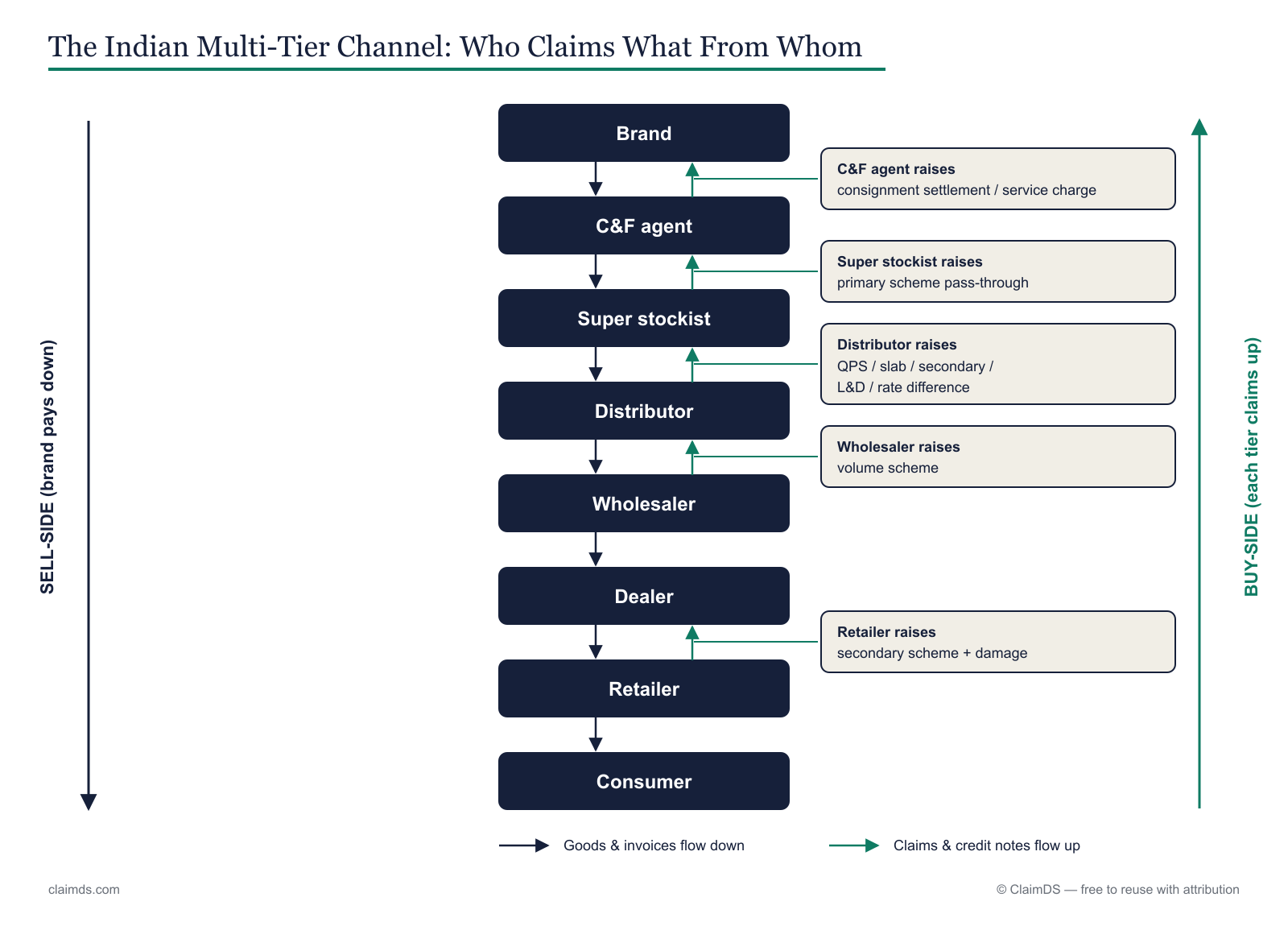 Price protection reaches every tier holding stock when a price is cut — distributor, dealer and modern trade.
The modern-trade and e-commerce dimension
Traditional price protection assumed one flow: brand to distributor to dealer, the primary, secondary and tertiary legs of the channel. Consumer electronics broke that assumption by adding two more routes that behave very differently.
Large-format retail (modern trade). LFR chains buy in large lots and merchandise at scale, often on their own promotional calendar. When they discount to move volume, the brand is frequently expected to protect the stock behind that discount — so a modern-trade price move can trigger protection independently of anything happening in general trade.
Online marketplaces. E-commerce is built on visible, real-time price competition. Marketplace price-matching means a single competitor move can cascade into a same-day cut across sellers, and the brand ends up protecting whatever the online channel is holding at that instant. This is why electronics sees more frequent protection events than any other vertical — the trigger is no longer just the brand's own roadmap, but continuous competitive matching across two fast-moving channels.
The operational hard part is reconciliation across all of it. The same model may sit simultaneously in general trade, in modern trade, and with online sellers — each with different stock visibility, different settlement terms, and different data quality. Protecting that model on one price revision means computing entitlement per channel without double-paying a tier or missing one entirely. Getting the distributor, dealer and super-stockist roles right in the data is the difference between a clean settlement and a reconciliation that runs for weeks. Handled well, it feeds cleanly into the electronics dealer claim settlement process; handled badly, it becomes the vertical's biggest channel-rebate headache.
Evidence and the price-cut cut-off
Everything in a price-protection claim hinges on one number: the stock a partner genuinely held at the exact cut-off moment. Get that right and the claim is arithmetic; get it wrong and the brand over-pays or invites a dispute. The core fraud risk is specific and well understood — partners inflating declared stock just before the cut-off to enlarge the payout — so the evidence standard has to bound that risk directly.
Electronics has one advantage other categories lack: units are individually identifiable. Serial and IMEI numbers make model-level, even unit-level, stock verifiable in a way a case of consumables never is.
| Evidence | What it proves | Why it matters |
|---|---|---|
| Cut-off-dated stock declaration | Position held at the exact revision date | The anchor for the whole claim |
| Serial / IMEI or model-level list | The specific units claimed exist | Blocks phantom or duplicated stock |
| Purchase records (primary) | Units were actually bought from the brand | Bounds the maximum a partner can hold |
| Recorded secondary sales | Units already sold on are removed | Prevents claiming stock that has left |
| Claim within the window | The claim was lodged in time | Keeps events closing on one date |
The reconciliation logic is simple to state: opening stock plus recorded purchases minus recorded sales caps what a partner can plausibly hold, and any declaration above that bound is queried before settlement. Pair that with a firm claim window so events close cleanly, and settle only the reconciled number. This is the same evidence discipline behind credit notes for expired and damaged goods and any well-run claim and rebate approval workflow — declared value gets the same scrutiny as any other claim on money.
How price protection settles under GST
Pointer level only, and not tax advice. A price-protection payout is a post-sale price reduction, and under GST the settlement instrument is a credit note. Which credit note depends on how the support was structured. Where the reduction was agreed before or at the time of supply and can be tied to specific invoices, a tax-adjusted credit note may be available; where it is an ad-hoc price cut — the usual case — it settles as a commercial credit note with no tax adjustment, so the financial and tax pictures diverge.
That financial-versus-tax split is a topic in its own right and is worked through with numbers in price protection and rate-difference credit notes under GST, with the instrument choice explained in financial vs tax credit notes. The electronics-specific treatment — including how it interacts with warranty and returns support — belongs in the GST treatment of electronics claims and schemes and alongside warranty and defective-returns handling. Keep the depth there; here the rule is only that a credit note settles it. If a term is unfamiliar, the glossary defines the credit-note and NLC vocabulary.
Operating price protection at scale
For an electronics brand, price protection is not an occasional adjustment — it is a high-frequency, high-value settlement engine running continuously across general trade, modern trade and online. Doing it on spreadsheets means slow payouts, disputed stock numbers, and leakage nobody can quantify. Doing it on purpose-built rebate management software means every revision computes per-partner, per-model entitlement against verified stock, settles by the correct credit note, and closes on one date. That is the difference between price protection as a liability and price protection as a channel-loyalty advantage — and it is exactly what distributor claim settlement software is built to deliver, using the same submit-validate-approve-settle backbone as the wider claim process. If you are still comparing tools, our guide to the best price-protection software sets out what to look for. To see how ClaimDS runs an electronics price-protection event end to end, book a demo.
Frequently asked questions
What is price protection in consumer electronics?
Price protection compensates channel partners when a brand cuts the price of a product they already hold in stock. In consumer electronics — where prices fall faster than any other category — it is the defining claim: every price cut leaves distributors, dealers and modern trade holding stock bought at the old, higher cost, and the brand funds that gap.
Why is price protection bigger in electronics than other industries?
Electronics prices erode faster than any other category: new models launch constantly, festival and online price wars force frequent cuts, and channel margins are thin. Every cut strands stock across the network at the old cost. High volume, high value and frequent price revisions combine to make price protection the largest and most recurring electronics claim.
What is net landing cost (NLC) protection?
Net landing cost is the channel partner's effective cost after all discounts and support are applied. NLC protection guarantees that a revised price does not leave the partner holding stock above its new landing cost. The claim equals the difference between old and new NLC multiplied by eligible stock held at the cut-off date.
What evidence does a price-protection claim need?
A price-protection claim needs a dated stock declaration at the exact cut-off, backed by model-level or serial/IMEI records that reconcile to purchases minus sales. Brands verify the declared quantity against recorded flows, apply a claim window, and settle only the reconciled number — the main fraud risk is stock inflated just before the cut-off to enlarge the payout.
How does price protection work across modern trade and e-commerce?
Large-format retail and online marketplaces price-match aggressively, so brands revise prices often to stay competitive — and each revision triggers protection on stock held across general trade, modern trade and online. The reconciliation challenge is protecting the same model across channels that have different stock visibility and settlement terms, without double-paying a tier or missing one.
How is a consumer-electronics price-protection claim settled under GST?
A post-sale price reduction is settled by a credit note. Where the reduction was agreed before or at supply and linked to specific invoices, a tax-adjusted credit note may apply; otherwise it is a commercial credit note with no tax adjustment. The financial-versus-tax routing is covered in our dedicated GST guides — treat this as a pointer, not tax advice.
See ClaimDS on your own claims data
A 30-minute walkthrough tailored to how your channel actually settles claims.
Related posts

Channel Claims and Rebates in Indian Agri-Inputs
How schemes, claims and rebates work across the Indian agri-input channel — fertilizers, crop-protection and seeds, seasonal schemes and expiry returns.
How to Settle Agri-Input Dealer Claims
The step-by-step process to settle agri-input dealer and distributor claims in India — seasonal schemes, liquidation claims and near-expiry returns.
Expiry and Season-End Returns in Agri-Inputs
How near-expiry, damage and season-end returns work in Indian agri-inputs — declaring returnable stock, the claim window and how each return settles.