Channel Claims and Rebates in Consumer Electronics
How schemes, claims and rebates work across the Indian consumer-electronics channel — price protection, QPS schemes, and DOA and warranty returns.
Consumer-electronics brands run a deep multi-tier channel — national and regional distributors down to dealers, large-format retail (LFR) and e-commerce — to reach the consumer, paying schemes and settling claims by credit note rather than cheque. Because electronics prices erode fast, price protection on channel stock is the category's signature claim, sitting alongside high-volume DOA, defective and warranty (RMA) returns. This pillar maps how the whole channel works, tier by tier, and where each claim attaches.
The consumer-electronics channel, tier by tier
The consumer-electronics channel is a classic Indian multi-tier route to market, stretched to cover both traditional shops and organised retail. Product moves from the brand or OEM to a national distributor, out to regional distributors and stockists who cover a state or zone, and then splits three ways at the front end — into independent dealers (general trade), into large-format retail chains (modern trade), and into e-commerce marketplaces. Money for schemes and claims flows back up the same chain, and defective or unsold units flow back up as returns.
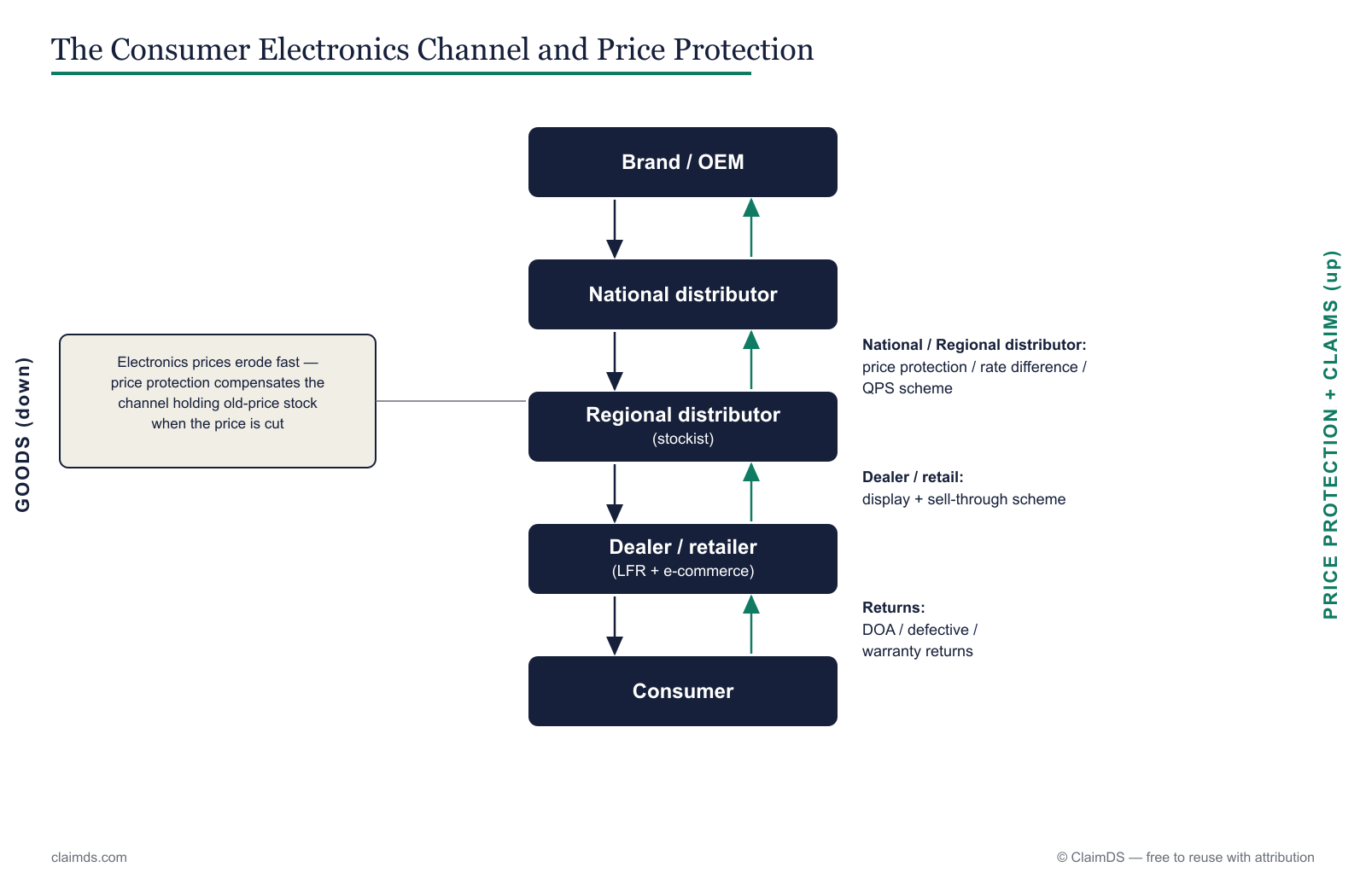 Electronics runs a deep, fast-moving channel — and price protection flows back up whenever a price is cut.
| Tier | Role in the consumer-electronics channel |
|---|---|
| Brand / OEM | Manufactures or markets the product; designs the schemes, sets net landing cost and price bands, and funds the credit notes. |
| National distributor | Buys in bulk and holds national stock, billing regional partners; the first tier below the brand. |
| Regional distributor / stockist | Covers a state or zone, extends credit to dealers and files the bulk of scheme claims. |
| Dealer / retailer (general trade) | The independent electronics shop the consumer walks into; sells at the counter and drives sell-through. |
| Large-format retail (LFR / modern trade) | Organised multi-brand chains that negotiate display, margin and price terms directly with the brand. |
| E-commerce / marketplace | The online channel, which price-matches aggressively and drives the fastest price erosion. |
| Consumer | The end buyer, whose price sensitivity and model preferences set the pace for everything above. |
Because the network runs several tiers deep and forks into three front-end formats, sorting out who occupies which rung matters before any claim can be validated. The distributor vs dealer vs super stockist breakdown untangles the roles, and the broader India multi-tier channel claim map shows how claims attach to each link. The electronics version is simply that structure read against a fast-eroding price rather than a stable one. For the settlement mechanics common to every tier, the overview of channel rebates in India is the umbrella reference, and the primary, secondary and tertiary sales model explains which invoice each scheme is measured on.
What kinds of claims does an electronics brand handle?
An electronics brand runs one of the widest spreads of claim types in the channel, because it is managing fast price erosion and high return volumes at the same time. The main families are price protection (also called price-drop protection or rate difference), volume schemes such as QPS, display and sell-through incentives, exchange and festival offers, DOA and defective returns, and warranty or RMA handling. Each rests on different proof, and the category has its own vocabulary a finance team must read fluently.
| Electronics term | What it means |
|---|---|
| Price protection | Compensation to the channel for stock held when the brand revises the price downward. |
| NLC (net landing cost) | The effective per-unit cost to a partner after standard discounts and scheme support. |
| LFR (large-format retail) | Organised modern-trade chains selling multiple brands from big-box stores. |
| DOA (dead on arrival) | A unit found defective or non-functional on first unboxing, before real use. |
| RMA (return merchandise authorisation) | The authorised process for returning a defective unit up the channel for repair or replacement. |
| Sell-through | Actual movement of product from the dealer or store to the consumer, not a purchase into the channel. |
| QPS (quarterly purchase scheme) | A volume incentive rewarding a purchase or sell-through target over a quarter. |
| Exchange offer | A scheme giving the consumer trade-in value on an old device against a new purchase, funded up the channel. |
| GT vs MT (general vs modern trade) | General trade is independent dealers; modern trade is organised LFR chains — often on different terms. |
| Rate difference | The per-unit gap between old and new price that a price-protection claim reimburses. |
| Display scheme | An incentive paying a store for giving a brand shelf, demo or planogram space. |
| Festival / season offer | A time-boxed consumer offer around a festival or sale event, funded through channel schemes. |
A consumer-electronics claim is a partner's request to be paid what a scheme promised — most often a price-protection adjustment on stock held through a price cut, plus volume, display and exchange incentives and a steady stream of DOA and warranty returns — validated against the scheme rules and settled by credit note.
Two of these families dominate the workload. Price protection is the defining electronics claim and gets its own detailed treatment rather than a re-explanation here — the mechanics of the rate-difference calculation live in the generic guides on price-drop protection, price protection in sales and the price-protection rate-difference credit note under GST. DOA, defective and warranty returns are the second heavyweight, because return volumes in electronics dwarf most categories. For the generic catalogue behind all of these, see the types of trade schemes used in India; the electronics list above is that catalogue read against fast-moving prices. The two families unique enough to warrant their own guides — price protection and defective returns — are covered in the price protection in consumer electronics standout and the warranty and defective returns guide.
Why price erosion changes everything
In most channels, schemes run against a stable list price and a financial quarter. In electronics they run against a price that is falling almost continuously. New models replace old ones on a short cadence, component costs drop, festival resets land, and online marketplaces price-match each other aggressively — so a product's list price can be cut several times across its shelf life. Each downward revision is a problem for anyone holding stock bought at the older price.
That is exactly what makes price protection the signature claim of the vertical. The channel routinely holds weeks of inventory ahead of demand; when the brand cuts the price, the distributor, dealer or store is sitting on units bought at the old net landing cost. Without compensation, they would lose margin simply for having stocked up. A price-protection claim pays the rate difference on the qualifying held stock, so the partner is not penalised for holding inventory the brand asked them to carry. Because revisions are frequent and stock is always in the pipeline, nearly every price cut triggers a wave of these claims — which is why electronics files more price-protection claims than any other vertical.
The LFR and e-commerce dimension sharpens the pressure. Organised modern trade and online marketplaces compete on visible price and reset it constantly, and independent general trade dealers then demand parity so they are not undercut in their own catchment. A single online price drop can ripple across every format within days, so the same unit can attract price-protection exposure at several tiers at once. The result is more frequent cuts, more channels holding old-price stock at each cut, and a heavier, faster price-protection claim load than a single-format channel would ever generate — often several distinct claim waves against one price revision. Provisioning for these payouts as sales accrue — rather than absorbing them as a quarter-end surprise — is what keeps the liability visible; the discipline that underpins clean distributor claims management applies here under constant price movement. The price protection in consumer electronics guide works through the calculation, the qualifying-stock rules and the LFR-versus-general-trade wrinkle in depth.
How electronics schemes settle in India
Settlement in electronics follows the same instrument as the rest of the Indian channel: the credit note, not the cheque. Once a claim is validated against its scheme, finance issues a credit note that reduces the partner's outstanding balance, and the amount is netted against future invoices rather than paid out separately. Across a quarter with price-protection runs, QPS payouts, display incentives and returns all live per partner, that netting is what keeps the ledger sane — but only if each claim is reconciled back to the scheme that authorised it.
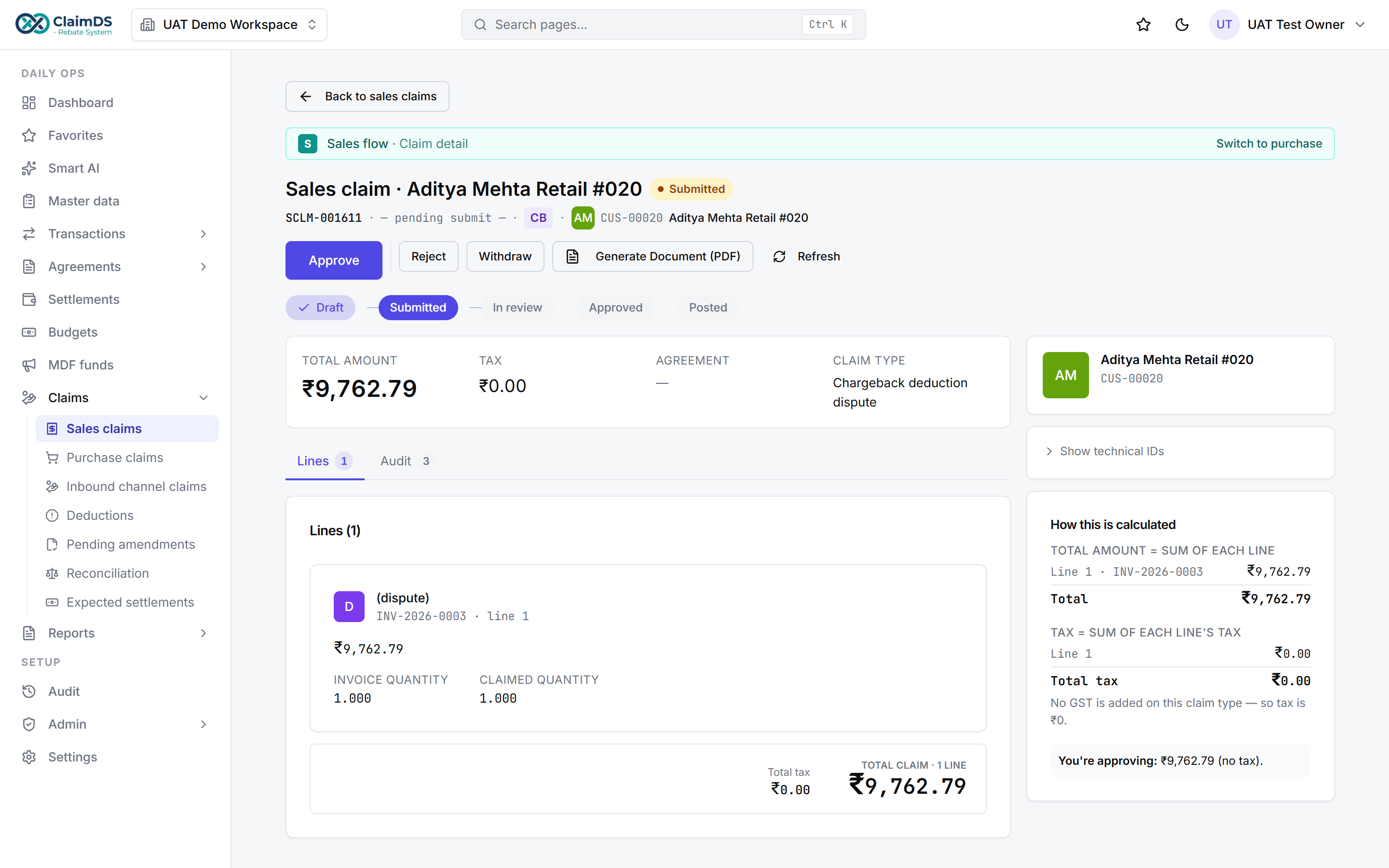 A price-protection claim validated against its scheme rules and stock data before a credit note is issued.
The credit note itself comes in two forms with very different tax effects. A tax credit note adjusts the supplier's output tax and forces the recipient to reverse input tax credit; a financial (commercial) credit note does neither. Choosing the wrong one creates real exposure at assessment — the mechanics are unpacked in financial vs tax credit notes under GST, the return-specific version in credit notes for expired and damaged goods returns, and the warranty-replacement version in GST on stock transfers and warranty replacements.
One electronics wrinkle deserves a flag rather than a full answer here: GST rate treatment varies by product across the electronics range, so what applies to one category on an invoice need not apply to another. That makes the credit-note tax treatment product-dependent in a way a single-rate channel never faces. This pillar keeps tax at pointer level by design — for the actual rate treatment and how it shapes settlement, route to the GST treatment of consumer-electronics claims and schemes.
GST note: This article is general information, not tax or legal advice. GST treatment of electronics schemes, returns and credit notes — including rate treatments that differ across product categories — must be re-verified at publish time with a qualified professional before you rely on it.
The discipline that ties it together is a repeatable claim and rebate approval workflow: scheme, claim and settlement reconciled against one another, with the credit note traceable back to the price cut, invoice or return it adjusts. Where a scheme rests on downstream data the brand cannot see directly, secondary scheme settlement is the validation problem to solve. The claim approval workflow reference walks the stages, and the glossary keeps the terms straight.
Bringing it together
Channel claims in electronics are the same idea as anywhere — pay the channel for performance, settle by credit note — but wrapped around a price that keeps falling. Price protection is the signature claim, generated every time a cut leaves the channel holding old-price stock; QPS and display schemes reward volume and shelf presence; exchange and festival offers pull consumers in; and DOA, defective and warranty returns flow back up in high volume. All of it settles through GST credit notes whose tax treatment depends on the product category on the invoice. Left to spreadsheets, that combination is where revenue leaks out of rebate programs.
Get the price-protection calculation, the qualifying-stock proof and the credit-note choice right, and the reconciliation gets dramatically simpler — even when several claim types land against the same partner in the same quarter. From here, follow the deeper electronics guides: the dealer claim settlement process, supplier and purchase rebates in consumer electronics, and the warranty and defective returns mechanics.
<!-- TODO: confirm capability wording with founder -->ClaimDS is built for exactly this shape of channel — multi-tier, fast-eroding, credit-note settled. See how it handles distributor claim settlement end to end, with purpose-built dealer claims management software, dealer rebate software and broader rebate management software — or book a demo to walk through your own scheme calendar.
Frequently asked questions
What is a consumer-electronics channel claim?
A consumer-electronics channel claim is a request from a distributor, dealer or retailer to recover money promised under a scheme: a price-protection adjustment on stock held when a price is cut, a volume or display incentive, an exchange offer, or a defective or warranty return. The brand validates it against the scheme rules and settles the approved amount by credit note.
What is price protection in electronics?
Price protection compensates the channel for stock it already bought when the brand later cuts the price. If a dealer is holding units purchased at the old net landing cost and the brand drops the price, the dealer would lose margin on that stock. A price-protection claim pays the rate difference so the partner is not penalised for holding inventory.
Why are price-protection claims common in electronics?
Electronics prices erode faster than almost any other category. New models, component-cost falls, festival resets and aggressive online price-matching push list prices down repeatedly through a product's life. Because the channel routinely holds weeks of stock bought at the older price, nearly every downward revision triggers price-protection claims — making them the highest-volume claim type in the vertical.
How are electronics schemes settled in India?
Settlement is almost always by credit note, not cheque. Once a claim is validated against its scheme, the brand issues a credit note that reduces the partner's outstanding balance, and the amount is netted against future invoices. The note may be a GST tax credit note or a purely financial one, depending on whether output tax is being adjusted.
What is a DOA return?
DOA means dead on arrival: a unit that is found defective or non-functional when first unboxed or installed, before real use. In electronics, DOA and early-failure units move back up the channel under a defined return or replacement window. Because volumes are high, DOA and defective returns are a routine, recurring claim finance teams here must process.
What is QPS in consumer electronics?
QPS stands for quarterly purchase scheme — a volume incentive that rewards a distributor or dealer for hitting a purchase or sell-through target over a quarter. It is one of the core recurring schemes in electronics, sitting alongside price protection, display incentives and exchange offers, and it is measured against primary or secondary sales data depending on the design.
What is net landing cost (NLC)?
Net landing cost, or NLC, is the effective price a channel partner pays for a unit after all standard discounts and scheme support are applied — the real cost at which the stock lands with them. It matters for price protection: when a price is cut, the rate-difference claim is calculated against the NLC of the stock the partner is still holding.
See ClaimDS on your own claims data
A 30-minute walkthrough tailored to how your channel actually settles claims.
Related posts

Channel Claims and Rebates in Indian Agri-Inputs
How schemes, claims and rebates work across the Indian agri-input channel — fertilizers, crop-protection and seeds, seasonal schemes and expiry returns.
How to Settle Agri-Input Dealer Claims
The step-by-step process to settle agri-input dealer and distributor claims in India — seasonal schemes, liquidation claims and near-expiry returns.
Expiry and Season-End Returns in Agri-Inputs
How near-expiry, damage and season-end returns work in Indian agri-inputs — declaring returnable stock, the claim window and how each return settles.