Price Drop Protection: How Channel Price-Protection Claims Work
How price-drop protection claims work — identify eligible stock-on-hand at the price-change date, compute the protection, validate and settle by credit note.
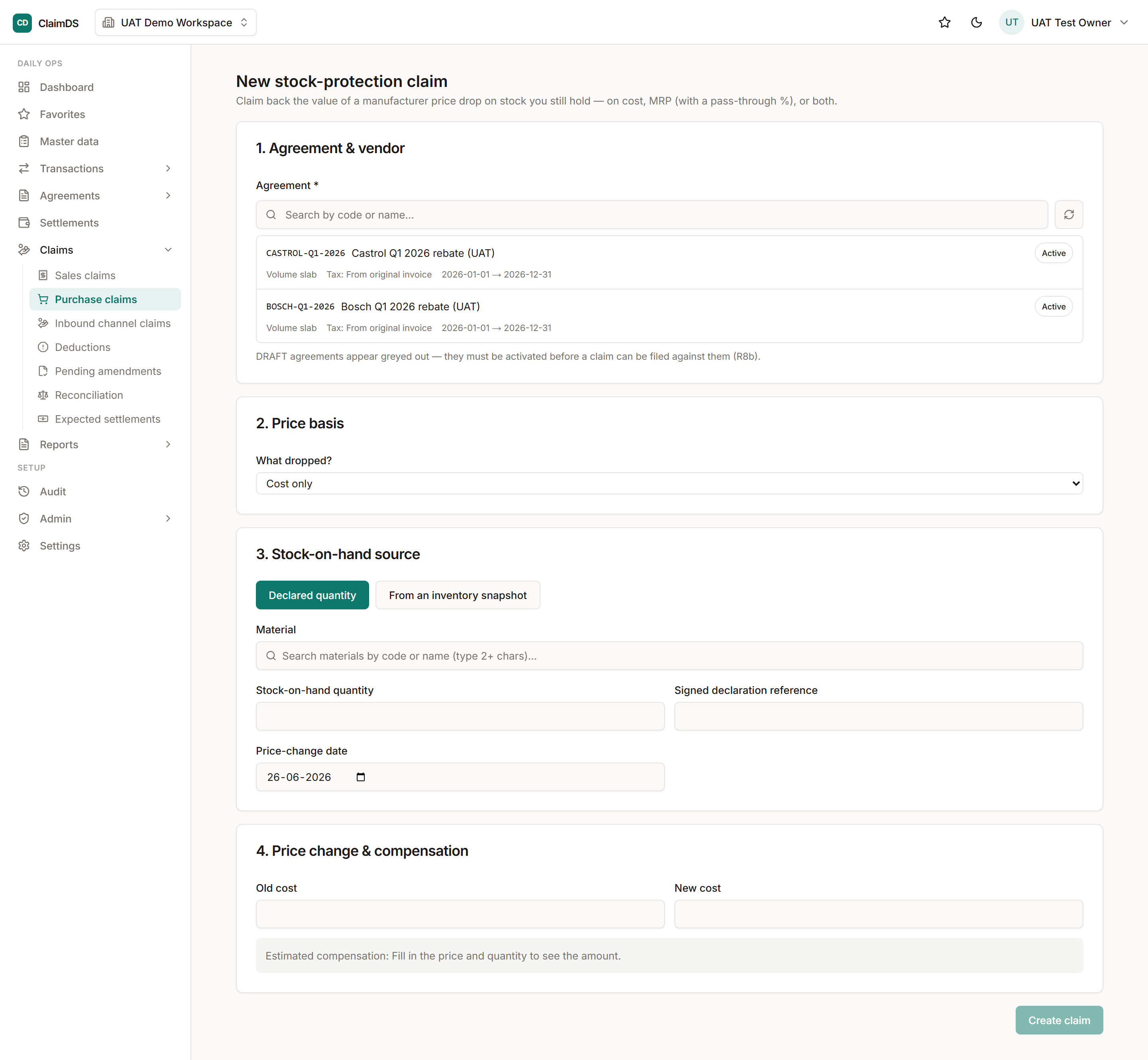
Price-drop protection compensates a channel partner when a manufacturer cuts the price of a product the partner already holds — so stocking up is not punished by a later price cut. The claim equals the per-unit price drop times the eligible stock-on-hand at the price-change date, validated against records and settled by GST credit note.
What price-drop protection is
When prices fall in fast-moving categories — electronics, IT, mobile — partners holding old-cost stock are suddenly carrying over-valued inventory. Price-drop protection bridges that gap so the channel keeps stocking confidently. It is the claim-mechanics view of the price protection software hub; the contractual view is price protection in sales.
The five steps
- Declare the price change. The manufacturer sets the new price and an effective date — the anchor for everything that follows.
- Identify eligible stock-on-hand. Establish how many units of the affected SKU each partner held at the change date.
- Compute the protection. Per-unit drop × eligible stock-on-hand.
- Validate. Check the claimed stock against records and the eligibility window; reject what does not reconcile.
- Settle. Settle the amount, usually by GST credit note, with an audit trail.
The eligible-stock problem
Everything hinges on the stock number at the change date. Get it right and the claim is arithmetic; get it wrong and you over-pay or invite disputes. This is why price-drop protection is a data problem: it needs a defensible inventory-on-hand position per partner per SKU at a precise moment, ideally from imported stock data rather than self-declaration. For the dealer-facing version see dealer claims management.
A worked example
A model drops ₹800. A dealer held 150 units at the change date. Protection = 150 × ₹800 = ₹1,20,000, validated against the dealer's stock records and settled by credit note. Multiply across SKUs and dealers and only software keeps it accurate at speed.
GST note: This article is general information, not tax or legal advice. Where settlement involves GST credit notes, positions — including CBIC Circular No. 251/08/2025-GST and the Finance Act 2026 amendments to Section 34 of the CGST Act, assented 30 March 2026 but not yet notified into force as of publication — must be re-verified at publish time with a qualified professional.
Frequently asked questions
What is price-drop protection?
Price-drop protection compensates a channel partner when a manufacturer reduces the price of a product the partner already holds, so the partner is not penalised for stocking inventory that has lost value. It is calculated on eligible stock-on-hand at the price-change date.
How is the protection amount calculated?
The protection amount is the per-unit price drop multiplied by the eligible stock-on-hand at the price-change date. The hard part is establishing accurate inventory-on-hand, which is why software is used.
How is a price-drop protection claim settled?
After the eligible stock is validated against records, the protection amount is settled to the partner, usually by GST credit note. The credit-note type depends on the GST treatment of the adjustment.
See ClaimDS on your own claims data
A 30-minute walkthrough tailored to how your channel actually settles claims.
Related posts

What Is Claims Management Software? A Practical Guide
Claims management software, explained: what it is, the claim lifecycle, the Indian claim types it settles, GST credit notes, and how to choose one.
How to Submit Rebate Claims Fast and Accurately with ClaimDS
A step-by-step guide to submitting rebate and scheme claims fast and accurately: the documents, the 5 steps, GST credit notes, and how to cut rejections.
Distributor Claim Settlement Software: A Buyer's Guide for Indian Mid-Market
What distributor claim settlement is, why spreadsheets fail at scale, what to look for in software, and how ClaimDS helps Indian mid-market finance teams.