
DOA and Warranty Returns in Electronics
How DOA, defective and warranty returns work in Indian consumer electronics — logging an RMA, serial-level evidence and how each return settles.
Consumer electronics moves in high volumes, and a real share of those units come back. Dead-on-arrival (DOA) stock, units that fail in the field, and in-warranty replacements make return-side claims a constant part of running an electronics channel. Each return is logged — usually as an RMA — verified against the serial or IMEI and the warranty terms, and settled by shipping a replacement unit or issuing a credit note. Getting that flow disciplined is what keeps returns from quietly eroding margin.
DOA and defective returns
Electronics returns split into two shapes, and the split decides how each one settles.
A DOA unit is dead on arrival — it fails on first power-up or never works at all — and it is caught inside a short opening window after the sale, often a handful of days. Because the fault clearly predates any customer use, a DOA is not diagnosed and repaired; it is swapped whole. The channel logs it fast, confirms the serial matches a genuine channel sale, and replaces the unit or credits it.
A defective-in-field unit fails later, during normal use, and runs through warranty validation instead: the company checks that the failure fell inside the coverage period and matches a covered fault type before approving anything. Both paths are serial or IMEI tracked end to end, because the physical identity of the unit is what every downstream check hangs on.
The returned unit then splits again by condition. A unit that is cosmetically fine and can be refurbished or restocked is saleable; a genuinely dead or unrepairable unit is scrap. That disposition matters, because saleable stock re-enters inventory while scrap is written off — and the two carry different downstream consequences, which is why the disposition is recorded against the RMA rather than decided informally on the warehouse floor. Units returned because they were damaged in transit rather than defective follow a different path again, closer to the credit-note route for expired and damaged goods.
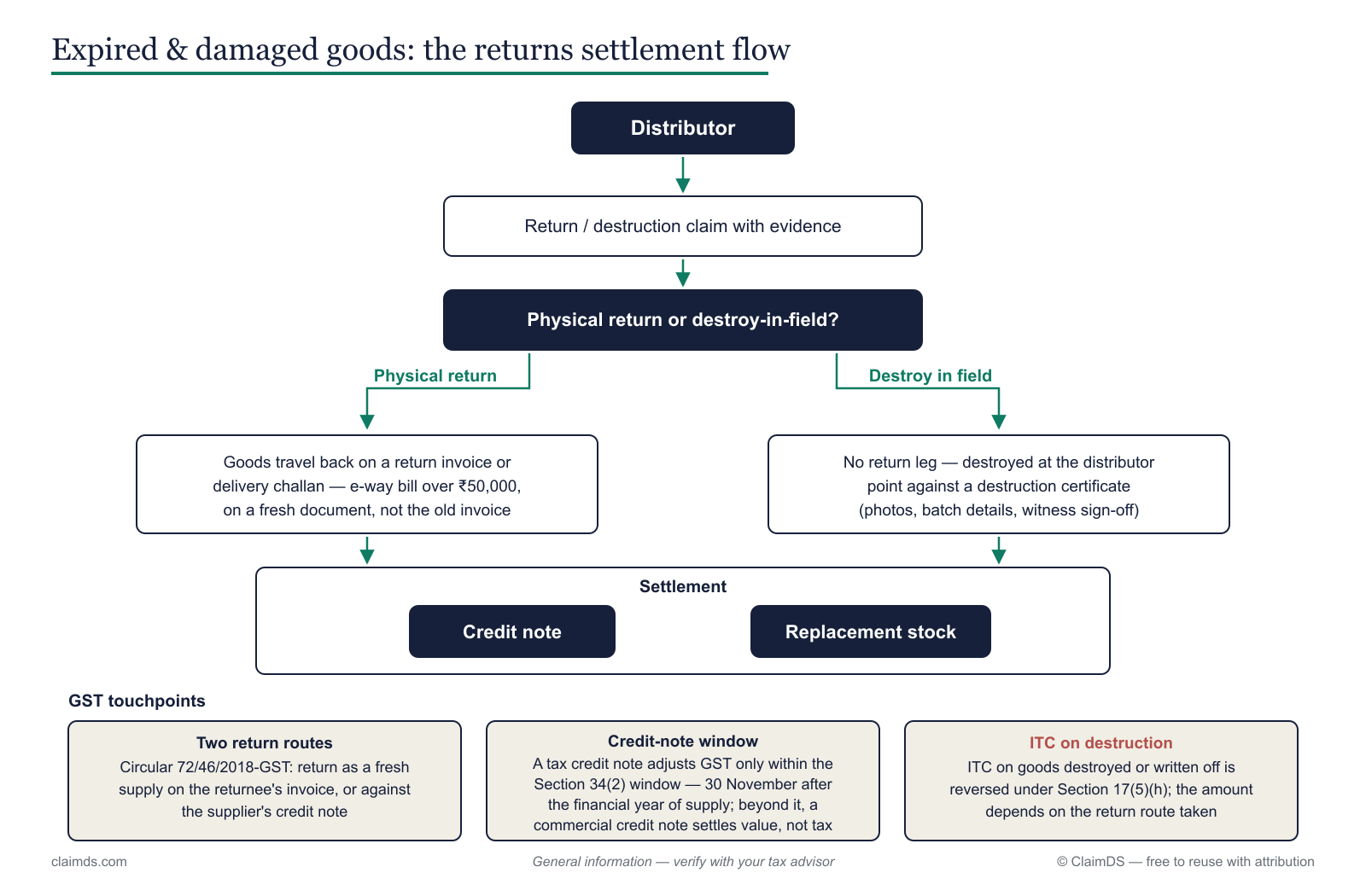
A defective or DOA electronics unit flows back up the channel as an RMA claim.
However the unit settles — replacement or credit — the return is a channel claim like any other, and belongs in the same distributor claims management pipeline as scheme and rebate claims. Treating returns as loose email-and-spreadsheet exceptions is a classic source of revenue leakage in channel programs. For definitions of the terms used here, the glossary is the reference.
What is an RMA and how does it flow?
An RMA — return merchandise authorisation — is the control that turns a customer complaint into a trackable claim. Nothing moves up the channel without one, and that is the point: the RMA number is the key that everything else attaches to.
The flow runs in a fixed sequence. First, the dealer or distributor requests the return, describing the fault and quoting the serial or IMEI of the failed unit. The company approves and issues an RMA number, which authorises the unit to travel back and sets the settlement route. Reverse logistics then move the physical unit — packed, labelled against the RMA, and shipped to the collection point or service centre. On receipt, the unit is inspected and dispositioned (saleable or scrap), and the claim is settled as a replacement unit shipped out or a credit note against the account.
Every stage leaves a record the company can validate later — mirroring the discipline behind any structured returns, reversals and cancellations process.
Serial-level tracking is why the RMA works. Tying each return to one physical unit is the single strongest control against fraud and duplicate claims: it confirms the unit was genuinely sold through the channel, stops the same defective unit being claimed twice, and prevents a claim for a unit that was never actually returned. Without serial discipline, an RMA is just a number; with it, the return is auditable end to end. That is the same claim-integrity principle that underpins good deduction management — a claim is only as strong as the evidence chain it can produce on demand.
Warranty replacements
An in-warranty replacement is a specific kind of return: a unit that fails inside its coverage period and is swapped for the customer at no charge, with the dealer then recovering from the company. Operationally it is a reimbursement claim — the dealer replaces the failed unit from shelf stock, files the claim with the serial, defect report and warranty proof, and the company makes the dealer whole once the claim clears validation.
It is worth separating this from a scheme claim. A warranty replacement compensates the dealer for honouring a product guarantee; a scheme claim pays out an incentive the dealer earned on sales performance. They travel different approval logic and settle against different budgets, even when they share a pipeline — and confusing the two is a common reason returns and incentives get mis-booked. The distinctions between the distributor, dealer and super-stockist roles shape who files which claim at each tier.
The GST characterisation of a warranty replacement — free swap versus billed part, credit note versus challan replenishment — has real depth to it, and this article stays at pointer level on tax. For the OEM-side warranty circular framing, see GST on stock transfers and warranty replacements in the channel; for the adjacent automotive treatment of the same claim shape, see automotive warranty claims and their GST treatment. Both cover the tax mechanics this piece deliberately leaves aside.
How do electronics returns settle under GST?
This section is a pointer, not a determination — the electronics GST sibling carries the depth.
At the settlement moment, a return or replacement is one of two events. A replacement ships a fresh unit against the RMA and needs no money to change hands. A credit note reverses the value of the returned unit against the dealer account instead. The choice between them is a financial versus tax question before it is anything else: a purely financial (commercial) credit note adjusts accounts without touching the original tax, while a tax credit note under GST also unwinds the tax on the original supply. The financial versus tax credit note distinction is exactly the line that governs which one a given return needs.
A warranty replacement made without separate consideration is treated distinctly again — because the unit is swapped free, the event is not a fresh taxable supply in the way an ordinary sale is. Naming the credit note is as far as this article goes; the statutory conditions, timing and reporting sit in the electronics GST sibling, GST treatment of consumer electronics claims and schemes, with the general mechanics in the reversals explained reference. Illustrative only: a returned unit invoiced at ₹18,000 might settle as a replacement unit or an ₹18,000 credit note — the figure is illustrative, not a rate.
Evidence and audit trail
A return is only as defensible as the evidence attached to it. Each item below answers a specific validation question, and a missing item is the usual cause of a rejected or short-paid claim.
| Evidence | What it proves | Why it matters |
|---|---|---|
| Serial / IMEI | The exact physical unit returned | Confirms a genuine channel sale and blocks duplicate claims |
| Defect report | The fault reported and observed | Establishes a covered failure, not misuse or wear |
| RMA number | The return was authorised | Ties the movement to an approved claim and its route |
| Warranty / DOA proof | The unit fell inside the eligible window | The hardest eligibility gate — date-bound |
| Original invoice reference | The unit's original sale | Links the return to the supply being reversed or replaced |
| Claim window | The return was filed in time | Late filing is a common ground for rejection |
Well-run channels capture this set at the point the return is raised, not reconstructed later — the same auditability a rebate management platform brings to every other claim type, and the same trail that makes any downstream return, reversal or cancellation defensible. The stronger the linkage between serial, defect report, RMA and warranty proof, the faster the claim clears.
Bringing returns into one claim pipeline
DOA, defective and warranty returns settle cleanly only when the operational trail and the settlement trail agree — the serial, defect report, RMA and warranty proof on one side, and the correct replacement-or-credit decision on the other. Run over email and spreadsheets, returns age quietly and leak margin; run as first-class channel claims, they stay tracked, evidenced and auditable. ClaimDS handles electronics returns as a claim type alongside rebates and scheme settlements — logging the RMA, holding the serial-level evidence, and keeping the replacement-or-credit-note choice consistent end to end. For the wider electronics picture, the pillar on consumer electronics channel claims and rebates in India, the dealer claim settlement process for electronics, and price protection in consumer electronics cover the adjacent claim types.
To see returns and settlement claims running on your own electronics network, book a demo.
Frequently asked questions
What is a DOA return?
A DOA — dead-on-arrival — return is a unit that fails on first use or arrives non-functional, within a short window after sale. Because the fault was present before the customer used it, a DOA is handled as a full swap rather than a repair: the channel logs it, verifies the serial, and settles it as a replacement unit or a credit note.
What is an RMA in electronics?
An RMA — return merchandise authorisation — is the reference number a company issues to permit a defective or DOA unit to travel back up the channel. Nothing moves without it. The RMA ties the returning serial to an approved claim, controls the reverse logistics, and becomes the key the settlement — replacement or credit — is booked against.
How is a warranty replacement settled?
A warranty replacement settles as a replenishment unit or a credit note against the dealer account. The dealer swaps the failed unit from shelf stock, files a claim with the serial and defect proof, and the company makes the dealer whole once the claim clears validation. The route chosen — stock or credit — drives how the event is recorded financially and for tax.
What evidence does a defective return need?
A defective return needs the serial or IMEI of the exact unit, a defect report describing the fault, the RMA number authorising the movement, proof the unit falls inside the warranty or DOA window, and the original invoice reference. Missing any one of these is the most common reason a company rejects or short-pays the claim on audit.
How does a DOA differ from a defective-in-field return?
Timing and treatment. A DOA fails immediately or arrives dead, inside a short opening window, and is swapped whole with little diagnosis. A defective-in-field unit fails later during normal use and runs through warranty validation — checking the coverage period and fault type before the company approves a replacement or credit. Both are serial-tracked; the eligibility gate differs.
Why does serial or IMEI tracking matter for returns?
Serial or IMEI tracking ties every return to one physical unit, which is what prevents duplicate and fraudulent claims. It confirms the unit was genuinely sold through the channel, checks it against the warranty window, stops the same defective unit being claimed twice, and gives the company an audit trail linking the RMA, the defect report and the settlement.
See ClaimDS on your own claims data
A 30-minute walkthrough tailored to how your channel actually settles claims.
Related posts

Channel Claims and Rebates in Indian Agri-Inputs
How schemes, claims and rebates work across the Indian agri-input channel — fertilizers, crop-protection and seeds, seasonal schemes and expiry returns.
How to Settle Agri-Input Dealer Claims
The step-by-step process to settle agri-input dealer and distributor claims in India — seasonal schemes, liquidation claims and near-expiry returns.
Expiry and Season-End Returns in Agri-Inputs
How near-expiry, damage and season-end returns work in Indian agri-inputs — declaring returnable stock, the claim window and how each return settles.