
Channel Claims and Rebates in Indian Tyres
How schemes, claims and rebates work in the Indian tyre channel — the replacement market, volume schemes and pro-rata warranty claims by tread depth.
Tyre companies sell through two channels at once: a smaller OEM channel that fits tyres onto new vehicles, and a larger replacement market that supplies tyres for vehicles already on the road. Both run through a distributor and dealer network, and both are paid with volume and slab schemes. On top of those, tyre makers settle a claim no other vertical carries in the same form — the pro-rata warranty, where a defective tyre is compensated in proportion to the tread depth remaining, not replaced at a flat value.
The tyre channel, tier by tier
A tyre travels a longer route to the buyer than most people picture. The manufacturer produces at plant scale, then pushes stock outward through a chain of intermediaries, each taking a margin and each raising claims back up the line while goods flow down.
The first hop is a depot or carrying-and-forwarding (C&F) agent — a stocking point that holds inventory close to a region without owning it outright. From there, tyres move to a distributor, who buys on their own account, carries a trading margin, and services a spread of dealers. Below the distributor sits the dealer or retailer — the tyre shop the vehicle owner actually visits, which fits the tyre, holds the purchase record, and handles the first line of any warranty conversation. Running parallel to all of this is the OEM fitment channel, where tyres go direct to a vehicle assembly line as original equipment, and a fleet channel serving transporters who buy in bulk and run tyres hard.
The distinction between the tiers is not cosmetic — it decides who raises which claim. If you are untangling who sits where, the distributor versus dealer and super-stockist breakdown draws the lines, and the multi-tier channel claim map shows how a claim threads back up through each tier.
| Tier | Role | Typical claim raised |
|---|---|---|
| Manufacturer | Produces tyres, owns the schemes | — (pays claims) |
| Depot / C&F | Regional stocking point | Handling, damage in transit |
| Distributor | Buys on own account, serves dealers | Volume / slab scheme, damage |
| Dealer / retailer | Tyre shop, fits and sells | Replacement scheme, pro-rata warranty, display |
| OEM fitment | Direct supply to vehicle line | Contract price, not channel scheme |
| Fleet | Bulk buyer, transporter | Negotiated volume rate |
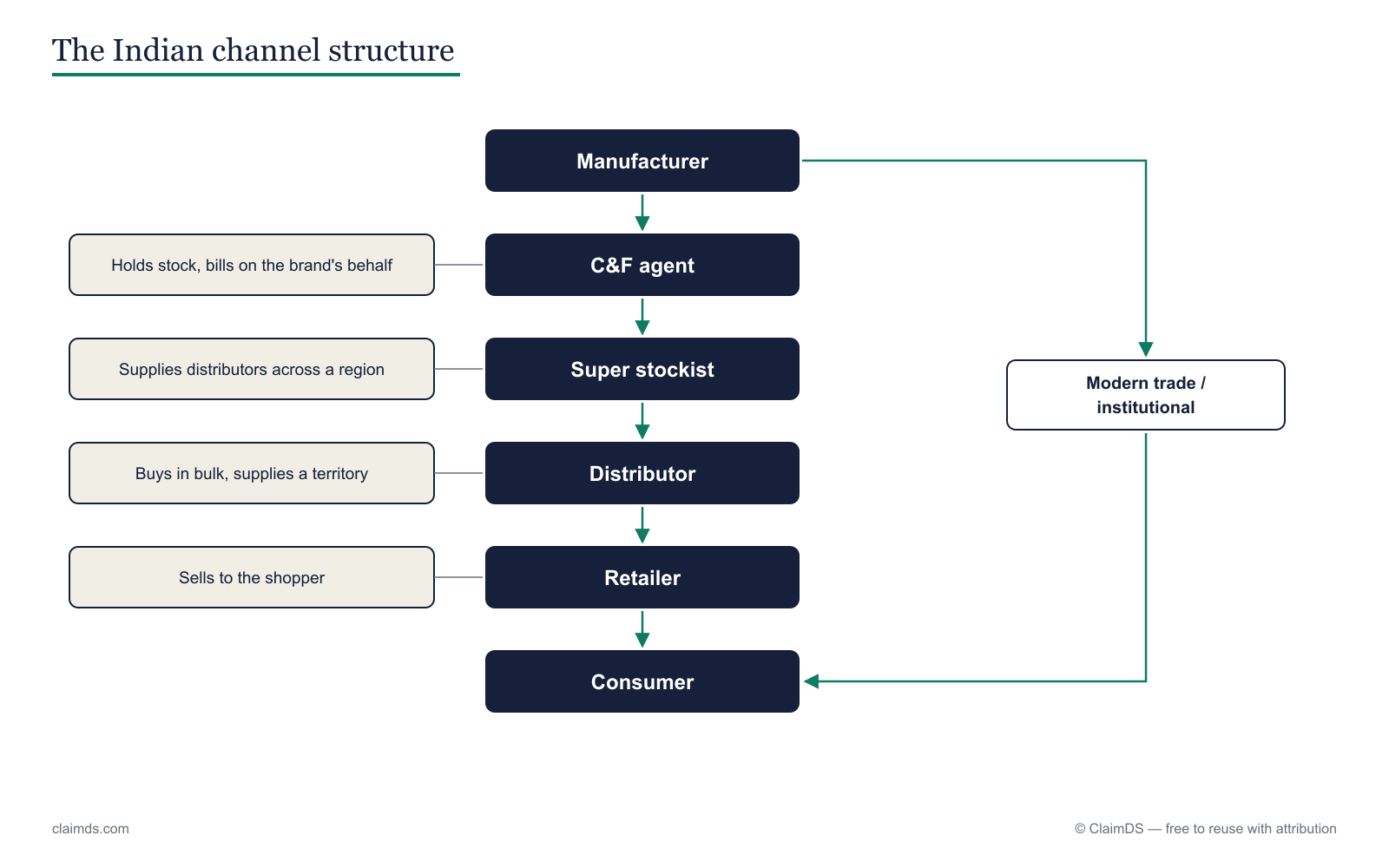
Tyres run an OEM channel and a larger replacement-market channel side by side.
What claims does a tyre company handle?
Five claim families cover almost everything a tyre company settles with its channel, and each is evidenced differently.
Volume and slab schemes are the workhorse. A distributor or dealer earns a per-unit incentive for hitting a purchase or sales target over a month or quarter, with the rate stepping up in slabs as offtake grows. These are the standard trade-scheme mechanics used across Indian distribution. Replacement-market schemes layer on top — extra incentives aimed specifically at pulling replacement tyres through independent dealers, distinct from anything the OEM line receives. Display and fitment schemes pay for branding at the tyre shop, wheel-alignment tie-ins, or preferred shelf position. Damage claims cover tyres that arrive with a manufacturing fault before sale or are damaged in transit — mechanically the same discipline as credit notes for damaged goods returns. And the pro-rata warranty — the one below — settles a defective tyre against the tread it has left.
A tyre channel claim is any amount a tyre maker owes its distributors and dealers for performance or protection — volume and slab schemes, replacement-market incentives, display support, damage, and pro-rata warranty — nearly all settled by credit note, not cash.
Left unmanaged, this mix is a textbook source of revenue leakage in rebate programs — over-claimed quantities and duplicate warranty submissions hide easily in tyre volumes. A shared vocabulary keeps the channel honest:
| Term | What it means |
|---|---|
| Replacement market | Channel selling tyres for vehicles already on the road |
| OEM fitment | Tyres supplied as original equipment to a new vehicle |
| Volume / slab scheme | Incentive that steps up with purchase or sales quantity |
| Pro-rata warranty | Defect compensation in proportion to remaining tread |
| Tread depth | Measured groove depth; the basis of pro-rata settlement |
| Casing | The tyre body that can be retreaded; assessed on failure |
| C&F / depot | Regional stocking point that holds inventory for the maker |
| Credit note | Instrument that settles a claim against the account |
| Claim window | Period within which a claim must be submitted |
| Manufacturing defect | Fault in make, not road damage; the warranty trigger |
Pro-rata warranty: the tyre-specific claim
The pro-rata warranty is the claim that makes tyres different. An ordinary warranty replaces a faulty product outright. A tyre cannot work that way, because a tyre is a consumable that wears every kilometre — by the time a manufacturing defect surfaces, the buyer has already used part of what they paid for. So the industry settles a defect claim in proportion to the tread still remaining, not at full value.
The logic runs on usable tread. A new tyre has a fixed depth of usable rubber down to its legal minimum. When a tyre fails with a genuine manufacturing defect part-way through that band, the remaining usable tread is measured, expressed as a fraction of the total usable tread, and that fraction is applied to a reference price to compensate the buyer. The dealer who honours the replacement at the counter then raises a reimbursement claim back to the tyre company for the compensated portion.
The evidence is specific. It takes a tread-depth measurement at several points across the tyre, purchase proof to establish age and warranty eligibility, and a defect assessment confirming the failure is a manufacturing fault rather than a road cut, impact break or under-inflation — often with the casing examined to judge the failure mode. Only when those line up does the claim value hold.
Here is an illustrative worked example (figures for illustration only). Take a tyre with a reference price of ₹12,000 and 6.4 mm of usable tread when new (from an 8 mm moulded depth down to a 1.6 mm legal minimum). It fails with a verified defect at 4.8 mm remaining — so 3.2 mm of usable tread is left. The unused fraction is 3.2 ÷ 6.4 = 50%, and the pro-rata compensation is 50% × ₹12,000 = ₹6,000. The buyer bears the half already consumed; the maker covers the unused half through the dealer credit.
This is the deep treatment the aftermarket overview only flagged. For where it sits among adjacent parts claims, see the automotive spare-parts and aftermarket claims guide, and for how a flat, non-pro-rata warranty settles by contrast, the automotive warranty claims treatment.
How tyre schemes and warranty settle under GST
The tax side is a pointer here, not a ruling. A tyre scheme almost always settles through a credit note, and the first question is whether that note is a financial (commercial) credit note or a tax credit note that also adjusts GST. The answer turns on how the scheme was agreed and documented up front — a distinction worked through in financial versus tax credit notes under GST, not something to decide by reflex on each claim.
A pro-rata warranty replacement raises a second question. Where a replacement tyre (or its compensated portion) is supplied without separate consideration because the original sale already priced in the warranty, its treatment differs from a straightforward discount or volume payout. Stock movements between depots and warranty replacements have their own handling, routed in the GST on stock transfers and warranty replacements in the channel guide.
The operational takeaway is simply that the claim exists the moment the defect is verified or the scheme target is met — the tax characterisation of the settling credit note is a separate, document-driven decision.
GST note: This article is general information, not tax or legal advice. The treatment of tyre schemes, warranty replacements and the credit notes that settle them — including whether a note adjusts GST and how a replacement without consideration is handled — must be re-verified at publish time with a qualified professional before you rely on it.
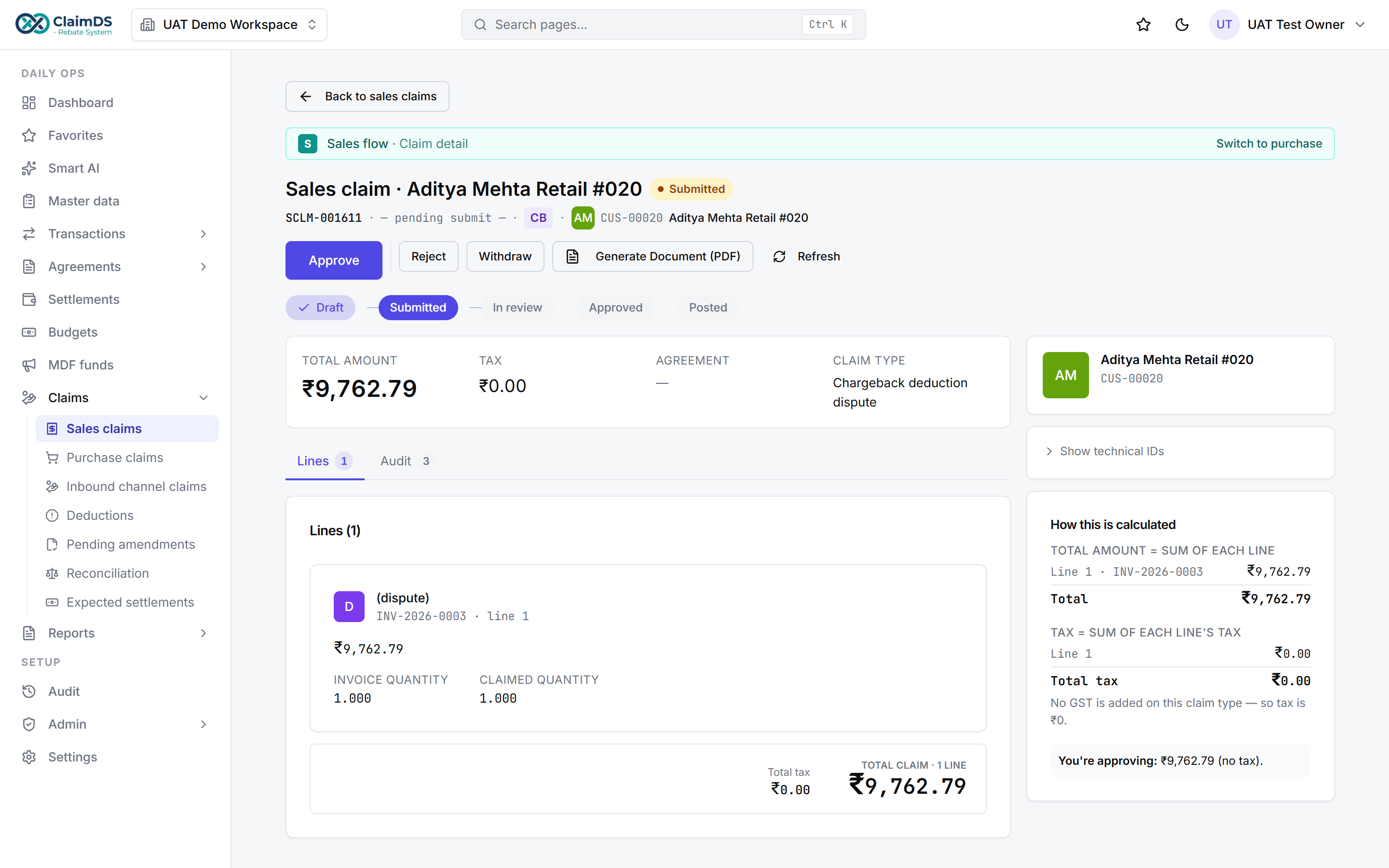
A pro-rata warranty claim validated before a credit note is issued.
Bringing it together
Tyre channel claims are the same idea as anywhere in Indian channel rebates — pay the channel for performance, settle by credit note — wrapped around one mechanic no other vertical shares: the pro-rata warranty, where a defect is compensated against the tread a buyer has left rather than the tyre replaced whole. Get the tread measurement, the defect assessment and the credit-note choice right, and settlement stops being a source of dispute. The discipline that holds it together is a repeatable claim and rebate approval workflow, with the approval-workflow reference walking the stages and the glossary keeping the terms straight. Tyres sit alongside the broader automotive channel claims and rebates picture, and the tax on rebates, chargebacks and buybacks primer covers the wider deduction landscape.
<!-- TODO: confirm capability wording with founder -->ClaimDS is built for exactly this shape of channel — multi-tier, scheme-driven, credit-note settled, with pro-rata warranty modelled natively against measured tread. See how it handles distributor claim settlement end to end, with purpose-built dealer claims management software, dealer rebate software and broader rebate management software — or book a demo to walk through your own tyre schemes and warranty settlement.
Frequently asked questions
What is a tyre channel claim?
A tyre channel claim is a payment a tyre company owes its distributors and dealers for performance or protection — volume and slab scheme incentives, replacement-market schemes, display support, damage, and the tyre-specific pro-rata warranty on defective tyres. Nearly all of it settles by credit note against the dealer account rather than by cash.
What is a pro-rata tyre warranty?
A pro-rata tyre warranty compensates a defective tyre in proportion to the tread it has left, not as a flat replacement. If a manufacturing defect surfaces after the tyre has run part of its rated life, the customer bears the portion of tread already used and the manufacturer covers the unused balance. This makes it distinct from ordinary damage claims.
How is a pro-rata warranty claim calculated?
A pro-rata warranty claim compares remaining tread depth against the tyre usable tread. The unused fraction is applied to a reference price to give the compensation: a tyre with roughly half its tread left earns close to half the reference value. Measured tread, purchase proof and a defect assessment support the number before a credit note issues.
What is the tyre replacement market?
The tyre replacement market, or aftermarket, is the channel that sells tyres for vehicles already on the road — replacements for worn or damaged tyres — as opposed to OEM fitment on new vehicles. It is the larger of the two tyre channels by volume and runs through distributors and independent tyre dealers rather than vehicle showrooms.
What is a tyre volume scheme?
A tyre volume scheme pays a distributor or dealer an incentive for buying or selling a target quantity of tyres over a period. Slab structures step the rate up as volume rises, so higher offtake earns a richer per-unit rate. The earned amount is reconciled against sales evidence and settled by credit note against the account.
How do tyre warranty replacements settle under GST?
Tyre schemes usually settle through a credit note, and whether it carries a GST adjustment or is purely financial depends on how the scheme was agreed and documented. A warranty tyre supplied without separate consideration is treated differently again. This article keeps tax at pointer level — confirm current treatment with a qualified professional before relying on it.
See ClaimDS on your own claims data
A 30-minute walkthrough tailored to how your channel actually settles claims.
Related posts

Channel Claims and Rebates in Indian Agri-Inputs
How schemes, claims and rebates work across the Indian agri-input channel — fertilizers, crop-protection and seeds, seasonal schemes and expiry returns.
How to Settle Agri-Input Dealer Claims
The step-by-step process to settle agri-input dealer and distributor claims in India — seasonal schemes, liquidation claims and near-expiry returns.
Expiry and Season-End Returns in Agri-Inputs
How near-expiry, damage and season-end returns work in Indian agri-inputs — declaring returnable stock, the claim window and how each return settles.