Supplier, Dealer, Vendor and Trade Scheme Incentives: What's the Difference?
Supplier incentive, dealer incentive, vendor rebate, trade scheme — used interchangeably but different things. A clear guide for Indian businesses.
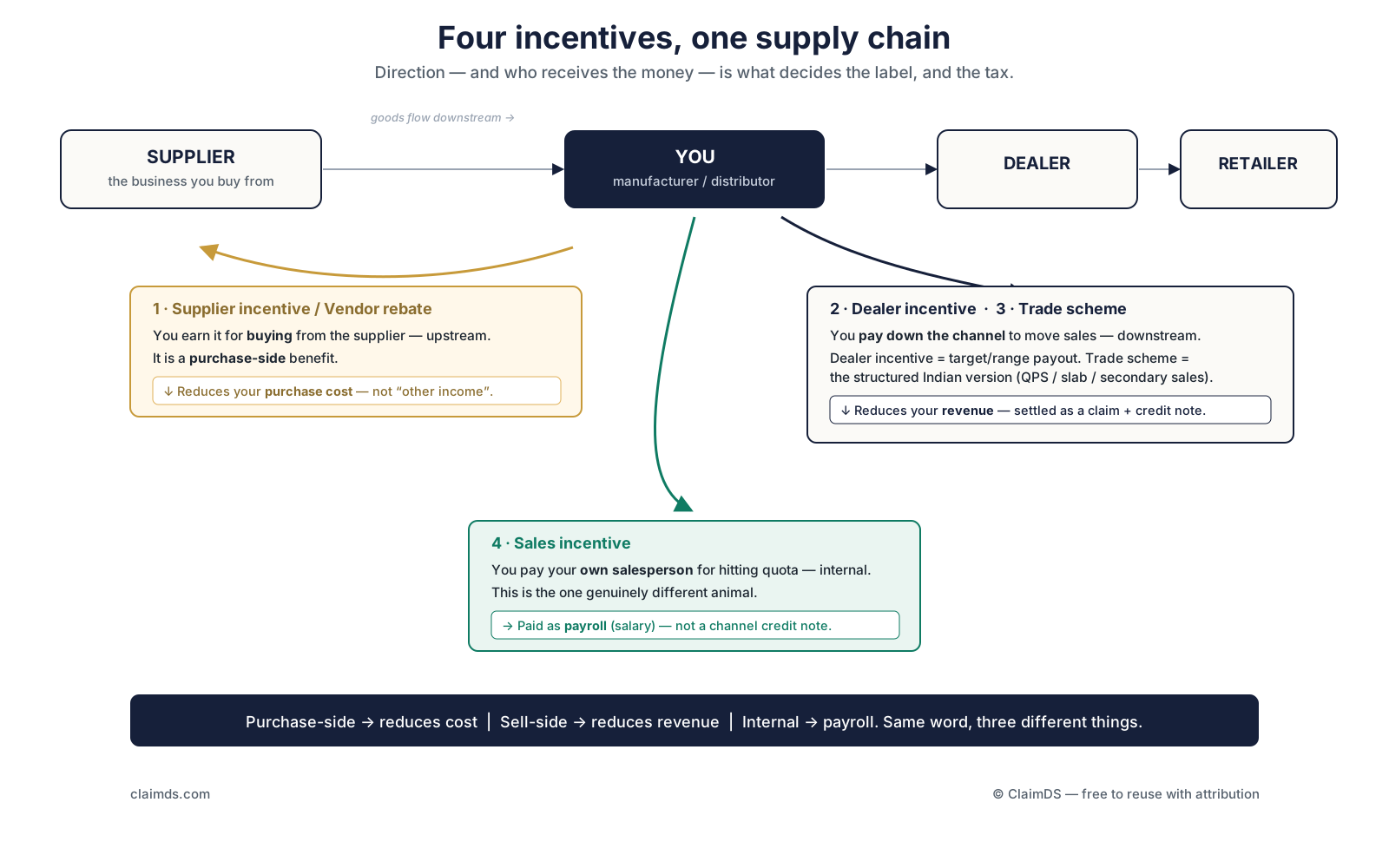
The short answer: these terms describe money moving along a supply chain; the difference is direction and the recipient. A supplier/vendor incentive is earned by a buyer — it reduces cost. A dealer incentive and a trade scheme are paid by a manufacturer down its channel to move sales — reducing revenue. A sales incentive is payroll to your own salesperson.
The words get used interchangeably in day-to-day conversation, but they are not the same thing — and treating them as if they were is where finance teams, GST filings and sales plans quietly go wrong. Here is the clean line between them.
The four terms side by side
| Term | Who pays | Who receives | Direction | Typical trigger | How it's usually settled |
|---|---|---|---|---|---|
| Supplier incentive / Vendor rebate | The supplier | The buyer (you) | Upstream | Volume of purchases | Credit note or price adjustment |
| Dealer incentive | The manufacturer | The dealer | Downstream | Sales / target | Credit note or scheme payout |
| Trade scheme | The manufacturer | The channel | Downstream | QPS / slab / target | Claim + credit note |
| Sales incentive | The company | Its own salesperson | Internal | Quota | Payroll |
The first three are channel money — they move between businesses along the supply chain. The last one is people money — it moves from a company to its own employee. That single distinction is what separates a channel-settlement question from a payroll question.
What is a supplier incentive (or vendor rebate)?
A supplier incentive — often called a vendor rebate — is money a business earns for buying from a supplier. It flows upstream: the supplier gives it to the buyer, usually for crossing a purchase volume or hitting a buying target. If you are a distributor or a retailer, this is the incentive you receive from the brands and manufacturers you stock.
Because you earn it for purchasing, a supplier incentive is a purchase-side benefit. In accounting terms it generally reduces the cost of purchases rather than counting as separate income — and where the goods are still in stock, it reduces the cost of that inventory too. Booking a large supplier rebate as "other income" instead of a cost reduction is a classic error: it inflates both your purchase cost and your income and distorts your gross margin.
This is the same family of money as the rebates a channel earns, and if you are on the receiving end it is worth reading how to calculate FMCG distributor claims so the amount you book matches what you are actually owed. Structured versions of these buy-side programmes are covered in supplier incentive programs.
What is a dealer incentive?
A dealer incentive flows the other way. Here a manufacturer pays a dealer — a downstream partner who resells the product — to push sales, hit a target, stock a fuller range, or clear specific stock. It is sell-side money: it moves down the channel, from the brand towards the market.
Because it is paid to move the manufacturer's own sales, a dealer incentive is treated in the manufacturer's books as a reduction of revenue, not as a marketing expense sitting next to salaries and rent. It is usually settled as a claim and a credit note down the channel, which is why measuring it accurately — which dealer, which scheme, which qualifying sales — is a claims problem before it is an accounting one.
Dealer incentives are one slice of the wider trade-promotion toolkit, and the software that runs them is the same engine used for distributor rebates. If a dealer overclaims or a scheme is misread, the result usually surfaces as a deduction or a billback you have to reconcile.
What is a trade scheme?
A trade scheme is the structured, India-specific form of a downstream incentive. Instead of an ad-hoc payout, it defines qualifying purchases or sales and a payout formula in advance — a quantity purchase scheme (QPS), a slab scheme, or a secondary-sales scheme tied to what the channel sells on rather than just what it buys in.
The mechanics are what make a trade scheme distinct: there are defined thresholds, a defined rate or slab, a qualifying period, and a claim the channel raises which the manufacturer verifies and settles. Getting the payout right depends entirely on measuring the right base — and in a multi-tier network that means telling primary, secondary and tertiary sales apart, because a secondary-sales scheme pays on a different number than a primary-purchase one.
Like a dealer incentive, a trade scheme is downstream money that reduces the manufacturer's revenue and settles through a credit note. Measuring the qualifying base accurately is the same discipline as calculating distributor claims — the scheme is only as good as the numbers underneath it. Trade schemes sit alongside, but are distinct from, consumer promotions, which target the shopper rather than the channel.
Where does a "sales incentive" fit — and why it's different
A sales incentive is the one genuinely different animal. It is money a company pays its own salesperson — a field rep, an ASM, an internal team — for hitting a quota. It never leaves the company to go to another business; it goes to an employee.
That makes it a payroll question, not a channel one. A sales incentive to an employee is treated as salary, not as a channel credit note — a completely different accounting and tax path from a dealer incentive or a trade scheme. Drawing this line matters: the same word "incentive" is doing two unrelated jobs, and merging them is how a payroll cost ends up mis-booked as a channel scheme, or vice versa.
If it is your own people you are paying, that is a plan-design and payroll problem — see how to design a sales incentive plan. If the payee is an external agent or channel partner rather than an employee, that is a third case again, covered in channel-partner and sales-agent commission. The through-line that a single engine can run both channel and people payouts is set out in the "rebates and incentives, one engine" article.
<!-- TODO: link "rebates-and-incentives-one-engine" once it is out of draft. -->Why the label matters for accounting and GST
The reason the vocabulary is worth getting right is that the direction decides the treatment. A purchase-side incentive reduces cost; a sell-side scheme reduces revenue; an internal sales incentive is payroll. The label is really just a name for the direction the money moved — and the accounting entry follows that direction, not the word you happened to use.
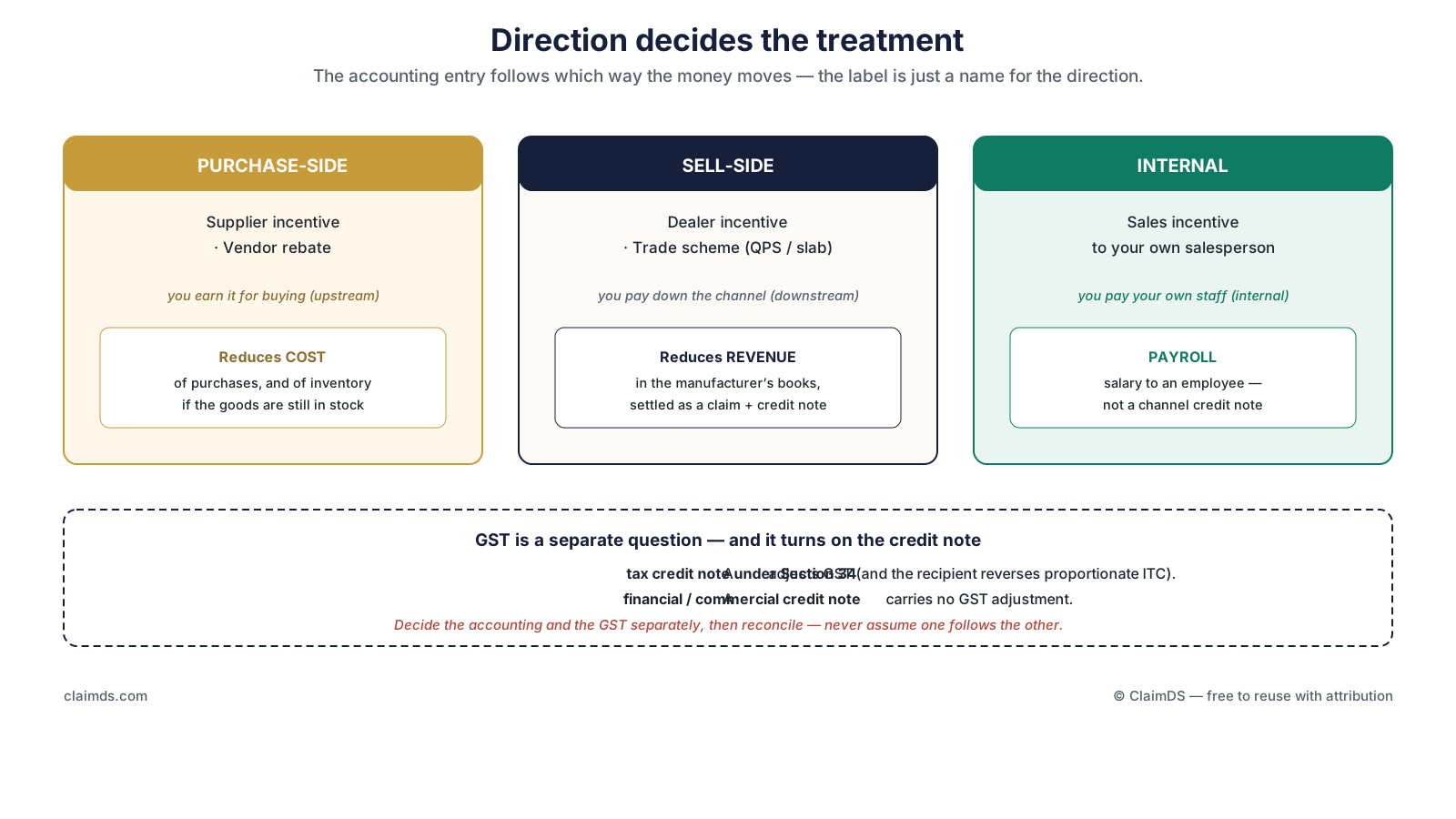
GST is a separate question on top of this, and it turns on whether the money moves through a credit note — and if so, which kind. We keep the detail in the dedicated, professionally reviewed GST guides rather than asserting a specific treatment here: start with CBIC Circular 251 on post-sale discounts. The one rule to carry away is to decide the accounting and the GST treatment separately and reconcile them — never assume one follows the other.
<!-- TODO CA REVIEW: high-level GST/accounting framing only; confirm before publish and do not assert a specific treatment for a specific scheme. --> <!-- TODO: link the rebate-accounting article (rebates-indian-gaap-accounting) once it is out of draft. -->General information, not advice. This article explains terminology in general terms and is not accounting, tax or legal advice. The accounting and GST treatment of any specific incentive, rebate or scheme depends on your facts and can change. Confirm the treatment of a specific arrangement with your chartered accountant before you rely on it.
Read next
- Rebate management software — the engine behind supplier and channel rebates.
- CPG trade-promotion guide — where dealer incentives and trade schemes fit in the wider trade-spend picture.
- Primary, secondary and tertiary sales — the sales bases a trade scheme pays on.
- How to design a sales incentive plan — the payroll-side incentive, kept separate.
- Incentive management software — running channel and people incentives without blurring them.
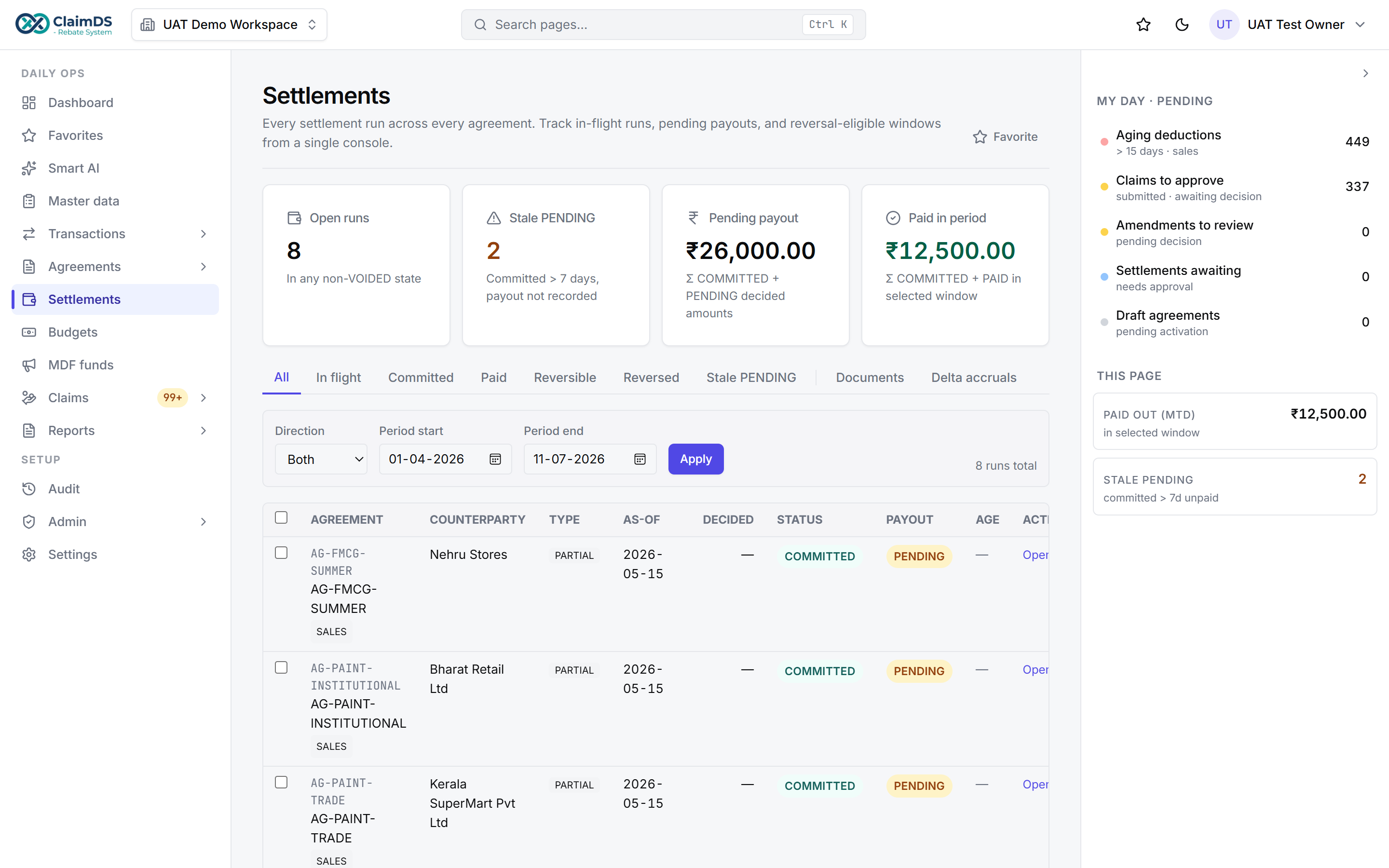
The ClaimDS settlement view — every scheme, claim and payout measured, approved and settled in one place.
ClaimDS manages the channel-side money — supplier and dealer incentives and trade schemes — as claims and credit notes, and (via the incentive module) sales incentives to your own people as a separate, payroll-aware payout. Each is settled the right way, so the label you use in conversation matches the entry in your books.
<!-- TODO: confirm capability wording with founder -->Book a demo to see how ClaimDS keeps channel schemes and people incentives cleanly apart — and correctly settled.
Frequently asked questions
What is the difference between a supplier incentive and a dealer incentive?
A supplier incentive (or vendor rebate) is earned by a buyer for purchasing from a supplier — it flows upstream and reduces the buyer's purchase cost. A dealer incentive is paid by a manufacturer down its channel to a dealer to push sales — it flows downstream and reduces the manufacturer's revenue. Same word, opposite directions.
Is a vendor rebate the same as a trade scheme?
No. A vendor rebate is a purchase-side benefit a buyer earns from a supplier for buying, and it reduces the buyer's cost. A trade scheme is a manufacturer's structured, sell-side programme — a QPS, slab or secondary-sales scheme with defined qualifying purchases and payout math — paid down the channel. One is money you receive; the other is money you pay out.
Is a supplier incentive income or a reduction in cost?
A supplier incentive received for buying is generally treated as a reduction in the cost of purchases, not as other income. Where the goods are still in stock, it also reduces the cost of inventory. Booking it as income instead of a cost reduction inflates both purchases and income and distorts the gross margin — a common finance error.
What is a trade scheme in Indian FMCG?
A trade scheme in Indian FMCG is a structured incentive a manufacturer runs down its distribution channel to move stock — for example a quantity purchase scheme (QPS), a slab scheme, or a secondary-sales scheme. It sets qualifying purchases or sales targets and a payout, which the channel claims and the manufacturer settles, usually through a credit note.
Is a sales incentive to an employee the same as a dealer incentive?
No. A sales incentive paid to your own salesperson is part of payroll — it is compensation to an employee and is treated as salary. A dealer incentive is a channel payout to an external business that resells your product, and it is settled down the channel, typically as a credit note. One is internal payroll; the other is a channel settlement.
Does a dealer incentive reduce revenue?
Generally yes, in the manufacturer's books. A dealer incentive is money paid down the channel to move sales, so it is treated as a reduction of the transaction price rather than a separate expense — which reduces net revenue. Whether it also adjusts GST depends on whether it moves through a tax credit note or a financial credit note.
See ClaimDS on your own claims data
A 30-minute walkthrough tailored to how your channel actually settles claims.
Related posts

Seasonal Schemes and Liquidation in Agri-Inputs
How seasonal schemes and liquidation claims work in Indian agri-inputs — schemes timed to Kharif and Rabi, sell-through targets and season-end settlement.
FMCG Trade Schemes Explained: QPS, Slab and Secondary
The trade schemes Indian FMCG companies actually run — QPS, slab, secondary, display and festive schemes — what each is calculated on and how it settles.
Types of Trade Schemes in India: The Complete Guide for Manufacturers and Channel Teams
Slab, QPS, target, display, visibility, tour, gift and secondary schemes — how each type is calculated, settled and taxed, with worked ₹ examples.