What is a Billback? Meaning, Process and How It Differs from a Chargeback
Billback meaning in plain English — how billbacks work, billback pricing, a worked example, and billback vs chargeback in Indian channels.
A billback is a post-sale charge where one trading partner bills the other back for an agreed amount after the sale. Typically that means a distributor billing a supplier for the difference between its into-stock price and a lower contracted customer price — or for promotional allowances it has earned.
That is the whole billback definition; everything else is mechanics. The billback meaning does not change if you write it as two words — the bill back meaning is identical, and if you searched what is a bill back, the answer is the same post-sale recovery described above. The term is sometimes misspelled as billsback. For how billbacks sit against chargebacks, deductions and rebates as a family, the master comparison is our billbacks vs chargebacks vs deductions glossary — this page goes deep on the billback side alone.
How billbacks work
The billback cycle has five steps, and every one of them leaves paper.
- Sell at the agreed lower price. A supplier and a distributor agree that a specific customer, promotion or period gets a price below the distributor's normal buying price. The distributor honours that price on its own invoice, taking the hit up front.
- Calculate the entitlement. After the sales happen, the distributor works out what it is owed — the price gap times the quantity sold under the agreement, or the promotional allowance earned.
- Submit the billback claim with proof. Sales invoices, dispatch records or a sales register go in alongside the claim, so the supplier can see which units actually moved at the deviated price.
- The supplier validates. The claim is checked against the agreement — right customer, right products, right period, right price — and against the volumes claimed.
- Settle by credit note or payment. The approved amount comes back to the distributor, most commonly as a credit note against future purchases.
Two things about this cycle are worth pausing on. First, the distributor carries the cost between step 1 and step 5 — it has already given the customer the lower price, so a slow or disputed billback is working capital stuck on its balance sheet. Second, the proof in step 3 is what makes step 4 possible: a billback claim without sell-through evidence is just an assertion, and suppliers are entitled to reject it. Most billback disputes trace back to one of those two points — settlement that dragged, or documentation that was thinner than the agreement required.
The term comes from foodservice distribution in the United States, where distributors routinely bought at list, sold to restaurant chains at contracted prices, and billed manufacturers back for the difference — hence the name. In Indian channels the same mechanic runs constantly but usually answers to other names: distributors call it a claim or a rate difference, and the recovery maths is the same one used to calculate FMCG distributor claims. Whatever the label, the defining features hold — the partner initiates, the supplier pays, and the sale has already happened.
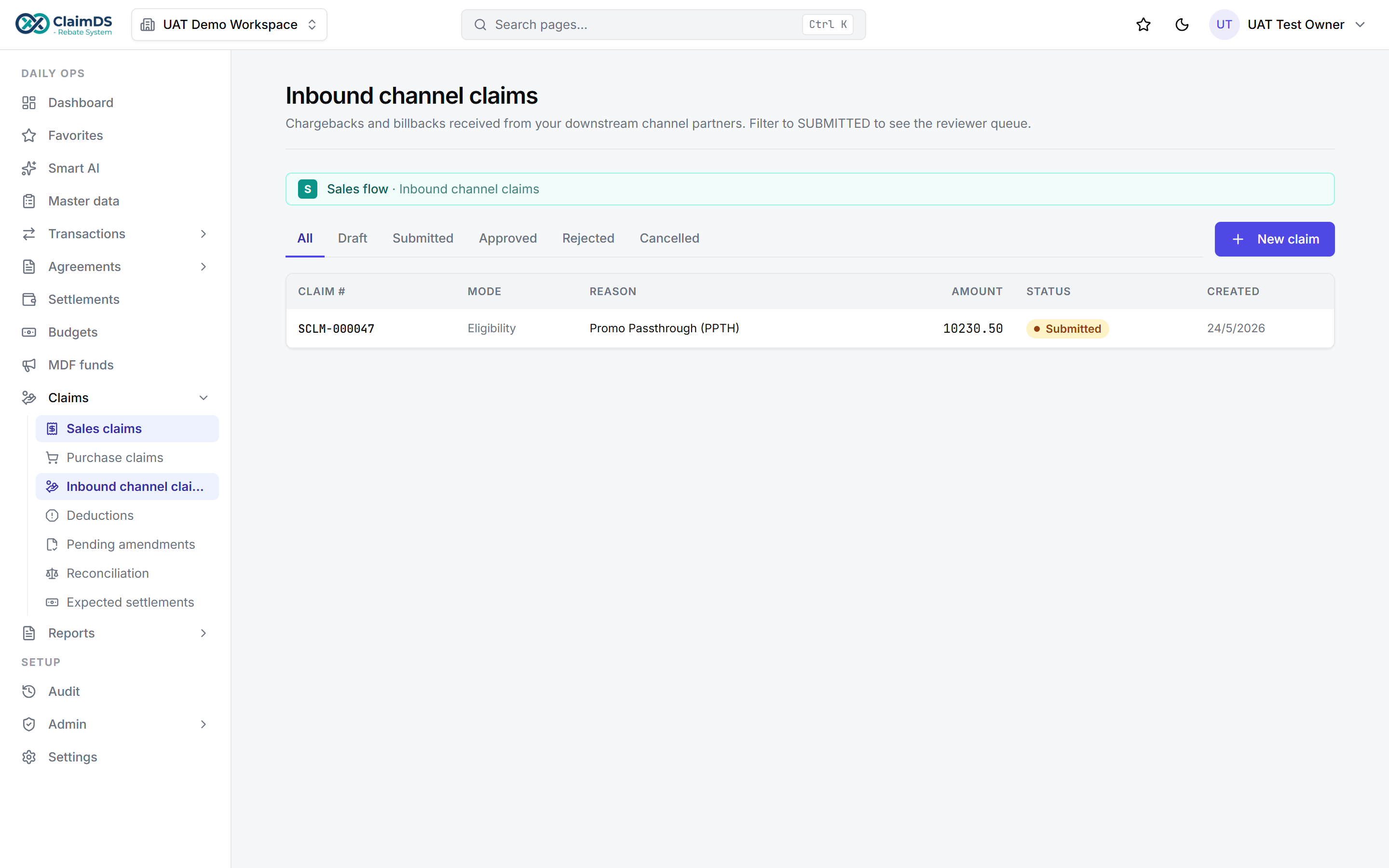
In practice, billbacks and chargebacks arrive as inbound channel claims that need validating against the agreement before settlement:
Billback pricing explained
Billback pricing rests on two numbers. The into-stock price (list price) is what the distributor actually pays the supplier when goods land in its warehouse. The contract price — also called a deviated price — is the lower price the supplier has agreed for a specific customer or deal. The distributor buys at the first number, sells at the second, and bills back the gap:
Billback amount = (into-stock price − contract price) × quantity sold under the contract
The obvious question is why suppliers bother. Why not just lower the list price? Because billback pricing gives the supplier visibility and control over deviated pricing. A blanket list-price cut applies to every unit, every customer, forever — and is very hard to raise back. A billback funds the lower price only for the agreed customer, only for units the distributor can prove it sold there, and only for the agreed window. The supplier sees exactly where its price support went, customer by customer, and can end it by letting the agreement lapse. It is the same logic that makes price protection a claim rather than a reprice — fund the exception, protect the list.
There is an accounting benefit on the supplier side too. Under billback pricing, deviated-price support shows up as a measurable trade-spend line — so a finance team can see what each contract, customer or promotion actually cost — instead of disappearing invisibly into a lower average selling price. That visibility is exactly what makes trade spend controllable rather than merely observable.
Worked example
A distributor buys 1,000 units at an into-stock price of ₹500. The supplier has agreed price support on an institutional deal that brings the distributor's effective cost down to ₹460 for those units. (Illustrative numbers only.)
| Item | Value |
|---|---|
| Quantity purchased | 1,000 units |
| Into-stock price | ₹500 per unit |
| Effective contracted cost | ₹460 per unit |
| Price gap | ₹40 per unit |
| Billback claim | ₹40 × 1,000 = ₹40,000 |
The distributor sells the units on the institutional deal, then raises a billback claim for ₹40,000 with its sales invoices attached. The claim is Submitted; the supplier checks it against the agreement and the quantities and marks it Validated; a reviewer signs off and it moves to Approved; and finally a credit note for ₹40,000 is issued against the distributor's account, at which point the claim is Settled. That Submitted → Validated → Approved → Settled path is the standard lifecycle any claims management software tracks — the billback is simply one claim type flowing through it.
Note what validation can do to the number. If the distributor's sales register only evidences 900 units sold on the institutional deal, the supplier approves ₹36,000, not ₹40,000 — a partial approval with a documented short-pay reason. That per-line adjustment, agreed and recorded rather than silently netted, is the difference between a clean billback process and a dispute.
Billback vs chargeback vs deduction
Billback vs chargeback is the comparison people actually search for, and the difference is direction — who initiates, and which way the money moves.
| Billback | Chargeback | Deduction | |
|---|---|---|---|
| Who initiates | The partner (distributor/dealer) | The supplier | Either side — the payer nets it |
| Direction of money | Supplier → partner | Partner → supplier (recovery) | Reduces a payment being made |
| Typical trigger | Contracted price gap or earned allowance | Scheme the supplier funded, price difference, damage | Any claimed amount withheld from a remittance |
| How it settles | Credit note or payment | Netted off or via credit note | Netted at payment, reconciled later |
A billback pulls money from the supplier; a chargeback recovers money for the supplier — the chargeback process is effectively this page run in reverse. A deduction is the bluntest of the three: an amount simply netted from a payment, with the paperwork sorted out afterwards, which is why it lives in deduction management on the receivables side and why teams invest in deduction management best practices to stop unresolved deductions ageing. The full four-way comparison — including where rebates fit — is in the glossary.
Where billbacks appear in Indian channels
Indian channel finance runs on billbacks without often using the word. Rate-difference claims — a distributor recovering the gap between the billed price and a revised or agreed price — are billbacks by another name. Price support on institutional deals works exactly like the worked example above, with a distributor honouring a negotiated price for a hospital, canteen or modern-trade account and billing the brand back. And scheme-linked support — where a trade scheme promises a per-unit payout the distributor claims after selling — follows the same submit-validate-settle path, with the documentation discipline of a scheme settlement playbook behind it. The vocabulary shifts by industry — pharma stockists talk rate difference, FMCG distributors talk claims, electronics dealers talk price support — but the mechanic underneath is one and the same.
Settlement is almost always a credit note rather than cash, and the type matters: a financial credit note versus a GST credit note have different tax consequences, including possible ITC reversal on post-sale discounts for the recipient. That choice is a tax position — this article is general information, not tax advice, so verify the treatment with a qualified professional.
Managing billbacks without leakage
Billbacks leak in predictable places. Claims arrive that no agreement supports; agreements exist but the deviated price on the claim does not match the one on file; valid claims arrive months late and get paid anyway. The fixes are equally predictable — agreement-to-claim matching so every billback is validated against a recorded agreement, deviated-price masters so the contract price is data rather than an email, and enforced claim windows so entitlements expire instead of accumulating. These are the same controls a distributor claims software buyer should test for, and they sit naturally alongside rebate management. ClaimDS handles billbacks and chargebacks as inbound channel claims — captured, validated against the agreement, and settled with GST-compliant credit-note reconciliation.
Frequently asked questions
What is a billback?
A billback is a post-sale charge where one trading partner bills the other back for an agreed amount after the sale. The classic case is a distributor billing a supplier for the difference between the price it paid into stock and a lower price it was contracted to sell at, or for promotional allowances it has earned.
What does billback mean in distribution?
In distribution, billback means the distributor sells at an agreed lower price first and recovers the difference from the supplier afterwards by submitting a claim. The supplier keeps its list price intact and funds the deviation only where a real agreement and real sales support it.
What is billback pricing?
Billback pricing is a model where the distributor buys at the normal into-stock price, sells specific customers at a lower contracted price, and bills the supplier back for the gap. The billback amount is the into-stock price minus the contract price, multiplied by the quantity sold under the contract.
What is the difference between a billback and a chargeback?
Direction. In a billback the partner bills the supplier and money flows from supplier to partner. In a trade chargeback the supplier charges the partner and recovers money from them. Both are post-sale adjustments tied to an agreement, but they are initiated by opposite sides and the money moves opposite ways.
How is a billback settled?
The partner submits the billback claim with supporting proof, the supplier validates it against the agreement and the sales data, and the approved amount settles by credit note or direct payment. In Indian channels settlement is usually a financial or GST credit note rather than a cash payout.
Is a billback the same as a rate difference claim?
Functionally, yes in most Indian channel contexts. A rate difference claim recovers the gap between the billed price and the agreed price — which is exactly what a billback does. Billback is the imported term from foodservice distribution; rate difference is the everyday Indian channel phrase for the same recovery.
See ClaimDS on your own claims data
A 30-minute walkthrough tailored to how your channel actually settles claims.
Related posts

Deduction Management: Challenges, Best Practices and the AR Deductions Process
The AR deductions process — 6-stage lifecycle, the 7 biggest deduction management challenges, invalid-deduction recovery and a best-practice checklist.
CPQ Software vs. Rebate and Claims Management: Which Do You Actually Need?
CPQ meaning, in one line: Configure-Price-Quote software for pre-sale quoting. Here is how it differs from post-sale rebate and claims management.
How Rebate Schemes Work for Online Sellers & E-Commerce Channels in India
How rebate and incentive schemes work for India's e-commerce channel — brands running schemes for marketplace/D2C sellers, and sellers reconciling rebates against platform deductions.