
How to Design a Sales Incentive Plan for Your Field Sales Team
A practical guide to designing a sales incentive plan for an Indian field team — quotas, OTE, accelerators, caps, qualifier gates, payout and clawback.
A sales incentive plan is the set of rules that turns performance into a payout. A good one names a clear quota, measures achievement against it, applies a rate or tier, enforces qualifier gates, sets caps and floors, and settles a payout — with a clawback if the sale reverses. Design it so a rep can predict their own number, and so your data can attribute each sale to the right person.
The parts of a sales incentive plan
| Part | What it decides |
|---|---|
| Quota / target | What "100% achievement" means for the period |
| Achievement | How performance is measured and attributed to a rep |
| Rate / tier | The payout rate, and any slabs or accelerators |
| Qualifier gates | Conditions to earn at all (collections, beat, range) |
| Caps & floors | The upper and lower limits on payout |
| Approval | Who signs off before money moves |
| Payout & clawback | Settlement, and recovery if a sale reverses |
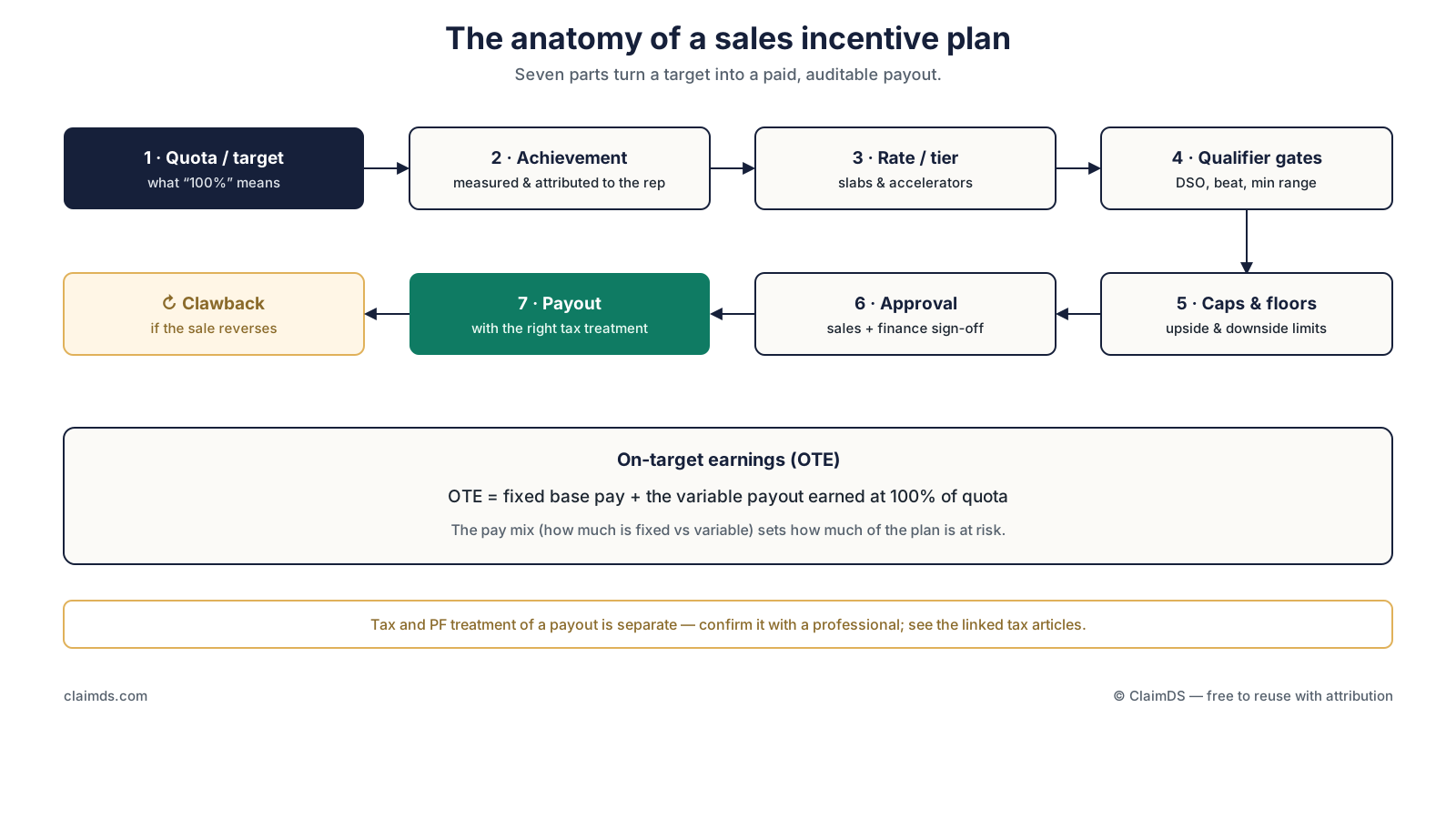
Source: ClaimDS — free to reuse with a link back to this article.
Start from the behaviour, not the formula
The most common design mistake is starting with a formula. Start instead with the behaviour you want to change: more new outlets, a richer product mix, faster collections, deeper coverage of a beat. The plan should pay most for the behaviour that matters most this year, and it should be simple enough that a salesperson can look at their own numbers mid-month and predict their payout. A plan nobody can predict does not change behaviour; it just pays out.
How do you set the quota and OTE?
Two decisions anchor the plan. The quota defines what "100%" is — the sales, volume or value a rep is expected to deliver in the period. The on-target earnings (OTE) define what they earn if they hit it: the fixed base pay plus the variable incentive payout at 100% of quota.
Inside OTE sits the pay mix — how much of the total is fixed versus variable. A high-variable mix puts more at risk and rewards over-performance harder; a high-fixed mix is steadier but moves behaviour less. The right mix depends on how much of the outcome the rep actually controls. This trade-off, and how OTE is built, is the subject of fixed vs variable pay and OTE.
What are accelerators, caps and gates?
Three levers shape the curve between quota and payout:
- Accelerators — a higher rate above a threshold (say, a richer rate beyond 100% of quota) that rewards over-performance without over-paying the base.
- Caps and floors — an upper limit that protects the budget from a windfall, and a floor that sets a minimum.
- Qualifier gates — conditions that must be met to earn at all, regardless of volume: collections (days-sales-outstanding) within terms, beat-visit compliance, a minimum range of SKUs sold. Gates are what stop a plan from rewarding volume that arrives at the cost of collections or coverage.
Used well, these keep the plan motivating and affordable at the same time.
How is the payout calculated and attributed?
Calculation is the easy half; attribution is the hard half. To pay the right person you have to credit each sale to the right rep — through a customer-to-rep mapping, a territory or beat mapping, or a rep stamp on the invoice line. At scale, across thousands of transactions, this is where spreadsheets quietly go wrong and where revenue leaks out of an incentive program. It is also why an ERP alone struggles to calculate incentives natively: it records the invoice but does not always know whose deal it was.
<!-- TODO: link "Can your ERP calculate rebates, schemes and sales incentives?" (erp-calculate) once it is out of draft. -->Once achievement is attributed and the gates and caps applied, the payout goes through approval and settlement — with a clawback rule ready for the case where a settled sale is later returned or cancelled, the same reversal discipline a rebate program needs.
What about the tax on the payout?
Keep plan design and tax treatment separate, but do not ignore the tax. Broadly, an incentive paid to your own employee is part of their salary, while a commission to an external agent or channel partner is treated differently — and the split has real consequences for TDS, GST and payroll. This article does not set out the tax; the detail, with the section references and thresholds, lives in the dedicated tax pillar, which is written to be reviewed by a chartered accountant before you rely on it.
<!-- TODO: link "TDS on commission and incentive: employee vs agent" (the 192-vs-194H pillar, #151) once it is out of draft. --> <!-- TODO: link "Is a sales incentive part of PF wages?" (#154) once it is out of draft. -->Common mistakes to avoid
- Too many metrics. If a rep is paid on six things, they optimise none. Pay on one or two that matter.
- No qualifier gates. Volume without collections or coverage is expensive volume.
- Unpredictable payouts. If a rep cannot forecast their own number, the plan does not motivate.
- Weak attribution. If you cannot reliably say whose sale it was, every payout is a dispute waiting to happen.
- No clawback. Paying on sales that later reverse turns an incentive into a leak.
Read next
- Fixed vs variable pay and OTE — how to set the pay mix.
- How to calculate sales incentives in Excel (and where it breaks) — the spreadsheet approach and its limits.
- ASM and field-force incentive structures — designing for the field hierarchy.
- Incentive management software and supplier incentive programs — the wider incentive picture.
- Rebate management — the channel-side engine that runs the same way.
- Channel-partner and sales-agent commission — the same engine for people you don't employ.
ClaimDS runs a sales incentive plan end to end — quota, attributed achievement, accelerators, gates, caps, approval, payout and clawback — in one auditable place, with the payout's tax treatment applied per payee.
<!-- TODO: confirm capability wording with founder -->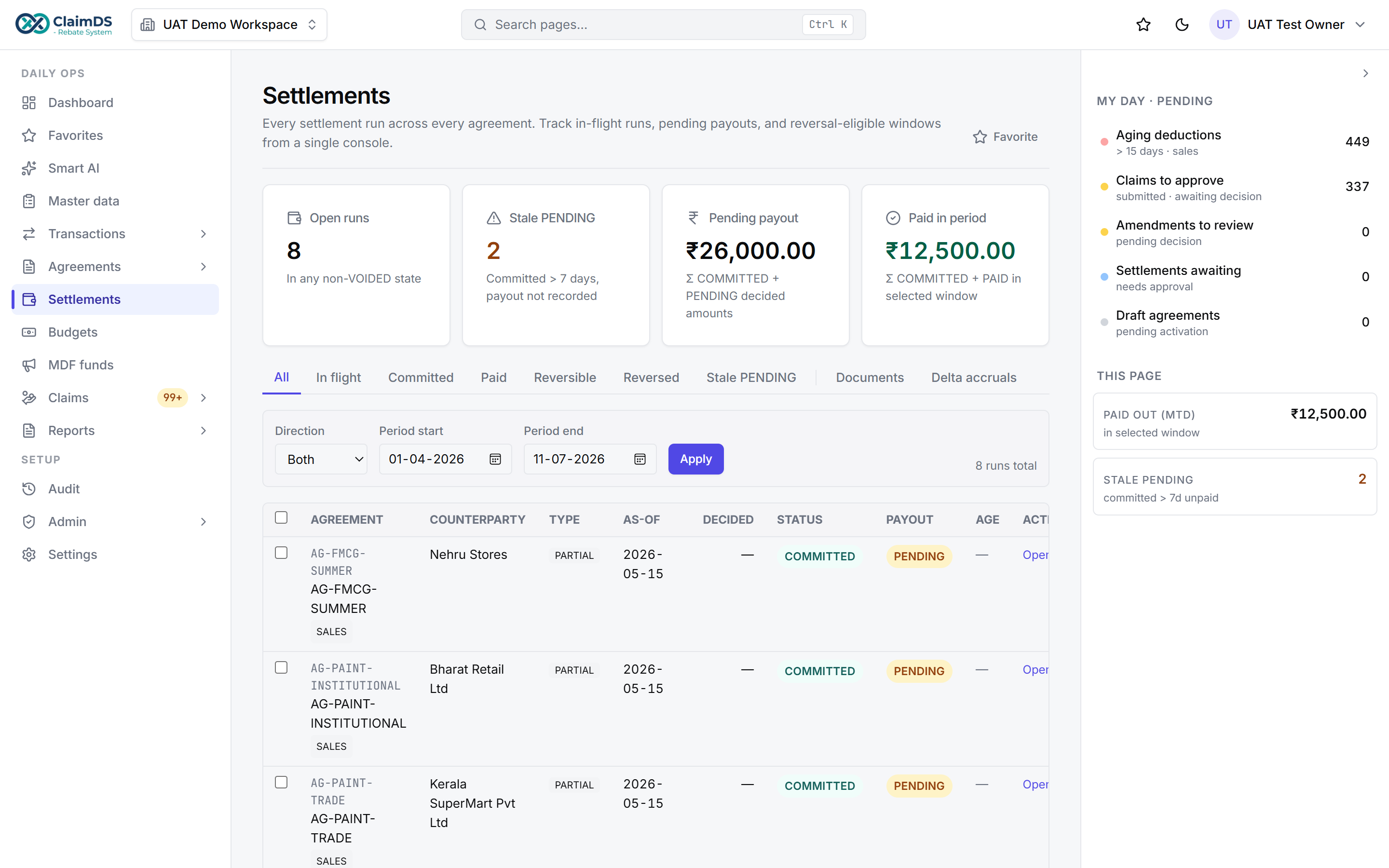
The ClaimDS settlement view — payouts calculated, approved and settled in one place.
Book a demo to see how a sales incentive plan runs on your own quotas and data.
Frequently asked questions
What is a sales incentive plan?
A sales incentive plan is the set of rules that turns a salesperson's performance into a variable payout. It defines the quota or target, how achievement is measured, the rate or tier applied, the qualifier gates that must be met, any caps and floors, and how the payout is approved and settled — including a clawback if a sale later reverses.
How do you design a sales incentive plan?
Start from the behaviour you want to reward, set a clear quota that defines 100% achievement, choose a pay mix and on-target earnings, then add the rate or tier, qualifier gates, and caps. Keep it simple enough that a rep can predict their own payout, and make sure achievement can actually be attributed to the right person from your data.
What is OTE in a sales incentive plan?
OTE, or on-target earnings, is the total a salesperson earns at 100% of quota — the fixed base pay plus the variable incentive payout earned at target. It is the headline number used to describe a role's earning potential, and the split between fixed and variable within it is the plan's pay mix.
What are accelerators and caps in an incentive plan?
An accelerator is a higher payout rate that kicks in above a threshold — for example a richer rate on sales beyond 100% of quota — to reward over-performance. A cap is an upper limit on the payout, and a floor is a minimum. Together they shape how much upside and downside the plan carries.
What are qualifier gates in a sales incentive?
Qualifier gates are conditions a salesperson must meet before an incentive is earned, regardless of sales volume — such as collections within terms, beat-visit compliance, or a minimum range of products sold. They stop the plan from rewarding volume that comes at the cost of collections, coverage or product mix.
How is a sales incentive payout attributed to the right rep?
Attribution links a sale to the person who earned the incentive, using a customer-to-rep mapping, a territory or beat mapping, or a rep stamp on the invoice line. Without reliable attribution the payout cannot be calculated correctly, which is why attribution data is usually the hardest part of running incentives at scale.
See ClaimDS on your own claims data
A 30-minute walkthrough tailored to how your channel actually settles claims.
Related posts

ASM and Field-Force Incentive Structures for Indian Distribution
How to structure incentives across a field sales hierarchy — sales officer, ASM and RSM — in Indian distribution, so each tier is paid on the right base.
How to Calculate Sales Incentives in Excel (and Where It Breaks)
A step-by-step way to calculate sales incentives in Excel — mapping, slabs, gates and payout — and the point at which a spreadsheet stops being safe to run on.
Paying C&F and DSA Partners: Commission for Carrying-and-Forwarding and Direct-Selling Agents
How carrying-and-forwarding (C&F) agents and direct-selling agents (DSA) are paid commission in India — two external partner types, clearly explained.