
Fixed vs Variable Pay and OTE in Sales Compensation
How fixed pay, variable pay and on-target earnings (OTE) fit together in a sales comp plan — the pay mix, and how to choose it for an Indian sales team.
In a sales comp plan, fixed pay is the guaranteed base, variable pay is what a rep earns by hitting targets, and on-target earnings (OTE) is the two added together at 100% of quota. The split between fixed and variable — the pay mix — decides how much of a role's earnings ride on results, and it is the single biggest lever in the plan.
OTE, fixed and variable at a glance
| Term | What it is |
|---|---|
| Fixed pay | Guaranteed base, paid regardless of performance |
| Variable pay | Earned on target achievement — the incentive |
| OTE | Fixed + variable at 100% of quota |
| Pay mix | The ratio of fixed to variable (e.g. 80/20, 50/50) |
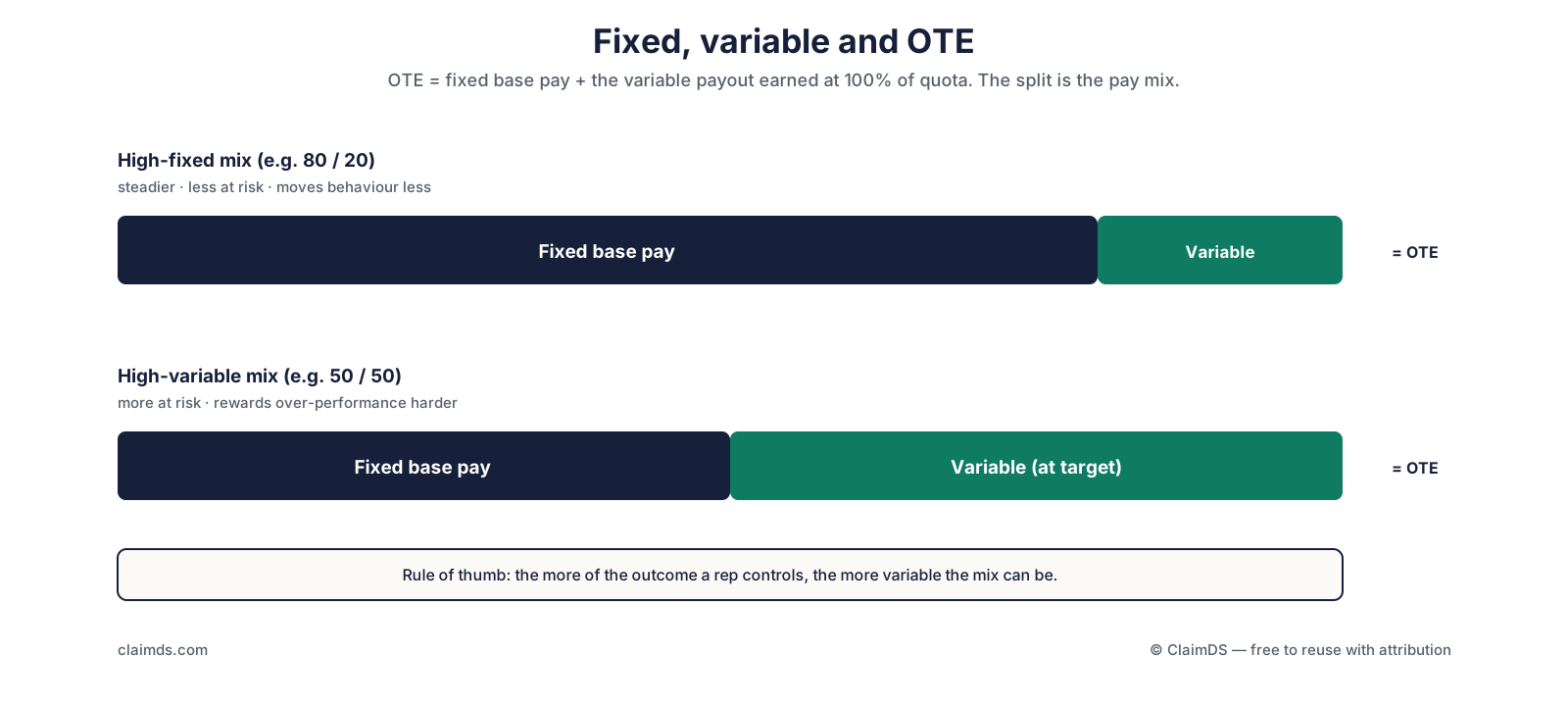
Source: ClaimDS — free to reuse with a link back to this article.
Why the pay mix is the real decision
Two roles can have the same OTE and behave completely differently, because the mix — not the total — drives behaviour. A role at 80/20 fixed-to-variable is steady; the rep earns most of their money whatever happens, so the plan nudges rather than pushes. A role at 50/50 puts half the pay on results, so it pulls hard on performance and rewards over-achievement — but it also carries more risk for the rep and more volatility for you.
How to choose the mix
The guiding question is how much of the outcome the rep actually controls. Where a salesperson personally closes the deal and directly influences the number, a higher variable share is fair and motivating. Where the outcome depends on many factors outside their control — supply, pricing, a long committee sale — a higher fixed share is more honest, because paying variable on something a rep cannot move just adds noise.
A practical way to set it: decide the OTE first (what the role should earn at target, benchmarked to the market), then split it into fixed and variable according to control. The incentive plan itself — the quota, slabs, gates and accelerators — then determines how the variable portion is actually earned.
OTE and over-performance
OTE describes earnings at target. What happens above target is set by the plan's accelerators and caps: an accelerator lets a rep earn more per unit beyond 100%, while a cap limits the total. Designing that upper curve well is what keeps a plan both motivating for top performers and affordable for finance — the balance covered in how to design a sales incentive plan.
A note on tax and PF
Whether variable pay is treated as part of salary, and how it affects provident fund, is a separate, fact-specific question that turns on how the pay is structured. This article is about the compensation design, not the tax; confirm the tax and PF treatment of your pay structure with a professional.
<!-- TODO: link "Is a sales incentive part of PF wages?" (#154) and the tax pillar (#151) once they are out of draft. -->Read next
- How to design a sales incentive plan — where the variable portion is earned.
- How to calculate sales incentives in Excel — running the numbers.
- ASM and field-force incentive structures — mixes for the field hierarchy.
- Incentive management software — the wider picture.
ClaimDS runs the variable half of the pay mix — the incentive plan — end to end, so OTE is not just a promise on an offer letter but a number the system actually computes and settles.
<!-- TODO: confirm capability wording with founder -->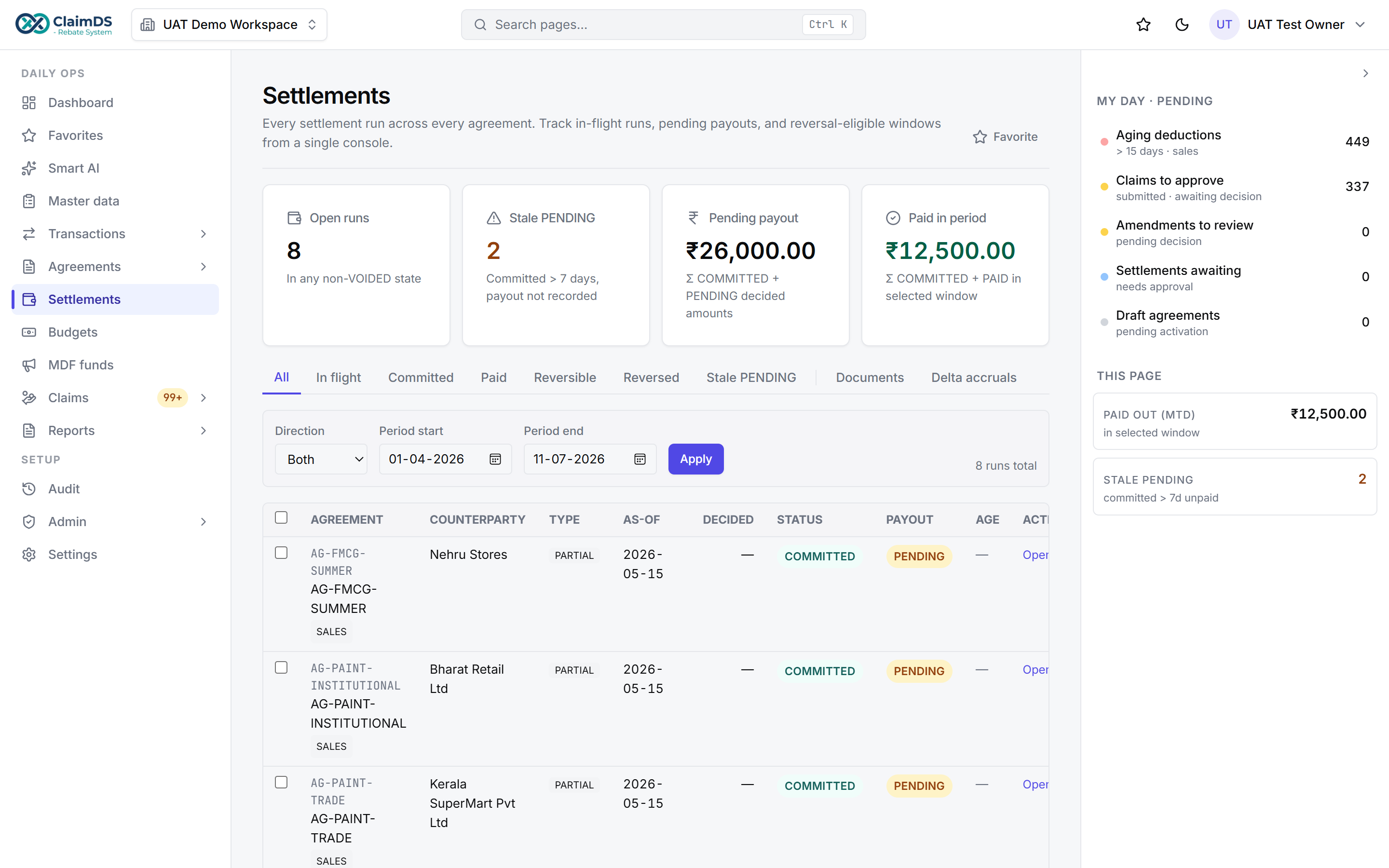
The ClaimDS settlement view — payouts calculated, approved and settled in one place.
Book a demo to see how the variable side of your pay mix is calculated and settled.
Frequently asked questions
What is the difference between fixed and variable pay?
Fixed pay is the guaranteed base a salesperson receives regardless of performance. Variable pay is the part earned by hitting targets — the incentive or commission. Fixed pay gives stability; variable pay drives behaviour. The balance between them, called the pay mix, determines how much of a role's earnings are at risk against results.
What is OTE (on-target earnings)?
OTE, or on-target earnings, is the total a salesperson earns at 100% of quota — the fixed base pay plus the variable payout earned at target. It is the headline figure used to describe a role's earning potential, and it lets you compare roles and plans on the same basis, whatever the underlying pay mix.
What is a good pay mix for a sales role?
It depends on how much of the outcome the rep controls. Roles with direct control over closing a sale often carry a higher variable share; roles where the outcome depends on many factors usually carry a higher fixed share. Common mixes range from around 80/20 fixed-to-variable to 50/50, but the right split is specific to the role.
How do you calculate OTE?
Add the annual fixed base pay to the variable payout a rep would earn at exactly 100% of quota. For example, a base of ₹6,00,000 with a variable of ₹2,00,000 at target gives an OTE of ₹8,00,000. The figures are illustrative; OTE describes earning potential at target, not guaranteed pay.
Is variable pay part of salary?
For a salesperson employed by you, variable incentive pay is generally part of their remuneration. How it is treated for tax and for provident fund depends on how it is structured and is a fact-specific question — so confirm the tax and PF treatment with a professional rather than assuming it from the pay label.
See ClaimDS on your own claims data
A 30-minute walkthrough tailored to how your channel actually settles claims.
Related posts

ASM and Field-Force Incentive Structures for Indian Distribution
How to structure incentives across a field sales hierarchy — sales officer, ASM and RSM — in Indian distribution, so each tier is paid on the right base.
How to Calculate Sales Incentives in Excel (and Where It Breaks)
A step-by-step way to calculate sales incentives in Excel — mapping, slabs, gates and payout — and the point at which a spreadsheet stops being safe to run on.
Paying C&F and DSA Partners: Commission for Carrying-and-Forwarding and Direct-Selling Agents
How carrying-and-forwarding (C&F) agents and direct-selling agents (DSA) are paid commission in India — two external partner types, clearly explained.