Valid vs Invalid Trade Deductions: How to Tell Them Apart and Recover What You're Owed
When a customer short-pays an invoice, is the deduction valid or should you dispute it? How to classify trade deductions and recover the invalid ones.
In short
A trade deduction is valid when it maps to an agreement both sides made — an approved scheme, a documented return, an agreed allowance — with amount, period and proof lining up. It is invalid when it doesn't: a promotion never agreed, a return without proof, a duplicate, or a baseless penalty. The test: does it map to an agreement?
When a customer short-pays an invoice, the first question is not "how do we get the money back" — it's "should we?" Some deductions are the customer correctly settling something you owe; others are money withheld with no basis. Telling them apart quickly, and recovering the invalid ones before they age into write-offs, is the core of deduction management. This article gives you the test and the workflow.
How to classify a deduction at a glance
| Deduction type | Usually valid when… | Usually invalid when… |
|---|---|---|
| Scheme / promotion | Maps to an approved scheme, correct rate + period | No scheme agreed, or rate/period doesn't match |
| Return (damage / expiry) | Documented, authorised, proof attached | No proof, no authorisation, or double-counted |
| Price / rate difference | A price-protection or contracted-price clause covers it | No clause, or claimed beyond the agreed price |
| Shortage / non-delivery | Proof of short receipt against the dispatch | No proof, or goods were actually delivered |
| Compliance / penalty | A contract clause sets the penalty and it's triggered | No contractual basis for the penalty |
| Freight / logistics | An agreed freight term makes it the seller's cost | No agreed term, or already built into the price |
| Duplicate / unexplained | (rarely valid) | Already deducted once, or no reason code at all |
The table is the shortcut; the rest of this article is the reasoning behind it.
What is a trade deduction?
A trade deduction is when a customer — usually organised or modern trade, sometimes a distributor down the primary-secondary-tertiary chain — pays less than the invoiced amount, taking off a sum for a promotion, a return, a shortage or a penalty. The short-payment arrives with (or without) a reason, and it lands on your accounts-receivable ledger as an open difference to resolve.
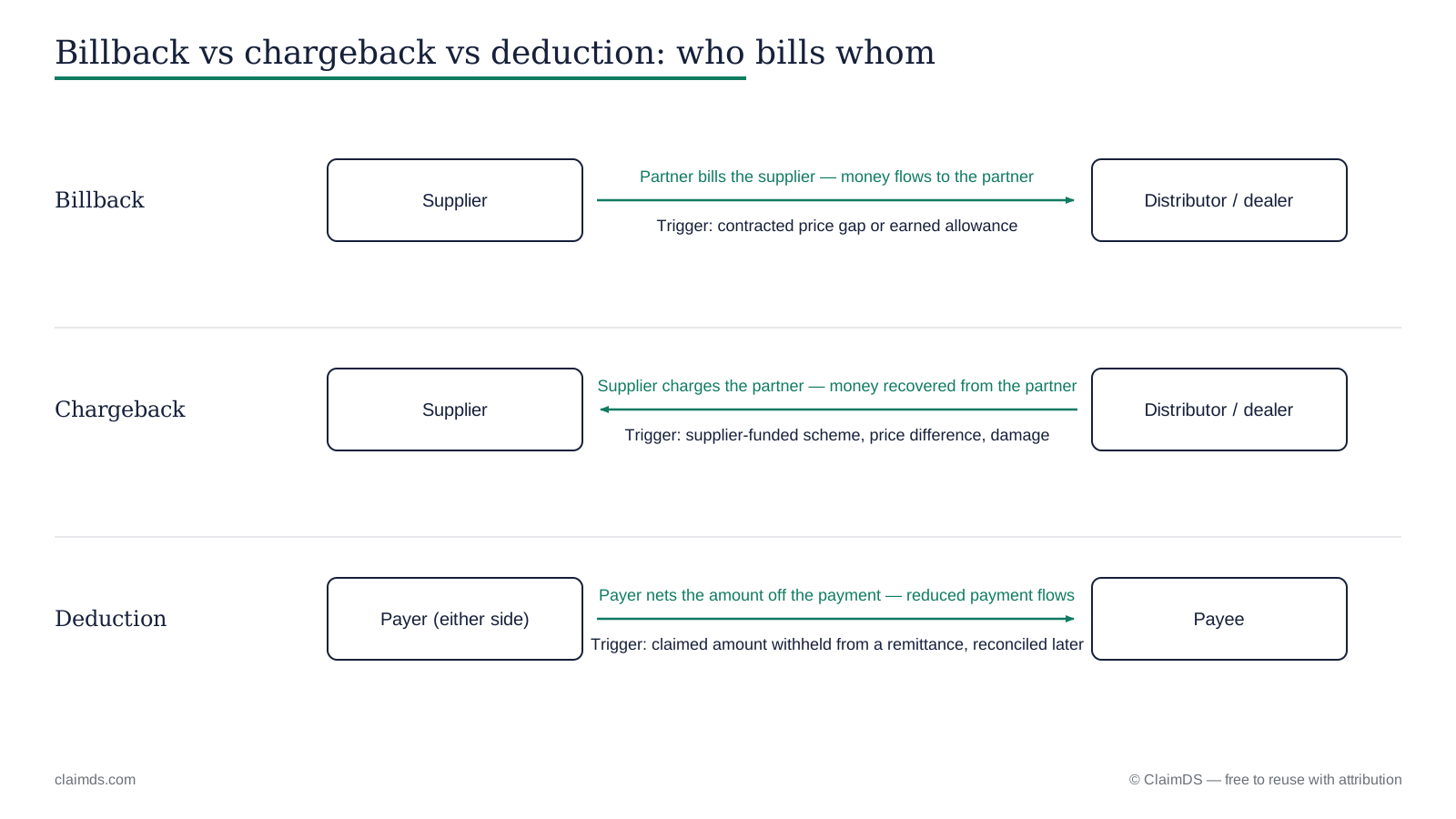
One disambiguation up front: in distribution this short-payment is sometimes loosely called a "chargeback," but that is not a card-payment chargeback (where a cardholder reverses a transaction through their bank). Throughout this article, "chargeback" and "deduction" mean a short-payment on a trade invoice — the sense used in the billbacks, chargebacks and deductions glossary. It is also the opposite direction from a rebate: a rebate is money owed to you and claimed; a deduction is money withheld from you.
Deductions are not inherently a problem — a valid one is just the customer settling something you agreed to. The problem is the ones that shouldn't have been taken, and the fact that separating the two is real work. That work is what deduction management exists to organise, and it overlaps heavily with billbacks and channel claims.
What makes a deduction valid?
A deduction is valid when it maps to a specific agreement the two sides actually made, and the details line up. Concretely, all of these hold:
- There is a matching agreement — an approved scheme with terms, a documented and authorised return, an agreed allowance, or a price-protection clause.
- The amount matches the agreed rate or the documented loss.
- The period matches — the deduction falls in the window the agreement covers.
- The proof exists — the scheme circular, the return authorisation, the short-receipt note.
A few illustrative examples (illustrative only):
- A distributor deducts a festival scheme at the rate in the approved scheme circular, for sales in the scheme period — the kind of FMCG distributor claim that maps cleanly to terms. Valid — it maps to the agreement.
- A retailer deducts for expired stock, with an authorised return note and quantities that match. Valid — documented and authorised.
- A buyer deducts a price difference covered by a price-protection clause after a price drop. Valid — the clause is the agreement.
When a deduction is valid, the right action is to accept and book it — often as trade spend against the scheme's budget. Disputing a valid deduction just burns goodwill and your team's time.
What makes a deduction invalid?
A deduction is invalid when it fails the mapping test. The common patterns:
- No matching agreement — a promotion the customer applied that was never agreed.
- Amount exceeds the agreed rate — the scheme was 3%, the deduction is 5% (illustrative).
- Duplicate — the same deduction already taken in a prior payment.
- Return with no proof or authorisation — a damage claim with no return note.
- Penalty with no contractual basis — a fine the contract does not provide for.
- Wrong period — a deduction booked against a scheme window it doesn't fall in.
Crucially, invalid rarely means fraudulent. Most invalid deductions are error — a scheme keyed at the wrong rate, a return counted twice, a promotion the customer genuinely believed was agreed. Treating them as disputes to resolve rather than accusations is not just courtesy; it recovers the money faster and keeps the account intact. Reserve the assumption of bad faith for the rare cases that earn it.
How to classify a deduction quickly
When a short-payment lands, run it through a fixed sequence rather than treating each as a fresh puzzle:
- What reason code is claimed? Scheme, return, shortage, price difference, penalty, freight — or none. A missing reason is itself a signal.
- Is there an agreement it maps to? Find the scheme, the return authorisation, the contract clause. No agreement is the single strongest invalid signal.
- Does the amount match the agreed terms? Compare the deducted amount against the agreed rate or the documented loss.
- Has it been claimed before? Check for a duplicate against prior deductions on the same reference.
- Is the supporting document present? The circular, the return note, the short-receipt proof.
Answer those five and the classification is usually obvious. What makes this fast at volume is a consistent reason-code taxonomy — everyone coding deductions the same way — so the same short-payment is never argued about twice. A deduction that arrives with a clean reason code and maps to a recorded agreement can be validated in minutes; one with neither is where the time goes.
Recovering invalid deductions
Once a deduction is classified invalid, recovery is a workflow, not a one-off argument:
- Flag it against its reason code as disputed.
- Assemble the evidence — the absence of an agreement, the rate mismatch, the duplicate reference.
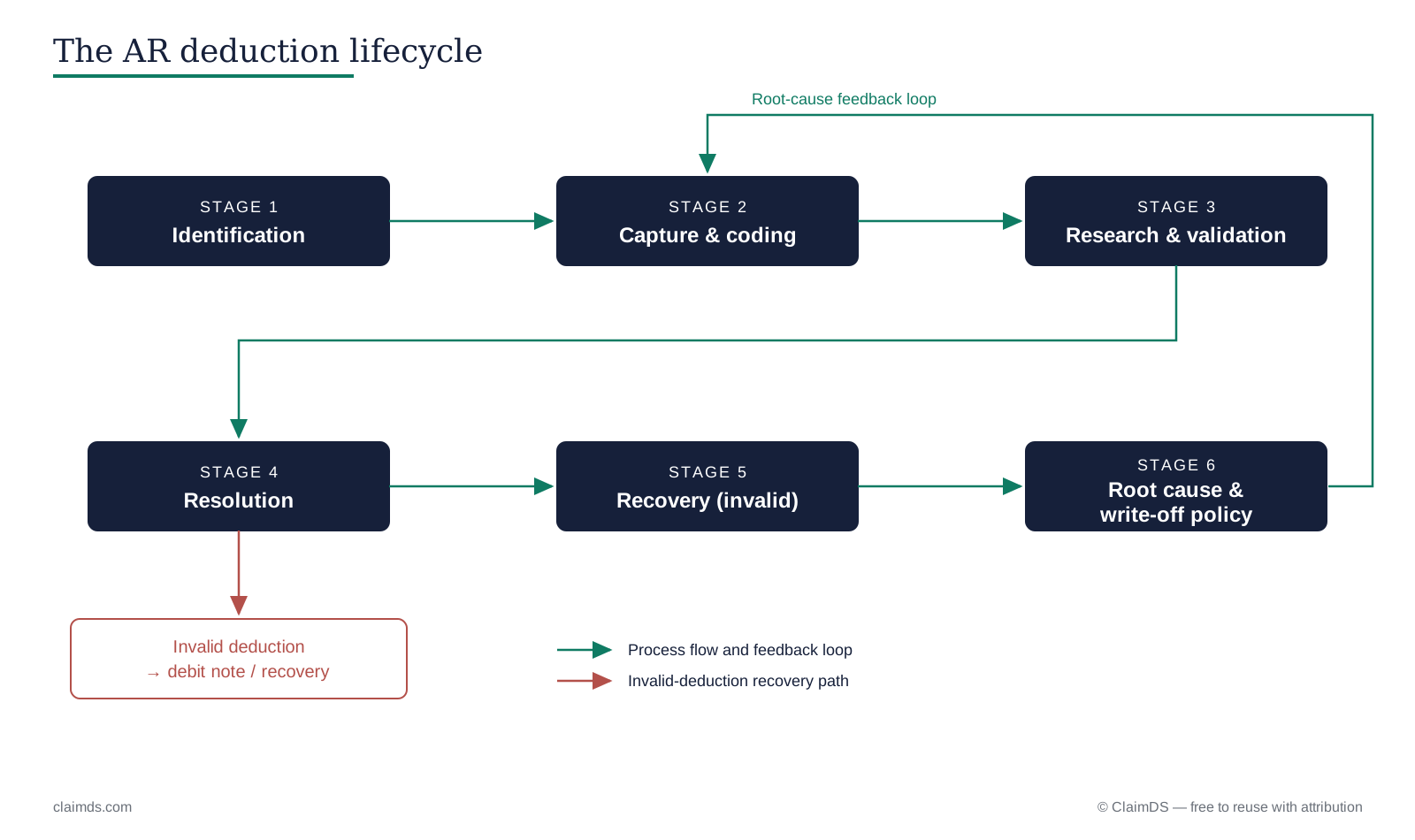
- Raise it with the customer as a documented query, not an accusation — the chargeback / deduction dispute process is mostly this step done consistently; most resolve once the customer sees there's no matching agreement.
- Track to resolution within an SLA, so it doesn't age silently.
- Write off only as a last, recorded decision — never by default because it aged out. A maker-checker control on that decision keeps write-offs honest.
The honest truth about invalid-deduction recovery is that the biggest leakage isn't lost arguments — it's the deductions nobody ever challenged because no one had the time before they aged past the point of raising them. That is exactly the revenue leakage a channel-finance team is fighting, and it's why the CFO view of claims and deductions treats un-worked deductions as a cash problem, not an admin one. ClaimDS is built to hold the agreements a deduction is validated against and to keep disputed deductions moving to resolution instead of ageing on a spreadsheet. <!-- TODO: confirm capability wording with founder -->
Where a return or price difference behind a deduction has a GST dimension, that is a credit-note question — see credit notes for expired, damaged and returned goods and financial vs tax credit notes — and this article takes no tax position on it. Deductions are one half of the channel-claims picture; the other is the claims you raise, and both belong in the same deduction-and-claims workflow.
Valid or invalid, the deciding question never changes: does this short-payment map to an agreement you actually made? Answer that consistently, recover the ones that don't, and the deduction wedge stops quietly draining margin.
This article is general information about commercial practice, not legal, tax or accounting advice. Where a deduction, return or credit note has GST or contractual consequences, confirm the treatment for your business with a qualified professional.
Frequently asked questions
What is a valid trade deduction?
A valid trade deduction is a short-payment that maps to an agreement both sides made — an approved scheme with terms, a documented and authorised return, an agreed allowance, or a price-protection clause — where the amount matches the agreed rate, the period matches, and the proof exists. If all of those line up, the deduction is the customer settling something you genuinely owe: accept and book it.
What is an invalid deduction?
An invalid deduction is a short-payment with no matching agreement, or one where the amount exceeds the agreed rate, duplicates a deduction already taken, cites a return with no proof, applies a penalty with no contractual basis, or is booked in the wrong period. Invalid does not mean fraudulent — it is usually error — but it is money withheld that you have a basis to dispute and recover.
How do you recover an invalid deduction?
Flag it against a reason code, gather the evidence that shows no agreement or an overcharge, raise it with the customer as a documented query rather than an accusation, and track it to resolution within an SLA. Write it off only as a last, recorded decision. The largest leakage is invalid deductions nobody challenged because no one had the time — so the recovery discipline matters more than the argument.
What is the difference between a deduction and a chargeback?
In distribution, a deduction (sometimes loosely called a chargeback) is a customer short-paying your invoice — withholding money they say they are owed for a scheme, return or shortage. This is different from a card-payment chargeback, where a cardholder reverses a transaction through their bank. This article is about the distribution sense: a short-payment on a trade invoice, not a card dispute.
Are invalid deductions the same as fraud?
No. Most invalid deductions are error — a scheme applied at the wrong rate, a return double-counted, a promotion the customer thought was agreed but wasn't. Treating them as disputes to resolve, not accusations, keeps the relationship intact and usually recovers the money faster. Genuine bad faith exists but is the exception; assuming it by default damages accounts you want to keep.
How do you prevent invalid deductions?
Agree schemes in writing with clear terms and periods, share those terms with the customer, use a consistent reason-code taxonomy so every deduction is classified the same way, and validate each short-payment against the agreement before it ages. Prevention is mostly upstream discipline — a deduction that maps cleanly to a recorded agreement is far less likely to be raised wrongly in the first place.
See ClaimDS on your own claims data
A 30-minute walkthrough tailored to how your channel actually settles claims.
Related posts
Deduction Management: Who Owns What, and Why It Matters
Who owns deduction resolution — finance, sales or claims-ops? How to split the work so deductions get resolved instead of ageing on a spreadsheet.
What Is a Price Waterfall? From Published Price to Net-Net Margin
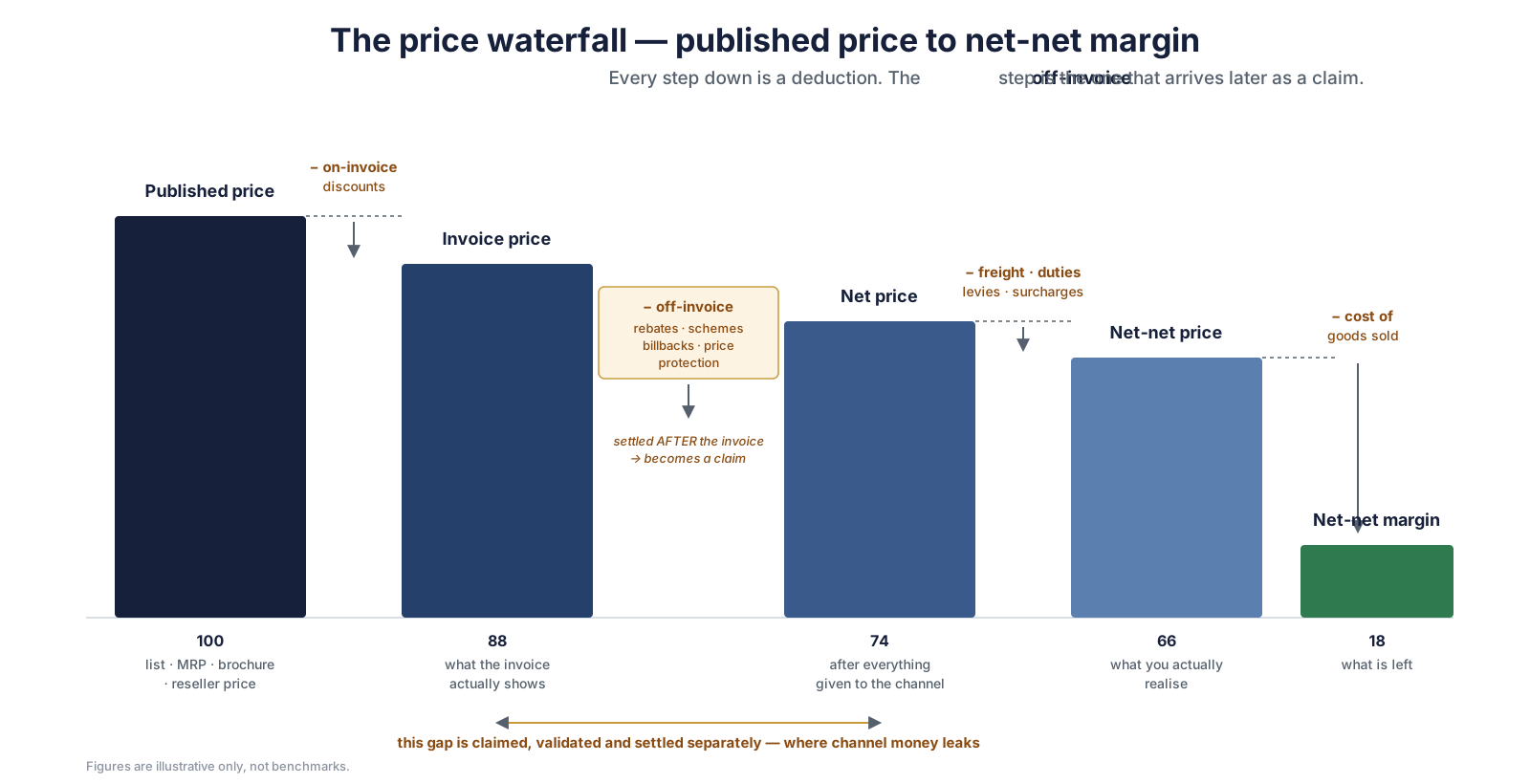
Every deduction between the price you publish and the money you keep — and why the step in the middle arrives later as a channel claim.

Is a Rebate a Discount? Rebate vs Discount vs Scheme
A rebate and a discount both reduce what a buyer pays, but they work differently and are treated differently in the books. The clear difference for Indian businesses.