What Is a Price Waterfall? From Published Price to Net-Net Margin
Every deduction between the price you publish and the money you keep — and why the step in the middle arrives later as a channel claim.
In short
A price waterfall is the sequence of deductions between the price you publish and the money you actually keep. Published price minus on-invoice discounts gives the invoice price; minus off-invoice settlements gives the net price; minus freight, duties and levies gives net-net; minus cost of goods leaves margin. Each step is a different kind of paperwork.
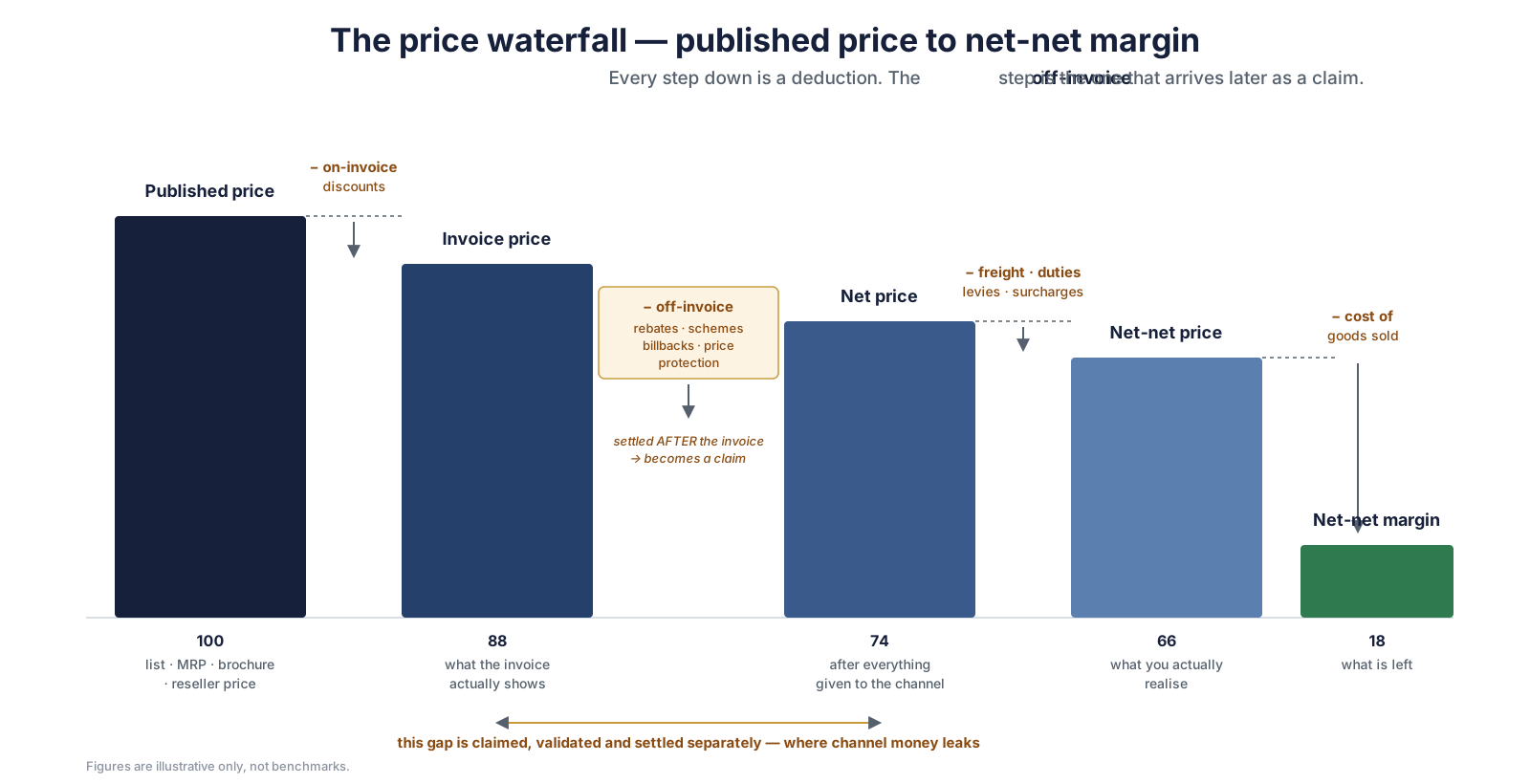
Most pricing conversations happen at the top of the waterfall and most margin problems happen further down. A commercial team agrees a list price and a headline discount; months later finance discovers what the account actually realised after every trade scheme, billback and freight cost landed. The price waterfall is the tool that puts both views on the same page.
What are the steps in a price waterfall?
Read the table top to bottom. Each row is a different mechanism with different paperwork — that is the whole point of separating them.
| Step | What it is | How it is applied | What it leaves you with |
|---|---|---|---|
| Published price | List price, MRP, brochure or reseller price | Printed or published before any negotiation | The reference everything else is measured from |
| − On-invoice discounts | Trade, volume or early-payment discounts known at the time of sale | Deducted on the invoice itself | Invoice price — what the document shows |
| − Off-invoice settlements | Trade rebates, secondary schemes, billbacks, price protection, display allowances | Claimed and settled after the invoice | Net price — after everything given to the channel |
| − Freight, duties, levies, surcharges | Costs attached to delivering and clearing the goods | Absorbed or recovered, depending on terms | Net-net price — what you realise |
| − Cost of goods sold | The cost of the product itself | From the costing system | Net-net margin — what is left |
Two of these steps are easy and two are not. On-invoice discounts and cost of goods are known when the transaction happens. Off-invoice settlements and, often, the true freight and duty burden are known later — which is why the bottom of the waterfall is usually an estimate for weeks after the sale.
Why is the off-invoice step different from every other step?
Because it is the only step where the money is agreed at one time, earned over a period, and settled at a third time.
An on-invoice discount is finished the moment the invoice prints. An off-invoice settlement — a trade rebate on a volume target, a secondary scheme, a rate difference, a price protection adjustment — is a promise at the point of sale and a liability until it is settled. Somebody has to establish that the target was met, agree the amount, produce evidence, and settle it. In an Indian distribution channel that means a distributor or dealer claim, and claims behave differently from deductions:
- They arrive after the period they relate to, so the accounting period that earned the cost is not the one that pays it.
- They arrive as someone else's calculation, which may not match yours.
- They can be partially approved, disputed, or lost entirely.
- Until they land, the net price in your reports is an estimate.
This is why the same commercial deal looks profitable in a sales review and marginal in a year-end reconciliation. Nothing was misreported; the waterfall simply had not finished falling. Our guide to calculating FMCG distributor claims walks through what that arithmetic looks like in practice, and deduction management covers what happens when the counterparty deducts before you have agreed.
What sits at the top — published or negotiated price?
Both, in sequence. The published price is what you put in a price list, a brochure or on a pack; the negotiated price is what a particular buyer actually gets before any scheme.
In India the top of the waterfall carries a wrinkle that imported pricing material tends to miss: MRP is a maximum, not a reference. A Western list price is a starting point for negotiation, whereas MRP is a ceiling the brand sets on retail. Both can sit at the top of a waterfall, but they commit you to different things. Published prices — list, MRP, brochure and reseller price covers that distinction, and contracted, customer-specific and grade pricing covers the negotiated prices that replace the published one for a particular buyer or contract.
Where a price comes from a situation rather than a list — the last invoice, a competitor's offer, a tactical push — it still belongs in the waterfall, but it needs an end date. Situational pricing explains why an undated concession quietly becomes the standard price.
Where does tax fit in the waterfall?
Tax is not a step in the margin waterfall, but which step a deduction sits in changes how it is taxed — and that is the part most pricing material skips.
Under Indian GST, a discount shown on the invoice is treated differently from a discount given after the supply has happened. A post-supply reduction affects taxable value only where the statutory conditions are met; otherwise it is settled commercially without a GST adjustment. The relevant provisions are Section 15(3) and Section 34, and we treat them in depth elsewhere rather than restating them here — see Section 15(3)(b) and post-supply discounts, CBIC Circular 251, financial versus tax credit notes and ITC reversal on post-sale discounts. <!-- TODO VERIFY AT PUBLISH + CA REVIEW: statutory framing of on-invoice vs post-supply discount treatment; assert no position beyond routing to the existing articles. -->
It is worth noting for readers working from international sources that GST is not the same animal as a US sales tax, a European VAT or a Canadian HST in how it interacts with channel incentives. The mechanics of input credit, and the documentation that has to accompany a post-sale reduction, are specific to the Indian regime — so a price waterfall template built for a US channel will not carry its tax logic across intact.
The practical consequence for the waterfall is simple: the off-invoice step is not just harder to forecast, it is harder to document. That is why on-invoice versus off-invoice discounts is the article to read next if you take only one from this cluster.
How does the waterfall differ by industry?
The steps are the same; their relative size and the evidence each needs are not.
| Industry | The dominant off-invoice step | What makes the evidence hard |
|---|---|---|
| FMCG | Secondary schemes on sell-out, not sell-in | Requires distributor secondary-sales data, not just your invoices |
| Pharma | Expiry, breakage and returns alongside trade schemes | Batch and expiry traceability at the point of claim |
| Automotive | Dealer rate difference and warranty-linked claims | Matching a claim to a specific VIN, part or campaign |
| Paints and building materials | Rate difference on frequent price revisions, plus damage | Establishing the stock position on the date a price changed |
| Agrochemicals | Seasonal schemes and season-end returns | Liquidation evidence over a season, not a month |
| Consumer electronics | Price protection on falling prices | Stock-in-hand at the moment of a price drop |
| Steel, chemicals and commodities | Grade and quantity differences | Grade captured on the invoice so a claim can be verified |
The pattern across all of them: the further the money moves from your own invoice, the more the claim depends on data you do not own. That is why primary, secondary and tertiary sales is a prerequisite for reading any waterfall in a multi-tier channel.
How does the waterfall differ by counterparty type?
Who you are settling with changes the shape of the deductions more than most pricing models allow for.
- Distributor — buys and resells on own account, so schemes are earned on their onward sales. The off-invoice step is the largest and the evidence sits in their system.
- Dealer or retailer — usually a narrower set of schemes, often rate difference and display allowances, settled against your own invoices.
- C&F or CFA agent — holds stock without buying it, so what looks like a discount may be a service fee. The distinction matters for both tax and margin attribution.
- Institutional or OEM buyer — contracted or customer-specific price replaces the published price entirely, and the recurring risk is a billed price drifting from the agreed one.
- Modern trade and e-commerce — listing fees, visibility allowances and marketplace deductions arrive as debits against your account rather than as claims you receive.
Where the counterparty deducts first and explains later, the waterfall stops being a planning tool and becomes a reconciliation exercise — see billbacks, chargebacks and deductions for how those three differ in direction, and consumer promotions versus trade promotions for which spend belongs in this waterfall at all.
How do you keep a waterfall honest?
The waterfall is only as good as the accrual behind its off-invoice step. Three disciplines make the difference:
Record the entitlement when the deal is agreed, not when the claim arrives. A scheme that exists only in an email is a liability nobody has measured. Rebate accounting covers estimating and accruing what will be earned.
Keep one authoritative record of the agreed terms. Most rate-difference disputes are not disagreements about entitlement; they are two parties reading different versions of the same scheme. See price protection and rate-difference credit notes.
Review the net-net number before agreeing the next scheme. If a scheme is renewed on the strength of a list-price margin, the waterfall never gets a chance to inform the decision.
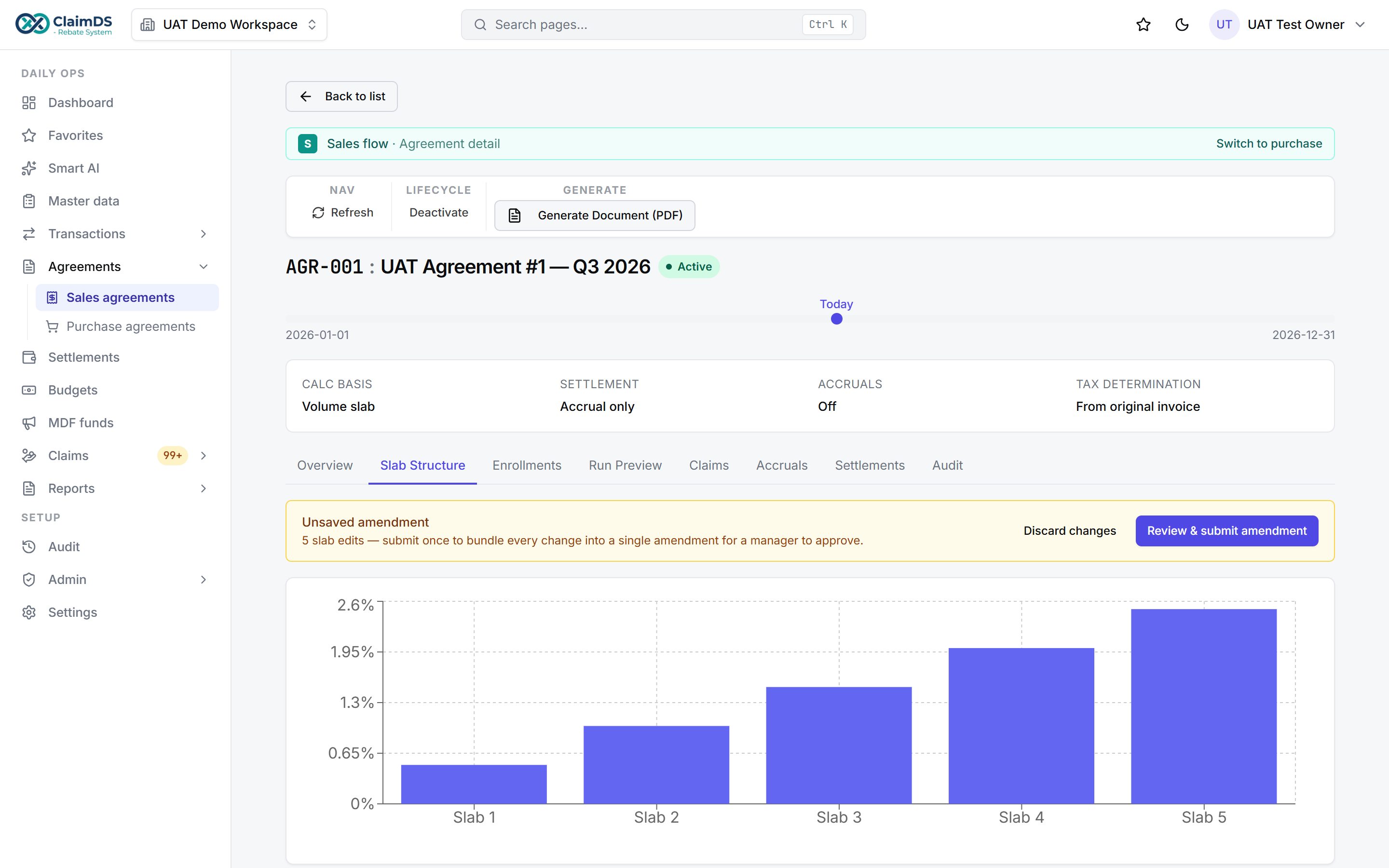
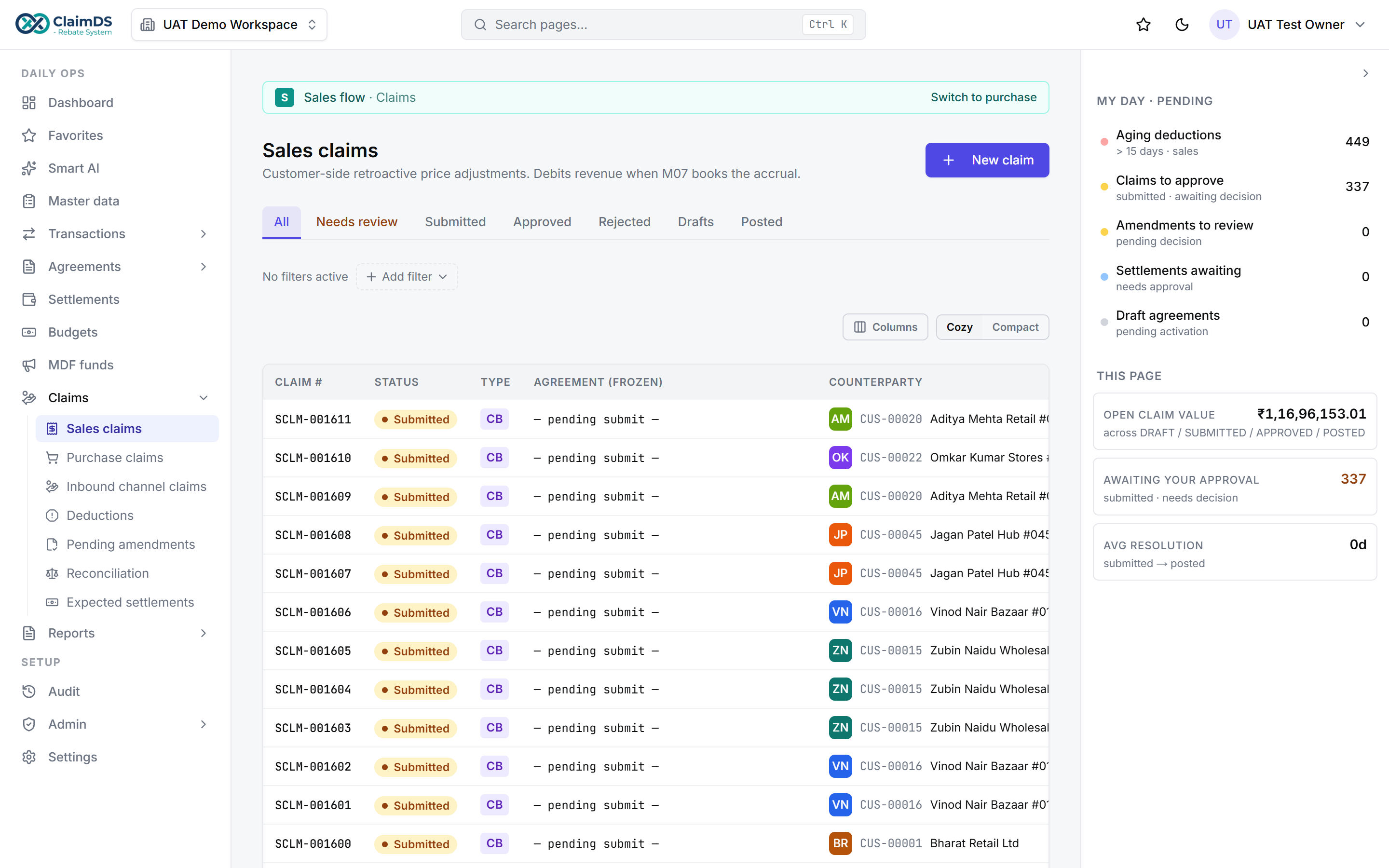
ClaimDS is built around that middle step — holding the agreed scheme terms, validating claims against them, and settling with the evidence attached, so the net-net number is derived rather than estimated. <!-- TODO FOUNDER CONFIRM: capability sentence — confirm scope wording matches shipped functionality before publish. -->
Where the arithmetic in this article is illustrative, it is labelled illustrative — the figures in the diagram are there to show the shape of a waterfall, not to suggest a benchmark for any industry.
If you want the single distinction that drives everything below the invoice line, read on-invoice versus off-invoice discounts next. If you want the vocabulary first, what is a rebate and is a rebate a discount are the shortest routes in.
This article is general information about commercial and accounting practice, not tax, legal or compliance advice. Tax treatment depends on facts and on current law — confirm the position for your business with a qualified professional.
Frequently asked questions
What is a price waterfall?
A price waterfall is the step-by-step view of every deduction between a published price and the net-net margin a seller finally keeps. It starts at list price or MRP, subtracts on-invoice discounts to reach the invoice price, subtracts off-invoice settlements such as trade rebates and schemes to reach the net price, subtracts freight, duties and levies to reach net-net, and subtracts cost of goods to leave margin.
Why is it called a waterfall?
Because the value falls in visible steps rather than in one drop. Drawn as a chart, each deduction takes the bar down a level, and the shape shows where the value went. The point of the picture is that no single number explains the gap between your list price and your realised price — several separate mechanisms do, and each one is documented differently.
What is the difference between net price and net-net price?
Net price is what remains after everything you have given the buyer — on-invoice discounts plus off-invoice settlements such as trade rebates, schemes and billbacks. Net-net price goes further and also removes costs attached to serving that sale, such as freight, duties, levies and surcharges. Net price answers what did I sell it for; net-net answers what did I actually realise.
Where do channel claims sit in the price waterfall?
In the off-invoice step, between invoice price and net price. That is the only step where the money is agreed at one time, earned over a period and settled afterwards, so it has to be claimed, validated and reconciled rather than simply deducted on a document. It is also where most disputes and unrecorded liabilities in a distribution channel accumulate.
Why does the gap between list price and net price matter?
Because decisions get made on the wrong number. A commercial team that reviews list price and volume can approve business that loses money once the off-invoice settlements land, since those arrive weeks or months later as claims. Reviewing the net-net number instead shows what the account is really worth before the next scheme is agreed.
Is a trade discount part of the price waterfall?
Yes. A trade discount known at the time of sale is an on-invoice step — it comes off the invoice itself, so the invoice already shows the reduced price. That makes it the simplest step in the waterfall, because there is nothing left to claim or reconcile afterwards.
Does GST apply to every step of the price waterfall?
Not in the same way. A discount shown on the invoice and a discount given after the supply are treated differently under Indian GST, and a post-supply reduction only affects taxable value where the statutory conditions are met. The treatment turns on which step of the waterfall the deduction sits in, which is why the on-invoice and off-invoice distinction matters beyond accounting.
See ClaimDS on your own claims data
A 30-minute walkthrough tailored to how your channel actually settles claims.
Related posts

Is a Rebate a Discount? Rebate vs Discount vs Scheme
A rebate and a discount both reduce what a buyer pays, but they work differently and are treated differently in the books. The clear difference for Indian businesses.
Supplier and Purchase Rebates in Agri-Inputs
How Indian agri-input makers treat money from raw-material and packaging suppliers — turnover and cash discounts under Ind AS 2 and GST credit notes.
Supplier and Purchase Rebates in Automotive
How Indian automotive treats money received from component and material suppliers — turnover and cash discounts under Ind AS 2 and GST credit notes.