On-Invoice vs Off-Invoice Discounts: Why the Difference Decides Everything
A discount on the invoice and one settled afterwards can cost the same — but they behave very differently in the books and under GST.
In short
An on-invoice discount is deducted on the invoice itself, so the invoice shows the reduced price and the transaction is complete. An off-invoice discount is settled after the invoice — through a trade rebate, scheme payout, billback or credit note. The money can be identical; the accounting, the paperwork and the GST treatment are not.
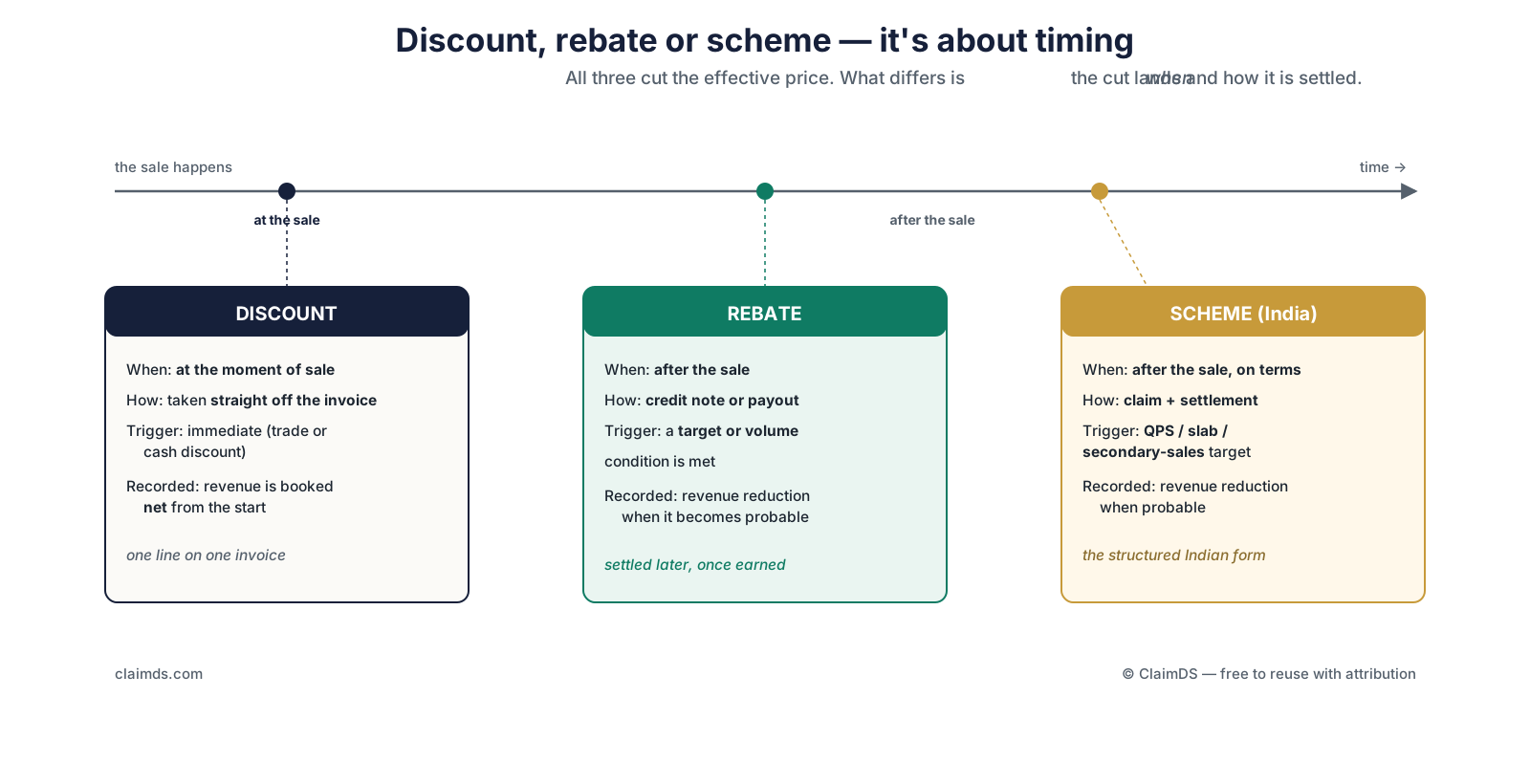
Two suppliers give a distributor the same ₹4 on a ₹100 product. One takes it off the invoice; the other pays it as a quarterly scheme. The distributor's bank balance ends up in the same place. Almost nothing else does — not the invoice, not the revenue entry, not the paperwork, and not necessarily the tax.
On-invoice vs off-invoice at a glance
| On-invoice | Off-invoice | |
|---|---|---|
| When it is applied | At the time of sale | After the invoice, once entitlement is established |
| What the invoice shows | The reduced price | The full price |
| How it is settled | Nothing to settle — it is already deducted | Claim, then credit note or payout |
| Typical examples | Trade discount, volume discount known at order, agreed early-payment terms, package or bundle discount | Trade rebate on a target, secondary scheme, billback, display allowance, price protection |
| How the seller records it | Revenue recognised net from the start | Estimated and accrued, then trued up on settlement |
| How the buyer records it | Purchase recorded at the net price | Receivable or income recognised when entitlement is reasonably certain |
| Documentation required | The invoice itself | Agreement, evidence of performance, claim, credit note |
| What can go wrong | Little — the amount is closed at the point of sale | Disputed entitlement, stale accruals, unclaimed money, mismatched credit notes |
Read the last row twice. It is the whole argument of this article: an on-invoice discount finishes, and an off-invoice discount begins a process.
What counts as an on-invoice discount?
An on-invoice discount is any reduction whose amount is known and applied when the invoice is raised. The common forms:
- Trade discount — the standard reduction off list price for a class of buyer, reflecting their role in the channel.
- Volume or quantity discount known at the time of sale — the order itself qualifies, so the discount applies to that invoice rather than to a period.
- Cash or early-payment discount agreed upfront — where the terms are set before the invoice and reflected on it.
- Package, group or bundle discount — a reduced price for buying a defined combination together.
- Demo, display-model or EDI-order discounts — where these are agreed at order and applied on the document.
The defining feature is timing, not size. A ₹4 trade discount and a ₹4 trade rebate are the same money; the trade discount is on-invoice because nobody has to prove anything afterwards for it to be earned. If the vocabulary itself is the question, what is a rebate sets out how rebates, discounts and schemes relate.
That is what makes it operationally cheap. There is no claim to raise, no evidence to gather, no accrual to carry, and no credit note to match. The invoice is the complete record of the transaction. For a supplier who wants to reduce the administrative weight of a channel, moving spend from off-invoice to on-invoice is the most direct lever available — at the cost of the flexibility discussed below.
What counts as an off-invoice discount?
An off-invoice discount is one where entitlement is established after the invoice is raised. The invoice goes out at the full price and the reduction is settled later, on evidence.
- Trade rebates and target-based schemes — earned by hitting a volume, value or growth target over a defined period.
- Secondary schemes — funded on what the distributor sells onward, not on what they bought. See primary, secondary and tertiary sales.
- Billbacks — the partner sells at an agreed lower price and bills the supplier for the difference. See what is a billback.
- Display and visibility allowances — paid for shelf position, in-store presence or a display commitment, usually against proof of performance.
- Price protection and rate difference — compensating a partner holding stock when the price falls, or settling the gap between the billed and agreed price. See price protection in sales and price protection and rate-difference credit notes.
- Quantity discounts earned only after a period closes — the same mechanism as a volume discount, but measured retrospectively, which moves it off-invoice. See QPS — quantity purchase schemes.
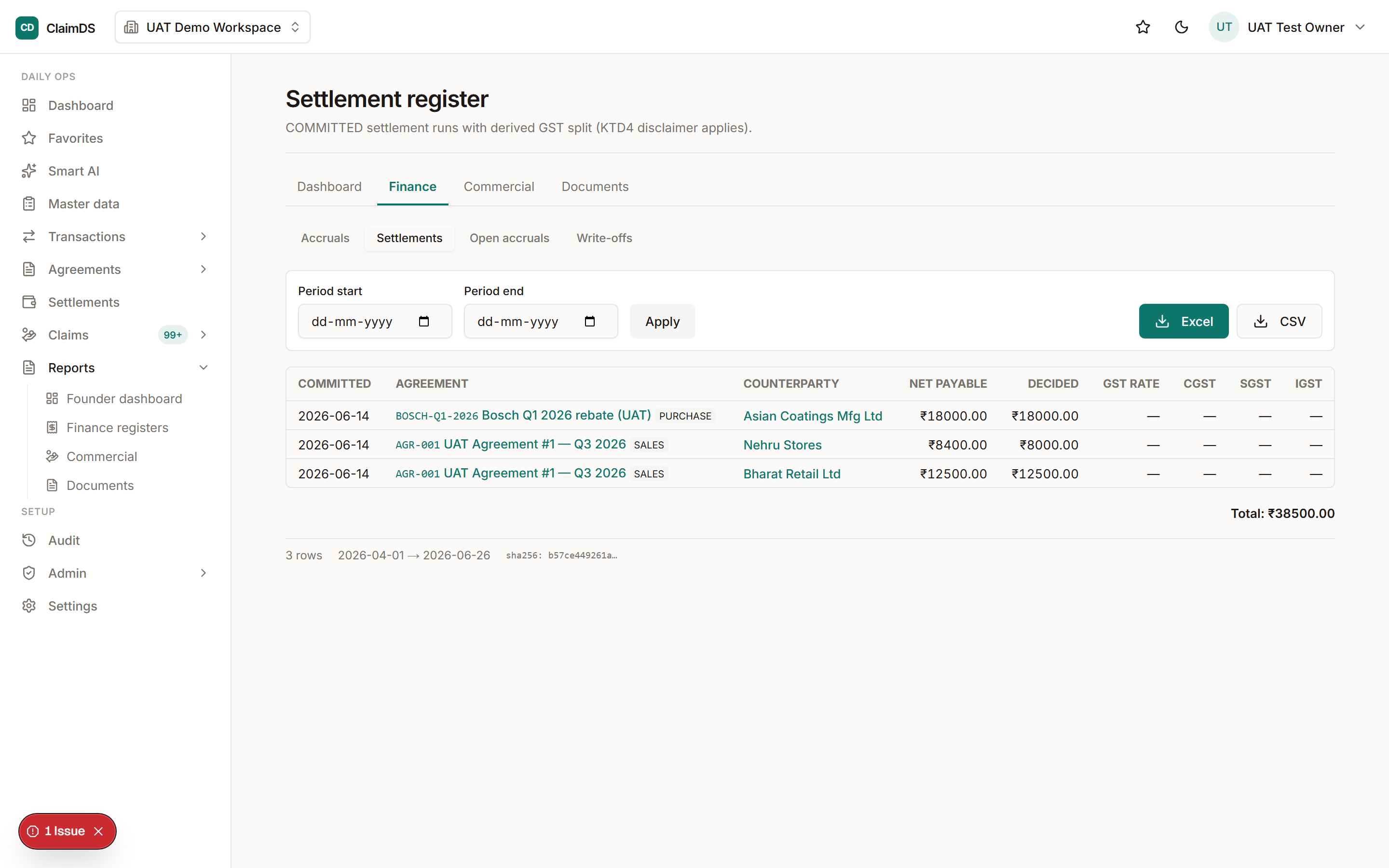
The defining feature is that somebody has to establish the entitlement. That produces a claim, and a claim has to be validated, agreed, settled and reconciled — the work described in deduction management and billbacks, chargebacks and deductions. Until it settles, it is a liability you have estimated rather than a cost you have paid.
In a price waterfall, this is the step between invoice price and net price — see what is a price waterfall for where it sits relative to everything else.
Why the distinction decides the GST treatment
This is the part that makes the distinction more than an accounting preference.
Indian GST treats a discount shown on the invoice differently from a discount given after the supply has taken place. Where the reduction is on the invoice, the taxable value reflects it directly. Where it is given after supply, the taxable value is reduced only if the statutory conditions are met; where they are not, the settlement is generally made through a financial or commercial credit note that carries no GST adjustment. <!-- TODO VERIFY AT PUBLISH + CA REVIEW -->
The provisions that govern this are Section 15(3) and Section 34. We deliberately do not restate their conditions here — the depth lives in the articles written for that purpose, and this page is a signpost rather than a second source of truth: <!-- TODO VERIFY AT PUBLISH + CA REVIEW -->
- Section 15(3)(b) and post-supply discounts
- CBIC Circular 251 on post-sale discounts
- Financial versus tax credit notes
- GST credit notes for rebates
- ITC reversal on post-sale discounts
- GST on trade discounts and dealer incentives
The practical consequence for a commercial team is worth stating plainly, because it is where the two worlds meet. When you choose to fund something off-invoice, you are not only choosing to create a claim — you are choosing a settlement route whose tax treatment depends on conditions being met and documented. A scheme agreed informally and settled loosely can end up costing more than the same money given on the invoice, not because the discount was larger, but because the adjustment could not be supported. <!-- TODO VERIFY AT PUBLISH + CA REVIEW -->
Tax treatment turns on the facts of each arrangement. Nothing on this page is a position on any specific case.
The accounting difference
An on-invoice discount means revenue is recorded net from the outset. The invoice is the source document, and it already carries the reduced amount, so there is no estimate to make.
An off-invoice discount generally requires estimating and accruing what will be earned, so that the period which generated the liability also carries the cost. If a quarterly scheme is recognised only when the claim arrives in the following quarter, two periods are both wrong — the first overstates margin and the second absorbs a cost it did not generate. Rebate accounting covers how the estimate is built and trued up as claims settle.
The estimate is only as good as the record of what was promised. Where scheme terms live in email threads and spreadsheets, the accrual is a judgement rather than a calculation — which is the practical reason the vocabulary in is a rebate a discount matters to finance and not just to sales. <!-- TODO VERIFY AT PUBLISH + CA REVIEW: accounting framing is general; confirm no Ind AS / GAAP position is implied. -->
Why companies use off-invoice at all
Given the extra work, the honest question is why anyone chooses off-invoice. There are four sound commercial reasons.
Protecting list price integrity. A discount on the invoice becomes visible, and visible prices travel. Once a buyer sees a lower invoice price, it becomes the reference for the next negotiation and often for their peers. Funding the same value off-invoice keeps the headline price stable across the channel.
Rewarding what can only be measured later. Growth against last year, share of a category, liquidation of seasonal stock, display compliance — none of these can be known when the invoice is raised. If the reward depends on the outcome, it has to be settled after the outcome.
Funding selectively. An on-invoice discount goes to everyone who buys. A scheme can be aimed at a region, a product, a season or a set of partners, which makes it a sharper commercial instrument. Where that spend is aimed at the shopper rather than the trade, it stops being a discount question altogether — see consumer promotions versus trade promotions. The arithmetic of settling those schemes is covered in calculating FMCG distributor claims.
Keeping price stable while flexing support. Support can be increased or withdrawn between periods without moving the price the market sees.
The cost is real and should be stated alongside the benefits: every off-invoice rupee creates a claim, and claims create reconciliation work, disputes, ageing balances and accrual risk that on-invoice discounts do not. That trade-off is the decision, not an afterthought.
How the choice looks by industry and counterparty
The same mechanics land differently depending on what you sell and who you sell it to.
| Industry | Typical on-invoice | Typical off-invoice |
|---|---|---|
| FMCG | Trade discount by partner class | Secondary schemes on sell-out, display allowances |
| Pharma | Trade discount to stockist | Expiry and breakage settlements, target schemes |
| Automotive | Dealer margin on the invoice | Rate difference, campaign and warranty-linked claims |
| Paints and building materials | Standard trade discount | Rate difference on price revisions, damage claims |
| Consumer electronics | Channel discount at billing | Price protection on price drops, sell-out schemes |
| Agrochemicals | Season-opening trade discount | Liquidation schemes, season-end returns |
By counterparty, the pattern is about who holds the evidence:
- Distributor — the heaviest off-invoice mix, because schemes are earned on their onward sales and the proof sits in their system.
- Dealer or retailer — narrower: usually rate difference and display allowances, settled against your own invoices.
- C&F or CFA agent — holds stock without buying it, so a payment may be a service fee rather than a discount at all. Treat that distinction carefully; it is not merely a labelling choice. <!-- TODO VERIFY AT PUBLISH + CA REVIEW: agent vs principal characterisation has tax consequences; route to a professional. -->
- Institutional or OEM buyer — mostly on-invoice against a contracted price, with rate difference as the recurring exception.
- Modern trade and e-commerce — off-invoice arrives as deductions taken by the buyer rather than claims you receive, which inverts who has to prove what.
Choosing between them
The test is simple, and it is about certainty rather than amount:
If the amount is known at the time of sale and is unconditional, put it on the invoice. You get a complete record, no accrual, no claim, and no reconciliation.
If it depends on a target, a behaviour or a period outcome, it has to be off-invoice — and the discipline moves to three things: recording the entitlement when the scheme is agreed, validating the claim against those recorded terms, and settling with the evidence attached.
Most channel disputes are not disagreements about whether money is owed. They are two parties reading different versions of the same scheme. Holding one authoritative record of the agreed terms, and validating claims against it, is what ClaimDS is built to do. <!-- TODO FOUNDER CONFIRM: capability sentence — confirm scope wording matches shipped functionality before publish. -->
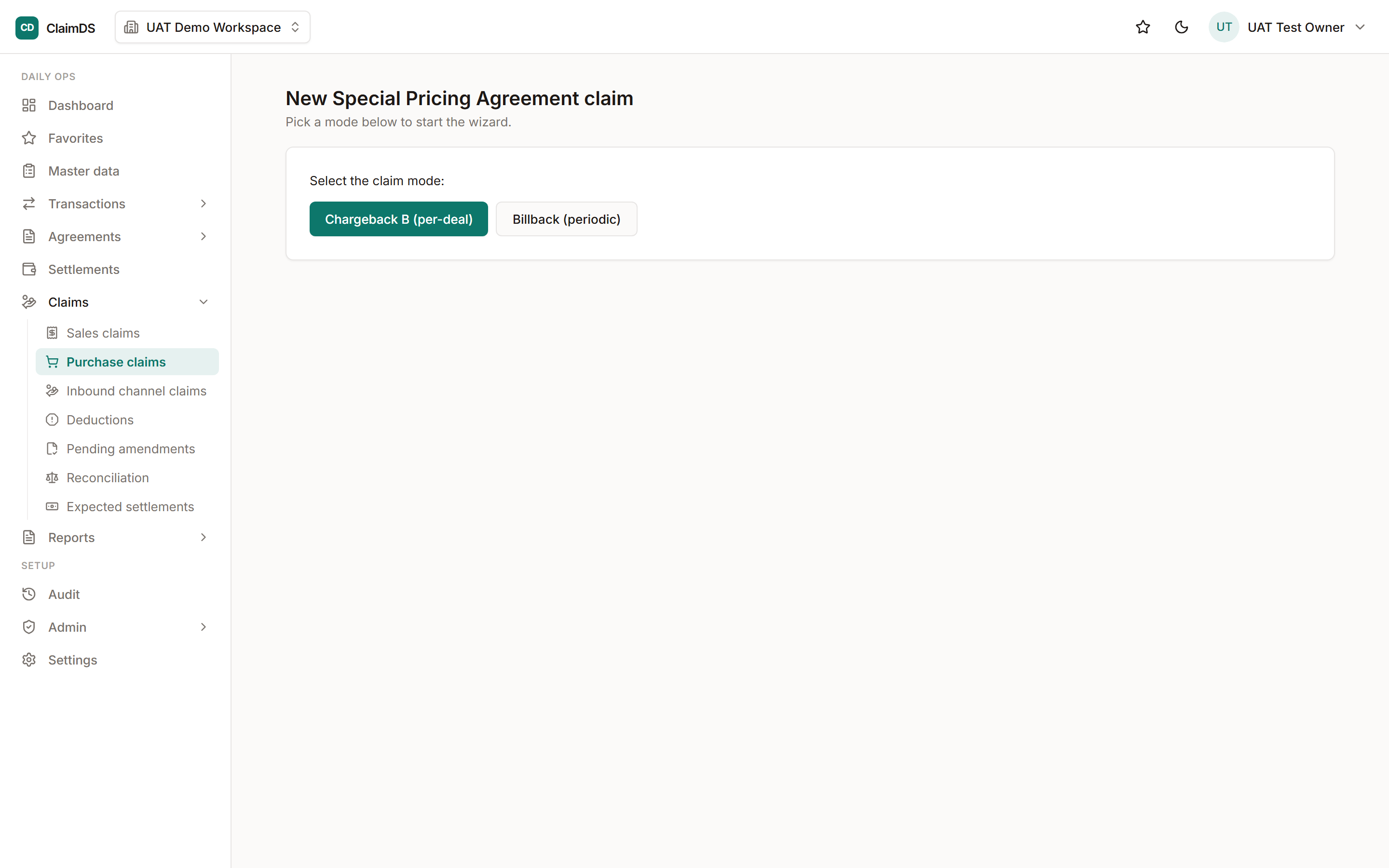
The ₹4 in the opening example is still ₹4. What differs is whether you spend the next quarter proving it.
This article is general information about commercial and accounting practice, not tax, legal or compliance advice. Indian GST treatment of discounts depends on the facts of each arrangement and on current law — confirm the position for your business with a qualified CA or CMA before acting on it.
Frequently asked questions
What is an on-invoice discount?
An on-invoice discount is a reduction applied on the invoice at the time of sale, so the invoice itself shows the reduced price. Trade discounts, volume discounts known at the point of order and agreed early-payment terms are typical examples. Because the amount is known when the invoice is raised, there is no later claim to make and nothing to reconcile afterwards.
What is an off-invoice discount?
An off-invoice discount is settled after the invoice has been raised, once entitlement is established. Trade rebates on volume targets, secondary schemes, billbacks, display allowances and price protection are the common forms. Because entitlement is proven later, the amount has to be claimed, validated and settled separately from the original sale.
Is a rebate an on-invoice or off-invoice discount?
A trade rebate is an off-invoice discount. It is earned against a target or condition measured over a period, so it cannot be known when the invoice is raised. That is what separates it from a trade discount — the entitlement is established after the sale, which is why a rebate produces a claim and a discount does not.
Does an off-invoice discount reduce GST?
Not automatically. Indian GST treats a discount shown on the invoice differently from one given after the supply, and a post-supply discount reduces taxable value only where the statutory conditions are met. Where they are not met, the amount is usually settled by a financial or commercial credit note without a GST adjustment. The treatment depends on the facts — confirm the position for your case with a qualified professional.
Why do companies give off-invoice discounts instead of on-invoice?
Mainly to protect list price integrity and to reward behaviour that can only be measured after a period has closed. An off-invoice settlement lets a supplier keep a stable headline price across a channel, fund schemes selectively, and pay only where a target was actually met. The cost is a claims and reconciliation burden that on-invoice discounts do not create.
How is an off-invoice discount recorded in the books?
Generally by estimating and accruing what is expected to be earned, rather than recognising it only when the claim is settled. Revenue is reported net of the expected settlement so the period that earned the cost also carries it. The accrual is then trued up as claims are received and agreed.
Which is better, on-invoice or off-invoice?
Neither — they serve different purposes. If the amount is known at the time of sale and is unconditional, on-invoice is simpler and creates no downstream work. If the amount depends on a target, a behaviour or a period outcome, it has to be off-invoice, and the discipline moves to recording the entitlement and validating the claim.
See ClaimDS on your own claims data
A 30-minute walkthrough tailored to how your channel actually settles claims.
Related posts

Your E-Invoice and GSTR Data Is Already Your Claims Dataset
E-invoicing already produces validated, structured invoice data. The same data can reconcile distributor claims and scheme settlements — here's how it fits together.
Rebate Credit Notes After a GST Rate Change: Original Rate or New Rate?
Settling a rebate against an invoice issued before a GST rate change? Which rate the credit note carries, why it anchors to the original supply, and what to check.
Discount or Commission? The Section 194H Line That Decides the Tax
Whether a channel payment is a discount or a commission decides the tax — credit note or 194H, ITC or GST. The principal-to-principal test, explained for India.